politics: the state

In light of Romney’s comments regarding those who depend on the government, we thought we’d re-post this great data showing that many people who are using government social programs don’t know they are doing so.  

————————

Dolores R. sent in a fascinating image posted at boingboing. It comes from a paper by Suzanne Mettler, a professor in the Department of Government at Cornell. Mettler first asked survey participants whether they had ever used a federal U.S. government program. Then later in the survey she specifically asked respondents whether they had ever benefited from or participated in specific federal programs. As it turns out, large number of people who have benefited from various federal programs or policies do not recognize themselves as having done so. This table shows what percent of people who said they had participated in or used these 19 federal programs had earlier in the surveys said they had never used any social program:
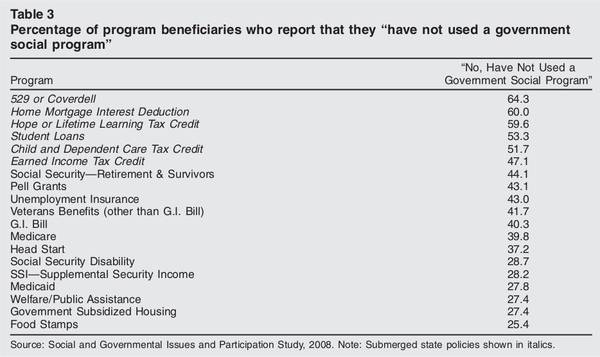
Mettler argues that recipients are less likely to recognize themselves as benefiting from programs that are part of what she calls the “submerged state” — programs and policies that provide incentives and motivations for particular behaviors in the private sector, rather than overtly directing behavior. If you receive food stamps, you interact directly with a government agency, are required to periodically meet with a government worker and reapply to re-establish eligibility, and can point to a specific thing that links you to the program (these days usually a debit-type card rather than the old style coupons/stamps).

On the other hand, if you participate in the government’s mortgage interest deduction program, which encourages home ownership by allowing people to deduct the cost of mortgage interest from their taxable income (which you can’t do with rent costs, for instance), it’s less noticeable that you are benefiting from a federal policy. You get a form from your mortgage company that provides the relevant number, and you transfer it over to the correct line when you’re filling out taxes.

Notably, the programs recipients seem least likely to recognize as a government program are among those the middle (and higher) classes are most likely to use, while those more common among the poor are more clearly recognizable to those using them as government programs. Yet allowing you to write off mortgage interest (but not rent), or charitable donations, or the money you put aside for a child’s education, are all forms of government programs, ones that benefit some more than others. But the “submerged” nature of these policies hides the degree to which the middle and upper classes use and benefit from federal programs.
Cross-posted at Montclair SocioBlog.

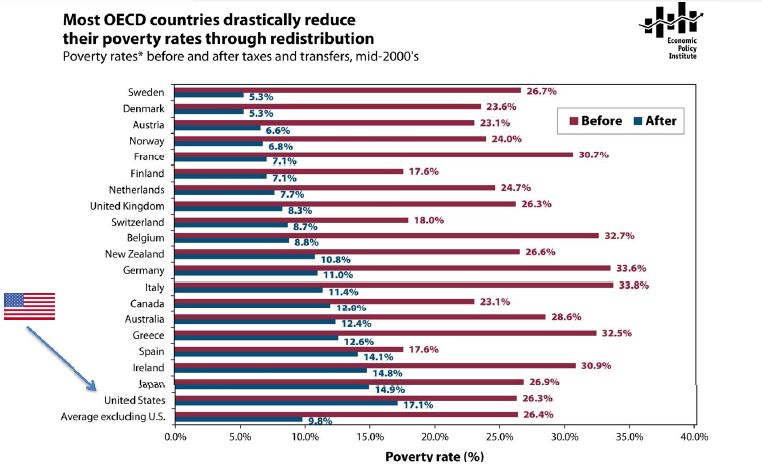
The poverty rate in the US in the mid-2000s was about 17%.  In Sweden, the poverty rate was 5.3%; in Germany, 11%.   That was the rate after adding in government transfers.  In Germany, the poverty rate before those transfers was 33.6%, ten points higher than that in the US.  Sweden’s pre-transfer poverty rate was about the same as ours.

Jared Bernstein has this chart showing pre-transfer and post-transfer rates for the OECD countries (click to enlarge):

Three  points:

1.  Governments have the power to reduce poverty, and reduce it a lot.  European governments do far more towards this goal than does the US government.

2.  It’s unlikely that America’s poor people are twice as lazy or unskilled or dissolute as their European counterparts.  Individual factors may explain differences between individuals, but these explanations have little relevance for the problem of overall poverty.  The focus on individual qualities also has little use as a basis for policy.  European countries have fewer people living in poverty, but not because those countries exhort the poor to lead more virtuous lives and punish them for their improvident ways.  European countries have lower poverty rates because the governments provide money and services to those who need them.

3.  The amount of welfare governments provide does not appear to have a dampening effect on the overall economy.

Cross-posted at Montclair SocioBlog.

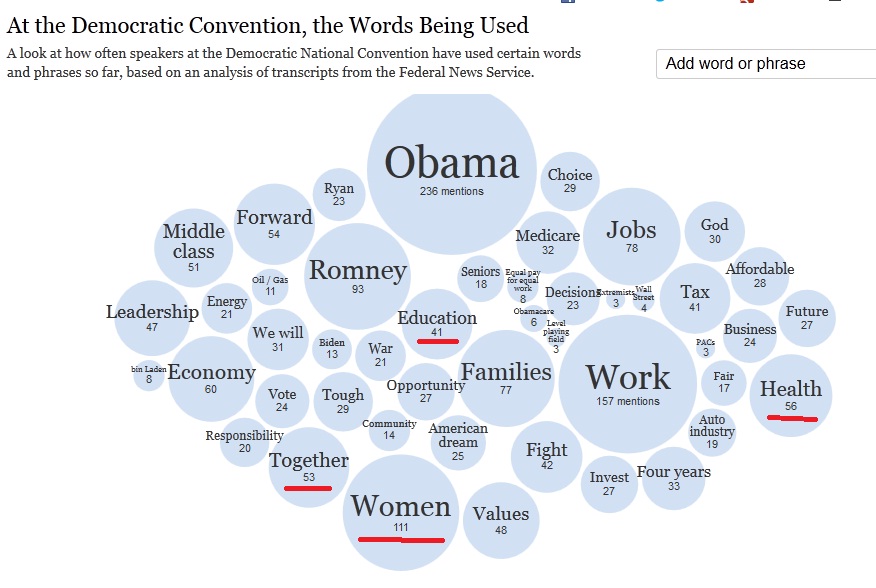
The New York Times ran these graphics showing the word frequencies of the Republican and Democratic conventions.  I’ve added underlining on the keywords that seem to differentiate the two conventions. (The data on the Democrats runs only through Sept. 4, but it looks like the themes announced early on will be the ones that are repeated.)

Both parties talked about leadership, the economy, jobs, and families.  More interesting are the differences.  Democrats talked a lot about Women, a word which seems to be absent from the Republican vocabulary.  The Democrats also talked about Health and Education.  I find it curious that Education does not appear in the Republican word cloud.

The Republican dictionary falls open to the page with Business – ten times as many mentions as in the Democrats’ concordance.  If you go to the interactive Times graphic, you can click on Business and see examples of the contexts for the word.  Many of these excerpts also contain the word Success.

You can put the large-bubble words in each graphic in a sentence that condenses the party’s message about government, though that word – Government – does not appear in either graphic.   For the Republicans, government should lower Taxes so that Business can Succeed, creating Jobs.

For the Democrats, government should protect the rights of Women and ensure that everyone has access to Health and Education.

Perhaps the most telling most interesting word in the Democratic cloud is Together.  The Republican story is one of individual success in business, summed up in their repeated phrase, “I built that.”  The Democrats apparently are emphasizing what people can accomplish together.  These different visions are not new.  They go back at least to the nineteenth century.  (Six years ago, I blogged here about these visions as NFL brands — Cowboys and Steelers — and their parallels in US politics.)

(HT: Neal Caren who has posted his own data about the different balance of emotional expression at the two conventions.)

Cross-posted at Montclair SocioBlog.

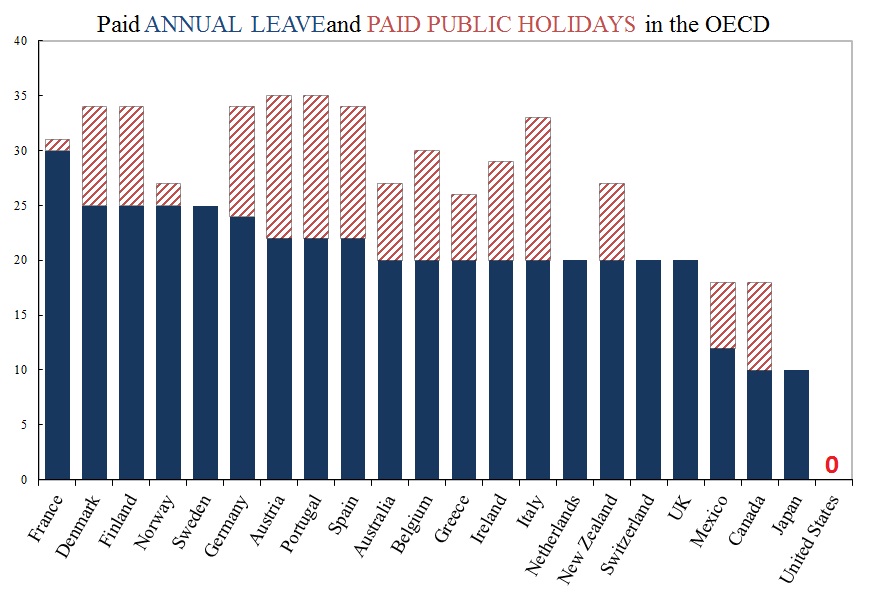
As I speculated years ago (here and here), it may be hard for Americans to imagine a world where the law guarantees them at least 20 paid vacation days per year.  But such a world exists.  It’s called Europe.*

Americans are the lucky ones.  As Mitt Romney has warned us “European-style benefits” would   “poison the very spirit of America.”  Niall Ferguson, who weighs in frequently on history and economics, contrasts America’s “Protestant work ethic” with what you find in Europe – an “atheist sloth ethic.”

The graph is a bit misleading. It shows only what the law requires of employers.  Americans do get vacations.  But here in America, how much vacation you get, or whether you get any at all, and whether it’s paid – that all depends on what you can negotiate with your employer.

Since American vacations depend on what the boss will grant, some people get more paid vacation, some get less, and some get none.  So it might be useful to ask which sectors of our economy are beehives of the work ethic and which are sloughs of sloth.  (Ferguson’s employer, for example, Harvard University, probably gives him three months off in the summer, plus a week or two or more in the winter between semesters, plus spring break, and maybe a few other days.  I wonder how he would react if Harvard did away with these sloth-inducing policies.)

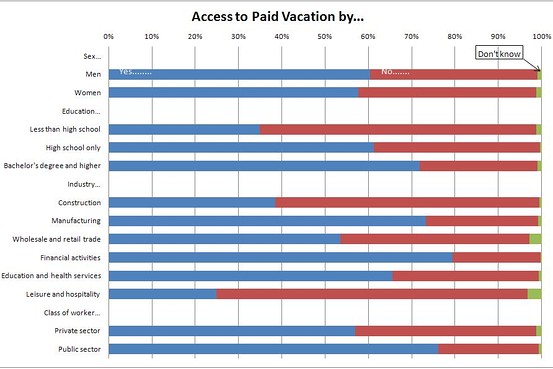
The Wall Street Journal recently (here) published a graph of BLS data on access to paid vacations; they break it up by industry near the bottom.

Those people who are cleaning your hotel room and serving your meals while you’re on vacation — only about one in four can get any paid vacation days.  And at the other end, which economic sector is most indulgent of sloth among its workforce?  Wall Street.  Four out of five there get paid vacation.

How much paid vacation do we get?  That depends on sector, but it also depends on length of service.  As the Journal says,

Europeans also get more time off: usually a bare minimum of four weeks off a year. Most Americans have to stay in a job for 20 years to get that much, according to BLS data.

—————————

* The graph is from five years ago, but I doubt things have changed much. The US still has no federal or state laws requiring any paid vacation days.

Most people assume that the various benefits we collectively describe as “welfare” go to people who aren’t working.  The truth is, however, that some people with full-time jobs still find themselves below the poverty line.  The U.S. federal minimum wage is $7.25 an hour.  A full-time employee who doesn’t miss a single day of work for a year earns $290 a week; that’s 15,080 a year.  According to how the government measures poverty, that’s enough to support a single adult.  For a single adult with a child, however, it’s officially below the poverty line. It’s $4,000 below the poverty line for a family of three.  When a person has a full-time job, but still lives in poverty, they are what sociologists call the “working poor.”

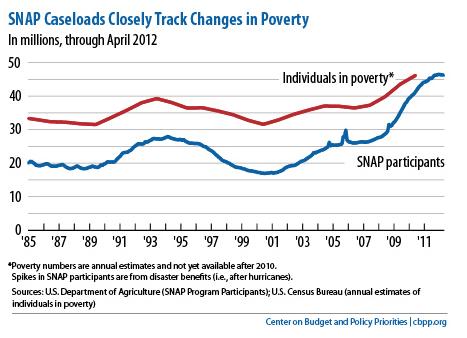
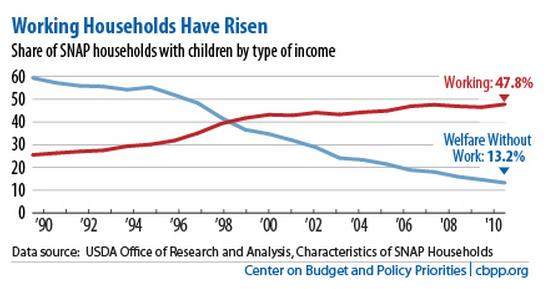
Some welfare benefits, then, go to people who do work.  The  Supplemental Nutrition Assistance Program, better known as food stamps, is an example.  Working parents have always comprised a large percentage of people receiving food stamps.  Today the number of working families who rely on food stamps is higher than it’s been in over 20 years (source).  These numbers reflect the impact of the recession generally, but also the extra-burden placed on already struggling families.  The first chart shows the rise of poor families, the second shows the increase in the working poor using food stamps.

This kind of data inspires me to ask if this is what a functional economy looks like.  We have policies — e.g., the federal minimum wage and somewhat laissez faire free market policies — that create a situation in which working full time doesn’t allow a single parent to support even one child.  When we hear criticisms of people who receive benefits, then, we should be careful to remember that their economic crisis is not a straightforwardly personal characteristic, one that can be explained by a poor work ethic or disorderly personality. There are structural reasons that people end up in need.  We have three choices: let them suffer and perhaps die, help them, or change our society.

Lisa Wade, PhD is an Associate Professor at Tulane University. She is the author of American Hookup, a book about college sexual culture; a textbook about gender; and a forthcoming introductory text: Terrible Magnificent Sociology. You can follow her on Twitter and Instagram.

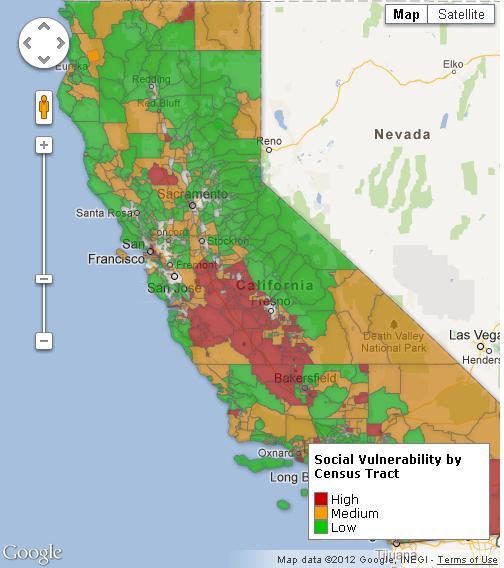
Scholars are busy attempting to predict the effects of climate change, including how it might harm people in some parts of the globe more than others.  A recent report by The Pacific Institute, sent in by Aneesa D., does a more fine-grained analysis, showing which Californians will be the most harmed by climate change.

They use a variety of measures for each Census tract to make a Vulnerability Index, including natural factors (like tree cover), demographic factors (like age), and economic factors (like income).  At the interactive map, you can see the details for each Census tract.  Their compiled index looks like this:

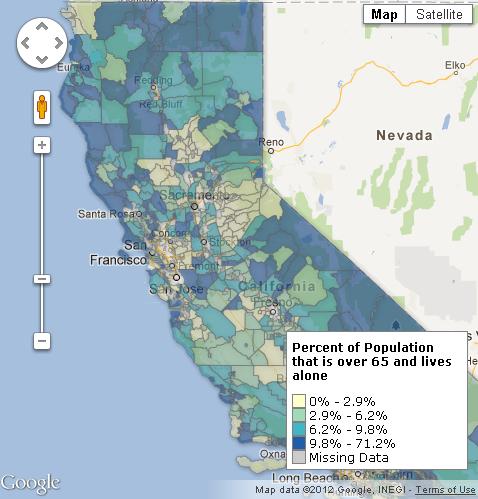
You can also see the Vulnerability Index for each measure individually.  Here is the data for the percent of people over age 65 who live alone, a variable we know increases the risk of death from heat wave.

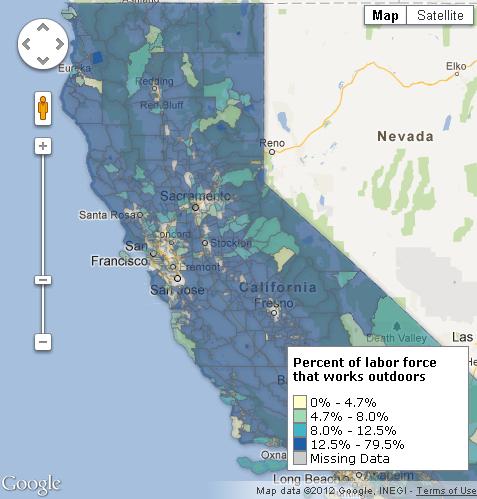
And here’s the data for the percent of workers who labor outside:

There’s lots more data at the site, but what’s interesting here is that, even in incredibly wealthy parts of the world, climate change is going to have uneven effects.  When it does, the most vulnerable people in the more vulnerable parts of the state are going to migrate to the other parts.  Most Californians don’t imagine that their cities will be home to refugees, but this is exactly what will happen as parts of California become increasingly difficult to live in.

Lisa Wade, PhD is an Associate Professor at Tulane University. She is the author of American Hookup, a book about college sexual culture; a textbook about gender; and a forthcoming introductory text: Terrible Magnificent Sociology. You can follow her on Twitter and Instagram.

An emerging controversy in Canada is a good example of just how difficult it is to be racially-neutral when the context is racially-charged.  The country recently redesigned its money.  On the back of the $100 dollar bill celebrating medical innovation they sketched an Asian-appearing woman looking into a microscope.  In a focus group in Quebec, people complained that the bill reproduced the stereotype that Asians pursue careers in science and medicine.  The Vancouver Sun reports:

“Some have concerns that the researcher appears to be Asian,” says a 2009 report commissioned by the bank from The Strategic Counsel… “Some believe that it presents a stereotype of Asians excelling in technology and/or the sciences. Others feel that an Asian should not be the only ethnicity represented on the banknotes. Other ethnicities should also be shown.”

A few even said the yellow-brown colour of the $100 banknote reinforced the perception the woman was Asian, and “racialized” the note.

The Canadian government responded that they had never intended the woman to appear “ethnic” and ordered the image re-sketched so it would be more racially “neutral.”  

They were then accused of being prejudiced again. Mu-Qing Huang, a Chinese-Canadian interviewed for the story, objected to the deletion of the figure’s Asian features:

If Canada is truly multicultural and thinks that all cultural groups are equal, then any visible minority should be good enough to represent a country, including (someone with) Asian features.

This is a tricky problem.  By including racial or ethnic minorities on their bills, Canada risks reproducing a stereotype.  Including all “neutral” figures can be seen as exclusionary because neutral looks suspiciously like White people in a country dominated by White people.  The third option is to deliberately break stereotypes by putting, say, an Asian woman running the hurdles and a Black woman looking through a microscope, but this can seem overly contrived (as many attempts at diversity do).

The truth is that all of Canada’s options can be read in racially-charged ways.  This isn’t because people are unfairly reading into the sketches, it’s because life in Canada is, in fact, racially-charged.  When race matters, it matters, all claims to colorblindness aside.

Thanks to Craig G., Tom Megginson, Jesse, Helen, and Alex, an MLIS from McGill, for the submission!

Lisa Wade, PhD is an Associate Professor at Tulane University. She is the author of American Hookup, a book about college sexual culture; a textbook about gender; and a forthcoming introductory text: Terrible Magnificent Sociology. You can follow her on Twitter and Instagram.

Opponents of abortion have long targeted the “demand side” of abortion by passing legislation aimed at dissuading patients from going through with an abortion. Examples of this type of restriction include parental consent/notification laws, waiting periods, and mandatory counseling. Research shows that targeting patients has had little impact on national abortion rates; they’ve been declining, but several factors are likely contributing to the decrease, including increased accessibility to contraceptives.

New approaches to restricting abortion have focused on the “supply side” of the abortion equation — that is, targeting the doctors and clinics that provide abortions. These regulations often require certain staffing and equipment requirements, resulting in clinics being shut down (often due to the expense of implementing the regulations). Reduced access to clinics often means that women have to travel further for an abortion — increasing costs (the procedure itself, travel, and accommodations), especially when a patient has to navigate waiting periods and counseling requirements.

Mississippi’s sole abortion clinic, for example, the focus of abortion opponents for many years, faced closure recently because of a law that changed licensing procedures. The law now requires all doctors performing abortions to have admitting privileges at local hospitals (difficult for the out-of-state doctors to acquire). The clinic was granted an extension to meet the requirements, though the law was allowed to stand.

So, does targeting the supply side of abortion work to reduce the procedure?

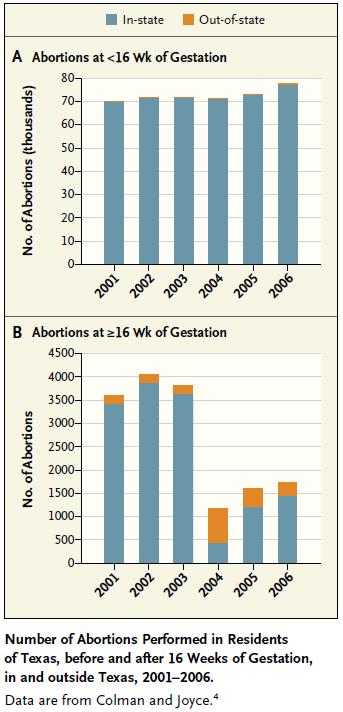
A recent article in the New England Journal of Medicine did a natural experiment to answer this question.  In 2004, Texas passed two new restrictions on abortion, one on each side. The “demand side” legislation required that women receive information about risks at least 24 hours before an abortion can be performed. The “supply side” legislation required that abortions after 16 weeks of gestation be performed in a hospital or an ambulatory surgical center instead of a clinic. At the time the law was passed, none of Texas’ non-hospital based clinics met the legal requirements, and very few abortions were performed in hospitals.

If the “demand side” legislation had an effect, the number of abortions would decrease at all levels of gestation. As Chart A illustrates, there was no change whatsoever in the number of abortions performed before 16 weeks — indicating that the demand side legislation had almost no impact.

If the supply-side legislation had an effect, the number of abortions provided after 16 weeks should have dropped.  In fact, Chart B shows that the number of later abortions performed dropped 88% after the legislation was implemented.

So, targeting the supply side reduced the number of abortions performed in Texas, but did the  women carry their baby to term?

No. Some of these women left the state to receive an abortion; in fact, the number of who received an out-of-state abortion more than quadrupled from 2003 to 2004. Accordingly, the average distance women had to travel to receive an abortion after 16 weeks increased from 33 miles in 2003 to 252 miles in 2004.

As has been noted on this site before, nations that have highly restrictive abortion laws do not have lower abortion rates; in fact, in those countries where abortion is illegal, many of those abortions are unsafe, resulting in high numbers of maternal deaths. Although targeting the supply-side of abortion might be appealing, it will probably not reduce the abortion rate nationwide. Instead, it likely places onerous restrictions on women with fewer resources, since they will be less able to meet the increased costs that result from having to travel for abortions.

Thanks to ­­­Jenna for the submission!

————————

Amanda M. Jungels is a PhD Candidate in the Department of Sociology at Georgia State University, focusing on sexuality, gender, and cognitive sociology. Her dissertation focuses on disclosures of private information at in-home sex toy parties. She is the current recipient of the Jacqueline Boles Teaching Fellowship, given to outstanding graduate student instructors.