politics: the state

In his book, Great American City, sociologist Robert Sampson argues that, while the effects of macro factors like poverty and political neglect on individual lives are well-documented, other local mechanisms matter too.  It’s important, then, to think about the constitution of neighborhoods.

Along these lines, he argues, even if a community is economically- and socially-marginalized, an existing neighborhood organizations can make a big difference.  He takes natural disasters as a case study.  A neighborhood organization can spread the news of an impending disaster, establish leadership, and organize assistance before, during, and after a crisis.  In this way, Sampson brings together micro, meso, and macro forces shaping the impact of disaster.

Lisa Wade, PhD is an Associate Professor at Tulane University. She is the author of American Hookup, a book about college sexual culture; a textbook about gender; and a forthcoming introductory text: Terrible Magnificent Sociology. You can follow her on Twitter and Instagram.
The New York Times recently ran an  interesting story on prison cemeteries in Texas.  For about $2,000, the state buries about 100 inmates a year. They die of lethal injection, old age, or illness, but they’re all dressed in dark pants, a white shirt, and tie, and are buried with a prayer from the prison chaplain.

When inmates die in custody, their bodies are sometimes unclaimed.  This may be because they have no family at all, or their family members don’t wish to claim the body.   Other times the inmate is cared for by family members who simply can’t afford to bury the person themselves.  So, occasionally the family members will decline to claim the body, but show up on the day of the burial to pay their respects.

Lisa Wade, PhD is an Associate Professor at Tulane University. She is the author of American Hookup, a book about college sexual culture; a textbook about gender; and a forthcoming introductory text: Terrible Magnificent Sociology. You can follow her on Twitter and Instagram.

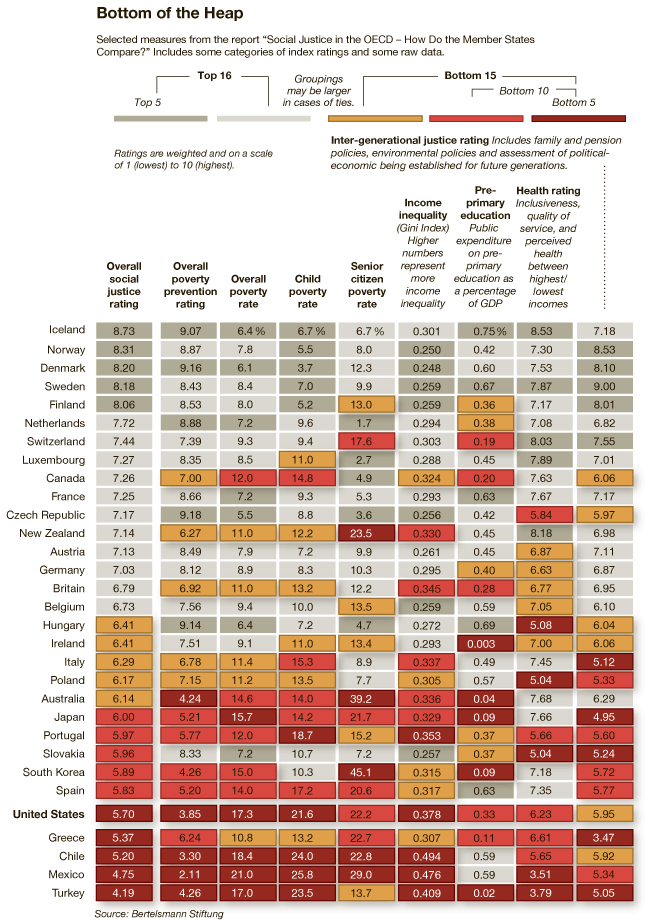
How does the U.S. compare to other developed countries on measures of social justice? According to the New York Times, not very well.  The visual below compares countries’ poverty rates, poverty prevention measures, income inequality, spending on pre-primary education, and citizen health.  The “overall” rating is on the far left and the U.S. ranks 27th out of 31.


Via Feministing.  See also how the U.S. ranks on measures of equality and prosperity(33 out of 33, for what it’s worth). Thanks to Dolores R. for the link!

Lisa Wade, PhD is an Associate Professor at Tulane University. She is the author of American Hookup, a book about college sexual culture; a textbook about gender; and a forthcoming introductory text: Terrible Magnificent Sociology. You can follow her on Twitter and Instagram.
Cross-posted at Reports from the Economic Front.

Here is a short (less than 4 minute) video that illustrates the fact that 53% of our tax dollars, conservatively estimated, go to finance our military.

And here is a link to a recent study by Robert Pollin and Heidi Garrett-Peltier on the employment effects of military spending versus alternative domestic spending priorities, in particular investments in clean energy, health care, and education.

The authors first examine the employment effects of spending $1 billion on the military versus spending the same amount on clean energy, health care, education or tax cuts.  The chart below shows their results.

defense.jpg

Moreover, even though jobs in the military provide the highest levels of compensation, the authors still find that “investments in clean energy, health care and education create a much larger number of jobs across all pay ranges, including mid-range jobs (paying between $32,000 and $64,000) and high paying jobs (paying over $64,000).”

Let’s see if these facts come up in the next Congressional budget debate.

Earlier this month I read an essay that explained to me why I am not married. These reasons included:

  • I’m a bitch.
  • I’m shallow.
  • I’m a slut.
  • I’m a liar.
  • I’m selfish.
  • I don’t think I’m good enough.

I’m not kidding.

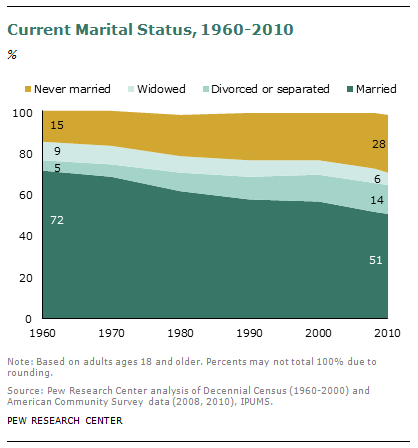
Coincidentally, the Pew Research Center released 2010 data showing that just 51% of all American adults were currently married. This is an all time low, down from 72% in 1960.

Comparing this data with the essay above is a nice illustration of the difference between “normative” and “normal.”  Normal is what is typical in a statistical sense; it is what actually holds.  Normative is what is believed to be good and right in an ideological sense; it is what it is believed does or should hold.

If you go by the essay, written by the thrice married and now single Tracy McMillan, marriage is an ideal state that we all should, or do, desire.  In her reality, if you aren’t married, it’s because you’re doing something wrong.  Marriage is normative.  In actual reality, though, the state of being married is not any more normal than the state of being unmarried.

Only if marriage is normative does the non-normality of marriage become something that needs explaining.  McMillan jumps in with hateful stereotypes, but social science has much better explanations.

  • Low-income women often do not take-for-granted (as many middle class people do) that they can sustain a marriage through tough times.  Accordingly, they wait much longer before marrying once they meet someone they like (as long as 10 years or more), so that they can be as sure as possible about the match.  In other words, they take marriage very seriously and are reticent to just jump right in.  They know they’re “good enough,” Tracy; in fact, they value themselves and their relationships enough to really put them to the test.  (Read Promises I Can Keep for more.)
  • Other women get divorced because men don’t do their fair share.  Unresolved conflicts over childcare and housework are one of the top reasons that couples dissolve.  Women struggle to keep up when they’re working a full time job and doing 2/3rds to 3/4ths of the childcare and housework.  They may not see the data, but they may intuit that single mothers do less housework than married ones (it’s true).  So they divorce their husbands.  They’re not “selfish,” they’re just trying to survive. (Read The Second Shift for more.)
  • Other people aren’t married because they’re in love with someone of the same sex.  They’re not “sluts,” they’re discriminated against.

And, just for the record:

  • I’m not married because I don’t want or need the state’s approval of my relationship and  I certainly don’t want it interfering if we decide to part.
  • I’m not married because the history of marriage is ugly and anti-woman; because I don’t like the common meanings of the words “wife” and “husband”; and because even today, and even among couples that call themselves feminist, gender inequality in relationships is known to increase when a couple moves from cohabitation to marriage (and I don’t think I’m so special that I’ll be the anomaly).
  • I’m not married because I’m opposed to the marriage industrial complex. It’s exploitative, stereotypical, and wasteful.
  • I’m not married because I value the fact that my partner and I decide to be together every day, even though we don’t have to jump through legal hoops to do otherwise.
  • I’m not married because I don’t want to support a discriminatory institution that has and continues to bless some relationships, but not others, out of bigotry.
  • I’m not married because I don’t believe in giving social and economic benefits to some kinds of relationships and not others.  I don’t believe that a state- or church-endorsed heterosexual union between two and only two people is superior to other kinds of relationships.

After reading some of the great comments, I’d like to add that I’m not married because of several points of privilege:

  • I’m not married because I live in a society that allows women to work, keep their paychecks, rent an apartment, and have a bank account.  (And, frankly, I think it’s kind of neat to be in the first generation of American women who can realistically choose not to marry. I like the idea of embracing that.)
  • I’m not married because both my partner and I are lucky enough to have  a stable, full-time job that offers benefits, so we don’t need to get married so that one of us can get the other health insurance or some other benefit.
  • I’m not married because we are both U.S. citizens and don’t have to marry in order to live together.

I could go on, but you get the idea.

The point is that when the normal and the normative don’t align it often leads to social conflict over the meaning of the gap.  Some people, like McMillan, may jump in to tongue-lash the deviants.  Others may revel in defending non-conformity.  In any case, it will be interesting to see how the conversation about marriage continues, especially if, as the trend suggests, married people become a minority in the near future.

Lisa Wade, PhD is an Associate Professor at Tulane University. She is the author of American Hookup, a book about college sexual culture; a textbook about gender; and a forthcoming introductory text: Terrible Magnificent Sociology. You can follow her on Twitter and Instagram.
Cross-posted at Family Inequality.

Let’s just stipulate that using a personal electronic device while driving increases the risk of an accident and should be avoided.

Let me just make sure I have the rest of the facts straight.

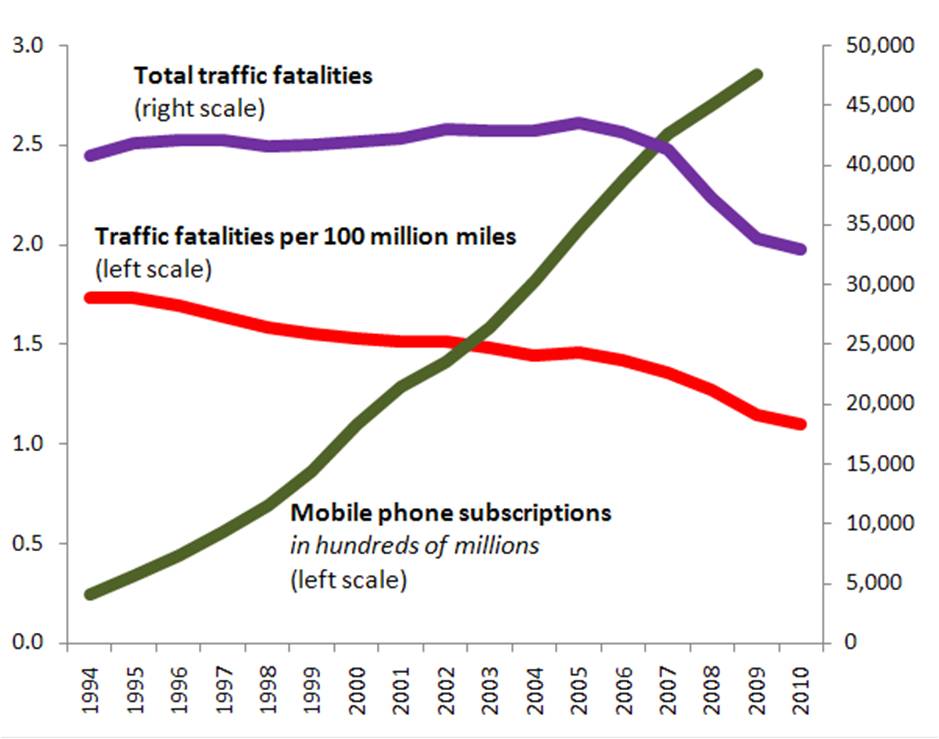
1.  The total number of traffic deaths is at its lowest level since 1949, even as the population, number of vehicles, and number of miles driven have all increased radically.

2.  The number of mobile phone subscribers has increased more than 1,000% since the early 1990s.

3.  “Distraction-affected” crashes accounted for less than 10% of traffic fatalities in 2010.

4.  Deaths attributed to drivers age 17 and younger have fallen by about half since 1990.

5.  The National Transportation Safety Board “is recommending that states prohibit all drivers from using cellphones, for talking or texting.”

Here’s a visual on some of the trends, in one figure:

Pay no attention to the man behind the curtain. Here are my previous posts on this.

————————

Sources: National Highway Traffic Safety Administration: 2009-2010 deathsdeaths trends;  Federal Communications Commission: phone trends; CTIA: 2009 phone subscriptions.


Cross-posted at Montclair SocioBlog.

The equation of wealth and virtue seems to come almost naturally, at least among the wealthy.  The logic is simple:  Virtue leads to success, therefore wealth is evidence of one’s virtue.  Virtue, in this case, means the Protestant Ethic – hard work and a willingness to forgo or postpone pleasures.  It follows then that those who are not wealthy must have turned their back on virtue.

David Brooks, in his Friday column (here),  applies this explanation to the wealth of nations.

Why are nations like Germany and the U.S. rich? . . . It’s because many people in these countries believe in a simple moral formula: effort should lead to reward as often as possible.

People who work hard and play by the rules should have a fair shot at prosperity. Money should go to people on the basis of merit and enterprise. Self-control should be rewarded while laziness and self-indulgence should not.

The US, Germany, and the Netherlands are Brooks’s exemplars of these virtues (Brooks uses the word ethos).  The bad countries, the ones whose economies are teetering on the brink, are the grasshoppers to our ant.  There they were – Brooks points his finger at Greece, Italy, and Spain – fiddling and dancing the summer away, refusing to live within their means or “reinforce good values.”

This seems accurate, doesn’t it – the dolce far niente Italians and other Mediterraneans, taking hours at midday for meals and siestas while the industrious Americans, Germans, and Dutch are working away, wolfing down a sandwich at their desks.

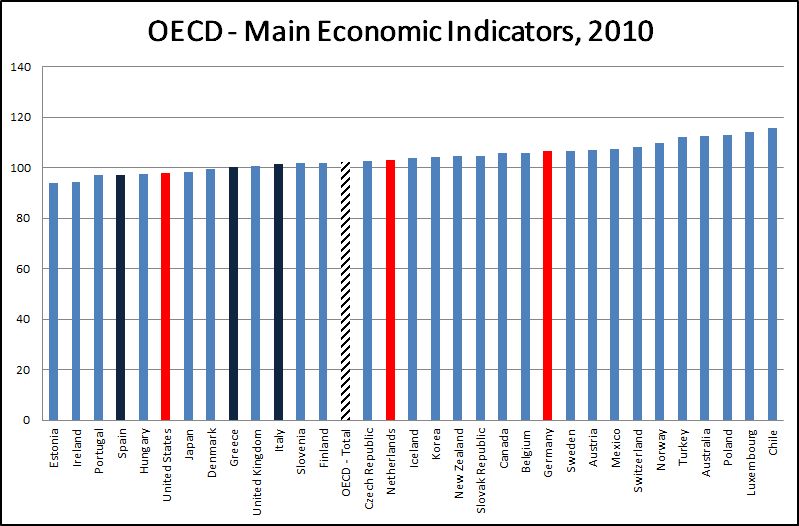
Just to be sure I downloaded some OECD data from 2007 – the last year before the big crash – on the number of hours people in different countries work. (Brooks’s three “ant” countries are red, the “grasshoppers” dark blue.)This is puzzling.  The US is slightly above the OECD average, but workers in Greece and Italy spend more hours at work than do Americans, while the Dutch and Germans are down at the low end of the scale.  (I do not know why the OECD still gives data for West Germany as well as Germany.)

I noticed that the OECD also had a measure of “employment protection,” which is basically how hard it is to fire someone.  I figured that workers in non-virtuous countries would be highly protected.  Since it’s nearly impossible for them to be fired, they know they can slack off on the job.  By contrast, virtuous countries would foster Brook’s ethos of “effort, productivity and self-discipline”  in workers, rewarding the industrious, firing the lazy and self-indulgent.I wasn’t surprised that the US anchored the low end of the scale.  Workers here have less job-protection than those in any of the other countries.  And Greece and Spain are above the average.  But so are Germany and the Netherlands, though only slightly, while Italy is slightly below the average.  There’s really not much difference between these three.  And if you look at the array of countries, there seems to be no strong connection between job protection and how well the country is weathering the current long recession.  I’m not sure what the best measure of the overall economy is, but the OECD has composite figure made up from ten main economic indicators.* I just wish we had better measure of Brooks’s “ethos.”

——————-

*  “The Labour Force Survey (MEI) dataset itself covers countries that compile labour statistics from sample household surveys on a monthly or quarterly basis. It is widely accepted that household surveys are the best source for labour market key statistics. In such surveys, information is collected from people living in households through a representative sample. Surveys are based on standard methodology and procedures used all over the world. The 10 subjects available cover labour force, employment, unemployment (including harmonised unemployment), and employees.”


Cross-posted at Reports from the Economic Front.

The deficit commission, better known as the “Super Committee,” failed to produce a plan to cut deficit spending by $1.2 trillion over the next ten years.  According to the ground rules of the agreement that created the commission, its failure is supposed to trigger approximately $1 trillion in “automatic” spending cuts that will go into effect beginning January 2013.

The agreement included the following stipulations for guiding the automatic cuts:

  • Approximately 50% of the required reduction is to come from the so-called security budget (national security operations and military costs).
  • Approximately 32% is to come from non-defense discretionary programs (health, education, drug enforcement, national parks and other agencies and programs).
  • About 12% is come from Medicare (reduced payments to Medicare providers and plans).
  • The rest is to come mostly from agricultural programs.

To be clear, these are reductions to be made in projected budget lines.  In other words, the cuts to the security budget will not produce an actual decline in security spending, only a slowdown in the projected increase previously agreed to by Congress.

As I previously argued, the failure of the commission is a good thing.  The commission was actively considering structural changes to a number of key social programs.  One was to change the formula for calculating social security payments so as to reduce them.  Another was to raise the age at which people could access Medicare. The automatic cuts, if enacted, will reduce spending on important programs, but at least they do not include steps towards their dismantling.  In fact, Social Security and Medicaid are exempt.

The next stage of the budget battle has now begun.  Political forces are maneuvering to change the formula for the automatic cuts mandated by the budget agreement.  In fact, this maneuvering began weeks before the commission formally announced its failure to agree on a deficit cutting plan.  According to a November 5, 2011 New York Times report:

Several members of Congress, especially Republicans on the House and Senate Armed Services Committees, are readying legislation that would undo the automatic across-the-board cuts totaling nearly $500 billion for military programs, or exchange them for cuts in other areas of the federal budget.

I believe that we need to enter the fray with a different plan, one that includes blocking further cuts to non-defense discretionary programs and Medicare.  It is worth recalling that the agreement that established the deficit commission already included approximately $1 trillion in cuts to non-defense discretionary programs.

It is the security budget that we need to focus on.  And we need to be clear that our aim in demanding cuts to that budget, as well as tax increases on the wealthy and corporations, is to help generate funds to support an aggressive federal program of economic restructuring not deficit reduction.

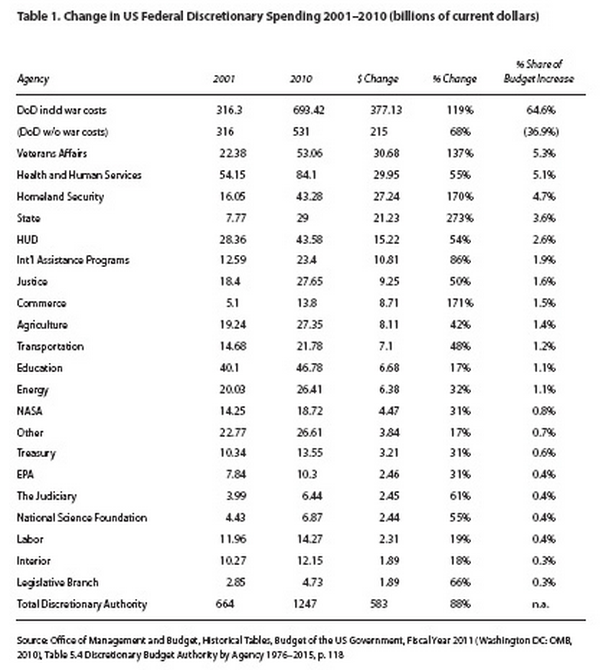
The table below makes clear just how important it is to target the security budget. It shows the pattern of  federal spending on discretionary programs, defense and non-defense, over the years 2001 to 2010.  The big winner was the Department of Defense, which captured 64.6% of the total increase in discretionary spending over those years.  It was still the big winner, at 36.9%, even if one subtracts out war costs.

While the defense gains are staggering, they do not include spending increases enjoyed by other key budget areas dedicated to the military.  For example, many costs associated with our nuclear weapons program are contained in the Energy Department budget.  Many military activities are financed out of the NASA budget.  And then there is Homeland Security, Veteran Affairs, and International Assistance Programs.  It would not be a stretch to conclude that more than 75% of the increase in spending on discretionary programs over the period 2001 to 2010 went to support militarism and repression. No wonder our social programs and public infrastructure has been starved for funds.

There is no way we can hope to reshape our economy without taking on our government’s militaristic foreign and domestic policy aims and the budget priorities that underpin them.