politics: the state

U.S. Senator Susan Collins (R, Maine) and Representative Carolyn Maloney (D, New York) have both gone on record claiming that having more women employed in the Secret Service would prevent scandals like the one involving Colombian prostitutes.

In classic Daily Show form, Jon Stewart and his “correspondents” respond (thanks to Dmitriy T.M. for the link!):

Lisa Wade, PhD is an Associate Professor at Tulane University. She is the author of American Hookup, a book about college sexual culture; a textbook about gender; and a forthcoming introductory text: Terrible Magnificent Sociology. You can follow her on Twitter and Instagram.

A resolution to the matter described below was announced yesterday.  In order to preserve the religious memorial without violating the separation of church and state, the Park Service has agree to give the land it sits on to two private citizens who take care of the monument.  Problem solved?

———————

The Supreme Court is in the process of deciding whether a cross erected 75 years ago as a memorial to war veterans violates the constitutional separation between church and state. The cross sits on the Mojave National Preserve and, therefore, is on public land. After lower court rulings, the cross was covered in plywood.

In deliberations, Justice Scalia tried to argue that the cross is a neutral and universal symbol. He said:

It’s erected as a war memorial. I assume it is erected in honor of all of the war dead… What would you have them erect?… Some conglomerate of a cross, a Star of David, and you know, a Muslim half moon and star?

Faced with an argument that the cross is distinctly Christian, he said:

I don’t think you can leap from that to the conclusion that the only war dead that that cross honors are the Christian war dead. I think that’s an outrageous conclusion.

Scalia’s comments reveal a common phenonemon that we’ve discussed in terms of race and gender, but not yet religion.  As Jay Livingston pointed out at MontClair SocioBlog, one can only think of Christian symbols as non-specific if one thinks of Christianity as somehow normal, neutral, and for everyone.  In the U.S., because Christianity is the dominant religion, many people simply see it as default.  You’re Christian unless you’re something else.  Something else that marks you as different and specific, Christianity does not.

This is one way that dominance works.  It makes itself invisible.

UPDATE! Dmitriy T.M. pointed out that Steven Colbert addressed this issue on The Colbert Report back in 2009:

See our other posts on how whiteness and maleness are the characteristics we attribute to “person,” unless there are reasons to do otherwise, herehere, here, and here.

Lisa Wade, PhD is an Associate Professor at Tulane University. She is the author of American Hookup, a book about college sexual culture; a textbook about gender; and a forthcoming introductory text: Terrible Magnificent Sociology. You can follow her on Twitter and Instagram.

Cross-posted at Reports from the Economic Front.

“Too big to fail” — that was the common explanation voiced at the start of the Great Recession for why the Federal Reserve had no choice but to channel trillions of dollars into the coffers of our leading banks. But, the government also pledged that once the crisis was over it would take steps to make sure we would never face such a situation again.  

The chart below shows the growing concentration of bank assets in the hands of the top 3 U.S. banks. The process really took off starting in the late 1990s and never slowed down right up to the crisis.  It was the reality of the top three banks controlling over 40 percent of total bank assets that gave meaning to the “too big to fail” fears.    

nature09659-f52.jpg

But what has happened since the crisis?  According to Bloomberg Businessweek, the largest banks have only gotten bigger:

Five banks — JPMorgan Chase, Bank of America, Citigroup, Wells Fargo, and Goldman Sachs — held more than $8.5 trillion in assets at the end of 2011, equal to 56 percent of the U.S. economy, according to the Federal Reserve. That’s up from 43 percent five years earlier.

The Big Five today are about twice as large as they were a decade ago relative to the economy, meaning trouble at a major bank would leave the government with the same Hobson’s choice it faced in 2008: let a big bank collapse and perhaps wreck the entire economy or inflame public ire with a costly bailout. “Market participants believe that nothing has changed, that too-big-to-fail is fully intact,” says Gary Stern, former president of the Federal Reserve Bank of Minneapolis.

pol_banks17_inline4051.jpg

Not surprisingly, this kind of economic dominance translates into political power.  For example, the U.S. financial sector is leading the charge for new free trade agreements that promote the deregulation and liberalization of financial sectors throughout the world.  Such agreements will increase their profits but at the cost of economic stability; a trade-off that they apparently find acceptable.

The recently concluded U.S.-Korea Free Trade Agreement is a case in point.  Leading financial firms helped shape the negotiating process.  As a consequence, Citigroup’s Laura Lane, corporate co-chair of the U.S.-Korea FTA Business Coalition, was able to declare that the agreement had “the best financial services chapter negotiated in a free trade agreement to date.”  Among other things, the chapter restricts the ability of governments to limit the size of foreign financial service firms or covered financial activities.  This means that governments would be unable to ensure that financial institutions do not grow “too big to fail” or place limits on speculative activities such as derivative trading.  The chapter also outlaws the use of capital controls.

These same firms are now hard at work shaping the Transpacific Partnership FTA, a new agreement with a similar financial service chapter that includes eight other countries.  Significantly, although the U.S. Trade Representative has refused to share any details on the various chapters being negotiated with either the public or members of Congress, over 600 representatives from U.S. multinational corporations do have access to the texts, allowing them to steer the negotiations in their favor.

The economy may be failing to create jobs but leading financial firms certainly don’t seem to have any reason to complain.

Abortion is highly politicized in the U.S. (more so than in many other countries) and the fight between those who are in favor of and against available abortion occurs on two fronts.  One is familiar to just about everyone: the effort to overturn Roe v. Wade, the legislation Supreme Court decision that established the legality of abortion in 1973.

The second front, though, is less familiar.  It involves reducing the ease of access to legal abortion. Efforts to increase barriers to accessing legal abortion include passing laws that require minors to notify their parents of an abortion or get their consent, requiring mandatory counseling for abortion-seekers, instituting waiting periods, and discouraging medical schools from teaching abortion procedures.  Some of the issues of diminishing access are non-movement related; others are the direct result of pro-life activism.

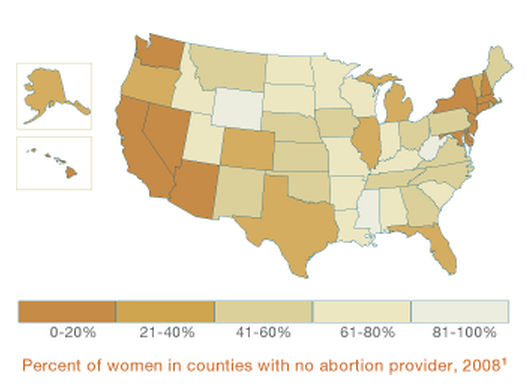
I bring this up in order to focus on an additional barrier to access: a reduction in the number of clinics and hospitals that provide abortions.  The map below, based on data from the Guttmacher Institute and compiled by ANSIRH, shows how availability varies by state.  In the darkest states, up to 20% of women live in a county with no abortion provider; in the lightest states, between 81 and 100% percent do.

Living far from the nearest abortion provider is a problem especially for low-income women.  Such women are less likely to have an employer who will give her a day off to travel to the clinic, less likely to get a paid sick day, and less likely to be able to afford to lose even a single day’s wages.  She is also less likely to have a car, making it more difficult to get to a distant location, and less likely to have reliable day care for any existing children.  If the state requires in-person counseling and has a waiting period, it means that the woman must take two days off, travel to and from the clinic twice, and arrange for child care on multiple days.

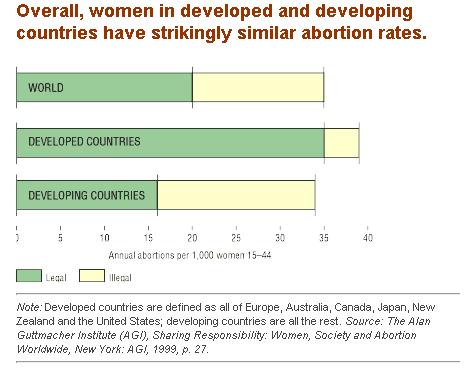
Reduction in the availability of abortion does not necessarily reduce the number of abortions.  We recently posted global data showing that less liberal abortion laws actually correlate with higher rates of abortion.  The data below, also from Guttmacher, show that were abortion laws are less liberal (largely in developing countries), the rate of abortion is 34/1,000 women oer year, compared to 39/1,000 in developed countries (the difference may look significant here, but imagine how trivial it would look if the horizontal axis went all the way to it’s true maximum of 1,000):

Guttmacher explains that the relevant variable isn’t availability of abortion, but the unintended pregnancy rate (which is surprisingly high in the U.S.).

Barriers to accessing abortion, then, don’t lower the abortion rate.  They do, however, increase the likelihood that an abortion procedure will occur later in pregnancy and guarantee a greater logistic burden on the pregnant woman.

Lisa Wade, PhD is an Associate Professor at Tulane University. She is the author of American Hookup, a book about college sexual culture; a textbook about gender; and a forthcoming introductory text: Terrible Magnificent Sociology. You can follow her on Twitter and Instagram.
The Numbers

Types of Taxes as a Percent of GDP (1937-2014)
Historical Comparison of Top Tax Brackets (1945-2010)
Tax Receipt for 2009

The Winners and the Losers

Recent Trends in US Income Inequality and the Tax Rate (1990-2010) (pictured)
Social Class and the Tax Burden
Donation and Welfare States
Corporate Tricks of the Trade
Who Benefited from the Bush Tax Cuts

Tax Cultures

Collecting Taxes in Pakistan
Danish vs. American Attitudes Towards Taxes
TurboTax Maps Out a (Conventional) Future

Lisa Wade, PhD is an Associate Professor at Tulane University. She is the author of American Hookup, a book about college sexual culture; a textbook about gender; and a forthcoming introductory text: Terrible Magnificent Sociology. You can follow her on Twitter and Instagram.
The presence of vintage cars on Cuban roads is one of the  most iconic consequences of the 50-year-old U.S. trade embargo on the communist country.  Cubans, however, have had to preserve many other types of items that Americans routinely replace, while making do with the gradual deterioration that comes with age.

Offering another peek into this life, Ellen Silverman has been photographing Cuban kitchens.  NPR describes how they capture, among other things, the “grand, but crumbling” architecture,” mismatched kitchenware, and vintage appliances:

See the photographs of Cuban kitchens and more at her webpage.

Lisa Wade, PhD is an Associate Professor at Tulane University. She is the author of American Hookup, a book about college sexual culture; a textbook about gender; and a forthcoming introductory text: Terrible Magnificent Sociology. You can follow her on Twitter and Instagram.

Cross-posted at Reports from the Economic Front.

While the press cheers on every sign of private sector job creation, little attention is being paid to public sector job destruction.  As the Economic Policy Institute reports, while there has been an increase of some 2.8 million private sector jobs since June 2009, public sector employment (federal, state, and local governments combined) has actually fallen by approximately 600,000.  As the figure below reveals, this is a very unusual development .

wwwepiorg.png

According to the Economic Policy Institute, if the percentage growth of public sector employment in this recovery had followed past recovery trends, we would have an additional 1.2 million public sector jobs and some 500,000 additional private sector jobs. A separate reason for concern about this trend is that lost public sector jobs generally means a decline in the services that we need to sustain our communities.  The withering away of our public sector during a period of expansion should worry us all.

Cross-posted at Montclair SocioBlog.

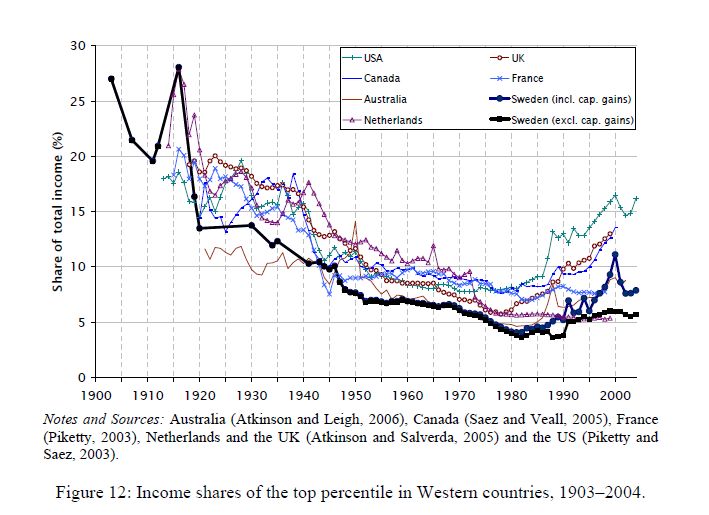
This graph tracks the share of income going to the top 1% in seven countries.  It’s from a paper by two Swedish economists, Jesper Roine and Daniel Waldenström (pdf).”’

The trend was towards greater equality up to 1980 — the share of the 1% was shrinking.    Since then, the 1% have increased their share of the income pie in all seven countries.  But the graph seems to show important differences, especially in recent decades.  Here is a  cropped version of the graph showing the 1980-2004 years.  I have added straight lines connecting those two points for Sweden and for the U.S.
Both changes are increases, but are they the same or are they different?  The answer is crucial.  The U.S. and Sweden have different economic policies.  If the changes are no different between countries, then inequality is just one of those inevitable things that’s happening no matter what governments do.  But if the growth of inequality in the US is much greater than in Sweden, maybe government policy can in fact mitigate the trend towards inequality.
The Swedish 1% share went from a little under 5% to about 7.5%.  In the U.S., the 1% share increased from about 7% to 16%.* You might see those increases as very similar.
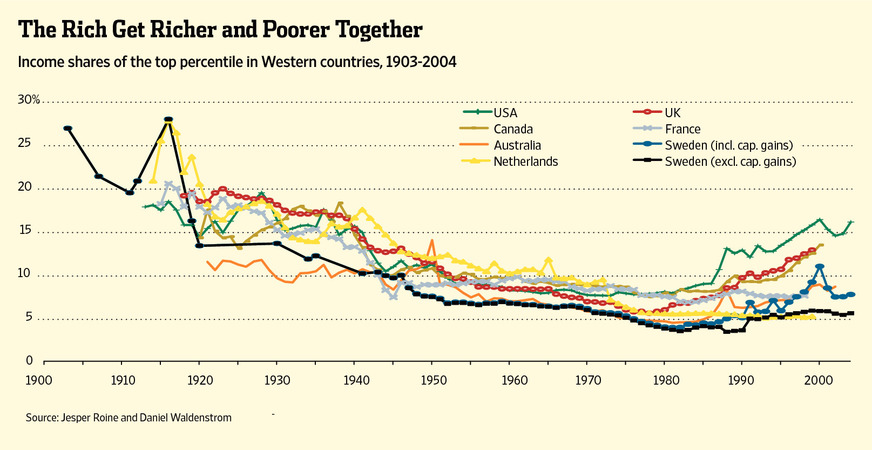
In fact, Allan Meltzer in the Wall Street Journal takes precisely that view.  He stretches out the graph to de-emphasize the vertical differences, and adds a title implying that all countries are “together” in this shift of income to the top 1%.
He adds this explanation:
As the . . . chart . . . shows, the share of income for the top 1% in these seven countries generally follows the same trend line. That means domestic policy can’t be the principal reason for the current spread between high earners and others. Since the 1980s, that spread has increased in nearly all seven countries. The U.S. and Sweden, countries with very different systems of redistribution, along with the U.K. and Canada show the largest increase in the share of income for the top 1%. [emphasis added]
If your pay went from $5 an hour to $7.50 an hour while your co-worker’s went from $7 to $16, you might think that your co-worker had gotten a substantially heftier raise.  But if so, that’s because you’re not the Wall Street Journal.
Meltzer’s main point in the article is that we should not raise taxes on the very wealthy.  However, as Bruce Barlett points out (here), if the rich are getting just as rich in high-tax countries like Sweden and the Netherlands as they are in low-tax countries like the U.S., we may as well raise taxes on them. They’ll be doing just as well, like their Swedish and Dutch counterparts, and the nation will have more revenue to put towards Medicare, education, deficit-reduction, etc.But Meltzer is wrong.  Sweden and the Netherlands are very different from the U.S.  As the graph shows, the income share of the 1% in the U.S. is twice that of the 1% in Sweden and 3 times that of the 1% in the Netherlands.  And it has risen more rapidly.  Yet Meltzer claims that inequality trends are similar everywhere.

So who are you going to believe – the Wall Street Journal or your lying eyes?