politics: the state

Cross-posted at PolicyMic and Racialicious.

In 1984 the U.S. began its ongoing experiment with private prisons. Between 1990 and 2009, the inmate population of private prisons grew by 1,664%  (source). Today approximately 130,000 people are incarcerated by for-profit companies.  In 2010, annual revenues for two largest companies — Corrections Corporation of America and the GEO Group — were nearly $3 billion.

Companies that house prisoners for profit have a perverse incentive to increase the prison population by passing more laws, policing more heavily, sentencing more harshly, and denying parole.  Likewise, there’s no motivation to rehabilitate prisoners; doing so is expensive, cuts into their profits, and decreases the likelihood that any individual will be back in the prison system.  Accordingly, state prisons are much more likely than private prisons to offer programs that help prisoners: psychological interventions, drug and alcohol counseling, coursework towards high school or college diplomas, job training, etc.

What is good for private prisons, in other words, is what is bad for individuals, their families, their communities, and our country.

This is a deeply unethical system and new research shows that, in addition to being disproportionately incarcerated, racial minorities and immigrants are disproportionately housed in private prisons.  Looking at three states with some of the largest prison populations — California, Texas, and Arizona — graduate student Christopher Petrella reports that racial minorities are over-represented in private prisons by an additional 12%; his colleague, Josh Begley, put together this infographic:

This means that, insofar as U.S. state governments are making an effort to rehabilitate the prison population, those efforts are disproportionately aimed at white inmates.  Petrella argues that this translates into a public disinvestment in the lives of minorities and their communities.

Lisa Wade, PhD is an Associate Professor at Tulane University. She is the author of American Hookup, a book about college sexual culture; a textbook about gender; and a forthcoming introductory text: Terrible Magnificent Sociology. You can follow her on Twitter and Instagram.

Cross-posted at Reports from the Economic Front.

The media continues to direct our attention to deficits and debt as our main problems.  Yet, it does little to really highlight the causes of these deficits and debts.

The following two figures from the Center on Budget and Policy Priorities help to clarify the causes.  It is important to note that the projections underlying both figures were made before the recent vote making permanent most of the Bush-era tax cuts.

Figure 1 shows the main drivers of our large national deficits: the Bush-era tax cuts, the wars in Iraq and Afghanistan, and our economic crisis and responses to it.  Without those drivers our national deficits would have remained quite small.

10-10-12bud-f1

Figure 2 shows the main drivers of our national debt. Not surprisingly they are the same as the drivers of our deficits.

10-10-12bud-f2

Significantly, the same political leaders that scream the loudest about our deficits and debt have little to say about stopping the wars or reducing military spending and are the most adamant about maintaining the Bush-era tax cuts.  That is because, at root, their interest is in reducing spending on non-security programs rather than reducing the deficit or debt.

Some of these leaders argue that the tax cuts will help correct our economic problems and thereby help reduce the deficit and debt.  However, multiple studies have shown that tax cuts are among the least effective ways to stimulate employment and growth.  In contrast, the most effective are sustained and targeted government efforts to refashion economic activity by spending on green conversion, infrastructure, health care, education and the like.

While Republicans and Democrats debate the extent to which taxes should be raised, both sides appear to agree on the need to rein in federal government spending in order to achieve deficit reduction.  In fact, federal government spending has been declining both absolutely and, as the following figure from the St. Louis Federal Reserve shows, as a share of GDP.

government-spending-as-a-percent-of-gdp

In reality, our main challenge is not reducing our deficit or debt but rather strengthening our economy, and cutting government spending is not going to help us overcome that challenge.  As Peter Coy, writing in BusinessWeek explains:

It pains deficit hawks to hear this, but ever since the 2008 financial crisis, government red ink has been an elixir for the U.S. economy. After the crisis, households strove to pay down debt and businesses hoarded profits while skimping on investment. If the federal government had tried to run balanced budgets, there would have been an enormous economy wide deficit of demand and the economic slump would have been far worse. In 2009 fiscal policy added about 2.7 percentage points to what the economy’s growth rate would have been, according to calculations by Mark Zandi of Moody’s Analytics. But since then the U.S. has underutilized fiscal policy as a recession-fighting tool. The economic boost dropped to just half a percentage point in 2010. Fiscal policy subtracted from growth in 2011 and 2012 and will do so again in 2013, to the tune of about 1 percentage point, Zandi estimates.

or02_GDPChart_405

If we were serious about tackling our economic problems we would raise tax rates and close tax loopholes on the wealthy and corporations and reduce military spending, and then use a significant portion of the revenue generated to fund a meaningful government stimulus program.  That would be a win-win proposition as far as the economy and budget is concerned.

—————————

Martin Hart-Landsberg is a professor of Economics and Director of the Political Economy Program at Lewis and Clark College.  You can follow him at Reports from the Economic Front.

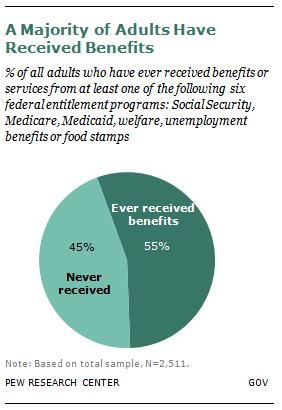
As politicians negotiated regarding the fiscal cliff, they debated whether to cut social programs aimed at alleviating poverty and deprivation.  Most of us imagine that these programs help a minority of the population.  In fact, the Pew Research Center reports that more than half of the population has received government benefits from one of the six most well-known programs:

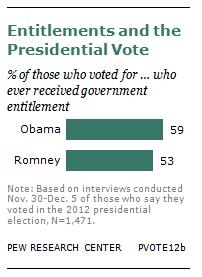
This isn’t the so-called 47% that Romney claimed would vote for a Democrat no matter what.  In fact, people who received one of these six benefits were only slightly more likely to vote Democratic:

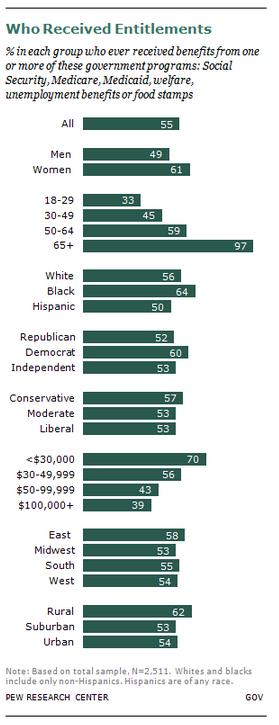
In fact, receiving benefits is pretty well spread out among the population. Except for people over 65, there seems to be significant consistency in the receipt of at least one benefit:

Notably, these programs also go to help the poor, women (largely because they end up single with young children), and people in rural areas.

Interestingly, many of us who have benefited from targeted government programs (“targeted” because we all benefit from programs like, oh, transportation initiatives and environmental protection and [insert dozens more here]) don’t know that we do.  In a previous post, we showed that large proportions of people who’ve benefited from social programs don’t recognize that they have unless their thinking is sparked by asking them about specific programs.  (It’s kind of like responding “No I don’t do drugs” and then being asked specifically about marijuana and saying, “Oh yeah, well that one I guess!”).

Since it is indeed the majority of Americans who benefit from targeted programs, it shouldn’t be too hard for politicians to find it in their hearts to support these programs.  That 57% of conservatives and 52% of Republicans have used them suggests that the political right is more interested in purporting an ideology than serving its constituency.

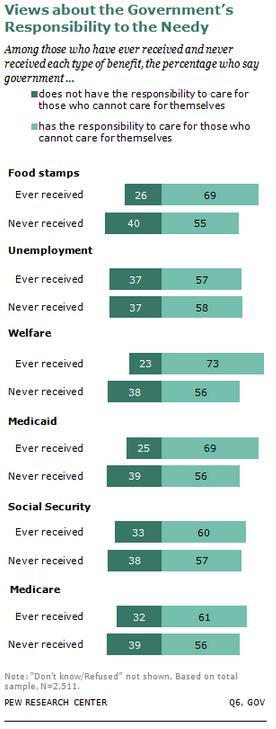
Alternatively, they realize that a certain proportion of benefit recipients also believe that the government “does not have the responsibility to care for those who cannot care or themselves.” About a third of people who hold onto this principle have used benefits:

It seems that data like this might be very useful for what we really need: an educational campaign designed to help Americans understand what social programs do and who benefits from them.   Maybe then we could have sensible policy discussions.

Lisa Wade, PhD is an Associate Professor at Tulane University. She is the author of American Hookup, a book about college sexual culture; a textbook about gender; and a forthcoming introductory text: Terrible Magnificent Sociology. You can follow her on Twitter and Instagram.

Cross-posted at Reports from the Economic Front.

One of the subthemes of current discussions about how best to reduce our national debt is that we must rein in out-of-control spending on federal safety net programs.   The reality is quite different.

The chart below shows spending trends in terms of GDP for the ten major needs-tested benefit programs that make-up our federal social safety net. The programs, in the order listed on the chart, are:

  • The refundable portion of the health insurance tax credit enacted in the 2010 health care reform law
  • Medicaid and the Children’s Health Insurance Program (CHIP)
  • The Supplemental Nutrition Assistance Program (SNAP)
  • Financial assistance for post-secondary students (Pell Grants)
  • Compensatory Education Grants to school districts
  • Assisted Housing
  • The Earned Income Tax Credit (EITC)
  • The Additional Child Tax Credit (ACTC)
  • Supplemental Security Income (SSI)
  • Family Support Payments

lowincprogs

As Jared Bernstein explains:

…for all the popular wisdom that programs to help low-income people are swallowing the economy, the truth is that like so much else that plagues our fiscal future, it’s all about health care spending.  The figure shows that as a share of GDP, prior to the Great Recession, non-health care spending was cruising along at around 1.5% for decades.  It was Medicaid/CHIP (Medicaid expansion for kids) that did most of the growing.

The takeaway from this: we need a new health care system (think single payer).

Regardless, the recent explosion in the ratio of Medicare/CHIP spending to GDP is largely due to the severity of the Great Recession, not the generosity of the programs. The recession increased poverty and thus eligibility for the programs, thereby pushing up the numerator, while simultaneously lowering GDP, the denominator.   Moreover, spending on all non-health care safety net programs is on course to dramatically decline as a share of GDP. Even Medicare/Chip spending is projected to stabilize as a share of GDP.

These programs are essential given the poor performance of the economy, and in most cases poorly-funded. Cutting their budgets will not only deny people access to health care, housing, education, and food, it will also further weaken the economy, in both the short and long run.

—————————

Martin Hart-Landsberg is a professor of Economics and Director of the Political Economy Program at Lewis and Clark College.  You can follow him at Reports from the Economic Front.

Ezra Klein at Wonkblog has put together an impressive collection of statistics on guns and mass shootings, including this data on public opinion on gun control.

To begin, people seem generally less interested in owning guns.  The percent of households with guns has been steadily decreasing for decades:

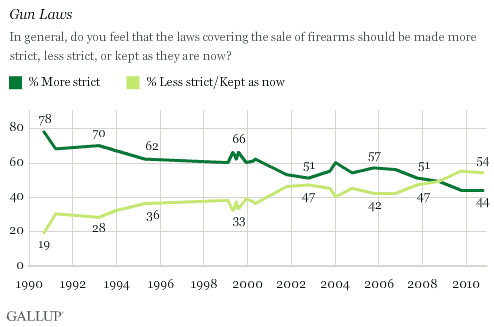
But, perhaps counter-intuitively, support for gun control has waned:

We might expect a tragedy like this week’s shooting to raise the overall level of support for gun control, but it probably won’t.  Previous shootings have not had much of an impact on opinion:

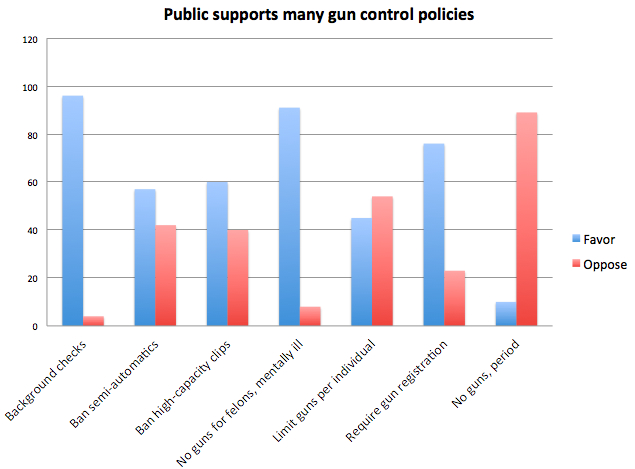
Still, there is more support for some forms of gun control than others:

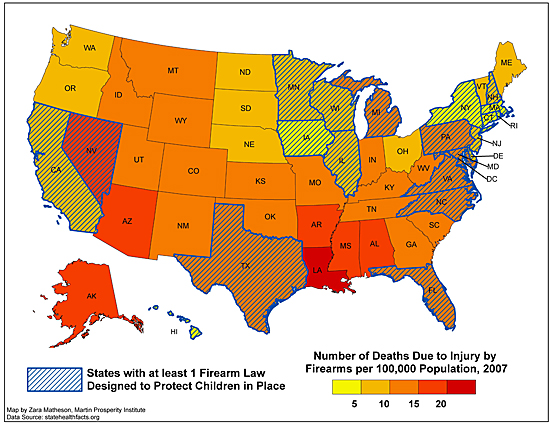
For what it’s worth, gun-related deaths are lower in states with stronger gun control.  Economist Richard Florida found “substantial negative correlations between firearm deaths and states that ban assault weapons (-.45), require trigger locks (-.42), and mandate safe storage requirements for guns (-.48)”:

It’s hard to know, however, whether this is correlation or causation.  Florida did not find correlations between gun deaths and other factors that we might expect to be correlated, including dense populations, high rates of stress, high numbers of immigrants, and mental illness.

Klein thinks that now is the time to talk about the role of gun control in preventing tragedies like the one in Newtown.  He suggests we go ahead and politicize the shooting, since silencing a discussion is just another form of politicization. He writes:

If roads were collapsing all across the United States, killing dozens of drivers, we would surely see that as a moment to talk about what we could do to keep roads from collapsing. If terrorists were detonating bombs in port after port, you can be sure Congress would be working to upgrade the nation’s security measures. If a plague was ripping through communities, public-health officials would be working feverishly to contain it.

Only with gun violence do we respond to repeated tragedies by saying that mourning is acceptable but discussing how to prevent more tragedies is not. “Too soon,” howl supporters of loose gun laws. But as others have observed, talking about how to stop mass shootings in the aftermath of a string of mass shootings isn’t “too soon.” It’s much too late.

I agree that now is a good time to talk about gun control. And, we should do it with as many facts as possible, no matter where they lead us.

Lisa Wade, PhD is an Associate Professor at Tulane University. She is the author of American Hookup, a book about college sexual culture; a textbook about gender; and a forthcoming introductory text: Terrible Magnificent Sociology. You can follow her on Twitter and Instagram.

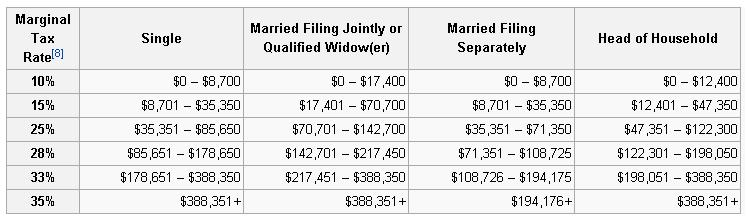
There are six (progressive) tax brackets for income.  The tax rate paid by earners is bumped up each time they reach a bracket threshold.  The threshholds are determined by type of household.  Here’s a handy chart for 2012 from Wikipedia:

U.S. politicians are now debating how these tax rates should change and they often focus on the “marginal” or “top” tax rate.  That’s the one that applies to the highest tax bracket, right now at 35%.

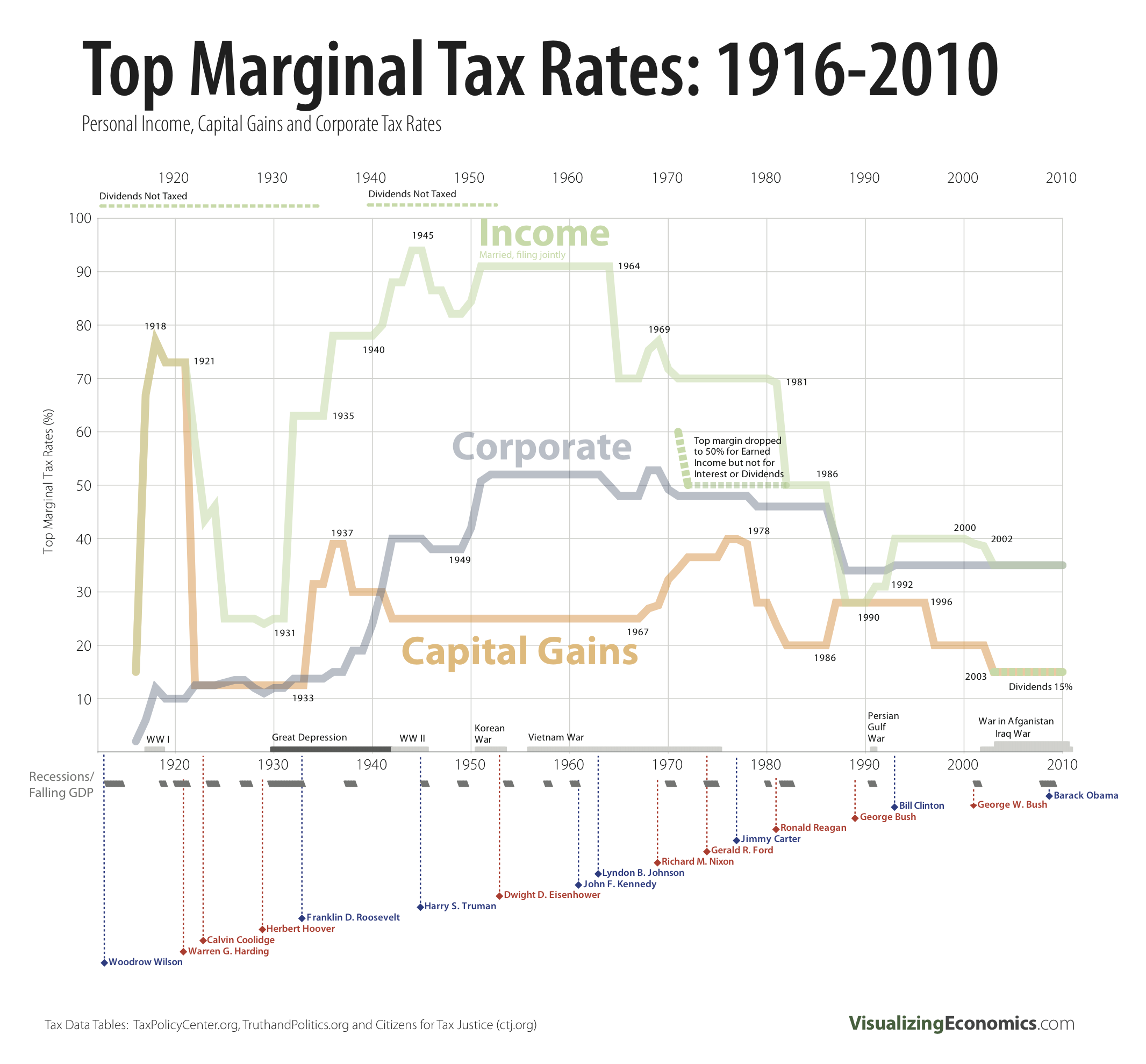
Dylan Matthews at the WonkBlog notes that the squabbling has been mostly over a percentage point or two.  Small beans, he asserts.  To put this in perspective, he includes this graph of fluctuations in the top tax rates throughout history (click to enlarge):

The green line labeled “income” correlates to the chart above.  You can see that especially income, but also corporate and capital gains top tax rates, have been shockingly variable since 1910.  They were about 25% right before the Great Depression, raised to about 95% during World War II, dropped to about 70% in the ’60s, and have been on the decline ever since.

Matthews refers to a pair of economists, Nobel laureate Peter Diamond and Emmanuel Saez, who argue that the top tax rate should optimally be 73%.  Sociologist Jose Marichal, however, at ThickCulture, observes that tax policy has rarely been about what is optimal for society.  Instead, he writes:

What these wild shifts in tax policy suggest is that our determination of how much we should tax our wealthiest is not based on any pragmatic assessment of what would result in the best policy outcome, but is rather guided by foundational assumptions about what is fair.

Beliefs about what is fair are, of course, strongly influenced by cultural ideologies and group stereotypes.  Politicians both fall victim to their own biases and strategically invoke and create ideas and resentments.  We shouldn’t expect the current debate over how to change our tax code to be either rational or practical, then.  The debate will be political, but you already knew that.

Lisa Wade, PhD is an Associate Professor at Tulane University. She is the author of American Hookup, a book about college sexual culture; a textbook about gender; and a forthcoming introductory text: Terrible Magnificent Sociology. You can follow her on Twitter and Instagram.

Cross-posted at Cyborgology.

On Thursday Syria’s internet was shut down.

This is a serious situation with literal life and death implications.  Much of this story has yet to play out. Right now, I want to take a moment to explore one aspect of what this all means. Namely, I want to explore the question: why did the internet shut off now? To do so, I turn to Derrick Bell’s interest convergence theory.

Derrick Bell’s theory of interest convergence is a canonical statement on race relations. Bell famously argues that whites promote racial justice only when doing so converges with their own interests. The key example is the 1954 Brown V. Board of Education case, in which racial integration in schools served the larger U.S. message within the Cold War of human rights, freedom, and equality.

Although many scholars critique the strong version of Bell’s argument for its failure to incorporate agency among blacks, the root of the argument is quite useful in explaining power relations. In short, interest convergence theory tells us that the will of the powerful wades towards the direction of self-interest. When these interests converge with those of the less powerful, the less powerful are better able to achieve their will.

To a degree, I think this framework helps us understand the decision of the Syrian government to shut down communication channels. Syrian rebels utilized digital communication channels to both organize among themselves, and share their experiences — often in real time — with the outside world. This was instrumental in their cause both on the ground and internationally. The real question then, is why did the government maintain these channels for so long? This question is particularly blaring in light of extreme government atrocities, including mass killings of innocent citizens — including children. Moreover, why did the government decide to cut off these channels now?

Internet and communication blackouts are not unique among the Arab uprisings. Egypt and Libyan governments both shut down communication during their respective battles. The Syrian government, however, is unique in its deft use of digital technologies to quash protests, locate dissidents, and suppress the movement. In short, the interests of the powerful (i.e. the government) converged with the less powerful (i.e. the rebels). In addition to appearing somehow less oppressive to the international community, we see here a possible reason for maintaining Internet capabilities despite their strategic importance in the rebel movement.

However, we may speculate that the costs got too high for the government. We may speculate that in light a persistent rebel force, culminating in massive protests in Damascus — so large that the major airport had to be shut down — it no longer served governmental interests to maintain digital connectivity. The interests of the powerful and the less powerful no longer converged.

Certainly, there are other factors in play. This is a minuscule fraction of the story. With that said, this framework suggests that perhaps today’s act by the Syrian government was one of desperation. They were forced to give up a key oppressive resource (digital communication capabilities). This resource was no longer adequately effective for keep the uprising at bay. Now, they must all battle in the dark.

—————————

Jenny Davis is a PhD candidate in the Department of Sociology at Texas A&M University, where she studies the intersection of culture and identity. You can follow her twitter feed at @Jup83.

I have just what you were wishing for: an overview of the electoral college. Yooooor welcome.

Also from CGP Gray:

Lisa Wade, PhD is an Associate Professor at Tulane University. She is the author of American Hookup, a book about college sexual culture; a textbook about gender; and a forthcoming introductory text: Terrible Magnificent Sociology. You can follow her on Twitter and Instagram.