politics: the state

Cross-posted at Reports from the Economic Front.

Presidential candidate Mitt Romney’s low federal tax rate — 14.1% — has called attention to the fact that our tax code favors people who make their money from investments rather than labor.  According to the conventional wisdom, this is as it should be.  It encourages people, like our job creators, to invest their money, thereby boosting growth and the well-being of all working people.  Sounds plausible, but the facts don’t support the policy.

BusinessWeek lays out the background and political context for our current low taxation rates on investment income as follows:

Since 1950 capital gains have generally been taxed at a lower rate than income, to spur investment. The rate under President George W. Bush went from 20 percent to 15 — the lowest ever — and was billed as a way to stimulate the economy. (If nothing’s done by Jan. 1 to change tax and budget provisions already passed by Congress, the rate will snap back to 20 percent, a scenario both parties hope to avoid.) Mitt Romney wants to ditch capital gains tax altogether for people earning less than $250,000. President Barack Obama, in his Affordable Care Act, increased the rate by 3.8 percent for high earners beginning in 2013, and has proposed the so-called Buffett Rule, which would among other things end an accounting interpretation that allows private equity and hedge fund managers (and Romney) to save money by paying tax on their earnings at the capital gains rate. Neither candidate, though, contests the Bush administration’s basic logic: that a lower capital gains rate encourages investment, which creates jobs and helps the economy grow. That doesn’t mean they’re right.

Leonard E. Burman, a tax expert, took on this issue in recent testimony before the House Committee on Ways and Means and the Senate Committee on Finance.   A good place to start is with who benefits from lower capital gains taxes.

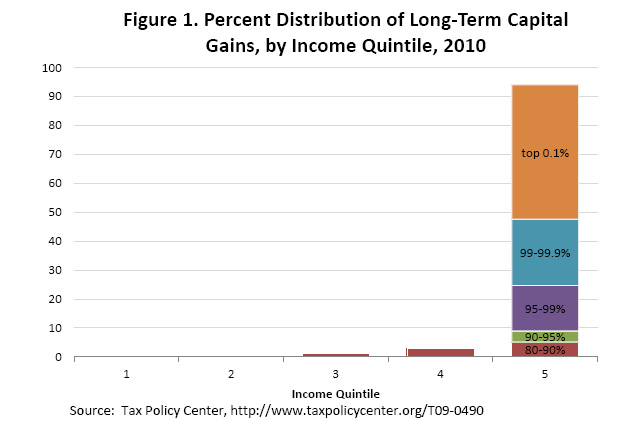
Not surprisingly, as the figure below (which is taken from Burman’s testimony) shows, the benefits are extremely concentrated.  As Burman noted:

In 2010, the highest-income 20 percent realized more than 90 percent of long-term capital gains according to the TaxPolicyCenter.  The top 1 percent realized almost 70 percent of gains and the richest 1 in 1,000 households accrued about 47 percent. It is hard to think of another form of income that is more concentrated by income.
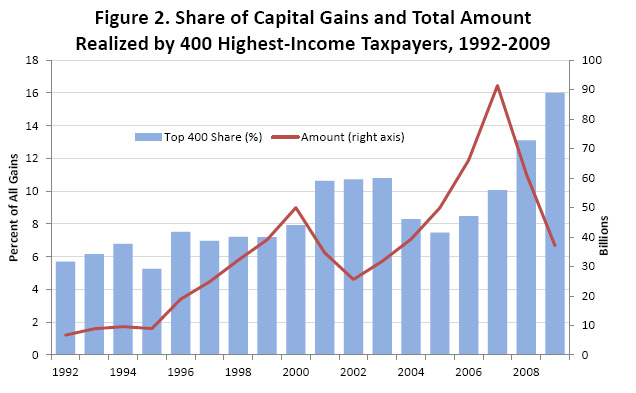
Moreover, as the next figure shows, the concentration of capital gains has grown over time.  Given that the rich fund political campaigns, this certainly helps to explain why both political parties are so determined to keep the rate low.
But, to the main question — do lower capital gains taxes actually boost growth? This is what Burman had to say in his testimony:

The heated rhetoric notwithstanding, there is no obvious relationship between tax rates on capital gains and economic growth. Figure 4 [below] shows top tax rates on long-term capital gains and real economic growth (measured as the percentage change in real GDP) from 1950 to 2011. If low capital gains tax rates catalyzed economic growth, we’d expect to see a negative relationship — high gains rates, low growth, and vice versa — but there is no apparent relationship between the two time series. The correlation is 0.12, the opposite sign from what capital gains tax cut advocates would expect, and not statistically different from zero. Although not shown, I’ve tried lags up to five years and using moving averages, but there is never a larger or statistically significant relationship.
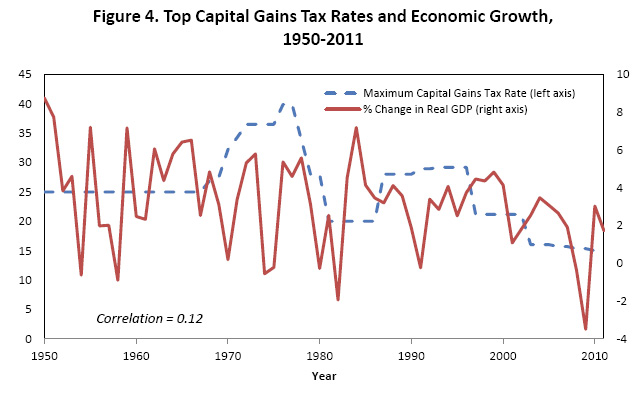
Burman notes that he posted this figure on his blog and offered the data to anyone interested, challenging readers to find support for lower rates.  “A half dozen or so people, including at least one outspoken critic of taxing capital gains, took me up on the offer, but nobody to my knowledge has been able to tease a meaningful relationship between capital gains tax rates and the GDP out of the data.”

As reported in a previous post, Thomes L. Hungerford, writing for the Congressional Research Service, came to the same conclusion about the lack of any relationship between the capital gains tax and GDP.  In fact, he concluded raising the top income and capital gains tax rates would likely reduce income inequality without causing harm to the economy.

So, if we are really concerned with the budget deficit, rather than slashing spending on social programs lets raise the top tax rates.  Wonder if this will come up during our presidential debates?

—————————

Martin Hart-Landsberg is a professor of Economics and Director of the Political Economy Program at Lewis and Clark College.  You can follow him at Reports from the Economic Front.

“Today,” Mother Jones‘s James Ridgeway reports, “roughly 1 in 12 state and federal prison inmates is 55 or older.”  Prisoners sentenced to life without parole will die in prison, so that means they’ll convalesce there too.  In other words, prisons are part nursing home and, according to a report from the ACLU, the number of elderly prisoners is expected to skyrocket:


Imprisonment is already expensive, but aging patients cost twice what a younger prisoner costs.  Today, we spent $16 billion a year to house elderly prisoners,  Soon we’ll have to start renovating our prisons.

Unless states start releasing them, [former warden Bob] Hood says, we will need to “retrofit every prison in America to put assisted living-units in it, wheelchair accessibility, handicapped toilets, grab bars — the whole nine yards.”

Prisons increasingly feature assisted-living cells and hospice units.

Some argue for “compassionate release.”  After all, elderly prisoners have a very low recidivism rate.  But the ACLU cautions us to remember that release shouldn’t mean abdicating responsibility.  “For many elderly prisoners,” the director of the ACLU’s National Prison Project explains, “particularly those with serious medical needs, simply pushing them out the prison door will be tantamount to a death sentence.”

Lisa Wade, PhD is an Associate Professor at Tulane University. She is the author of American Hookup, a book about college sexual culture; a textbook about gender; and a forthcoming introductory text: Terrible Magnificent Sociology. You can follow her on Twitter and Instagram.

W.W. Norton has released a fun little animation answering this thorny question. It has to do with abundance and hoarding, and the technological innovations that underlie these things, as well as government’s willingness to redistribute wealth.

Enjoy:

See more of Norton’s videos at their YouTube channel.

Lisa Wade, PhD is an Associate Professor at Tulane University. She is the author of American Hookup, a book about college sexual culture; a textbook about gender; and a forthcoming introductory text: Terrible Magnificent Sociology. You can follow her on Twitter and Instagram.

Cross-posted at PolicyMic.

In this clip from a campaign rally, Vice Presidential nominee Paul Ryan argues that “traditional marriage” is a “universal human value.”

Ryan could not be more wrong. In fact, few practices have undergone more fundamental transformation.

For thousands of years, marriage served economic and political functions unrelated to love, happiness, or personal fulfillment.  Prior to the Victorian era, love was considered a trivial basis for marriage and a bad reason to marry.  There were much bigger concerns afoot: gaining money and resources, building alliances between families, organizing the division of labor, and producing legitimate male heirs.

These marriages were patriarchal in the strictest sense of the term.  Men were heads of households and women were human property, equivalent to children, slaves, servants, and employees.  Women didn’t choose to enter a marriage that defined her as property, she was entered into the marriage by her father, who owned her until he “gave her away.”

Ultimately, in response to feminist activism as well as other forces, marriage would change.  By the 1950s, a new kind of marriage would become ideal.  This is the one that Ryan likely means when he uses the terms “traditional” and “universal.”  In this model, men and women married by choice and were expected to find sustenance in their relationship.  Women were not legally subordinate to their husbands (that is, she was no longer property).  But the rights and responsibilities of husbands and wives continued to be defined differently.  Women owed men domestic services (cleaning, cooking, childcare, and sex); in return, men were legally required to support their wives financially.

This type of marriage signed its own death warrant, a story I’ll tell in another post, and was relatively short-lived (and not at all universal, even at its peak in the U.S.).  It was soon replaced by an ideal of marriage based on gender-neutral roles that spouses could work out for themselves. Today married couples are free to organize their lives however they wish.  And they do.  Stephanie Coontz, famed historian of marriage, writes:

Almost any separate way of organizing caregiving, childrearing, residential arrangements, sexual interactions, or interpersonal redistribution of resources has been tried by some society at some point in time.  But the coexistence in one society of so many alternative ways of doing all of these different things—and the comparative legitimacy accorded to many of them—has never been seen before.

Ryan is right, then, in that “traditional marriage,” however you define it, is not normal in the U.S.  He’s completely wrong, though, it calling it universal.  Even a quick review of American history reveals it not to be so.

Sources:

  • Coontz, Stephanie. 1992. The Way We Never Were: American Families and the Nostalgia Trap.  New York: Basic Books.
  • Coontz, Stephanie.  2004. The World Historical Transformation of Marriage. Journal of Marriage and Family66, 4: 974-979.

See also The Daily Show on nostalgia, the “traditional” age of marriage, and mocking “traditional marriage.”

Lisa Wade, PhD is an Associate Professor at Tulane University. She is the author of American Hookup, a book about college sexual culture; a textbook about gender; and a forthcoming introductory text: Terrible Magnificent Sociology. You can follow her on Twitter and Instagram.

Generally speaking, gender equality in the U.S. and other Western countries has involved women moving into men’s spheres.  We have not seen an equivalent migration of men into women’s spheres.  Accordingly, while women have integrated many male occupations (they are now, for example, 50% or more of law and medical students), many female-dominated ones remain heavily female.

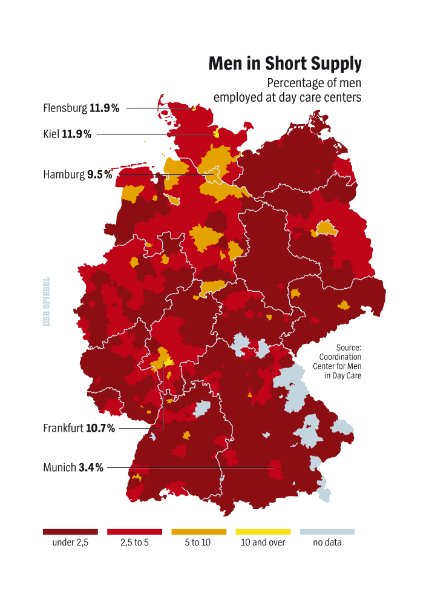
This is perhaps nowhere more true than in early childhood education.  In a story about male childcare workers at Organizations, Occupations and Work, Lata Murti reports that only 5% of child care workers and 3% of pre-school teachers are male.  Numbers are also low in other Western countries.  In Germany, the average is 3.5% (and this includes all employees of child care centers, including custodians).

So, Spiegel Online reports, Germany has decided to try to do something about it.  Aiming to increase the percentage of men in child care to 20%, the government is spending 13 million Euros on a “More Men in Early Childhood Education and Care” program.

The state isn’t doing this, though, solely out of a passion for gender equality or a soft place in their heart for men holding babies.  They’re doing it because Germany has promised that there will be a spot in a day care center for all children when they turn one year old.  To fulfill this promise, they need more day care workers badly; recruiting men means that that other half of the population might fill out the profession.

Lisa Wade, PhD is an Associate Professor at Tulane University. She is the author of American Hookup, a book about college sexual culture; a textbook about gender; and a forthcoming introductory text: Terrible Magnificent Sociology. You can follow her on Twitter and Instagram.

Though laws varied, American slaves generally could not legally marry.  They were the subject of contracts, legally barred from entering into contracts themselves.  And while some enslavers encouraged their slaves to form romantic relationships because such relationships discouraged running away, slave families were always at risk of being torn apart at the whims of the “master.”

On this day in 1863, Abraham Lincoln signed the Emancipation Proclamation, an executive order that ended slavery for all people in territories that were under Union  control.  Two years later, the Thirteenth Amendment amended the constitution to prohibit slavery.  The next year, two newly-freed now ex-slaves, Thomas and Jane Taylor, were married in Kentucky.

Text:

This day came before me Thomas Taylor and Jane, his wife, persons of color and servants of Christian County and declared that they have been and still aim to continue living together as husband and wife. Given under my hand this 27th day of July 1866.

G.W. Lawson, Clerk
Geo. C. Long, D.C.

Thomas and Jane are the great-great-great-grandparents of Tami, who blogs at What Tami Said.  They had been together for many years before they were given the opportunity to marry and had two children.  According to Dr. Tera Hunter at NPR, they were one of many newly-freed couples to marry in the years after the abolishment of slavery extended them the right.  By 1900, she explains, marriage would be “nearly universal” among American blacks.

Lisa Wade, PhD is an Associate Professor at Tulane University. She is the author of American Hookup, a book about college sexual culture; a textbook about gender; and a forthcoming introductory text: Terrible Magnificent Sociology. You can follow her on Twitter and Instagram.

Cross-posted at Reports from the Economic Front.

There are those that argue that lowering the top marginal tax rates on “ordinary” income (from wages or salary) and capital gains will stimulate economic growth.  Thomas L. Hungerford, in a Congressional Research Report, tests and rejects this claim.

He finds no statistical relationship between changes in either of these top tax rates and private savings, investment, productivity, or real per capita GDP growth.  However, he does find a strong statistical relationship between changes in these tax rates and income inequality.  More specifically, raising top tax rates can be expected to promote greater income equality without causing harm to the economy.

Tax Trends

There are two main tax concepts: the marginal tax rate, which is the tax paid on the last dollar of income received, and the average tax rate, which is the proportion of all income that is paid in taxes.  How much a person pays on the last dollar received depends on whether it is classified as ordinary income or capital gains.

Most importantly, as the chart below shows, the very top tax payers have enjoyed a steady decline in their average tax rate.

The next chart shows trends in top marginal tax rates on ordinary income and capital gains.  The top marginal tax rate on ordinary income has clearly been on the decline: from 91% in the 1950s, 70% in the 1960s and 1970s, to a low of 28% in 1986.  It now stands at 35%.  The top marginal capital gains tax rate has not changed as much.  It was 25% in the 1950s and 1960s, 35% in the 1970s, and is now 15%.

The Tests

Hungerford used econometric methods to test whether changes in top marginal tax rates affect private savings, investment, productivity, and/or per capita GDP growth.  Simply plotting the movement of top tax rates and each of these variables suggests that a decline in top tax rates is associated with a positive movement in each of these economic variables.

However, as Hungerford correctly states, correlation is not the same as causation.  Using regression analysis, he found that the relationships were only coincidental or spurious; there was no statistically significant connection between changes in the top tax rates and movements in any of the variables.

Hungerford also tested to see if changes in top marginal tax rates had any effect on the distribution of income.  The first chart below shows the scatter plot of top tax rates and the share of income going to the top 0.1% for the years 1945-2010.  The second shows the same with the top 0.01% of income earners.

As we can see the fitted lines suggest a very strong relationship between the variables.  As before, Hungerford used regression analysis to determine whether the relationships were statistically significant.  This time his answer was yes in both cases; changes in top marginal tax rates do affect income concentration.  In other words, lowering the top rates increases income inequality, raising them reduces it.

It is time for us to start agitating for raising the top tax rates.

Cross-posted at Caroline Heldman’s Blog.

On Monday, Mother Jones released a video recorded in May of presidential candidate Mitt Romney speaking at a $50,000-a-plate fundraiser in the Boca Raton home of “private equity party boy” and “sexy party” host, Marc Leder. A hidden camera caught controversial remarks about IsraelIran, and a joke about being more electable if his parents had been born in Mexico, but the topic of this post is Romney’s use of the 47% Meme.

The 47% Meme is the idea that half of Americans take from rather than contribute to tax coffers. It sometimes surfaces in the form of the “takers vs. makers” frame. I have encountered this “argument” for years on Fox News, so it is surprising to see it gaining national attention now. Romney did a superb job articulating the 47% Meme in response to a question of how he might win in November:

There are 47 percent of the people who will vote for the president no matter what. All right, there are 47 percent who are with him, who are dependent upon government, who believe that they are victims, who believe the government has a responsibility to care for them, who believe that they are entitled to health care, to food, to housing, to you-name-it. That that’s an entitlement. And the government should give it to them.

Many myths start with a kernel of truth. The 47% Meme is loosely based on the statistic that 47% of Americans pay no income tax (down to 46% in 2011). This meme is wildly dishonest since people pay a host of other federal, state, and local taxes. It’s about as honest as saying a person doesn’t eat vegetables because she only eats carrots, celery, bell peppers, cucumbers, and cabbage, but not broccoli.

So who is paying taxes, and what taxes are they paying?


Federal Income Tax

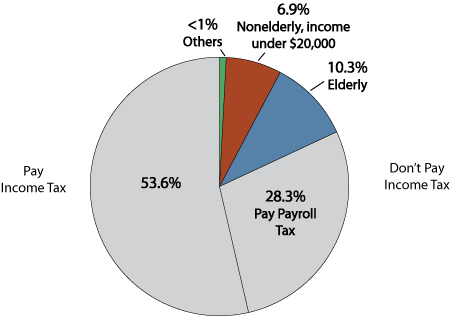
The Tax Policy Center finds that two main groups comprise the 46% who do not pay federal income tax: (1) The poor whose subsistence-level income is not taxable, and (2) those who receive tax expenditures. This chart shows that the lion’s share of tax expenditures goes to senior citizens, children, and the working poor, with the notable exception of 7,000 millionaires who paid no income tax in 2011.


Other Federal Taxes

But enough about income tax since this narrow focus only serves to further the misleading 47% Meme. The chart below shows a more accurate picture of who pays federal taxes. If we don’t count retirees, only 8% of Americans pay no income or payroll taxes.

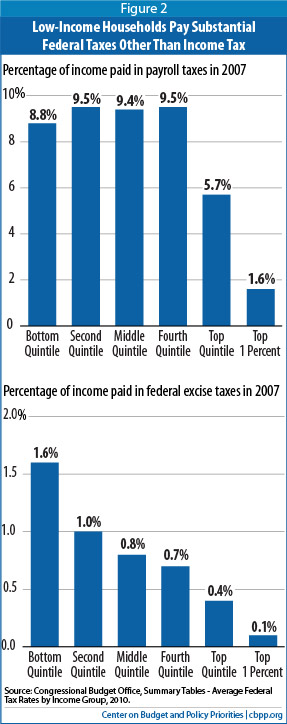
Americans also pay federal excise tax on gas, liquor, cigarettes, airline tickets, and a long list of other products, so virtually every American pays federal taxes in some form. And contrary to the 47% Meme, poor and middle-class Americans actually pay a greater percentage of their income in federal payroll and excise taxes than wealthier Americans.

State and Local Taxes

When it comes to state and local taxes, the Institute on Taxation and Economic Policy finds that the poor pay more in state and local taxes in every state except Vermont. As the chart below indicates, state and local taxes are regressive, meaning that those who can least afford to pay, pay more.

Romney has apologized for the inelegance of his statements, but stands by their substance, despite ample data debunking the dependency (above) and entitlement bases for the 47% Meme. I don’t believe that Romney believes that half of the people in the U.S. are pathetically entitled “victims.” He is a smart person, and this is a ludicrous line of reasoning. But what does it say about our bitterly partisan nation that heaping unmitigated scorn on the poor brings in big bucks from the base?