politics: the state

Cross-posted at Jezebel.

I’ve been watching the response to Anne-Marie Slaughter’s Why Women Still Can’t Have It All roll out across the web.  Commentators are making excellent points, but E.J. Graff at The American Prospect sums it up nicely:

Being both a good parent and an all-out professional cannot be done the way we currently run our educational and work systems… Being a working parent in our society is structurally impossible. It can’t be done right… You’ll always be failing at something — as a spouse, as a parent, as a worker. Just get used to that feeling.

In other words, the cards are stacked against you and it’s gonna suck.

And it’s true, trust me, as someone who’s currently knee-deep in the literature on parenting and gender, I’m pleased to see the structural contradictions between work and parenting being discussed.

But I’m frustrated about an invisibility, an erasure, a taboo that goes unnamed.  It seems like it should at least get a nod in this discussion.  I’m talking about the one really excellent solution to the clusterf@ck that is parenting in America.

Don’t. Have. Kids.

No really — just don’t have them.

Think about it.  The idea that women will feel unfulfilled without children and die from regret is one of the most widely-endorsed beliefs in America.  It’s downright offensive to some that a woman would choose not to have children.  Accusations of “selfishness” abound.  It’s a given that women will have children, and many women will accept it as a given.

But we don’t have to.  The U.S. government fails to support our childrearing efforts with sufficient programs (framing it as a “choice” or “hobby”), the market is expensive (child care costs more than college in most states), and we’re crammed into nuclear family households (making it difficult to rely on extended kin, real or chosen).  And the results are clear: raising children changes the quality of your life.  In good ways, sure, but in bad ways too.

Here are findings from the epic data collection engine that is the World Values Survey, published in Population and Development Review. If you live in the U.S., look at the blue line representing “liberal” democracies (that’s what we are).  The top graph shows that, among 20-39 year olds, having one child is correlated with a decrease in happiness, having two a larger decreases, and so on up to four or more.  If you’re 40 or older, having one child is correlated with a decrease in happiness and having more children a smaller one.  But even the happiest people, with four or more children, are slightly less happy than those with none at all.

Don’t shoot the messenger.

Long before Slaughter wrote her article for The Atlantic, when she floated the idea of writing it to a female colleague, she was told that it would be a “terrible signal to younger generations of women.”  Presumably, this is because having children is compulsory, so it’s best not to demoralize them.  Well, I’ll take on that Black Badge of Dishonor.  I’m here to tell still-childless women (and men, too) that they can say NO if they want to.  They can reject a lifetime of feeling like they’re “always… failing at something.”

I wish it were different. I wish that men and women could choose children and know that the conditions under which they parent will be conducive to happiness.  But they’re not.  As individuals, there’s little we can do to change this, especially in the short term.  We can, however, try to wrest some autonomy from the relentless warnings that we’ll be pathetically-sad-forever-and-ever if we don’t have babies.  And, once we do that, we can make a more informed measurement of the costs and benefits.

Some of us will choose to spend our lives doing something else instead.  We’ll learn to play the guitar, dance the Flamenco (why not?), get more education, travel to far away places, write a book, or start a welcome tumblr.  We can help raise our nieces and nephews, easing the burden on our loved ones, or focus on nurturing our relationships with other adults.  We can live in the cool neighborhoods with bad school districts and pay less in rent because two bedrooms are plenty.  We can eat out, sleep in, and go running.  We can have extraordinary careers, beautiful relationships, healthy lives, and lovely homes.  My point is: there are lots of great things to do in life… having children is only one of them.

Just… think about it.  Maybe you can spend your extra time working to change the system for the better.  Goodness knows parents will be too tired to do it.

Lisa Wade, PhD is an Associate Professor at Tulane University. She is the author of American Hookup, a book about college sexual culture; a textbook about gender; and a forthcoming introductory text: Terrible Magnificent Sociology. You can follow her on Twitter and Instagram.
Cross-posted at Global Policy TV.

Title IX, an amendment to the Civil Rights Act of 1964, stated that “No person in the United States shall, on the basis of sex, be excluded from participation in, be denied the benefits of, or be subjected to discrimination under any education program or activity receiving Federal financial assistance…”  Passed on this day in 1972, this policy meant that schools and colleges receiving federal funding could not legally give preference to men.  Instead, they had to allocate their resources to men and women in proportion to their interest and enrollment.

The intention of the policy was to change the norms that gave preference to men in all sorts of fields, from medical schools to sports teams.  Because most schools and colleges have extensive athletics departments, sports was included among the resources that the schools were required to dole out fairly.

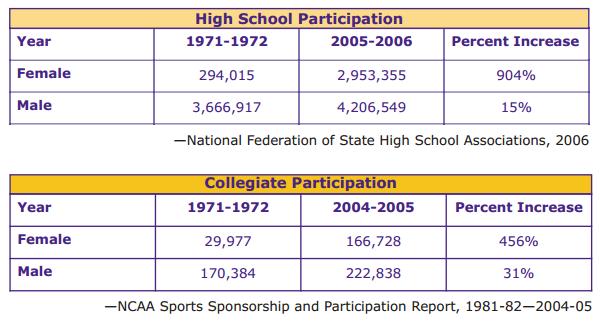
Accordingly, even grudging and partial compliance with the requirements of Title IX dramatically increased the opportunity for women to play sports.  In the next 35 years, women’s participation in high school and college sports would increase by 904% and 456% respectively (source).  Today, 42% of high school athletes and 45% of college athletes are women (source).

Title IX is often mistakenly accused of forcing schools to cut funding for men’s athletics.  In fact, funding for men’s athletics, as well as the number of men who play sports in school, has increased since Title IX.  The chart above also shows that men’s participation has increased by 15% in high school and 31% in college.  It’s not true, then, that Title IX has led to fewer male athletes (especially because some colleges count men as women).  Still, there is great resistance to the Amendment, with a particular emphasis on sports.  Many schools are only marginally compliant, and then only because (tireless) Title IX Officers keep pressure on institutions to follow the law.

It will be fascinating to see how changing college demographics affect the politics around Title IX.  After all, forty years later, people still argue that it’s not right that women’s sports get (almost) as much funding men’s.  Now there are more women on college campuses than men, so proportional funding may mean spending more money on women’s sports than men’s.  Fire and brimstone upon us.

Lisa Wade, PhD is an Associate Professor at Tulane University. She is the author of American Hookup, a book about college sexual culture; a textbook about gender; and a forthcoming introductory text: Terrible Magnificent Sociology. You can follow her on Twitter and Instagram.

The conventional wisdom seems to be that our biggest economic challenge is runaway government spending. The reality is that government spending is contracting and pulling economic growth down with it.  And worse is yet to come.

Perhaps the best measure of active government intervention in the economy is something called “government consumption expenditure and gross investment.”  It includes total spending by all levels of government (federal, state, and local) on all activities except transfer payments (such as unemployment benefits, social security, and Medicare).  

The chart below shows the yearly percentage change in real government consumption expenditure and gross investment over the period 2000 to 2012 (first quarter).  As you can see, while the rate of growth in real spending began declining after the end of the recession, it took a nose dive beginning in 2011 and turned negative, which means that government spending (adjusted for inflation) is actually contracting.

fredgraph-percente-change-from-a-year-ago.png

The next chart, which shows the ratio of government consumption expenditure and gross investment to GDP, highlights the fact that government spending is also falling as a share of GDP.

dolan-relative-to-gdp.png

Adding transfer payments, which have indeed grown substantially because of the weak economy, does little to change the picture.  As the chart below shows, total government spending in current dollars, which means unadjusted for inflation, has stopped growing.  If we take inflation into account, there can be no doubt that total real government spending, including spending on transfer payments, is also contracting. 

current-total-expenditures.png

The same is true for the federal government, everyone’s favorite villain.  As the next chart shows, total federal spending, unadjusted for inflation, has also stopped growing.

federal-current.png

Not surprisingly, this decline in government spending is having an effect on GDP. Real GDP in the 4th Quarter of 2011 grew at an estimated 3 percent annual rate.  The advanced estimate for 1st Quarter 2012 GDP growth was 2.2 percent.  A just released second estimate for this same quarter revised that figure down to 1.9 percent.  In other words, our economy is rapidly slowing.

What caused the downward revision? 

The answer, says Ed Dolan, is the ever deepening contraction in government spending:  

What is driving the apparent slowdown? It would be comforting to be able to blame a faltering world economy and a strengthening dollar, but judging by the GDP numbers that does not seem to be the case. The following table (see below) shows the contributions of each sector to real GDP growth according to the advance and second estimates from the Bureau of Economic Analysis. Exports, which we would expect to show the effects of a slowing world economy, held up well in the first quarter. In fact, the second estimate showed them even stronger than did the advance estimate. The contribution of private investment also increased from the advance to the second estimate, although not by as much. Exports and investment, then, turn out to be the relatively good news, not the bad, in the latest GDP report.

Instead, the largest share of the decrease in estimated real GDP growth came from an accelerated shrinkage of the government sector. The negative .78 percentage point decrease of the government sector is the main indicator that we are already on the downward slope toward the fiscal cliff.

p120601-1a.png

If current trends aren’t bad enough, we are rapidly approaching, as Ed Dolan noted, the “fiscal cliff.” That is what I was referring to above when I said that worse is yet to come. As Bloomberg Businessweek explains 

Last summer, as part of its agreement to end the debt-ceiling debate (debacle?), Congress strapped a bomb to the economy and set the timer for January 2013. Into it they packed billions of dollars of mandatory discretionary spending cuts, timed to go off at exactly the same time a number of tax cuts [for example, the Bush tax cuts and the Obama payroll-tax holiday] were set to expire  

The congressional deficit supercommittee had a chance to disarm the bomb last fall, but of course it didn’t. And so the timer has kept ticking. The resulting double-whammy explosion of spending cuts and tax increases will likely send the economy careening off a $600 billion “fiscal cliff.”

The fiscal contraction will actually be even worse, since the extended unemployment benefits program is also scheduled to expire at the end of the year.  

So, what does all of this mean?  According to Bloomberg Businessweek:

If Congress does nothing, the U.S. will almost certainly go into recession early next year, as the combo of spending cuts and tax hikes will wipe out nearly 4 percentage points of economic growth in the first half of 2013, according to research by Goldman’s Alec Phillips, a political analyst and economist. Since most estimates project the economy will grow only about 3 percent next year, that puts the U.S. solidly in the red.

One can only wonder how it has come to pass that we think government spending is growing when it is not and that it is the cause of our problems when quite the opposite is true.  Painful lessons lie ahead — if only we are able to learn them.

On this day in 1963 the U.S. Congress passed the Equal Pay Act, a law designed to end wage discrimination against women.

How to get the word out? Advertising of course!

Thanks to Sean D. for the link!

Lisa Wade, PhD is an Associate Professor at Tulane University. She is the author of American Hookup, a book about college sexual culture; a textbook about gender; and a forthcoming introductory text: Terrible Magnificent Sociology. You can follow her on Twitter and Instagram.

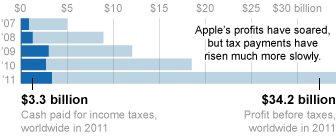
Apple’s profits more than quintupled in the last five years, but their tax burden has risen much more slowly.  Last year, just 9.8% of their profits went to taxes.   “By comparison,” writes economist Marty Hart-Landsberg, “Wal-Mart was downright patriotic — paying a tax rate of 24 percent.”

How does the company do it?  Hart-Landsberg summarizes the New York Times: “The answer is tax loopholes and a number of subsidiaries in low tax places like Ireland, the Netherlands, Luxembourg and the British Virgin Islands. ”  More details at Reports from the Economic Front.

Lisa Wade, PhD is an Associate Professor at Tulane University. She is the author of American Hookup, a book about college sexual culture; a textbook about gender; and a forthcoming introductory text: Terrible Magnificent Sociology. You can follow her on Twitter and Instagram.

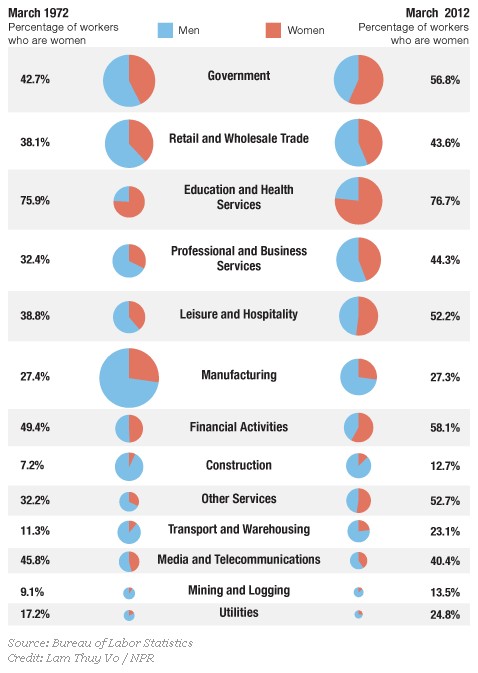
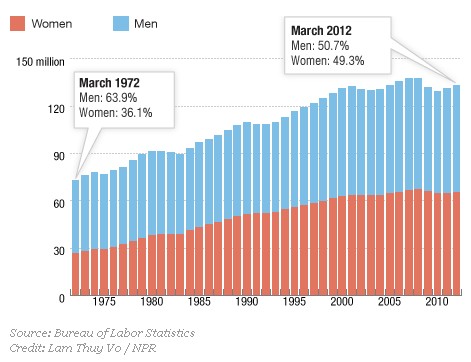
NPR’s Planet Money asks an interesting question.  If there are more women in the workforce now than there were forty years ago (and there are), where did all the additional jobs come from?

The pie charts below tell some of the story.  On the left are charts representing the percentage of women in various occupations in 1972.  The size of the circle corresponds to the size of the sector: larger is equivalent to more total jobs; on the right are the same charts for 2012.

Notice two trends: first,  in almost all categories today women are a larger percentage of the workers than they were in 1972 and, second, many of the occupational sectors that have high percentages of women have grown (e.g., education and health), whereas many in which men dominate have shrunk (e.g., manufacturing, media/telecommunications).

So, as women have joined the workforce, they’ve contributed to the overall growth of the American workforce and, specifically, filled the demand for employees in growing occupations.

Lisa Wade, PhD is an Associate Professor at Tulane University. She is the author of American Hookup, a book about college sexual culture; a textbook about gender; and a forthcoming introductory text: Terrible Magnificent Sociology. You can follow her on Twitter and Instagram.

Americans are familiar with seeing the phrase “In God We Trust” on our paper money.  The motto is, indeed, the official United States motto.  It wasn’t always that way, however.  While efforts to have the phrase inscribed on U.S. currency began during the Civil War, it wasn’t until 1957 that it appeared on our paper money, thanks to a law signed by President Eisenhower.

1956:

1957:

The motto wasn’t simply added in order to please God-fearing Americans, but instead had a political motivation.  The mid- to late-1950s marked an escalation in the Cold War between the U.S., the Soviet Union, and their respective allies.  In an effort to claim moral superiority and demonize the communist Soviet Union, the U.S. drew on the association of communism with atheism.  Placing “In God We Trust” on the U.S. dollar was a way to establish the United States as a Christian nation and differentiate them from their enemy (source).

Lisa Wade, PhD is an Associate Professor at Tulane University. She is the author of American Hookup, a book about college sexual culture; a textbook about gender; and a forthcoming introductory text: Terrible Magnificent Sociology. You can follow her on Twitter and Instagram.

CGP Gray is in rare form in this 4 1/2 minute argument in favor of phasing out the penny. He argues, entertainingly, that:

…they cost more to make than they’re worth, they waste peoples’ time, they don’t work as money, and because of inflation they’re less valuable every year making all the other problems worse.

See what you think:

Also from CGP Gray:

Lisa Wade, PhD is an Associate Professor at Tulane University. She is the author of American Hookup, a book about college sexual culture; a textbook about gender; and a forthcoming introductory text: Terrible Magnificent Sociology. You can follow her on Twitter and Instagram.