race/ethnicity: Latinos

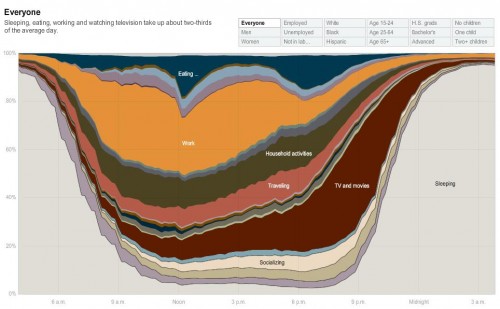
The New York Times has a neat interactive graph based on data from the American Time Use Survey that lets you look at hour-by-hour time use broken down by sex, employment status, 3 racial/ethnic groups (White, Black, Hispanic), age, education, and number of children (though, unfortunately, you can’t search by more than one category at once). Here is the breakdown for the entire sample:
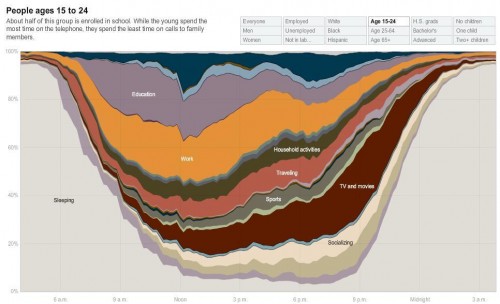
For people age 15-24:
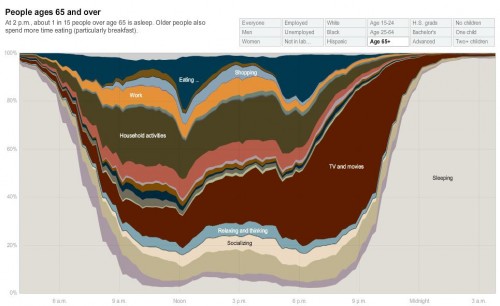
Watching TV and movies takes up a lot of the time of those over age 65:
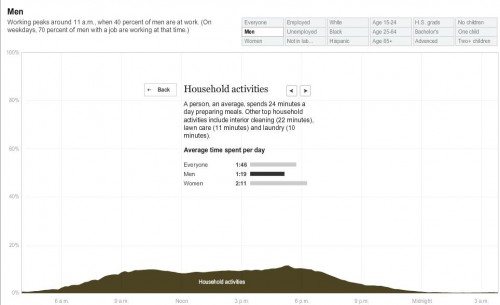
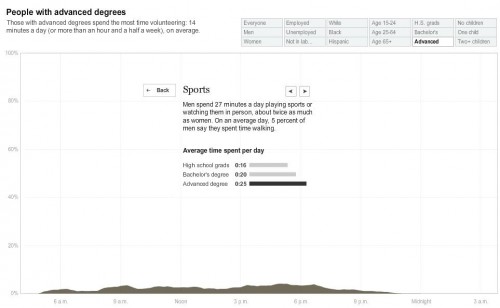
You can also click on a particular activity to get more information about it:
Those with advanced degrees spent the most time participating in sports or watching them in person; I suspect that the data might look a bit different if time spent watching sports on TV went in this category instead of the TV category:
Just a note, the averages for time spent at work seem pretty low, but that’s because they’re averaged over all days of the week, including any days off, rather than only days a person actually went to work.

Presumably the amount of time you’ll spend playing around with the site goes under computer use.
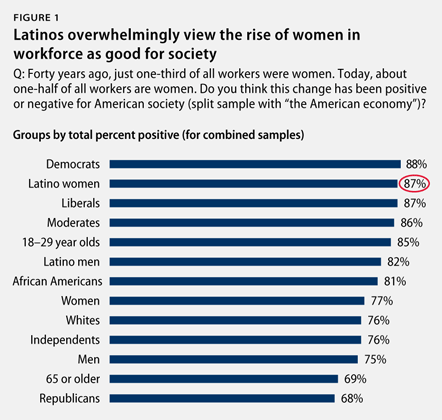
Teresa L.-M. sent us a link to an article at Color Lines about a survey of 3,413 people conducted by several groups, including Time magazine and the Center for American Progress, about attitudes toward a variety of issues including changes in women’s work and family roles. Overall, we see that every group said that women’s increased participation in the paid workforce has been good for the U.S., but not surprisingly, some groups were more enthusiastic than others:

This includes those who said it has been “somewhat” or “very” positive.  The % for Latinas was highlighted in the original because the memo focused on the fact that Latinos and Latinas, despite stereotypes that they hold more “traditional” gender attitudes, reported more positive feelings about increased workforce participation than did men and women as a whole. Hispanics were somewhat oversampled — that is, more were included than you would expect relative to their proportion in the U.S. population — because the organizations conducting the survey wanted to get more detailed information about Latino/a attitudes. The results indicated that “Latino attitudes were basically in line with those of other groups on nearly every indicator in the survey. Some minor differences did emerge in terms of the intensity of these beliefs and the degree of consensus about an issue.”

Also, obviously the categories above are not mutually exclusive, they just illustrate some interesting differences when you sort on various characteristics.

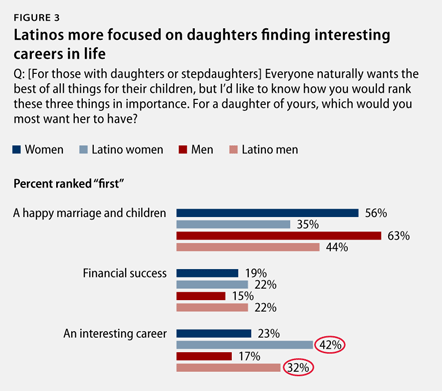
One area where Latinos/as differed was that they were more likely to report having an “interesting career” as the most important thing for their daughters to have, and less likely to say marriage and family is the most important, compared to all men and women, which is the opposite of what stereotypes of Latinos and Latinas would predict:

But I can’t help but note the wording there: “Everyone naturally wants the best of all things for their children…” That’s sloppy survey writing there, because it’s leading — it implies that a certain attitude or desire is universal and normative, and implies that everyone would agree that the three items they include in the question are examples of “the best.” It’s not that I’m saying most parents want their daughters to have miserable marriages or shitty jobs they hate. But you always want to be careful about wording questions in ways that take beliefs or values for granted, and thus set up a situation where contradicting them puts the respondent in the position of feeling deviant or fearing disapproval from the interviewer. I don’t know that in this particular example, that wording would have a huge impact on responses, since participants had to rank 3 specific items relative to one another. But I’d be very concerned if they had then been asked how important each item was (rather than asked to rank them), since the wording might lead people to rate items more highly than they would otherwise, because that’s what parents “naturally” want for their kids.

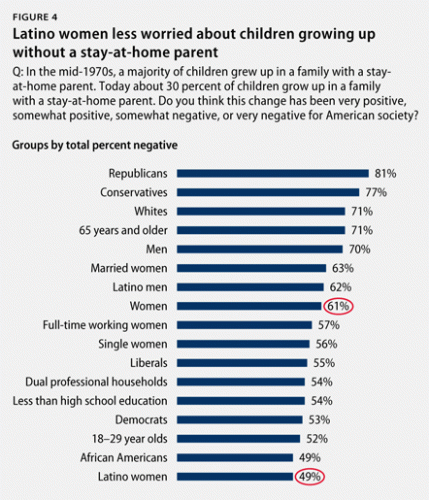
Anyway, moving on. Latinos/as were less concerned about children growing up without a full-time stay-at-home parent than were men  and women overall, with Latinas expressing significantly less negative attitudes than women overall and Latino men (this includes those who answered “very” or “somewhat” negative):

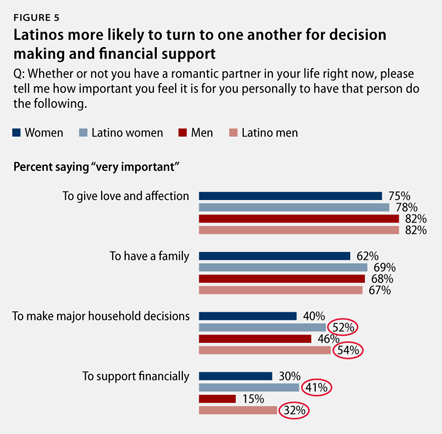
Back to methodological quibbling, this next graph is a great example of slippage between what the graph shows and what the heading claims it shows. As we see, the title says it indicates that Latinos are “more likely to turn to one another for decision making and financial support”:

But that’s not what the data are about at all. The question wording makes it clear this is both hypothetical (including people who don’t have a romantic partner and thus may be answering based on what they suppose would be true if they did) and is about how they value these things (“how important you feel it is for you personally…”), which is very different than if they regularly do them. The fact that you feel that it’s very important to have a romantic partner who provides financial support does not mean you are, in fact, turning to another person for financial support.

Of course, the heading for the table was written after the data were gathered and analyzed, and it doesn’t necessarily indicate that the data themselves are problematic. And yet, along with the wording issue above — and these are just two things I noticed in the memo that summarizes a few of the findings — it makes me a bit hesitant. The topic is interesting, and the results, which seem to undermine stereotypes about Latinos/as, would be great to use…except the methodological issues are overshadowing what might be perfectly valid, useful, and insightful findings. So ultimately, I present the images here less as information on attitudes about women’s roles and more as a cautionary tale.

And, you know, feel free to let me know if you think I’m over-reacting.

Deepa D. sent in an interesting post from Racebending about the race/ethnicity and gender of stars who get top billing in Paramount movies. Three volunteers at Racebending analyzed relevant data on movies produced or distributed by Paramount Pictures since 2000, as well as those currently in development. They focused on top billing — that is, which stars are most frequently highlighted in promotional materials, whose names appear highest in the credits, and so on. This both reflects power and status in Hollywood (the more prestige you have, the higher you’re likely to be credited compared to lower-status stars with similar screen time) and contributes to it (higher billing leads to more exposure and attention. Racebending explains:

Various types of Credit include Main Title Credit (before the movie starts), End Title Credit (after the movie is over), Paid Advertising Credit (mention during commercials and publicity), Above-the-Title Credit (name shows up on top of the movie name in promos and on screen), and Billing Block Credit (the block of text on posters and trailers.)

Their methodology:

For our review, we simply looked at which actor is listed first on imdb.com. Even if several actors have received top billing or above the title billing, someone is always listed first…

Our review of actors in top billing was necessarily subjective, but the cultural ethnicity and gender of most of Paramount’s top-billed actors like John Travolta, Angelina Jolie, and Samuel L. Jackson are well established in the public sphere. For animated characters like Shrek the Ogre, Spongebob Squarepants, and Eliza Thornberry we looked to the gender and ethnicity of the voice actor. We simply tallied the first actor billed, (for example: Malin Ackerman in Watchmen, Chris Pine in Star Trek, Ben Affleck in The Sum of All Fears, Jamie Foxx in The Soloist, Noah Ringer in The Last Airbender.)

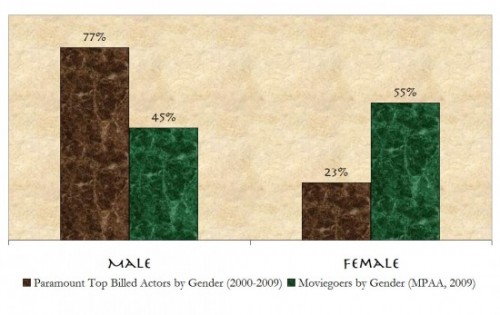
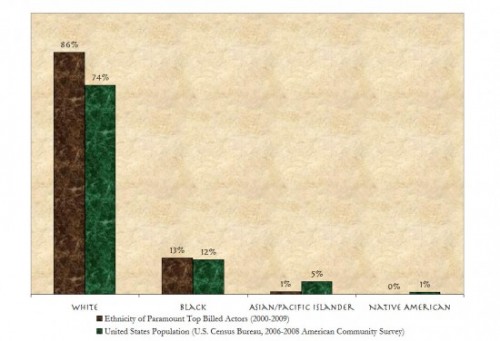
The analysis found that the vast majority of top-billed stars in Paramount films from 2000 to 2009 are male, while movie audiences are about 45% male:

An even higher proportion — 86% — of top-billed stars are White (the green bars show each groups percent of the overall U.S. population):

The category White there specifically includes White non-Hispanics. No Latinos had top billing in Paramount movies during this time period. Also,

Out of 133 movies either produced or distributed, 17 had a black lead actor and only one had an Asian actor–Parry Shen in the film Better Luck Tomorrow (2002). However, Paramount did not produce Better Luck Tomorrow, the company distributed the film to theaters after the film made the independent film circuit.

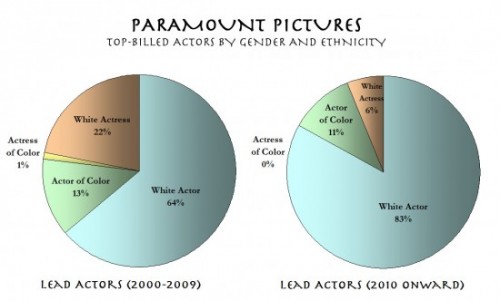
When the data are broken down by race/ethnicity and gender, we see that the vast majority of top-billed stars who are non-White are men. Non-White women are almost entirely shut out:

The chart on the right represents films currently under development. While Whites predominate in the starring roles in these projects, notice that White women make up only 6% of top-billed stars, and non-White men make up about twice that proportion.

This is, of course, just one studio. If you have links to similar data on other studios, or on movies more generally, send them in!

Related posts: the Bechdel test, the real stars of Glee, underrepresenting women in Hollywood, the Smurfette principle, whitening Heroes, White actors in yellowface, casting cheat sheet, Hollywood’s discomfort with Asian lead characters, race in Transformers II, gender in Pixar films, racist Disney characters, and the gender hierarchy in Bee Movie.

Crossposted at Jezebel.

Lisa recently discussed the trend of women having children at older ages. The Pew Research Center also just released data on women who do not have children lessfree (a commenter pointed out that “childless” implies a lack, whereas “childfree” doesn’t; others say “child-free” is also value-laden; “childless” is the word used in the report). They defined “childless” as women aged 40-44 who have no children; importantly, women who have adopted but never given birth themselves are also categorized as without children, which I find rather problematic. I can see why you might want info on both situations, but to define adoptive mothers as not having children? That’s weird. Also, they don’t report info for men.

From the report:

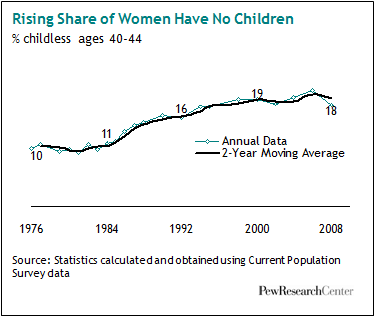
One in five women aged 40 to 44 reported that they’ve never had children. Meanwhile, just 41 percent of Americans say having children is necessary to a good marriage, compared to 65 percent in 1990.

The number has been increasing over time, with slightly short-term dips here and there:

Not having children is more common as education increases, though interestingly, the number of women without kids who have a Master’s or higher degrees is actually lower than in the early ’90s:

Of course, you could interpret the educational pattern a couple of ways. Perhaps achieving advanced degrees requires women who would have liked to have children to choose between career advancement and family life. Or maybe having an advanced degree makes them less attractive to potential partners, or unwilling to accept the partners available to them, so they have to decide whether to be single parents. But of course, it could also be that women who pursue advanced degrees are women who were less interested in having children to begin with. I’m sure there are other explanations and that it’s likely to be a combination of all these factors, and I’m sure somewhere there is data available. Let me know if you’ve got a good link.

But I’m stumped about the decrease in the number of highly-educated women without children between the early ’90s and now. Any thoughts on what might have caused that?

Anyway, moving on…

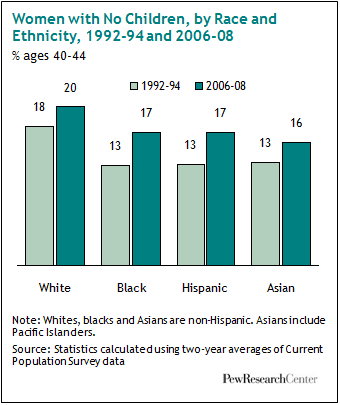
The increase in women without children holds for all racial/ethnic groups (and, as usual, data on Native Americans wasn’t included; sorry):

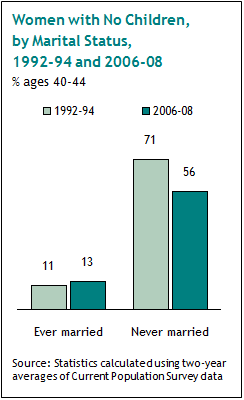
Probably not surprisingly, women aged 40-44 who never married are much more likely to be without children than are married women, though as we see, the percentage has gone down, indicating more never-married single mothers:

From that perspective, it appears that marriage and childbearing are tightly linked–only a small proportion of women who have been married at some point have no children.

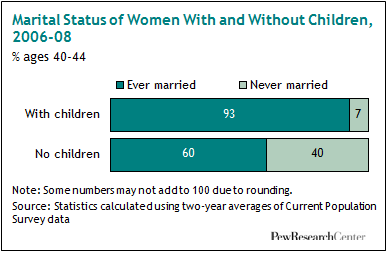
But if we break down the data a bit, we see that of women aged 40-44 without children, 60% were married at least once:

So while for the U.S. population as a whole, getting married generally indicates children will appear at some point, most women who forgo childbearing do marry at least once, showing that this isn’t just a phenomenon of single women.

Where did I learn about this report? From the website Shit My Kids Ruined, which I read with morbid fascination.

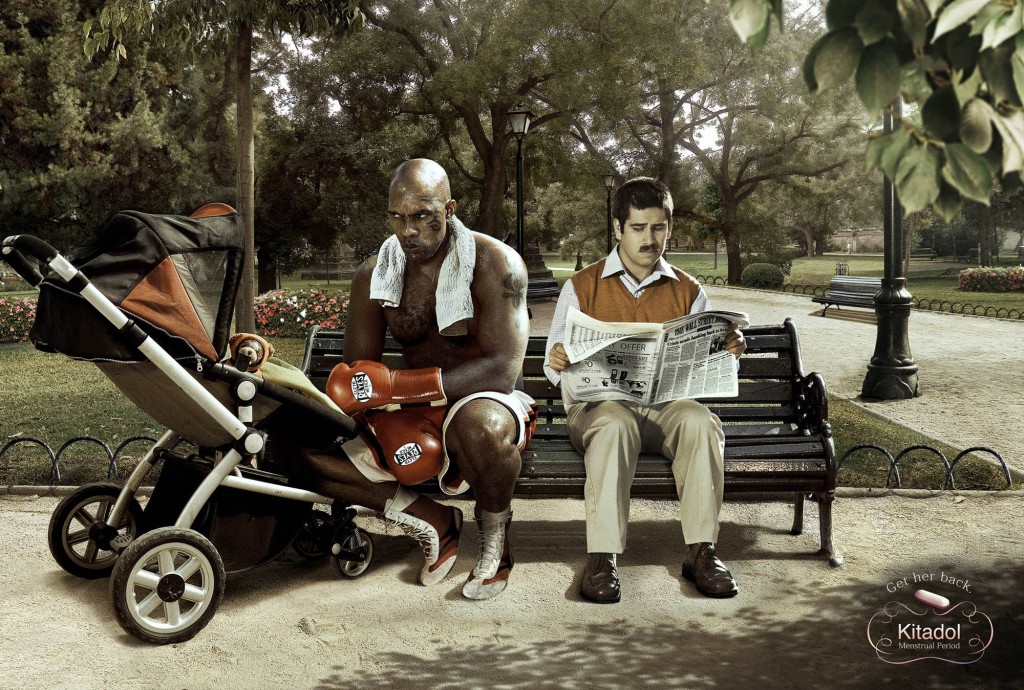
These Chilean ads for menstrual pain medication, sent in by Mia A., turn women into symbols of violent aggression: fighters, literally, but also men of color.  They simultaneously affirm, then, the association of violence with both masculinity and non-white skin and the de-association of women with those characteristics.  The message is that men of color are appropriately violent, while women are not.

(source)

Lisa Wade, PhD is an Associate Professor at Tulane University. She is the author of American Hookup, a book about college sexual culture; a textbook about gender; and a forthcoming introductory text: Terrible Magnificent Sociology. You can follow her on Twitter and Instagram.

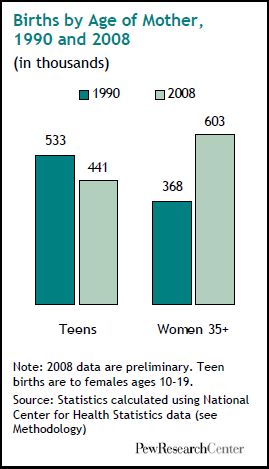
A Pew Research Center report on the changing demographics of American motherhood (discovered thanks to a tip by Michael Kimmel) shows that there has been a significant rise in childbearing among women at the later end of their childbearing years.

Not quite twice as many U.S. women over 35 gave birth in 2008 compared to 1990 (while we see the opposite trend for teen births):

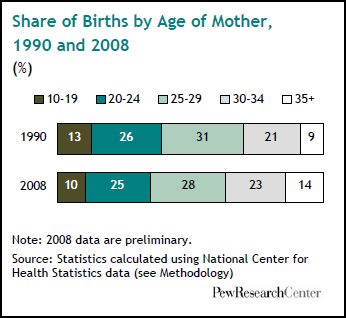
The share of all births that were to women over 35 also increased from 9% to 14%:

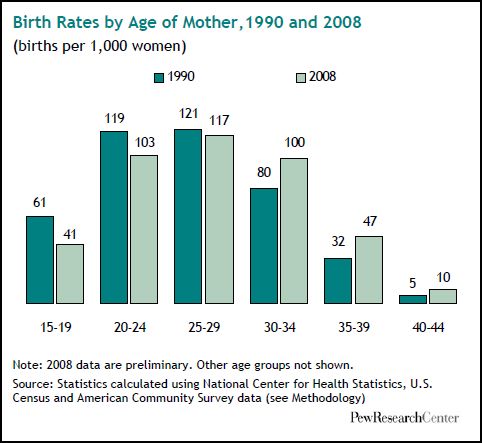
A look at the birth rates across women from 15 to 44 shows that fewer women between 15 and 29 are giving birth, but the numbers are up for all women 30 and over.

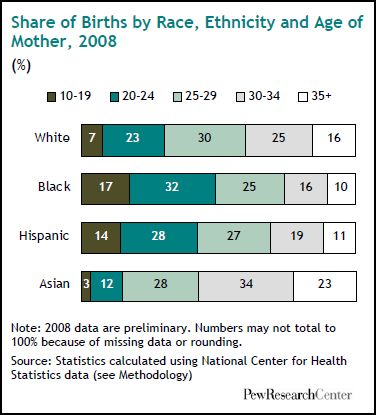
The data broken down by race also suggests that it is white and Asian women who are driving this trend:

For more from this report, see our post on race trends in motherhood.

Lisa Wade, PhD is an Associate Professor at Tulane University. She is the author of American Hookup, a book about college sexual culture; a textbook about gender; and a forthcoming introductory text: Terrible Magnificent Sociology. You can follow her on Twitter and Instagram.

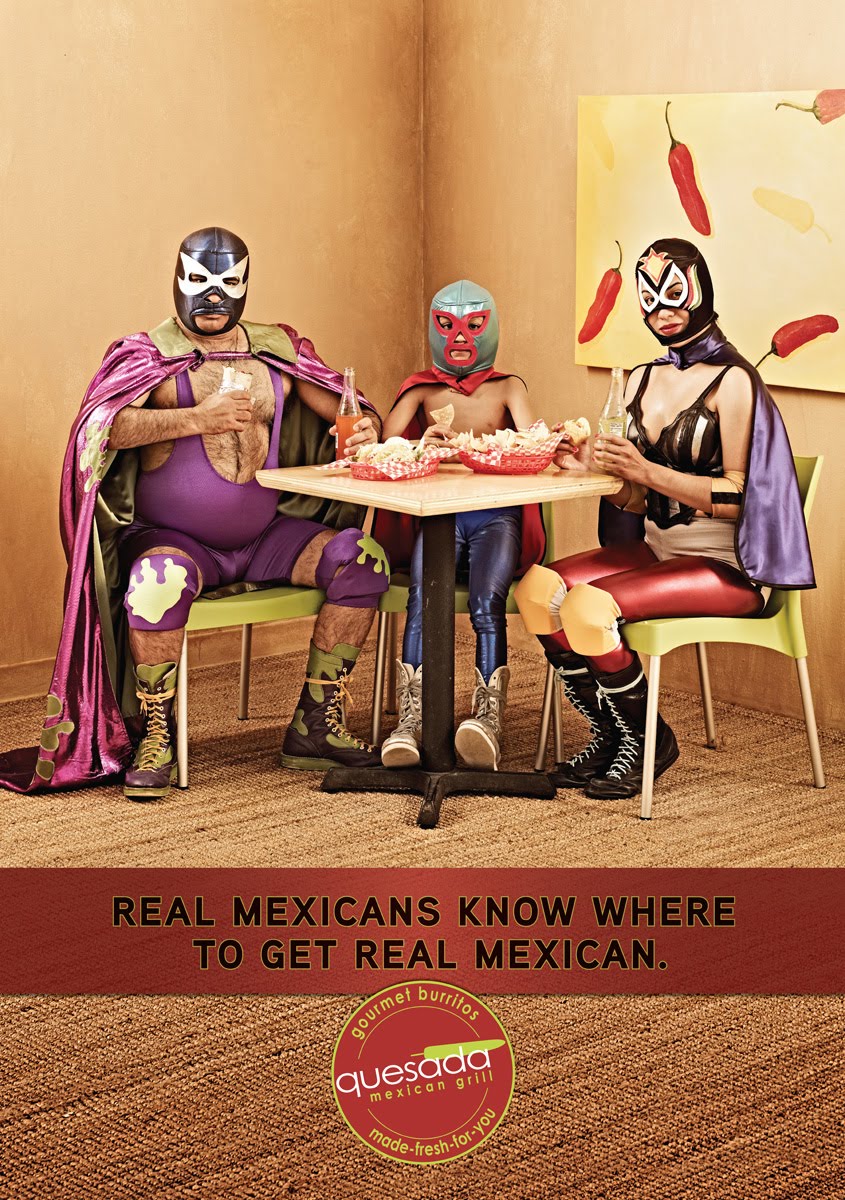
The Quesada Mexican Grill in Canada tries to claim authenticity (“real Mexican”) by, ironically, invoking Western stereotypes of Mexicans:

Hat tip to Copyranter.

Lisa Wade, PhD is an Associate Professor at Tulane University. She is the author of American Hookup, a book about college sexual culture; a textbook about gender; and a forthcoming introductory text: Terrible Magnificent Sociology. You can follow her on Twitter and Instagram.

A reader who asked to remain anonymous sent in a video about a recent interview by Star Jones with the lawyer for Kelsey Peterson, a teacher accused in 2007 of fleeing to Mexico in order to live with a 13-year-old student of hers (he was 12 at the time they began having sex together). In the interview, the lawyer for Peterson says he “resents” the boy being referred to as a child because he is a “Latino machismo teenager” (a phrase that doesn’t even make sense) and “manly”:

Notice that the lawyer also argues, at about 1:25, that teen boys have a high sex drive, which somehow excuses an adult woman having sex with a 12-year-old. In addition, at 3:30 in Jones mentions that some individuals have implied the kid couldn’t be a victim because he was physically larger than other kids his age (5′ 6″ in 8th grade, which doesn’t sound super unusual to me); it sounds like Peterson’s defenders have questioned his age because of his size.

Jones calls him out on his implication that Latino teens are hyper-sexual and therefore this boy shouldn’t be seen as a victim. At about 5:45 one of her guests discusses the adultification of non-White children — that is, the way they are often treated as adults, regardless of their age. Ann Arnett Ferguson discusses this process at length in her book, Bad Boys: Public Schools in the Making of Black Masculinity. This adultification includes assumptions that they are sexual at earlier ages than White children.

From what Jones and one of her guests say, it also appears that the fact that he was an undocumented immigrant has also been used as a way to undermine his ability to claim victim status. At about 7:55 a guest discusses the way that referring to people as “aliens” dehumanizes them, making it easier to deny them equal legal protection. (Side note: Jones mentions the history of immigration in the U.S. and in doing so says everyone in the U.S. is descended from immigrants, something Native Americans might find surprising, though I suppose if you go back a few thousand years to the migration from Asia to North America, technically yes, they are immigrants.)

When I searched for news stories about the case, I came across one at ABC news in which the boy is described as “a sexually-active sixth-grade student with a crush on her,” which seems to me to be reminiscent of the way female rape victims are often asked about their sexual history, as though they cannot be true victims if they have been sexually active.

The ABC story contains this quote from Peterson’s lawyer:

From the beginning, he was trying to entice her. There’s no question about that…He would try to kiss her, he would grab her, he would do these things. She didn’t initiate this relationship. That young man did.

Again the blame is placed not on the adult woman but on a 12-year-old boy. Peterson says she was shocked the first time he kissed her, which was in her kitchen — a place that maybe a thinking person wouldn’t have a 12-year-old student in. She also says his parents knew about and were fine with their sexual interactions; they dispute this.

Perhaps drawing on the stereotype of macho Latino men, her lawyer said,

He used to tell her what she could wear. And whether she could wear makeup and the length of her skirts in terms of where they were gonna go and what they were gonna do…He had a very, very strong influence over her in terms of controlling her behavior.

The comments to the ABC story are pretty fascinating too.

This is a disturbing example of the way that boys, and particularly non-White boys, are generally denied victim status when it comes to sex because our cultural beliefs include the idea that boys want sex and attempt to get it at an early age, and thus can’t really be vulnerable to sexual assault or coercion. For another example, see this post about how Jimmy Kimmel reacts when Lil’ Wayne confirms that he lost his virginity at age 11.