race/ethnicity: Latinos

Yesterday I posted the news that the percent of Americans in poverty reached nearly 15% in 2009.  Philip Cohen, at Family Inequality, used the same Census data to give us an idea of how both wealth and poverty are distributed across U.S. racial groups.  We know that Blacks, Latinos, American Indians and some, but not all, Asian sub-groups are poorer, on average, than Whites.  Cohen offers us a different way of looking at this, however, by plotting the income-to-needs ratio for Whites, Blacks, and Latinos over the last 8 years.

That income-need ratio is, by definition, 1.0 at the poverty line, and numbers above that are multiples of needs, so 3.0 is income of 3-times the poverty line.

That ratio sits along the vertical axis, with time at the horizontal:
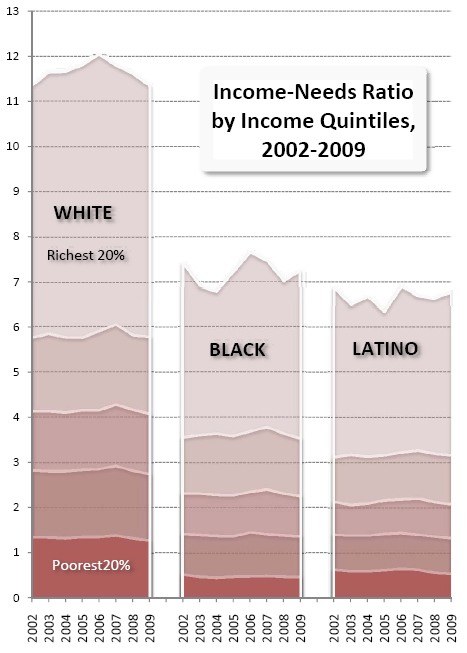
This, Cohen explains, “…allows us to see the size of the White advantage…”  He continues:

So, for example, the richest 5th of Whites are above 11-times the poverty line, while the poorest 5th of Whites are (on average) just above the poverty line. In contrast, the richest 5th of Blacks and Latinos are around 7-times the poverty line, and 40% of both groups are below 1.5-times the poverty line.

It’s not simply, then, that Blacks and Latinos are disproportionately poor.  Their poor are also poorer than the poor Whites and their rich are less rich than rich Whites.

Lisa Wade, PhD is an Associate Professor at Tulane University. She is the author of American Hookup, a book about college sexual culture; a textbook about gender; and a forthcoming introductory text: Terrible Magnificent Sociology. You can follow her on Twitter and Instagram.
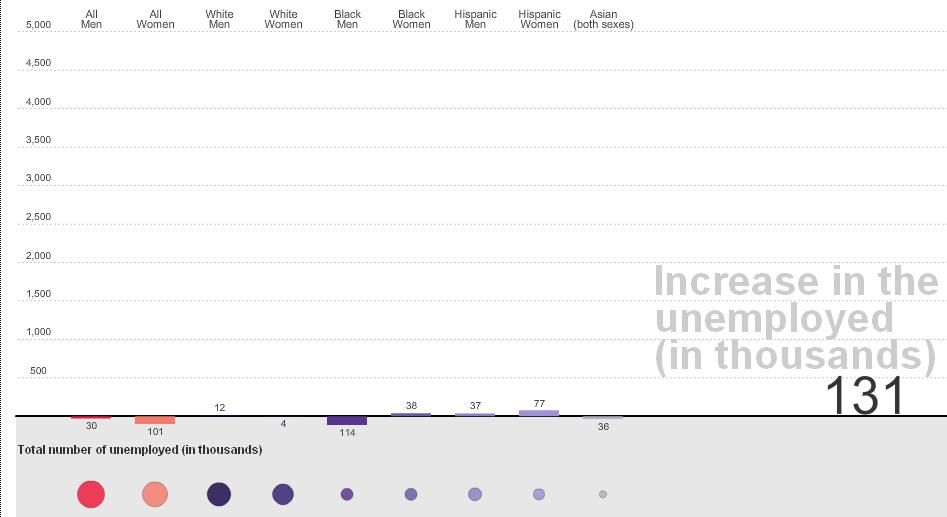
Rachel sent in a link to a post about the recession by Tim Cavanaugh at Reason that led me to an interactive graphic at the Wall Street Journal that lets you track job loss by either sector or by race/ethnicity and sex from December 2007 to August 2010.

Here is the race/ethnicity and sex data for January 2008 (for reasons I cannot understand, Asians are not separated out by sex, and as usual, American Indians aren’t included):

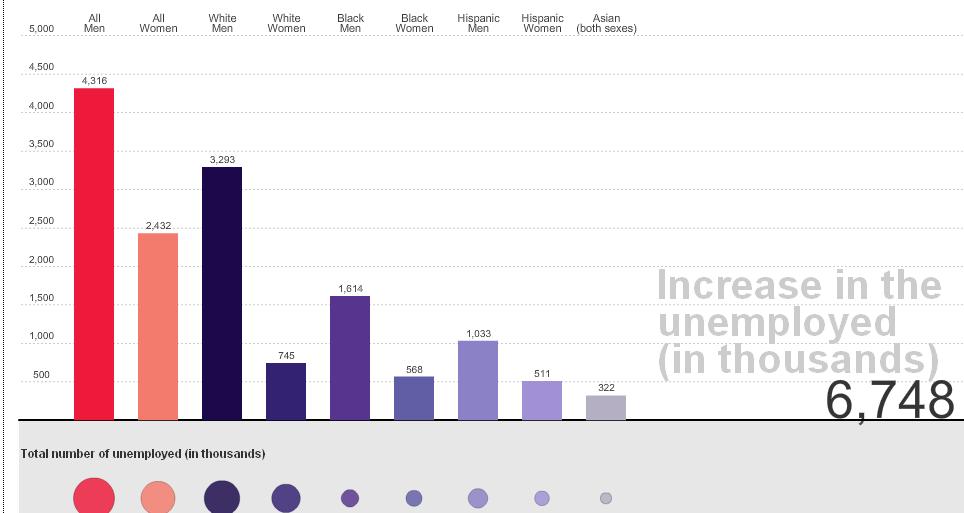
And here’s the breakdown for January 2010:

Unfortunately, the numbers aren’t weighted by the number of total workers per category, so we don’t have any way to know how these raw numbers translate into percentages of workers losing their jobs.

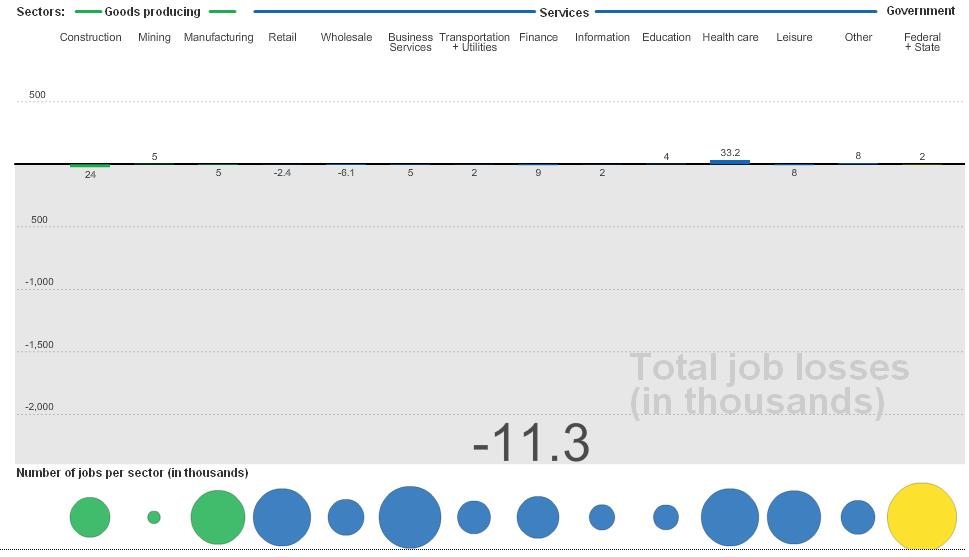
By economic sector, for January ’08:

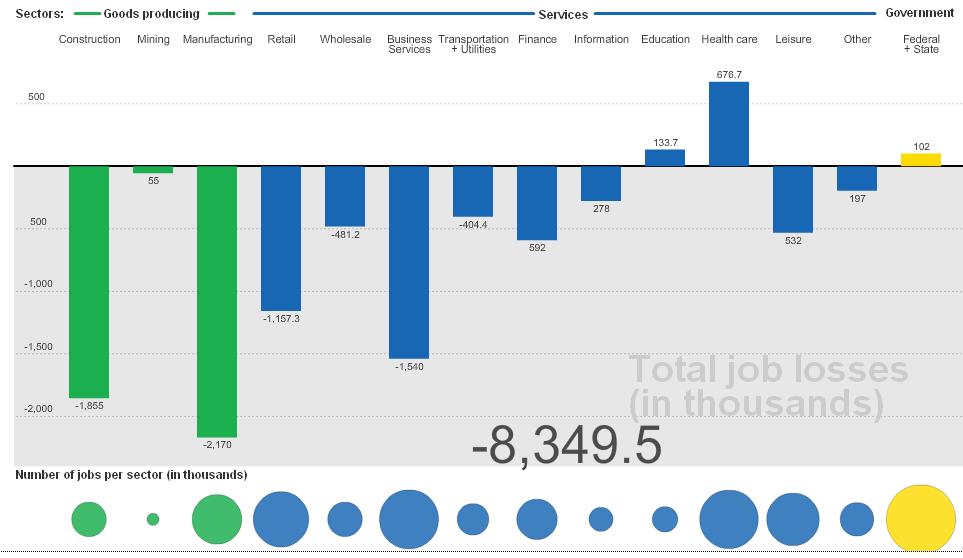
January ’10:

[On a nitpicky note, the sector graphs show job losses in negative numbers, which would work if it showed total change in # of jobs. But I think we’d be thrilled if we had -8… thousand job losses, as the graph is labeled. Just a small sloppy labeling issue.]

As the data show, and as we’ve discussed before, the economic recession has disproportionately affected men. But Cavanaugh cautions that it might be a little soon to declare men an at-risk species or lament the bad luck of being born male. Presumably, if men’s over-representation in construction, for instance, has meant they suffered more than women from the real estate bust, if you felt like it you could turn it around and argue that perhaps they disproportionately benefited from the boom that preceded it. Additionally the employment sectors are pretty broad; “retail” or “finance” will include some specific occupations that are fairly gender balanced, some that are dominated by men, and some dominated by women. And overall loss in retail jobs doesn’t tell us if the losses are spread equally across occupations within the sector.

Should we care about the suffering of men and their families in the recession? Of course. And to the degree that men are disproportionately represented in occupations that are prone to boom/bust cycles, we’re likely to continue to see greater volatility in their employment rates than women’s, sometimes to their advantage, sometimes not. But we might want to be a little careful and look at some more in-depth data before we declare, as some commentators seem to want to do, that women have basically escaped the recession. If nothing else, men and women aren’t islands; lots of us share household expenses, and a woman whose husband loses his job but keeps her own doesn’t exactly avoid any negative consequences of the recession.

Related posts: more comparisons of joblessness, race and recession, unemployment and education level, not everyone suffers during a recession, the gender employment gap,

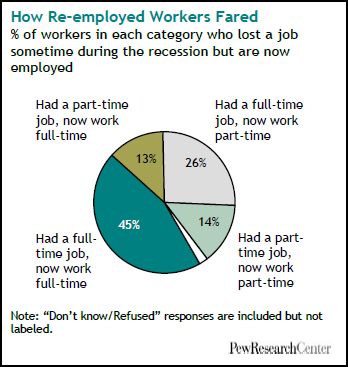
U.S. unemployment numbers only begin to describe how U.S. workers have suffered in this recession.  The Pew Research Center has some additional data on this experience.

Twenty-six percent of full-time workers who became re-employed currently only work part-time.  Thirteen percent moved from part-time to full time work.  So, among the employed, there are 13 percent fewer full-time workers.

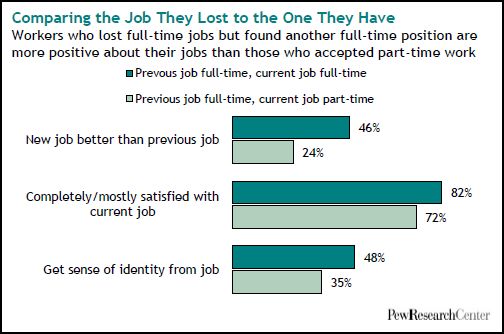
Americans who lost their jobs and became re-employed during this recession say that they’re making about the same, that the benefits are about equal, and many like their new job better:

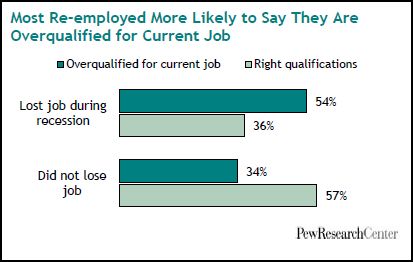
Still, the re-employed are more likely than the still-employed to say that they are overqualified for their current job:

People that moved from full- to part-time work are significantly less likely to be satisfied with their new position:

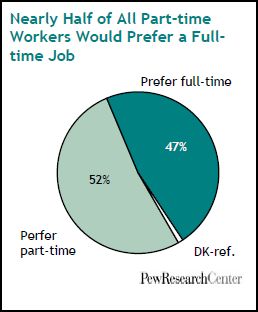
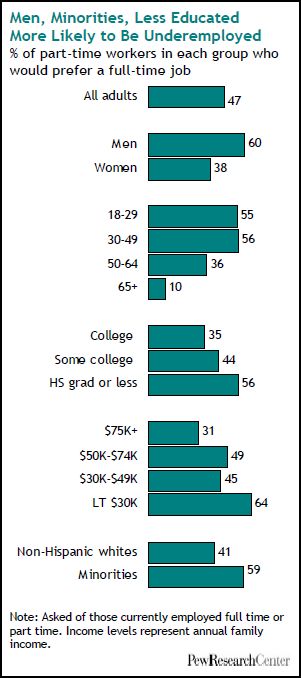
Forty-seven percent of part-time workers would like a full-time job:

The term “underemployed” refers to this 47 percent of the population.   Men, young people, the less educated, lower income, and non-whites are more likely to be underemployed:

Lisa Wade, PhD is an Associate Professor at Tulane University. She is the author of American Hookup, a book about college sexual culture; a textbook about gender; and a forthcoming introductory text: Terrible Magnificent Sociology. You can follow her on Twitter and Instagram.
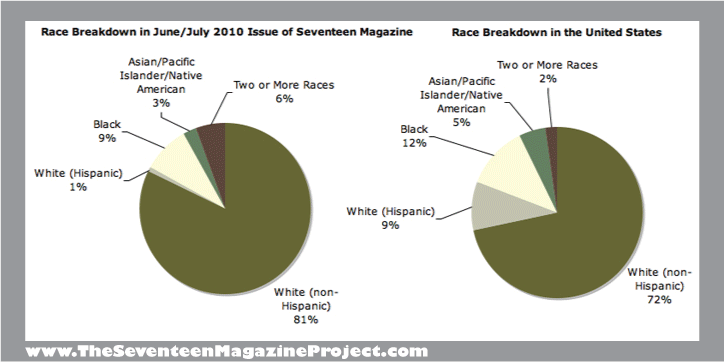
Jamie Keiles, of  the Seventeen Magazine Project and Teenagerie, wondered how racially representative Seventeen was compared to the U.S. population.  So she offered some data based on the May 2010 issue.  Her methods:

There are 332 faces in this month’s issue of Seventeen. I counted a face as a head with at least one visible eye. That is, backs of heads and disembodied mouths or eyes were not included in my data. I researched the races of the models and celebrities that I could identify. Those whose race I could not determine with reasonable certainty I’ve excluded from my data, making for 319 surveyed faces.
She found that Seventeen was not representative (it was nine percent more white than the U.S. population and especially under-represented Hispanics).  Still, she concluded that it was surprisingly representative, considering what she’d heard about the modeling industry.  Her findings actually reflect Ashley Mears’ argument that there is much more diversity among “commercial” models than “high end” fashion models.

Keiles was also surprised by the fact that, compared to the U.S. population, there were many models who identified as bi-racial.  My guess is that it’s because advertisers think (and perhaps know, but I’m not sure) that models whose identities are hard to discern appeal to a larger array of audience members who may see themselves in what is otherwise an “ambiguous” appearance.

Any ideas as to why white Hispanics are particularly underrepresented?  Is it possible that white Hispanic models simply identify publicly as “white”?  Other ideas?

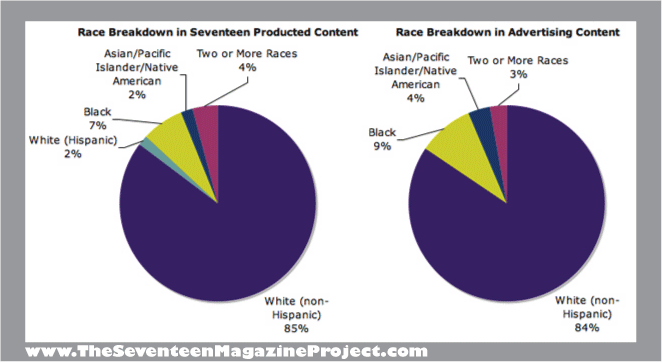
Keiles finds a similar patterns when she looks by gender and by whether it was Seventeen content or advertiser content:

Lisa Wade, PhD is an Associate Professor at Tulane University. She is the author of American Hookup, a book about college sexual culture; a textbook about gender; and a forthcoming introductory text: Terrible Magnificent Sociology. You can follow her on Twitter and Instagram.
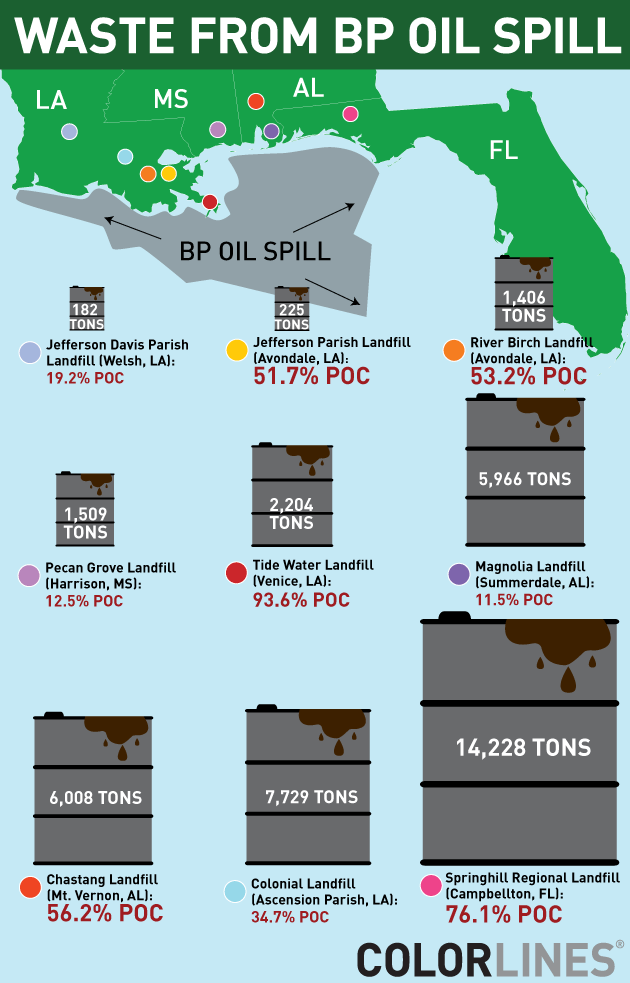
Abby Kinchy sent in a link to a story at Colorlines about where waste from BP’s Gulf oil leak is being disposed of. Nine landfills have been approved as disposal sites. Robert Bullard, who studies environmental racism (particular how toxic waste dumps are often located in neighborhoods where racial/ethnic minorities are over-represented), posted his calculations of the racial makeup of the areas surrounding these nine landfills over at Dissident Voices. This map from Colorlines shows the location of the landfills, the amount of waste (which includes “oily solids,” waste from the cleanup, and so on) sent there, and the percentage of people living within a 1-mile radius that are People of Color:

I looked up the % who aren’t non-Hispanic Whites for each state (as of 2008), just to provide some context:

  • LA: 38.1
  • MS: 41.3
  • AL: 31.6
  • FL: 39.7

So if we compare the neighborhoods simply to the % of POC in each state, there are 3 in LA, 1 in AL, and 1 in FL that have an over-representation of non-Whites and/or Hispanics. On the other hand, 3 landfills are in neighborhoods with racial/ethnic minority populations significantly below the state overall. This, of course, is a very rough measure, since different racial groups are not evenly spread across a state. I just wanted to provide at least some background info.

According to a story at the Miami Herald, operators of the landfills say there is no danger:

…operators of the landfills insist the BP garbage is not unprecedented and is suitable for the type of landfills they’ve selected: disposal sites that take household waste, as well as “special waste” like contaminated soil. They note much of the waste is generated by the cleanup operation itself: soiled cleanup coveralls, gloves, sandwich wrappers and drink containers.

They point out that the BP waste makes up a tiny amount of the material taken to these landfills each day.

However, residents are concerned because the landfills are regular municipal landfills, not designated for toxic waste (since the EPA has not categorized the waste as hazardous). The Associated Press discovered problems, including a truck that was leaking and left a trail of tar balls behind it, waste in containers that were not lined with the protective liners BP is supposed to use, and uncovered containers, including one in a state park that was leaking liquid from the previous night’s rain. The AP concluded, “…the handling and disposal of oily materials was haphazard at best.”

I’m not an environmental toxicologist, so whether or not the waste is hazardous or whether the landfills can keep it from seeping into groundwater is, obviously, beyond my ability to judge. I’m more interested in perceptions of risk and confidence in experts. There are distinct differences by gender and race, with women and non-Whites expressing higher concern about environmental pollution/dangers and higher perceptions of risk compared to men and Whites. In fact, White men stood out from all other groups, rating potential environmental risks significantly lower than every other group. In the U.S., the gender gap is not explained by differences in scientific knowledge.

Given these differences, discussions of environmental safety and risk are often very contentious. Experts in both the private and public sector are disproportionately White men. Regardless of scientific knowledge, they may underestimate the risks involved compared to how women with the same scientific knowledge would (I don’t have similar data on how scientific knowledge might affect the racial gap). Science doesn’t just provide us with objective facts; researchers and those applying their findings must interpret the data. Individuals with the exact same level of expertise may interpret the same data on the hazardousness (or lack thereof) of a particular type of waste very differently, without anyone being intentionally deceptive or more clearly biased.

And not all groups have equal faith in science or, more specifically, the people engaged in scientific research. Scientists in the 1800s used supposed objective measures to prove that Whites were superior to non-Whites (and, thus, to justify slavery) and conducted the Tuskegee Syphilis Experiment, in which they allowed Black men to suffer and die of syphilis just to see what happened despite having a cure available. And the hazards of materials or pollutants often aren’t immediately apparent and may become clear only later (or may differ for adults and children, or due to cumulative exposure over time, etc.), which scientific analyses may not predict.

I’m not arguing that scientists studying the toxicity of the BP oil waste don’t have any useful information about whether or not it poses any danger to human health, or that data doesn’t help us come to more accurate judgments than we would if we didn’t take such information into account. However, in situations such as these that may be framed, particularly by scientists themselves, as an example of uninformed public opinion vs. fact-based expertise, the differences in interpretations and the fears of local residents despite assurances by researchers may be based in a number of factors that make the story, and conflicts over perceptions of risk, much more complex than it might at first appear.

Sources:

  • James Flynn, Paul Slovic, and C.K. Mertz. 1994. “Gender, Race, and Perception of Environmental Health Risks.” Risk Analysis 14(6): 1101-1107.
  • Bernadette C. Hayes. 2001. “Gender, Scientific Knowledge, and Attitudes toward the Environment: A Cross-National Analysis.” Political Research Quarterly 54(3): 657-671.
  • Paul Mohai. 1997. “Gender Differences in the Perception of Most Important Environmental Problems.” Race, Gender & Class 5(1): 153-169.

Safa S.-Y., of Naked Lady in a White (Silk) Dress, and K. sent us a link to a story about the recent collaboration between MAC cosmetics and the Rodarte clothing line to create a collection of makeup and clothing the sisters who own and design for Rodarte said was inspired by the city of Juárez and female maquiladora workers:

…the sisters explained that a long drive from El Paso to Marfa, Texas, got them thinking they might like to explore their Mexican roots. From there, they became interested in the troubled border town of Ciudad Juárez; the hazy, dreamlike quality of the landscape there; and the maquiladora workers going to the factory in the middle of the night. And that, according to the designers, who certainly know how to romance a pitch, led to this conclusion: They’d build a collection off the idea of sleepwalking. [source]

The cosmetics received names such as Factory, Ghost Town, Juárez, and del Norte. The eyeshadows are meant to give wearers an ashen, tired appearance. After many in the fashion blogsphere criticized the line, both MAC and Rodarte issued apologies, said they will change the names of some of the products, and promised to donate a portion of proceeds to charities working in Juárez.

Just for some context, MAC is a mid-range cosmetics company; a single color of eyeshadow runs about $14.50, lipsticks are generally $13-15 but some are $18-19. This is less than high-end lines like Chanel and Estée Lauder, but more than drugstore brands such as Cover Girl. Rodarte, on the other hand, is a luxury fashion line, selling t-shirts for $120+, sweaters for nearly $3,000, and dresses for $4,000 or more. They do have a much cheaper Rodarte for Target line, however.

Safa argues that it is problematic that these companies, both completely beyond the financial resources of maquiladora workers (and most people in the U.S., for that matter, particularly Rodarte), to use pale White women made even paler with cosmetics to represent low-wage workers in Mexico, none of whom they met or spoke to. Most of the online critics point out that Juárez is quite dangerous, and hundreds of women, many workers at maquiladoras on their way to or from work, have been raped and killed (NPR had a story about the murders in 2003). These numbers don’t include women who simply disappeared, since authorities don’t have proof they were murdered without a body, though most officials and activists believe that at least some of those women were also killed. The vast majority of the crimes are unsolved.

Safa says,

These women [the Rodarte designers], who had never been to Juarez, but nearby Texas towns, entitled themselves and their clothing line to represent the stories of women they never met.

Female factory workers in Juárez thus become exoticized Others for U.S. companies to represent and claim to speak for — that is, they are supposedly concerned about the problems faced by Mexican women workers (or anyway, they said so after all the criticism) and by creating a line in which White women are made up to look like zombies, or as though perhaps they got punched in the eye, they are actually helping women in Juárez by bringing attention to them…in some undefined way that most women who buy their products are unlikely, I think, to pick up and which probably isn’t going to lead to much concrete action to improve these women’s lives.

I think Safa sums it up nicely, so I’ll let her have the last word:

Human suffering became a look of glamour.  They presented social consciousness in the form of consumerism, and with that, female oppression became another commodity that could be measured not in statistics, but in revenue sales.

Gwen Sharp is an associate professor of sociology at Nevada State College. You can follow her on Twitter at @gwensharpnv.

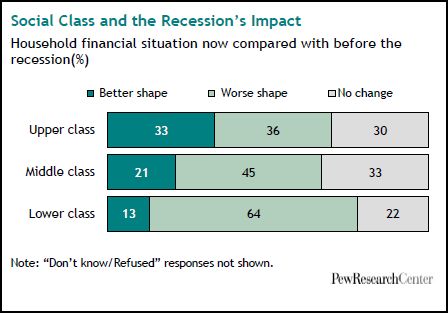
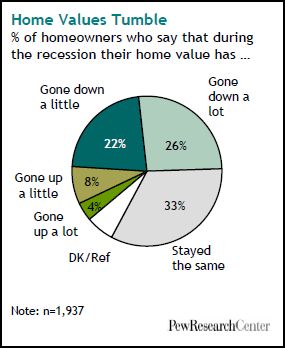
Data from the Pew Research Center shows us the extent to which the recession has hurt the economic health of American households, especially the middle and working classes:

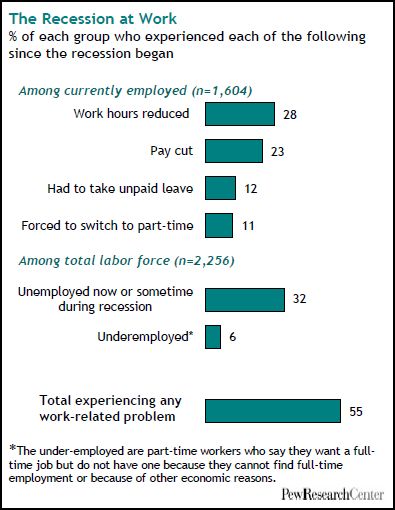
More than half of all Americans report some sort of work-related disruption:

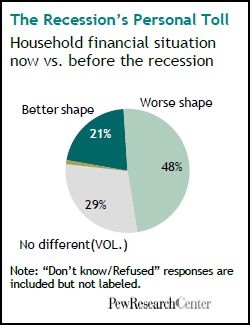
Nearly half state that they are worse off than they were before the recession:

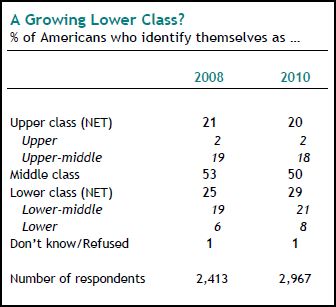
An additional four percent (since 2008) identify themselves as lower class:

Pew specifies:

Blacks, as a group, are an exception to this overall pattern. The share of blacks who now identify with the upper class has gone up during this recession, to 20% now from 15% two years ago.

Forty-eight percent have lost equity in their homes:

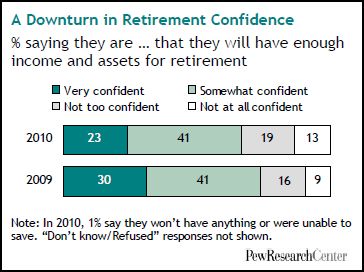
Sixty percent of Americans fear that they may have to delay retirement:

A larger percentage lack the confidence that they have enough income and assets for retirement, even compared to last year:

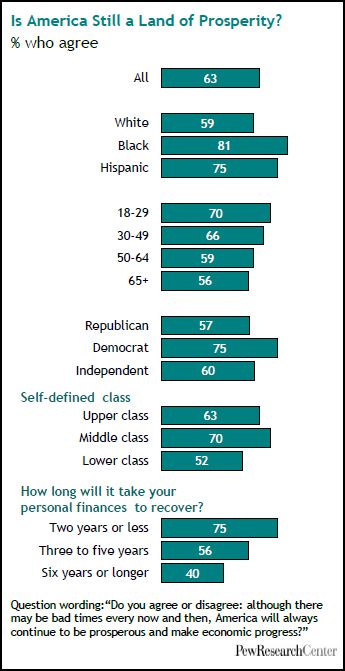
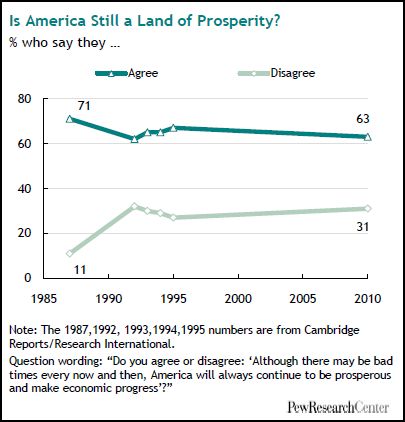
“Is America still a land of prosperity?”

The question in some historical perspective:

Lisa Wade, PhD is an Associate Professor at Tulane University. She is the author of American Hookup, a book about college sexual culture; a textbook about gender; and a forthcoming introductory text: Terrible Magnificent Sociology. You can follow her on Twitter and Instagram.
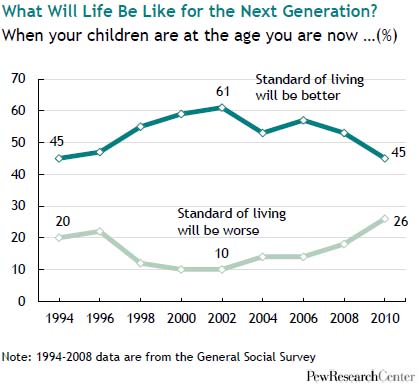
Pew Research Center has released data suggesting an age gap in optimism for the future of American young adults.

When asked if their children will be better off or worse off than they are, less than half of U.S. parents say “better off” and a full 25 percent say “worse off.”  This is the most pessimistic we’ve seen parents in 16 years.

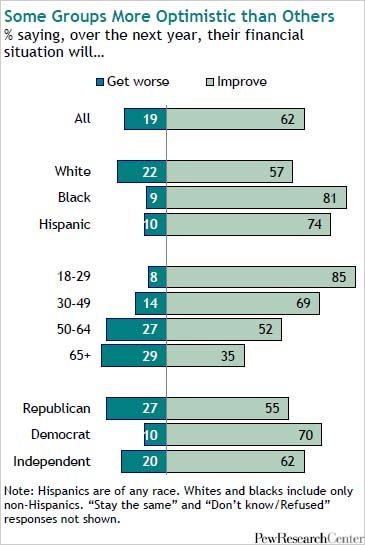
But their kids are more optimistic than anyone else, with 85% saying that they expect that their financial situation will improve next year:

Of course these data aren’t entirely compatible, but it’s an interesting comparison nonetheless.  The idealism of youth?  The pessimism that comes with bad backs and mortgage payments?  The possibility that 18-29-year-olds have nowhere to go but up?

Economix, via Karl Bakeman.

Lisa Wade, PhD is an Associate Professor at Tulane University. She is the author of American Hookup, a book about college sexual culture; a textbook about gender; and a forthcoming introductory text: Terrible Magnificent Sociology. You can follow her on Twitter and Instagram.