race/ethnicity: Latinos

Sanguinity sent in an interesting, if disheartening, report by Insight Center for Community Economic Development. The report looks at the assets owned by women of color and the wealth gap between them and men of different racial/ethnic groups.

An overview of wealth (the value of all assets minus the value of debts) broken down by race/ethnicity and type of household:
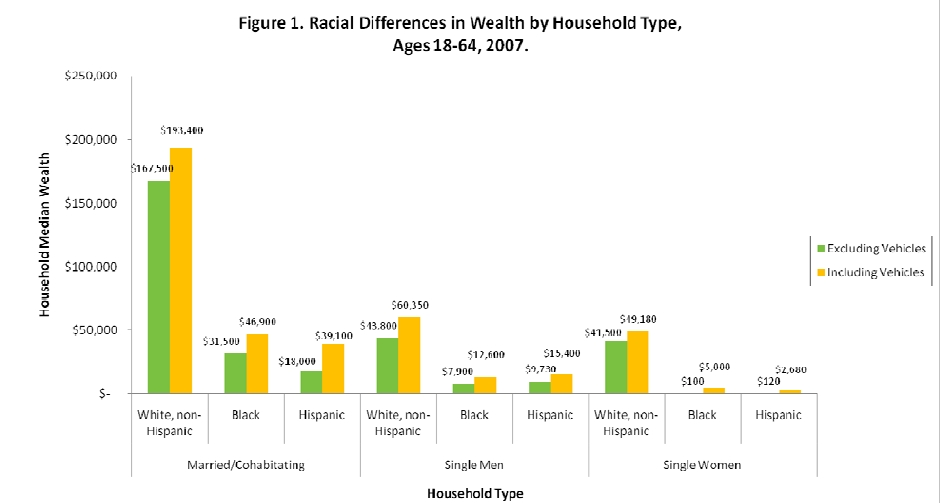
Of course, the most striking finding there are the major disparities by race, particularly how much wealth White non-Hispanics have compared to all other groups (largely due to owning more valuable homes). Notice that single White men and women have higher median household wealth than married Black or Hispanic couples. This is astounding.

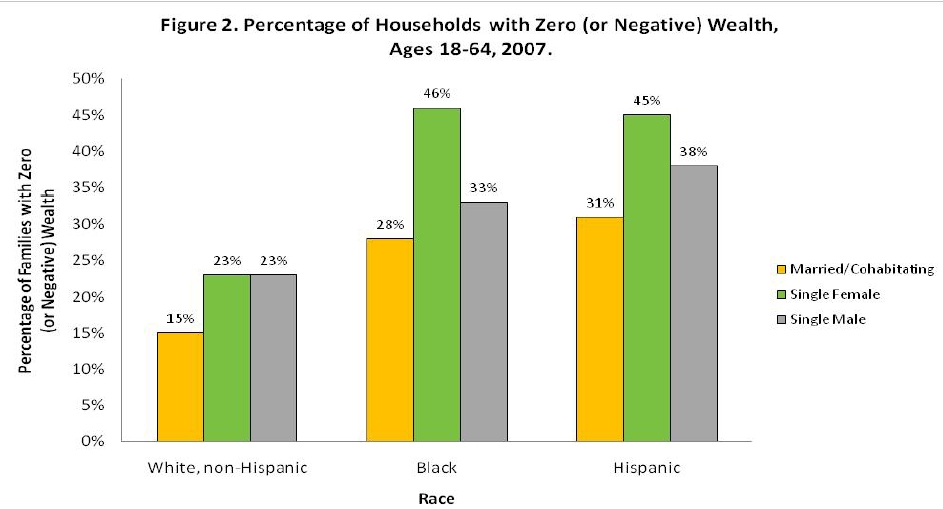
Blacks and Hispanics are more likely than Whites to have no wealth at all, or to have debts outweigh all assets; again, unmarried Whites are better off in this regard than are married Blacks and Hispanics:
Among single parents, women appear to bear a disproportionate amount of the financial hardships of caring for children. White single mothers with children of any age (second column) have only 57% as much wealth as White single fathers; the equivalent ratio for Blacks is 0.4% and for Hispanics, 5%. Read that again: 0.4% and 5% as much wealth as single fathers from the same race! And take a look at the actual cash value: median wealth for Black women is $100, and for Hispanic women, it’s $120!
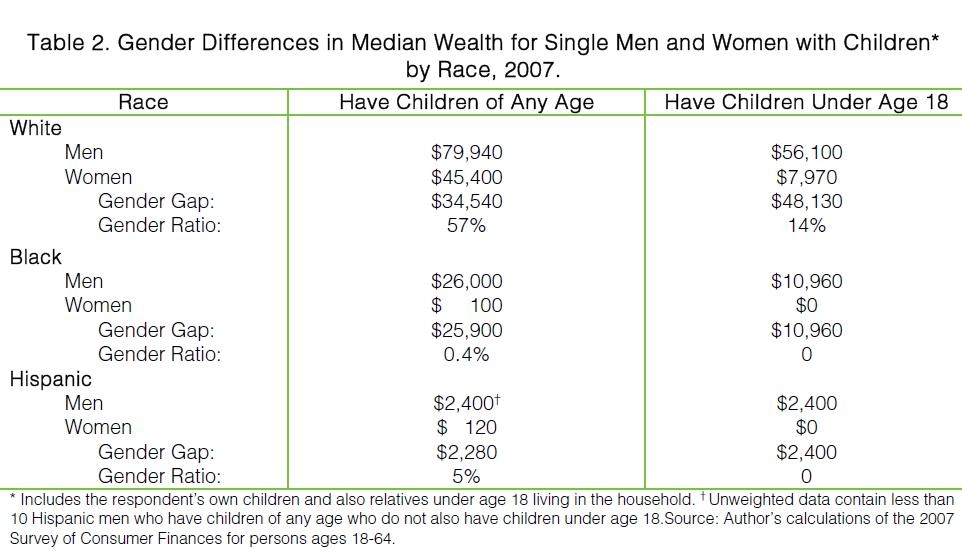
But then look at that third column! If you’re a single mother and have children under the age of 18 — who are more likely to be living with you than with their father — your financial picture is pretty dismal. Black and Hispanic women with children under age 18 have a median wealth of zero, meaning half have no wealth at all or owe more than all their assets combined are worth. Even White women, who are absolutely wealthy by comparison, have only 14% as much wealth as White single fathers with children under age 18.

Thinking about the implications of those numbers — the very meager financial resources available to many families, the particularly difficult situation of single mothers of all races, what this means for a family’s ability to cope with a crisis such as a car breaking down or a medical emergency, the ability to come up with deposits for an apartment — is mind-blowing.

The report has quite a bit of other information too, so if you’re interested in this topic, go check it out.

Oh my. Inés V. just let us know about a contest on WTVN, a conservative talk radio station in Ohio (reader Scapino clarifies that the conservative tone is mostly due to syndication of Glenn Beck and Rush Limbaugh, not really the local DJs). Just…see for yourself:

Inés says,

This campaign is a response to Columbus mayor Michael Coleman who boycotted AZ by banning all city-funded travel after SB1070, and the mayor is depicted as a holder of a green card [that’s him shown on the ID card].

It’s an astounding example of dehumanizing undocumented immigrants — being a proud American is linked to “illegals” (a term that somehow seems more stigmatizing than terms like “illegal immigrants” or “illegal aliens,” even — a linguistic erasure of personhood altogether) being scared, presumably of all the proud Americans they encounter, and the lucky winner gets to go “spend a weekend chasing aliens”. It’s like you’re getting to go on a safari.

Groups in Columbus have organized a response and will be delivering letters to the station this afternoon, before the contest ends, in protest.

I’d add more commentary, but what can you really say?

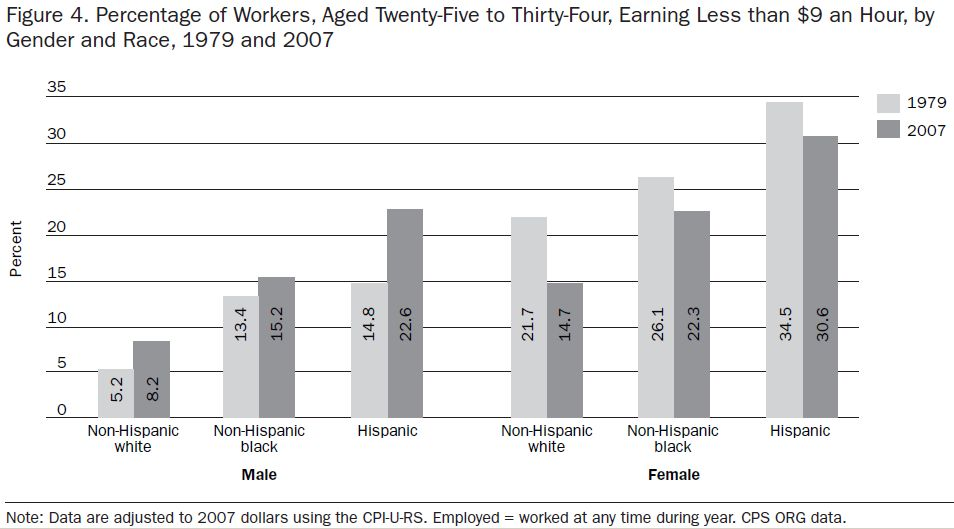
A full-time worker making nine dollars an hour cannot raise a family above the poverty line.  A paper by Sheldon Danziger and David Ratner demonstrates that fewer women survive on less than $9 an hour today than (its adjusted equivalent) in 1979.  The same cannot be said for men: The authors write:

…changes in the labor market over the past thirty-five years, such as labor-saving technological changes, increased globalization, declining unionization, and the failure of the minimum wage to keep up with inflation, have made it more difficult for young adults to attain the economic stability and self-sufficiency that are important markers of the transition to adulthood.

This is just more evidence of the shrinking of the middle class; solid working class jobs that will allow you to buy a modest home are disappearing. Hat tip to Family Inequality and Karl Bakeman’s blog.

Lisa Wade, PhD is an Associate Professor at Tulane University. She is the author of American Hookup, a book about college sexual culture; a textbook about gender; and a forthcoming introductory text: Terrible Magnificent Sociology. You can follow her on Twitter and Instagram.

Nationalist white supremacy organizations, and their gentler counterparts in the U.S., sometimes argue that non-white women are having more children than white women.  The result is a shift in the national demographic (that they don’t like).

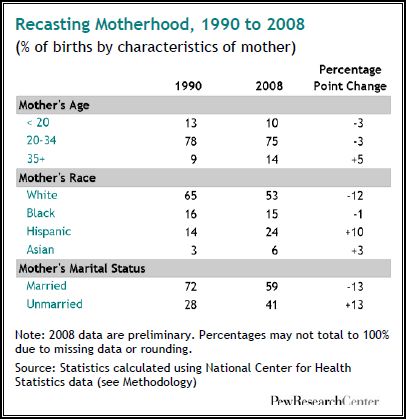
This month the Pew Research Center released a report on the changing demographics of American motherhood (discovered thanks to a tip by Michael Kimmel).  Under “Mother’s Race,” we see that there has been a 12 percentage point decrease in the share of births to white women between 1990 and 2008.  In contrast, births to Asian and, especially, Hispanic women have increased (a combined 13 percentage points):

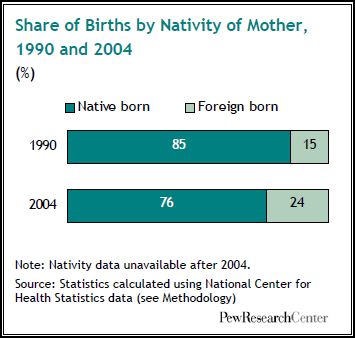
The share of births to native versus foreign born women has also shifted, with a quarter of births now to women who have immigrated to the U.S.:

They summarize:

White women made up 53% of mothers of newborns in 2008, down from 65% in 1990. The share of births to Hispanic women has grown dramatically, to one-in-four.

So, whether you agree with the national white supremacists’ evaluation of the data or not (I assume you do not), they’re right about the data.

UPDATE: Sabrina, in the comments, rightly points out that my comments assume that the father’s race matches the mother’s.

Lisa Wade, PhD is an Associate Professor at Tulane University. She is the author of American Hookup, a book about college sexual culture; a textbook about gender; and a forthcoming introductory text: Terrible Magnificent Sociology. You can follow her on Twitter and Instagram.

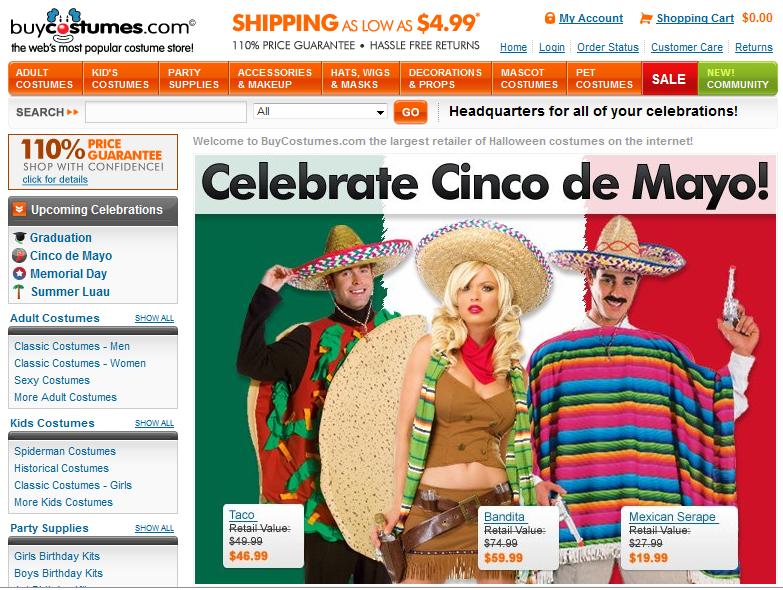
Mexican Independence Day May 5th commemorates the Battle of Pueblo in which Mexico defeated the French…  how better to celebrate than to animate offensive stereotypes and make fun of Spanish!

Maya sent us a link to publicity for a clothing swap schedule for May 5th called “Swappo de Mayo,” of course:

And Maddy B. sent us a screen shot from buycostumes.com.  This image was featured on the front page in mid-April:

See also our post featuring “celebrations” of Martin Luther King Day.

(Thanks to Ramona, Jess, Ryan, Kristen, CS, and Jorge for the correction on the significance of the date!)

—————————

UPDATE: Several Readers who corrected my mistake have stated that it was offensive.  I’m really sorry.

Gwen and I have a policy of owning our mistakes.  I don’t know everything, even things that I really should know.  One of the best things about this blog, for me as an author, is that I learn all the time.  I don’t resent being corrected, I am grateful.

I apologize that my ignorance was offensive. My hope is that, by leaving the post up, with my ignorance laid bare, I am modeling the kind of humility that allows people to learn new ideas and accept correction from others.

Lisa Wade, PhD is an Associate Professor at Tulane University. She is the author of American Hookup, a book about college sexual culture; a textbook about gender; and a forthcoming introductory text: Terrible Magnificent Sociology. You can follow her on Twitter and Instagram.

Breastfeeding is widely believed to carry significant health advantages for infants and the American Academy of Pediatrics (AAP) would like to see all mothers breastfeed their children for at least 12 months, with no supplemental food for the first six.

Breastfeeding, however, is a big job.  Even if a newborn takes to breastfeeding without any problems (some mothers struggle mightily with less-than-cooperative infants), mothers must feed their children around the clock (they now recommend every two hours, 24-hours a day for newborns).  If it takes a half hour to settle the baby down and fill it up, you’ve got an hour and a half before the next feeding time.

Mothers who have the privilege to stay home with their babies — for three, six, or even twelve months — then, are going to find it much easier to follow the AAP guidelines.  For mothers who return to work, those who work in flexible positions that award some degree of autonomy and respect will also be more likely to continue breastfeeding.   In other words, a lawyer with a private office and a work schedule under her own control can stop several times a day and express milk to bring home to her child; in contrast, a woman working the cash register at McDonald’s with a boss hovering over her doesn’t have the same autonomy or privacy and may be forced to give up breastfeeding.

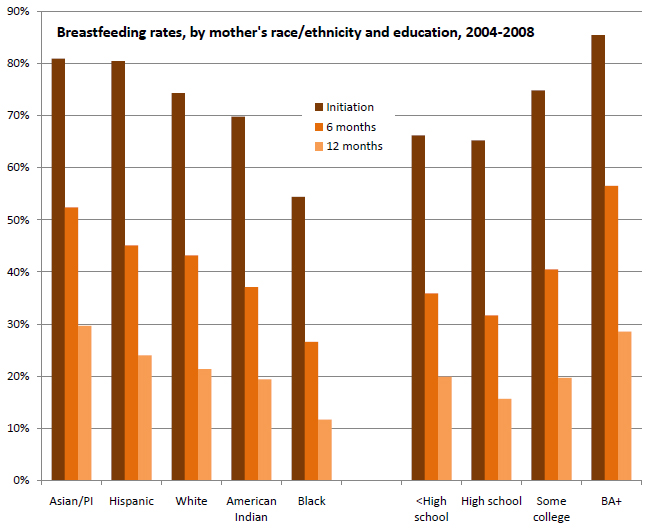
It shouldn’t be surprising, then, that breastfeeding rates are higher among more educated women and White and Asian women.  Both of these variables tend to correlate with class privilege:

There are some interesting things, however, that don’t correlate with this class thesis.  First Hispanic women are more likely to breastfeed than White women and people with less than a high school education are more likely to breastfeed, especially at six and 12 months, than people with a high school education.

I can think of some reasons why… I’ll let you discuss it in the comments.

Borrowed from Philip Cohen’s Family Inequality Blog.  For more data on rates of breastfeeding, including U.S. state comparisons and changes in rates over time, see here.

Lisa Wade, PhD is an Associate Professor at Tulane University. She is the author of American Hookup, a book about college sexual culture; a textbook about gender; and a forthcoming introductory text: Terrible Magnificent Sociology. You can follow her on Twitter and Instagram.

At Racialicious, Arturo R. García lodges a complaint against the modern makeover of Speedy Gonzales which is, apparently, underway.  Actor and Comedian George Lopez is scheduled to voice the character in a feature cartoon.

Starting in 1955, Speedy was a recurring character in Warner Brothers cartoons.  Dubbed “The Fastest Mouse in all of Mexico,” Speedy wore a sombrero and spoke in broken English.  In the cartoon below, he helps other Mexican mice steal cheese from across the Mexico/U.S. border guarded by a “Gringo cat” (Sylvester):

Lopez’s wife is on record saying that the new Speedy will not be the same racist caricature, but instead a Mexican boy who “…comes from a family that works in a very meticulous setting, and he’s a little too fast for what they do.”  But García isn’t convinced.  He writes:

The thing is, it’s not just about Speedy, but about the universe he inhabited. If this new film strays from the original Andale! Andale! schtick, critics will decry that the character was neutered by “the PC Patrol.” If it doesn’t, the couple has resurrected a very problematic cartoon character (two, if Slowpoke Rodriguez is also brought back.) What would be the next step – the return of Heckle & Jeckle? Is bringing back an “established brand” like this really a better option than creating an original character and building something positive from the ground up?

He also points out that Lopez’s success has rested largely on his own reproduction of racist stereotypes (of the whites-and-Latinos-are-so-different-hahaha! and Latinos-are-so-Latino-hahaha! varieties). For example:

Yeah… so I can’t imagine that that guy would ever participate in a project stereotyping Latinos.

I guess we’ll have to wait and see but, like García, I’m skeptical.

Lisa Wade, PhD is an Associate Professor at Tulane University. She is the author of American Hookup, a book about college sexual culture; a textbook about gender; and a forthcoming introductory text: Terrible Magnificent Sociology. You can follow her on Twitter and Instagram.

The American Anthropological Association website on race has a great collection of the racial and ethnic categories included on Censuses throughout the world, showing how different countries formalize different racial categories.  They illustrate just how diverse ideas about race are and challenge the notion that there is one “correct” question or set of questions.

Lisa Wade, PhD is an Associate Professor at Tulane University. She is the author of American Hookup, a book about college sexual culture; a textbook about gender; and a forthcoming introductory text: Terrible Magnificent Sociology. You can follow her on Twitter and Instagram.