race/ethnicity: Latinos

db, Lindsey B., and ABC News asked us to talk about the recent scandal over Walmart pricing a darker-skinned version of the Ballerina Theresa doll less than its white counterpart.  The evidence (from FunnyJunk):
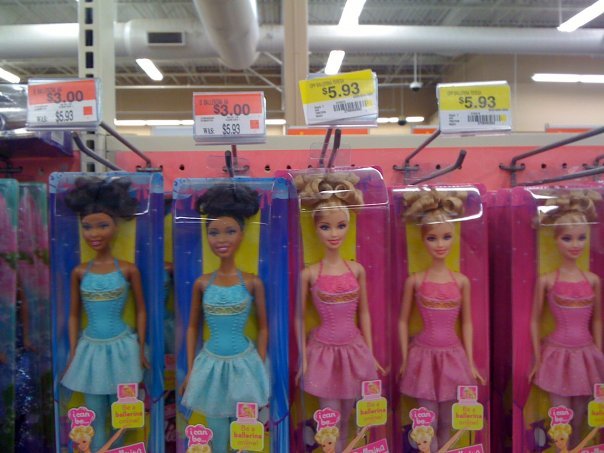
Walmart claimed that the doll was priced less because they were trying to move inventory (ABC News).  It’s possible that the doll wasn’t selling (low demand) or they had ordered more than they could sell (high supply) and so the doll went on sale.  In fact, we know that people of all colors tend to absorb a color hierarchy in which whiteness is nicer, more beautiful, and more valuable (test your unconscious preferences here), so maybe the white doll WAS outselling the non-white doll because both white and non-white people were buying it, but not the darker-skinned doll.  Walmart, in this case, would only be following the market so as to maximize profits.

Walmart, however, could have chosen, in this case, to opt out of profit maximization.  The market isn’t physics; a company doesn’t have to follow its laws.  Walmart could have said, “You know, putting the dark-skinned doll on sale symbolically values whiteness higher than blackness.  Perpetuating that stereotype isn’t worth the money.”  That is, they could have decided that anti-racism trumped profits.

But they didn’t.

It’s important to say that I know of no study showing that, as a rule, white dolls are priced higher or are less likely to go on sale than other dolls.  It may be true that, if we were paying attention, we’d see all kinds of disparate pricing and it wouldn’t pattern itself on race.  Even in this case, I still think that companies need to be cognizant of the context in which they price their products.  In fact, I will go so far as to say that I think it is perfectly fine to discount white dolls while other dolls are left undiscounted, but not vice versa.  Why?  Because we live in a world where discounting dark-skinned dolls resonates with a discourse the symbolically devalues dark-skinned human beings.  Discounting white dolls simply does not carry the same problematic message.

Costco faced this kind of problem when it’s black Lil’ Monkey doll was pulled from shelves.  It turned out that the Lil’ Monkey doll came in three different races, but the black doll carried connotations that the others did not because black people have been compared to primates for centuries in an effort to dehumanize them.  A black Lil’ Monkey is wholly inappropriate in a way that a white Lil’ Monkey is not.

Companies make and sell products in a context.  Following market demands is not opting out; often, it reproduces the status quo.

NEW (Mar. ’10)! Sarah G., after seeing a different post on a multicultural cast of Barbies, looked them up on Target only to discover that the light-skinned Barbies were all priced at $19.99 and the dark-skinned Barbies were all priced at $19.95.  Here are all of the Barbies:

I don’t know, people.  I just don’t know.

See another example here.

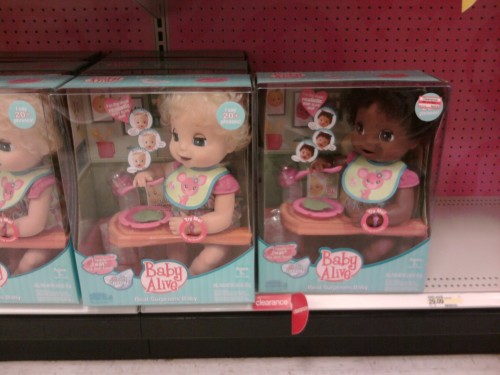
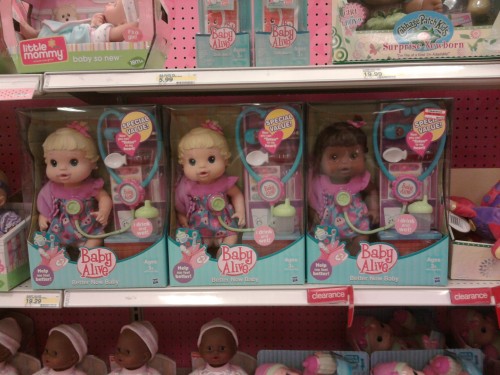
NEW! (July ’10): Christine B. sent in images from Target that show Black Baby Alive dolls (two different types) on clearance (down from $19.29 to $13.50) while the White versions aren’t; the Black dolls are clearly marked on the shelf and with individual stickers:
Lisa Wade, PhD is an Associate Professor at Tulane University. She is the author of American Hookup, a book about college sexual culture; a textbook about gender; and a forthcoming introductory text: Terrible Magnificent Sociology. You can follow her on Twitter and Instagram.
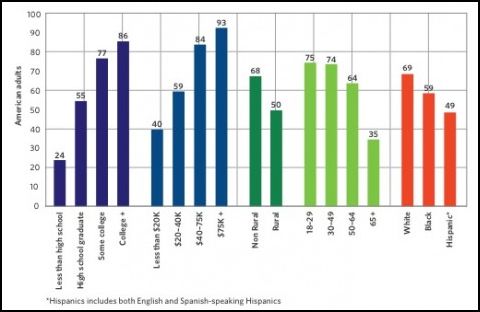
The image below shows who has broadband internet (as opposed to dial up or no internet at all). It was sent in by Dmitrity T.M., who sees no surprises here. Do you?

Lisa Wade, PhD is an Associate Professor at Tulane University. She is the author of American Hookup, a book about college sexual culture; a textbook about gender; and a forthcoming introductory text: Terrible Magnificent Sociology. You can follow her on Twitter and Instagram.

Carolyn L., who blogs at Remodel Minority, found these and other mascot costumes at Costume Shop.  They are, from left to right, the “Mexican Costume Mascot”, “Mandarin Man Chinese Costume”, “Native American Chief Costume Mascot,” “Native American Indian Costume”:

The costumes start at $887.   This reminds us that racist mascots are an industry, not just a poor choice.  It would be much more difficult to field a team called the Indians, the Gauchos, or the Orientals if there were no pre-made costumes to buy.

Lisa Wade, PhD is an Associate Professor at Tulane University. She is the author of American Hookup, a book about college sexual culture; a textbook about gender; and a forthcoming introductory text: Terrible Magnificent Sociology. You can follow her on Twitter and Instagram.
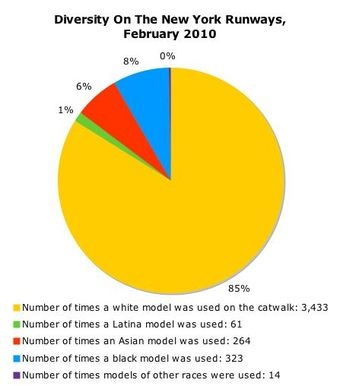
Dmitriy T.M. sent us a link to Jezebel’s analysis of the inclusion of models of color at New York fashion weeks.  The post author, Jenna, begins:

…in the fall of 2007 that fully one-third of shows in New York had 100% white casts. Two years later, we calculated that 18% of spots in show lineups were booked by models of color — a real improvement in the representation of black, Latina, and Asian faces in the crucible where the beauty standard is forged.

This season, fashion took a step back.

Of 4,095 turns on the runway, only 662 went to models who weren’t white. That’s barely 16%.

More:

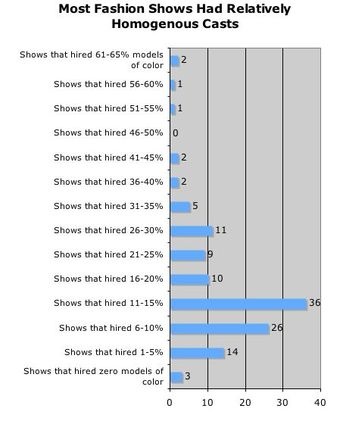
Most of the shows that took place used some models of color — just three designers, A Détacher, Alice + Olivia (full disclosure: an old client of mine), and Preen, chose exclusively white casts — but many used very few. Well over 60% of the shows, in fact, used casts that were 85% white, or more.

Most of the shows that took place used some models of color — just three designers, A Détacher, Alice + Olivia (full disclosure: an old client of mine), and Preen, chose exclusively white casts — but many used very few. Well over 60% of the shows, in fact, used casts that were 85% white, or more.

More details on the data, and the models, at Jezebel.

Lisa Wade, PhD is an Associate Professor at Tulane University. She is the author of American Hookup, a book about college sexual culture; a textbook about gender; and a forthcoming introductory text: Terrible Magnificent Sociology. You can follow her on Twitter and Instagram.
Dmitriy T.M. reminded me of this classic performance of the song “America” from a classic American musical, West Side Story (1961; it won 10 Academy Awards, including Best Picture).  The song features white New Yorkers and Puerto Rican immigrants debating about the benefits of living in America.  The “streets paved with gold” mythology is articulated by the women at the same time that the white men remind them that they face racism and poverty.

Also, Rita Moreno is awesome:

UPDATE: Commenter Jesse W. says,

…as a theater nerd, I wanted to point out it’s not a debate between white New Yorkers and Puerto Ricans, I think you just get that impression from the bad casting. They’re all supposed to be Puerto Rican; it’s more of a battle of the sexes between the men who wanted to stay in the old country and the women who wanted to come to America.

And Laura says,

…the women are arguing with the men that America is great, and they prefer it to Puerto Rico, and the men are arguing that America is racist and oppressive.

Lisa Wade, PhD is an Associate Professor at Tulane University. She is the author of American Hookup, a book about college sexual culture; a textbook about gender; and a forthcoming introductory text: Terrible Magnificent Sociology. You can follow her on Twitter and Instagram.
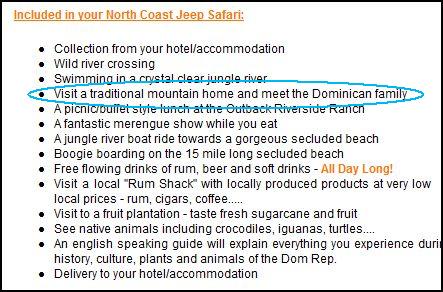
We often talk about gender objectification on this blog, but we also try to talk about other types of objectification.  In this case, Literanista sent us a great example of racial/nationalist objectification.  The example comes from a tourism website for travelers to the Dominican Republic.  It offers, in one of its excursions, the chance to swim in a jungle river, enjoy a secluded beach, visit a “Rum Shack,” taste fresh sugarcane, see native animals and meet an honest-to-goodness-real-Dominican family.

Elsewhere, just to add some negative stereotyping, the website suggests that Dominican’s are drunk all the time:
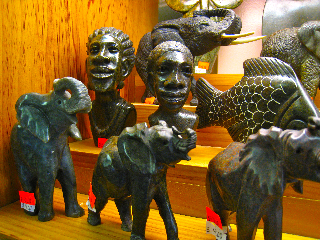
In a similar vein, Karole F. sent in a photograph of some “African” carvings for sale a Stones ‘n Stuff in Exeter, New Hampshire.  Human beings are included as objectified tokens alongside animals:


For more tourism-related objectification, see our posts on tourism in Hawaii, Brazil, and Thailand, and, related, these images of international adoption and onesies for internationally adopted babies.

Lisa Wade, PhD is an Associate Professor at Tulane University. She is the author of American Hookup, a book about college sexual culture; a textbook about gender; and a forthcoming introductory text: Terrible Magnificent Sociology. You can follow her on Twitter and Instagram.

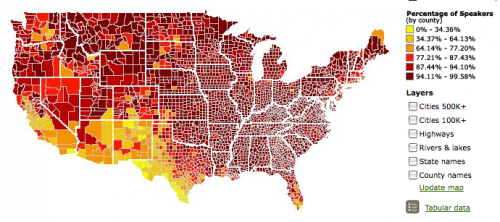
The Modern Language Association has all kinds of awesome language-related data available that you can customize depending on your interests. Most basically, you can get an interactive map showing the percent or number of speakers of various languages spoken at home by county (or number by zip code). Here is English:

English

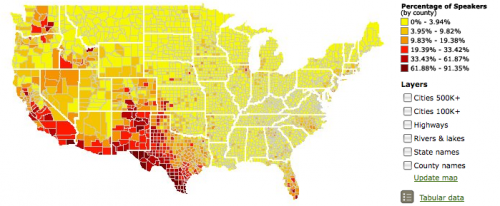
Spanish:

Spanish

Navajo:

Navajo

Notice that the scale of the maps changes, so the same color doesn’t indicate the same percent of speakers for each language. For some languages the darkest red only indicates 1 or 2 percent.

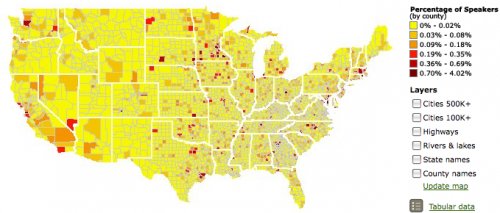
There was one odd category I noticed. This is the map for “African languages”:

African languages

I can understand why you might lump some languages from an area together if they are so rare in the U.S. that they’d barely show up. But what, exactly, is an “African” language? It doesn’t appear to include Arabic, though it is spoken in much of northern Africa. Many people in Africa speak European languages (particularly French and English) due to colonialism. Presumably this category includes “native,” non-Arabic languages. It’s a strange category.

For those of you wondering about the little pockets of African language speakers in, say, Iowa and Nebraska, I could be wrong, but I would suspect in some of those counties it might have something to do with slaughterhouses. In the last decade or so some packing houses have recruited African immigrants, particularly Somalis, to move to rural areas and work in the plants. Again, that’s just a guess, but some of the locations fit.

UPDATE: Commenter mordant.espier says,

I think you’re wrong about African languages and meatpacking in the midwest. I know that Omaha has a significant Sudanese community, about 7,000, many of whom are refugees and asylum seekers.  In Minneapolis, there are a number of Somali. They are there because of the US government, and even more because religious and charitable organizations, especially the Episcopal Church and Catholic Charities, have provided support through all stages of the immigration process.  The existance of a group of refugees who are able to enlist the support of locals has created such pockets.

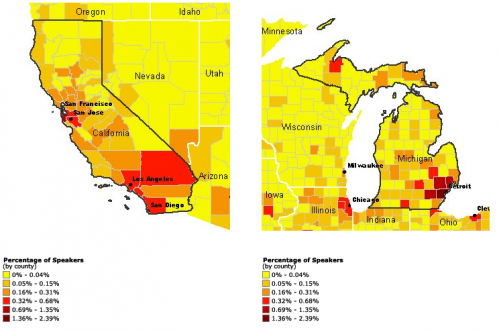
Anyway, moving on.You can also get side-by-side comparisons of two states. This shows the percentage of the population speaking Arabic in California and Michigan:

Arabic comparison

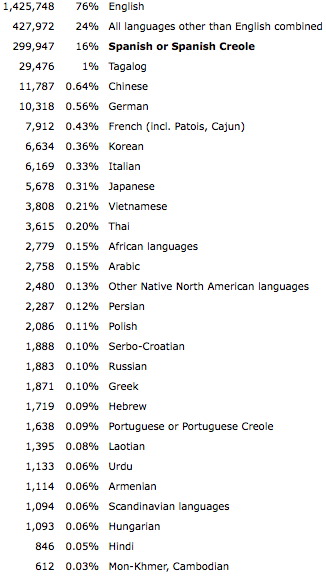
Number and percent of speakers of various languages:

Picture 1

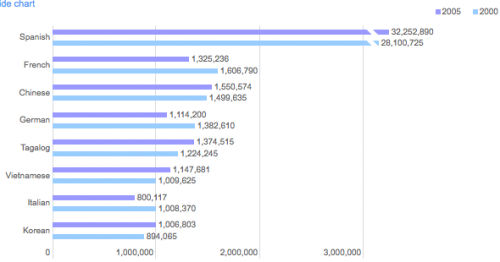
You can compare the number of speakers in 2000 and 2005:

Picture 3

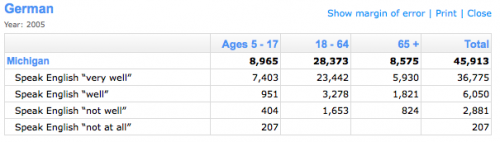
If you go to “Language by State” in that last link and select a language, you can then look at “ability to speak English”. Annoyingly, it only shows raw numbers, not percentages, so you have to do the calculations yourself. But here’s the breakdown for German in Michigan; clearly the vast majority of people who speak German also say they speak English “very well”:

Picture 4

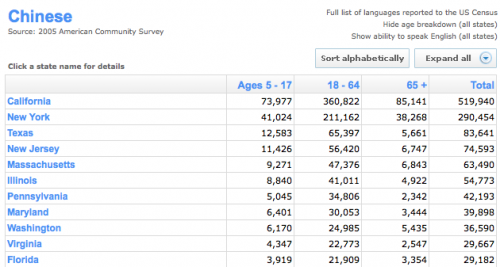
You can also get an age breakdown (again, just raw numbers) for each language, by state. Here’s a partial list for Chinese:

Picture 1

I’m warning you now, the site can turn into an enormous time-suck. You think you’ll just look up the state you live in, say, and then you get started comparing things, and the next thing you know, it’s a half hour later.

UPDATE 2: Commenters have also pointed out that a) “Chinese” is as much of a thrown-together category as “African” (does it mean Cantonese? Mandarin?) and b) the site doesn’t have any information about use of American Sign Language, both great points.

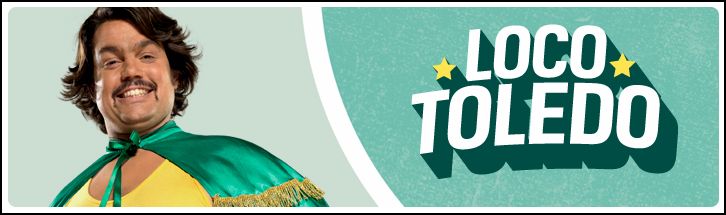
Ricardo G. sent in a link to a British campaign encouraging citizens to ride the train.  The campaign features a Mexican wrestler named Loco Toledo.

Capture

The commercials basically feature him acting weird (“loco” means crazy), speaking broken English, and comparing the awesomeness of England’s train system with Mexico’s. An example:

How exactly is this different than the Frito Bandito and the Sleepy Sanka Mexican?

Other examples of contemporary advertising campaigns featuring demeaning racial and ethnic stereotypes: the U-Washee, KFC thinks Asians are ridiculous, Native American sports mascots, racism in identity theft ads, Indian, Chinese, and Italian stereotypes in superbowl ads, Asian kitchselling noodles with Asian enlightenment, and Mr. Wasabi.

Lisa Wade, PhD is an Associate Professor at Tulane University. She is the author of American Hookup, a book about college sexual culture; a textbook about gender; and a forthcoming introductory text: Terrible Magnificent Sociology. You can follow her on Twitter and Instagram.