Search results for The

I found this ad for the De Beers diamond company in the New Yorker:
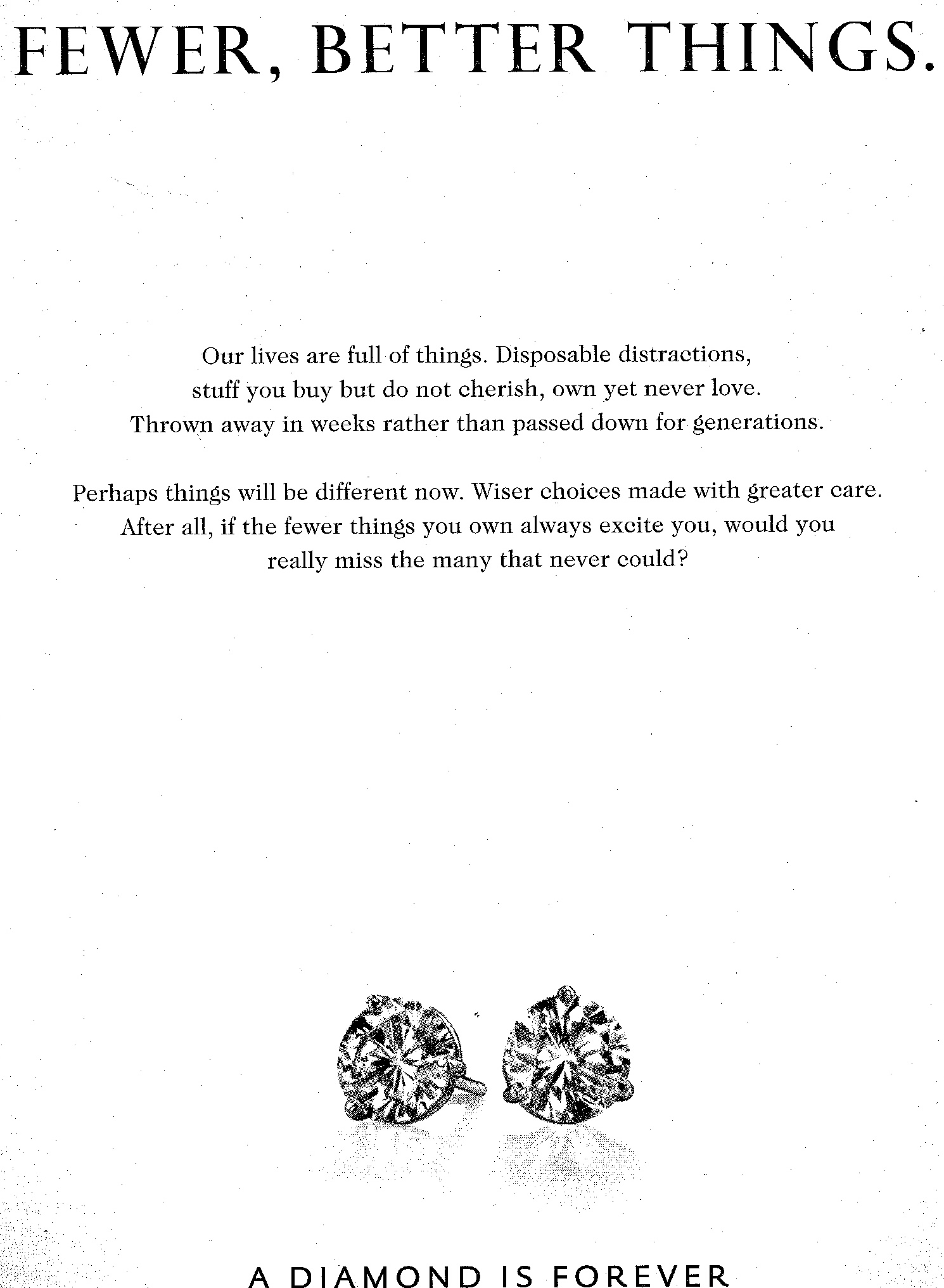
It uses the fascinating strategy of selling diamonds, an unnecessary luxury item made very expensive because the De Beers company has a monopoly on diamond mines and makes sure to keep supply artificially low, by criticizing consumerism based on buying unnecessary items. The message here is that we should stop buying so much unnecessary stuff…but that diamonds don’t fall into the category of unnecessary. Rather, diamonds are “better” things you should cherish “forever.” Of course, this anti-consumerist, buy-less-stuff message is also useful for De Beers because buying fewer things might be the only way, in a struggling economy, for people to save up to buy one or two more expensive items that can become family heirlooms to be “passed down for generations”…such as, say, diamonds.

Honestly, this is one of the most interesting ads I’ve seen in a while. I mean, it takes some nerve to sell luxury jewelry by telling people to stop wasting money on unimportant things.

UPDATE: Commenter Barbar pointed me to this interesting article in The Atlantic about the history of the diamond market.
Miguel E. sent us a link to a story about Natural High, a Japanese company that reportedly makes “extreme” pornography.   The producer, Sakkun, felt bad that many children in Africa live in poverty and so he sent a porn star to Kenya to have sex with African men (on film, of course).  The company gave a Kenyan aid organization one million yen (around $10, 800 U.S.) and 1,000 more (currently about $10.77 U.S.) is donated for every DVD sold (story here).  Images and discussion after the jump:

more...

Welcome to Christmas 2008!

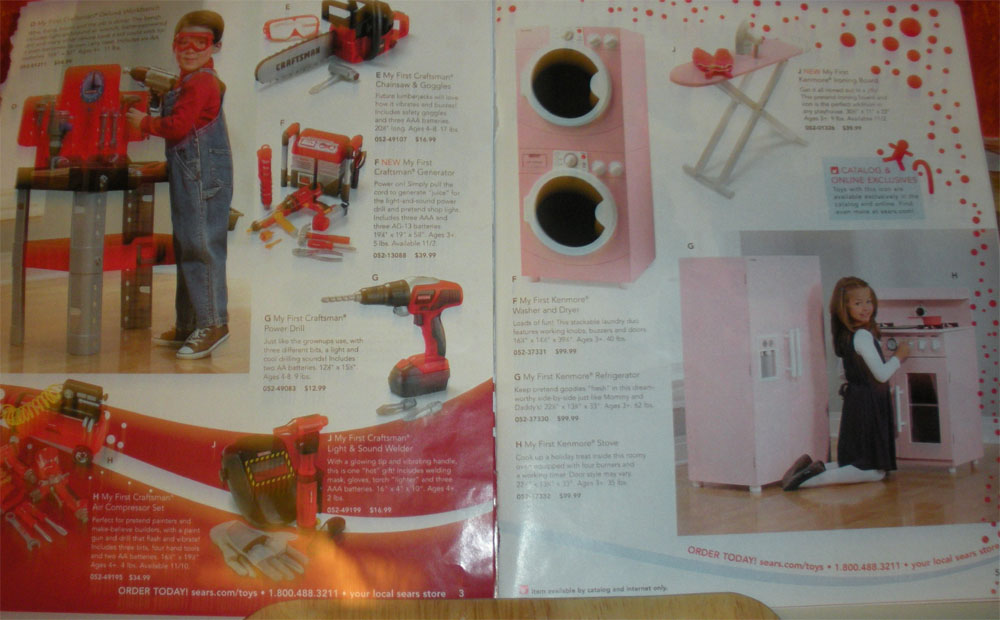
Rose McM. sent us this great example of rigidly gender-coded toys from the Sears Wish Catalog (click to enlarge):

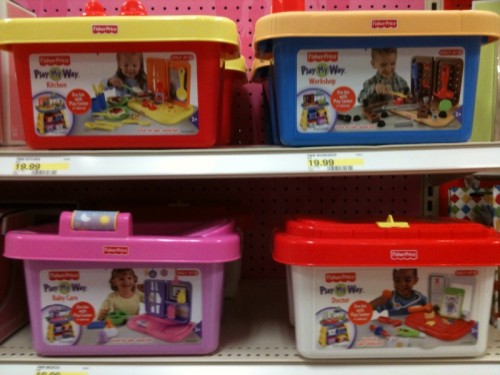
NEW! (Jan. ’10): Sarah O. snapped this photo of toys that teach girls they should cook and care for babies, while boys can build things and be doctors:

-2

See also these posts on the Rose Petal Cottage and Tonka Trucks (“built for boyhood!”).

Lisa Wade, PhD is an Associate Professor at Tulane University. She is the author of American Hookup, a book about college sexual culture; a textbook about gender; and a forthcoming introductory text: Terrible Magnificent Sociology. You can follow her on Twitter and Instagram.

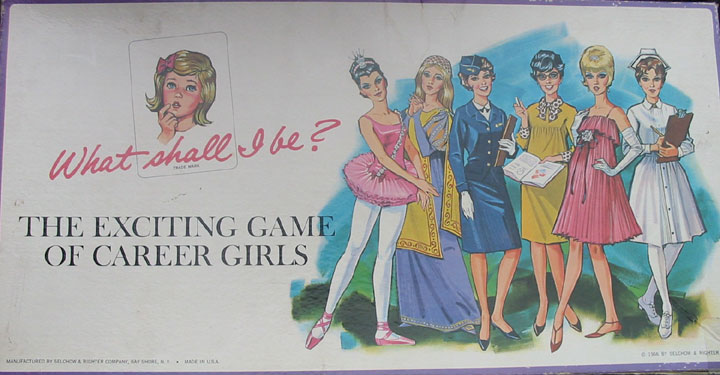
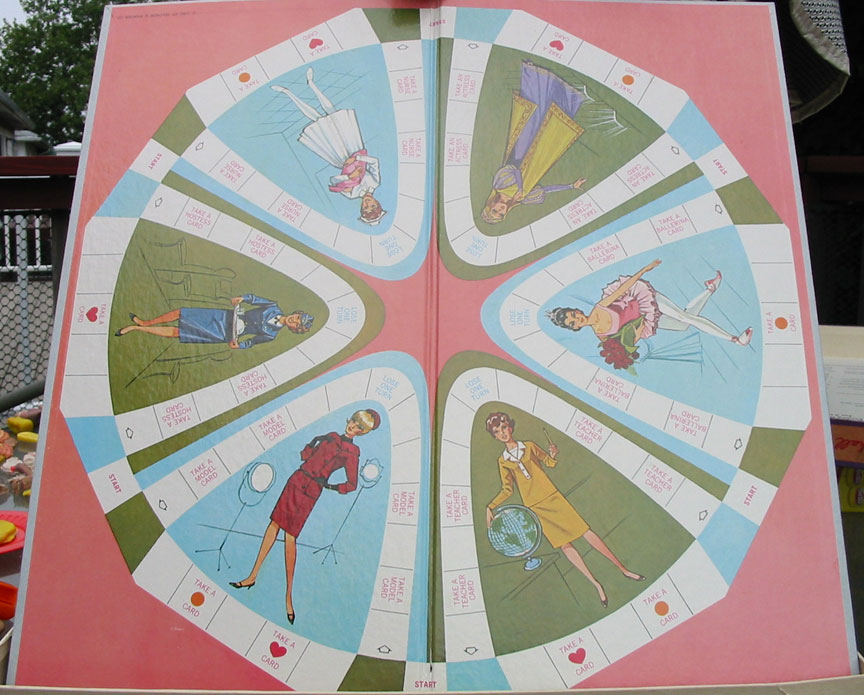
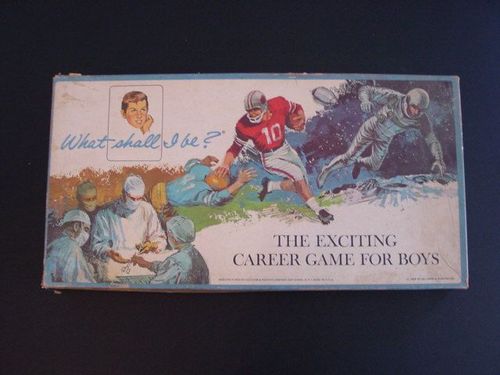
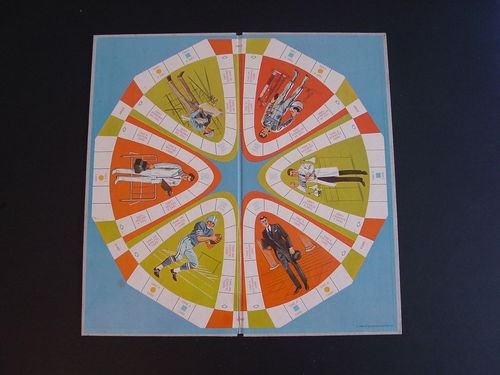
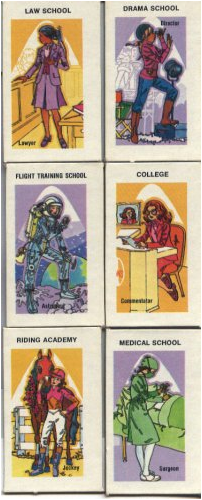
The 1966 and 1976 editions of this old board game illustrate both historical ideas about gender and the way they can change in just ten years.

The 1966 version for girls (found here):

Options for girls include going to charm school to become a model, nursing school to become a nurse, drama school to become an actress, college to become a teacher, ballet school to become a ballet dancer, or airline training school to become an airline hostess.

The 1966 version for boys (found here):

Options for boys include going to law school to become a statesman, graduate school to become a scientist, medical school to become a doctor, college to become an athlete (!?), technical school to become an engineer, or flight school to become an astronaut.

They revised the girl’s game (I’m not sure about the boy’s game) in 1976 (found here).  Girls could now choose between going to medical school to become a surgeon, the riding academy to be a jockey, flight training school to be an astronaut, college to be a commentator, drama school to be a director, and law school to be a lawyer.

I wonder if the revised boy’s version included going to college to become an elementary school teacher, to medical school to be a pediatrician, or to a dance academy to become a dancer.  I predict not.

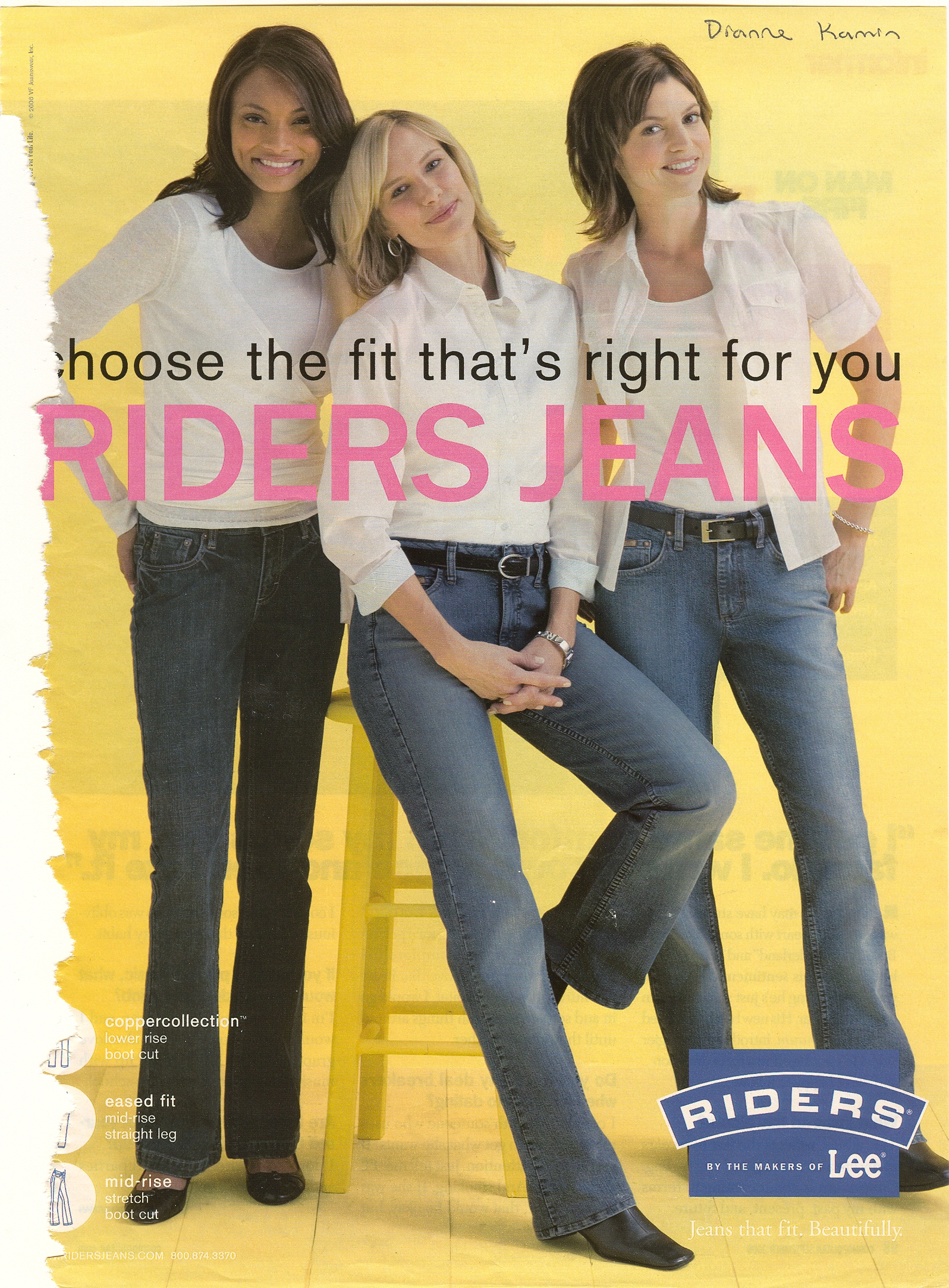
Thus far in this series I have offered five explanations of why people of color are included in advertising: (1) to associate the product with a racial stereotype, (2) give a product “color” or “flavor,” (3) invoke ideas of “hipness” or “modernity,” (4) trigger the idea of human variation itself, or (5) suggest that the company cares about racial equality.

With this post, I begin illustrating how they are included. Here I show that, in many cases, people of color are included, but they are made to blend in with whiteness such that they vary only by the color of their skin.  This is related to two things (at least).

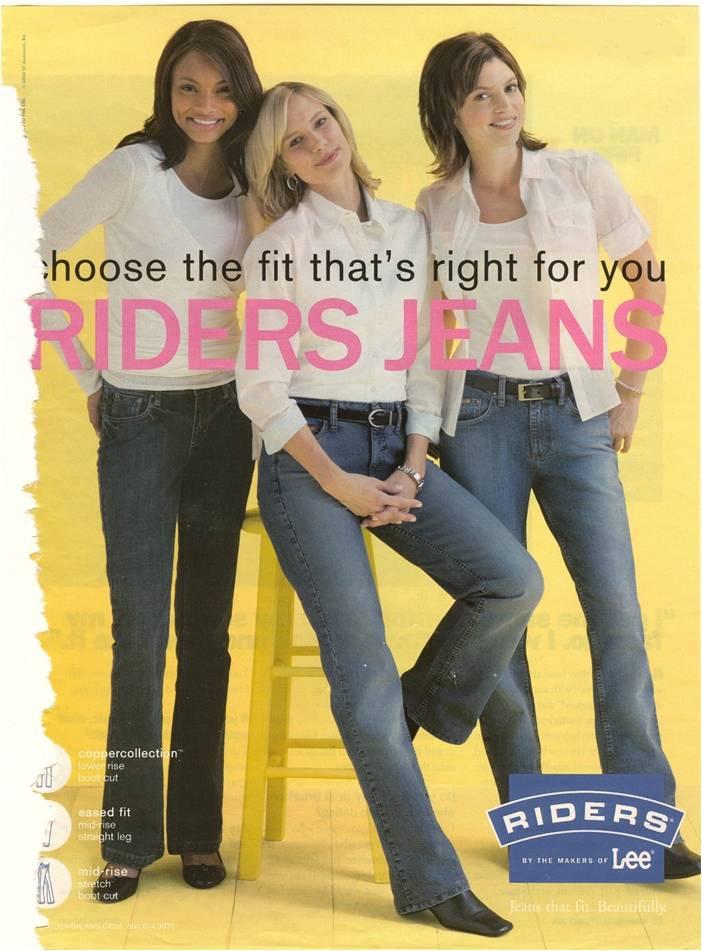
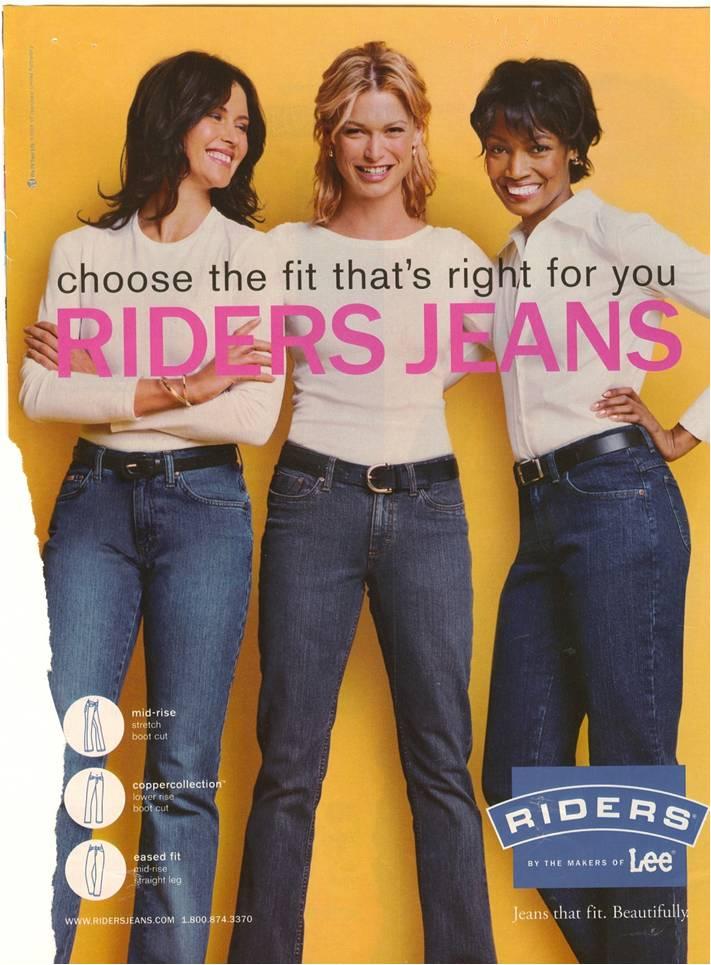
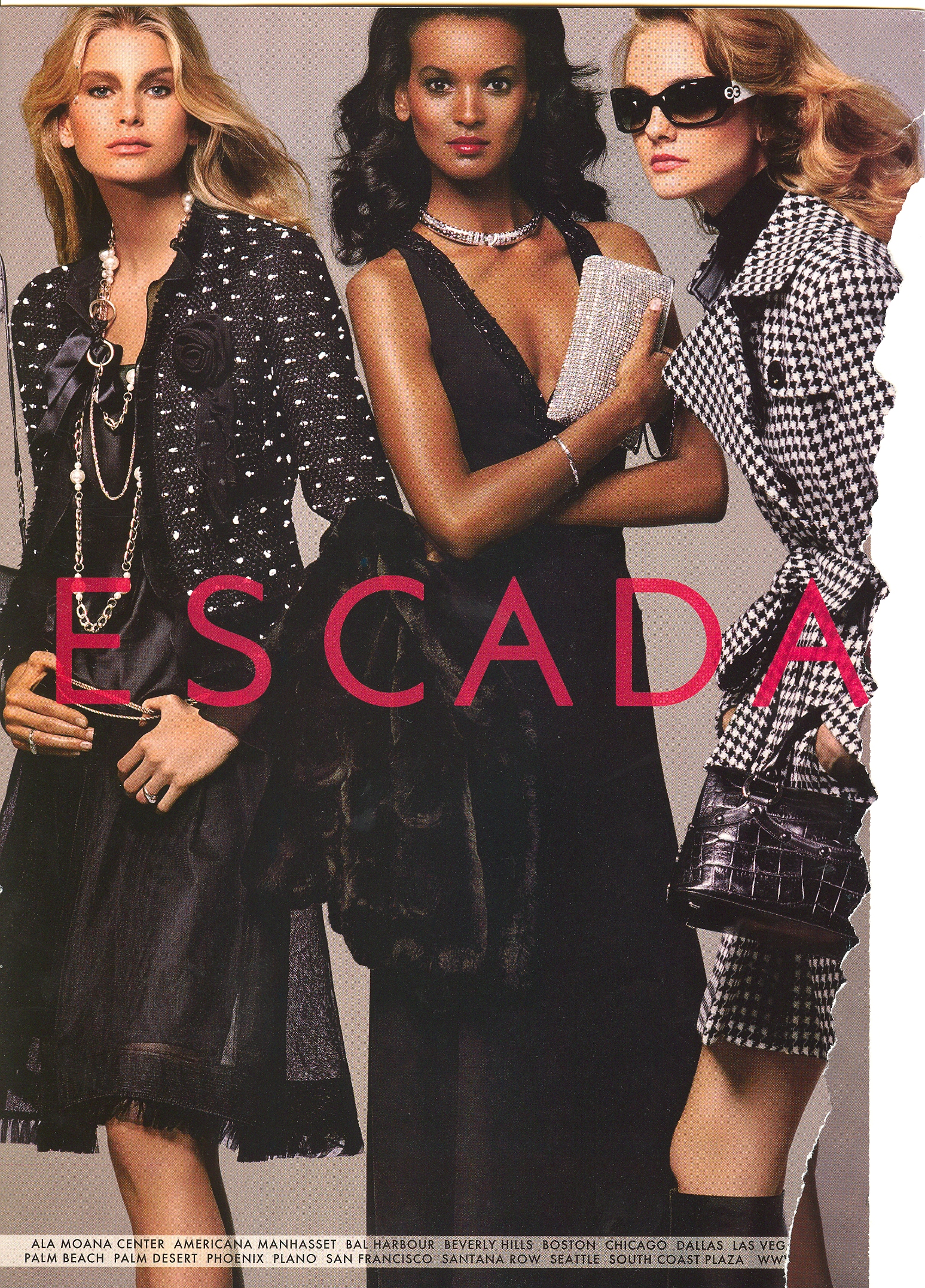
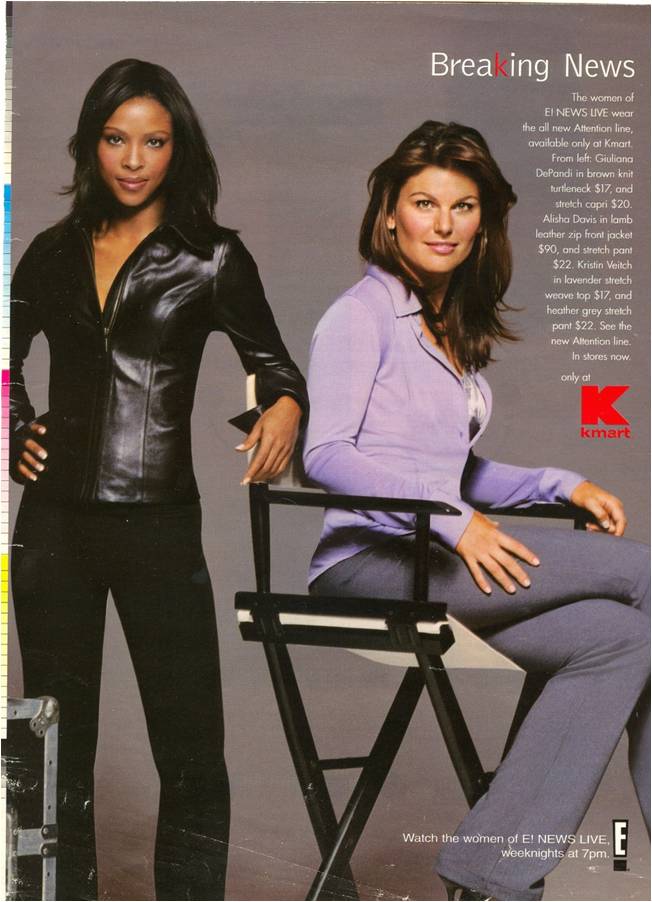
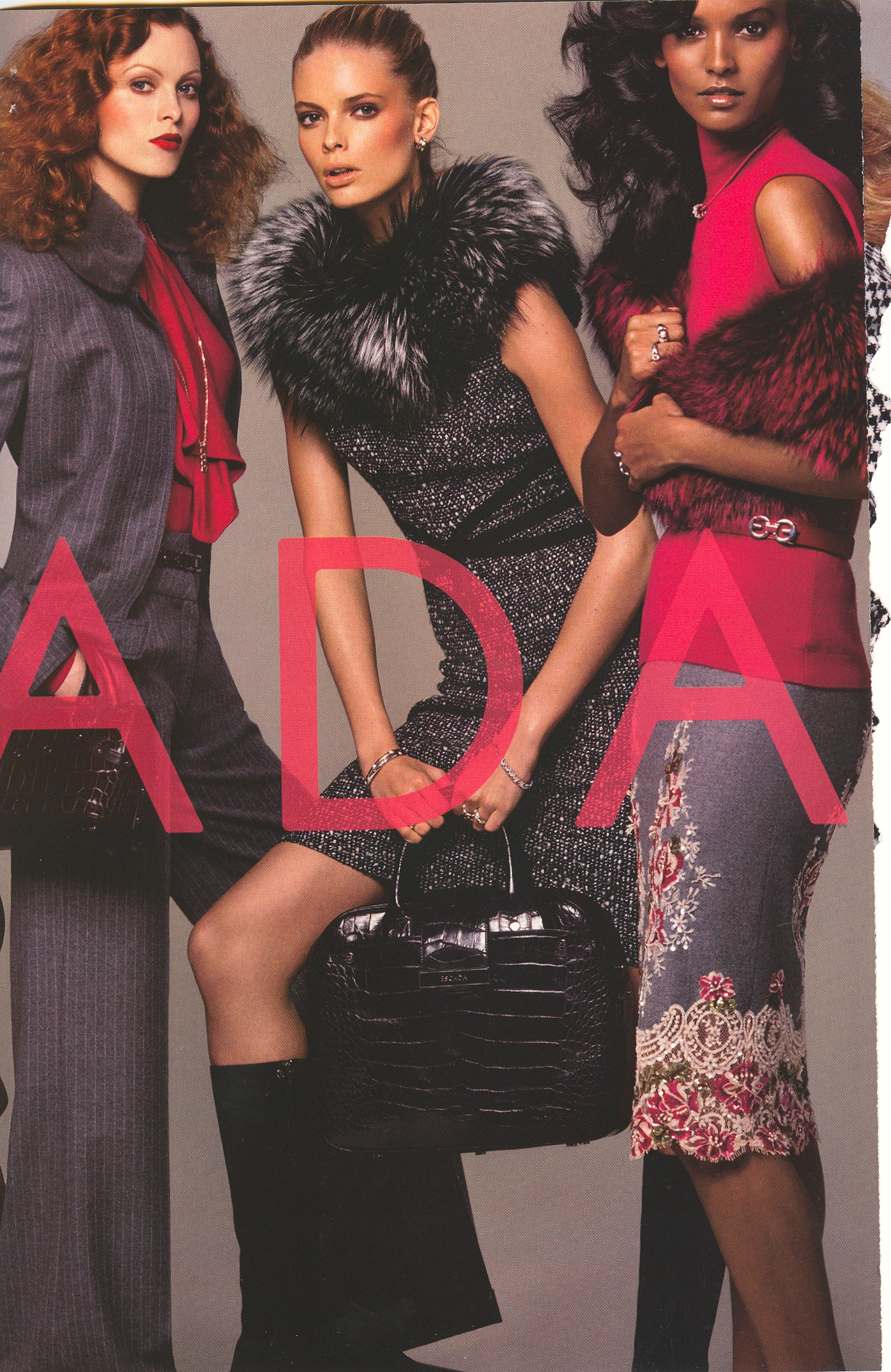
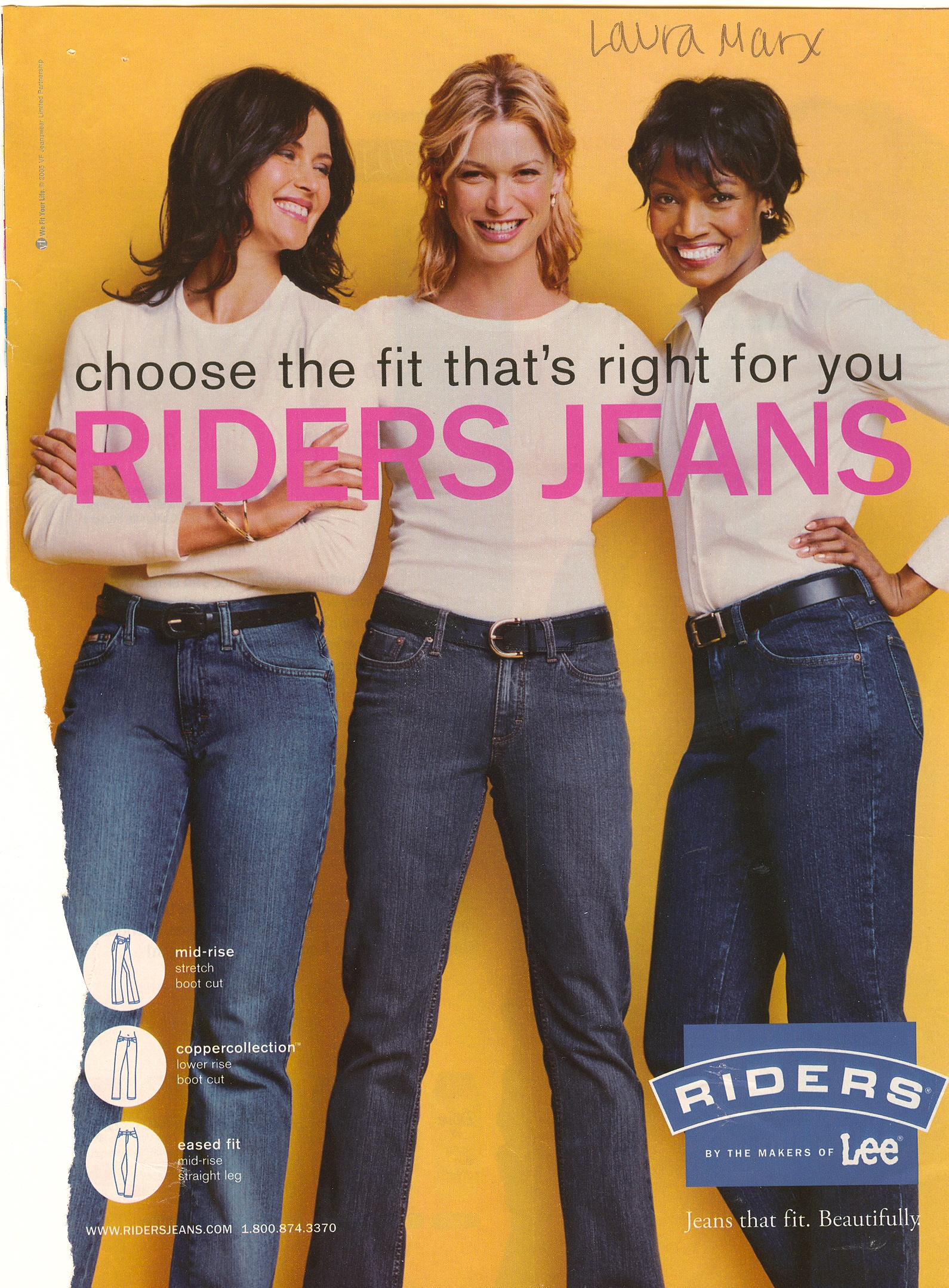
First, beauty is racialized such that what makes some darker-skinned women distinctive from some lighter-skinned women ( e.g., hair texture, nose shape, skin color) also makes them less beautiful according to mainstream cultural standards in the U.S.  When women of color are included in advertising, then, they often look very similar to the White women they are with, varying only by a few degrees (eg., straightened hair [sometimes lightened], slightly darker skin, slightly wider nose).  Check out these terrific examples.

Second, when women of color don’t conform to white standards of beauty, it is often interpreted as resistance to assimilation to whiteness and, thus, threatening.  For example, when The New Yorker wanted to parody the rumor that the Obamas were Muslim terrorists, they put an afro on Michelle.  So an advertiser will often choose women of color who look more-or-less white because to do otherwise is to send a message of non-conformity or resistance.  This is often done strategically, but if they don’t want to send this message, they will include a woman of color who look assimilated.

Here are some examples:

Next up: Chaperoning.

Also in this series:
(1) Including people of color so as to associate the product with the racial stereotype.
(2) Including people of color to invoke (literally) the idea of “color” or “flavor.”
(3) To suggest ideas like “hipness,” “modernity,” and “progress.”
(4) To trigger the idea of human diversity.
(5) To suggest that the company cares about diversity.


Via Slate.

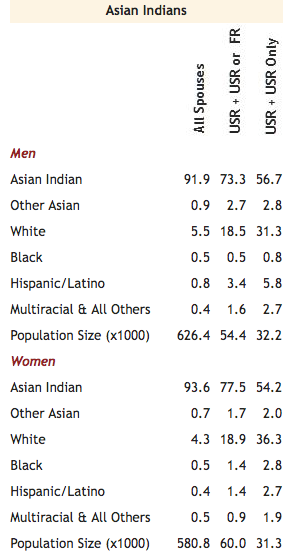
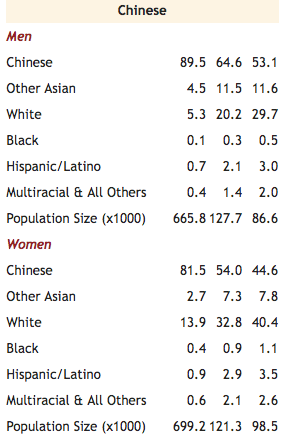
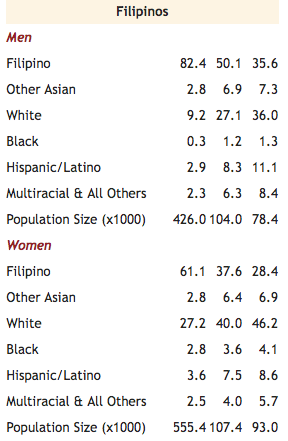
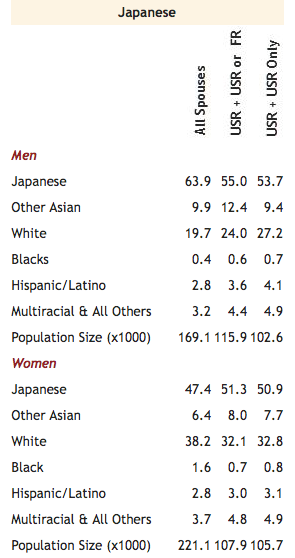
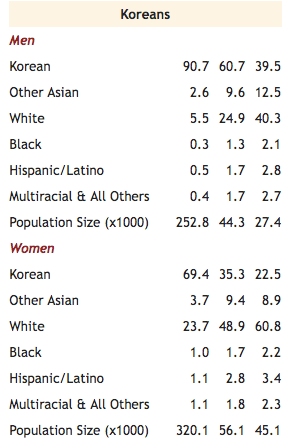
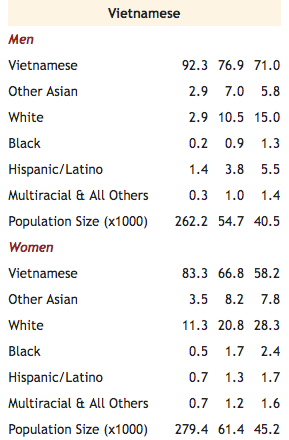
I just discovered the entirely excellent website Asian Nation, run by C.N. Le and full of great information about the Asian American community. Here are some tables showing what percent of various Asian American groups are married to spouses of the same or other groups, updated as of October 2007 using Census data (an explanation of the three columns follows):

Ok, now to explain the three columns of numbers. The first one presents data for all marriages that include at least one Asian American spouse–this will include large numbers of immigrants who were married before they moved to the U.S. The second column includes only those marriages where at least one spouse was raised in the U.S., defined as either born here or moved here by age 13. The third column includes only those marriages where both spouses were raised in the U.S. According to Le, this group represents less than 25% of all marriages including an Asian partner, but “…has the advantage of including only those who were raised and socialized within American society and its racial dynamics. It is this U.S.-raised population that best represents young Asian Americans, since they are the ones who have the most exposure to prevailing American cultural images and media.”

Not surprisingly, endogamous (in-group) marriage rates drop off significantly among U.S.-raised Asian Americans. There are other interesting gender patterns as well. Notice, for instance, that Chinese, Vietnamese, Korean, and Filipina women are quite a bit more likely to be married to a White partner (the most common out-group spouses) than are men, and for the remaining groups, women are slightly more likely to be married to a White spouse. You might discuss the social and historical factors that might cause that pattern, and compare it to the trend in marriages with a Black and a White spouse, in which the gender pattern is usually reversed–Black men are more likely to be married to Whites than are Black women. It might also be worth noting that Korean and Filipina women are significantly less likely to marry endogamously than the other Asian American ethnic groups.

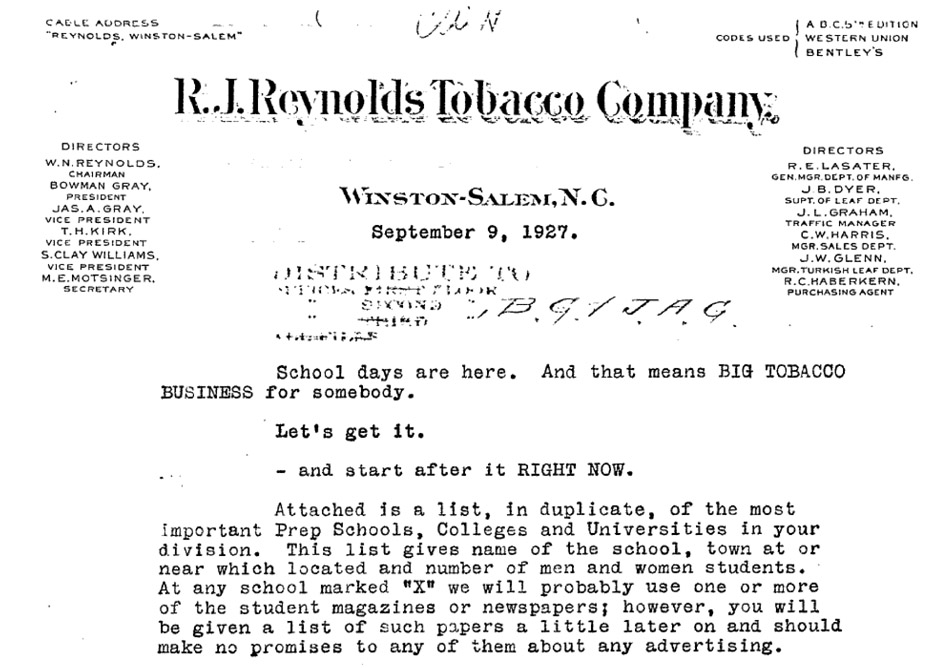
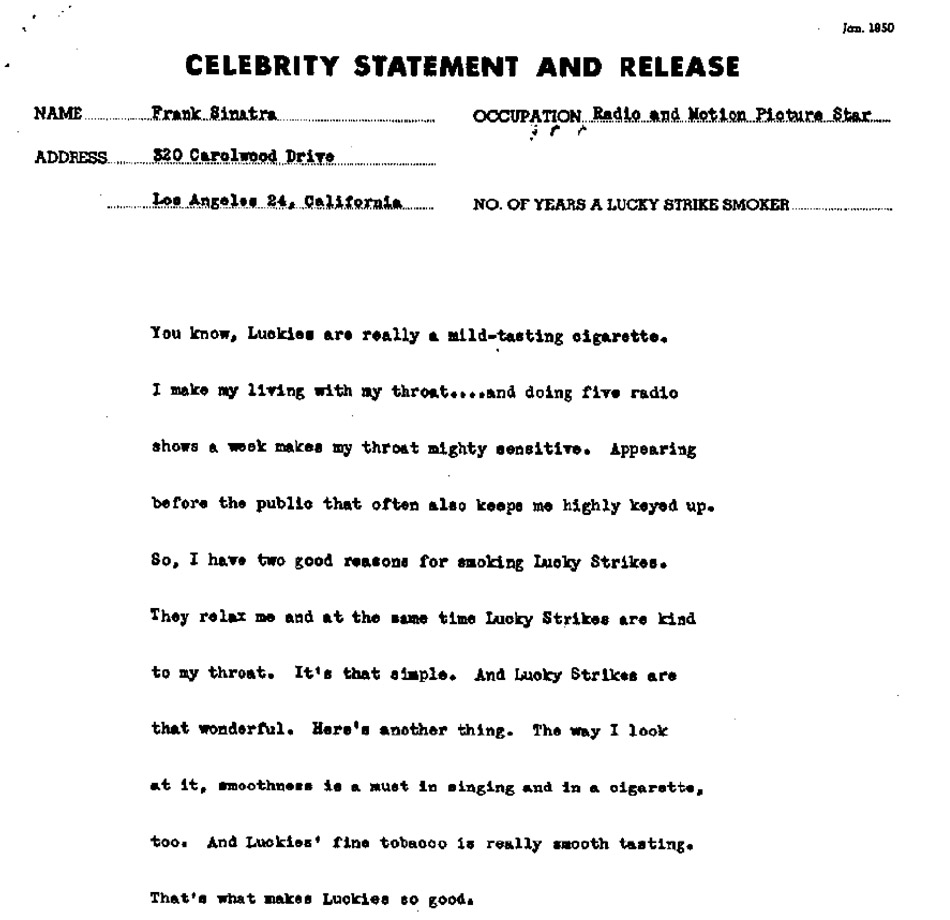
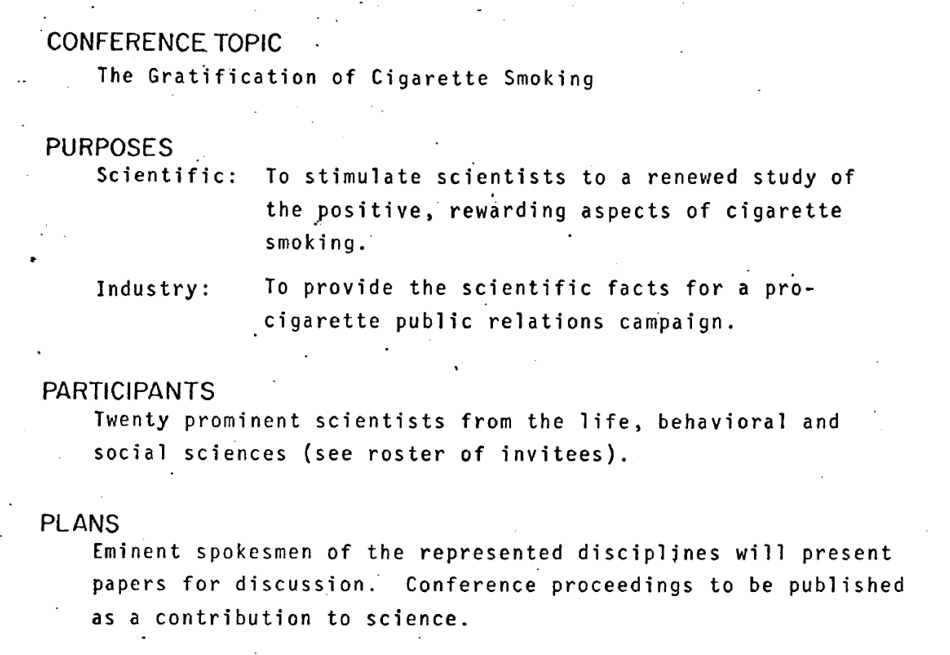
Kay W. sent us a link to an archive of cigarette advertising and other historical materials.  Among the many interesting things there were some internal documents circulated by tobacco companies. I include some below:

Product placement contract:

Targeting youth:

Script for Frank Sinatra:

Directing scientific research: