Search results for The

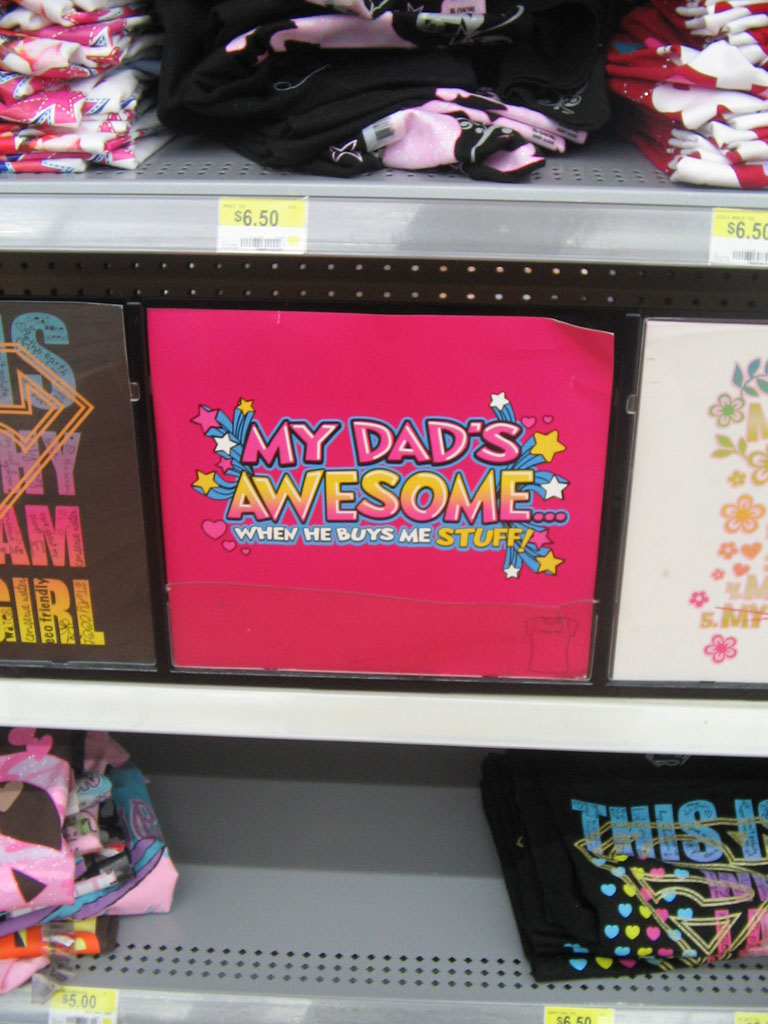
We were shopping for my 6-year-old stepdaughter in Walmart in the Boston metro area this weekend. I took a picture of a display of T-shirts for sale for girls, available in size 6X-14. Clockwise, these 4 say “Peace, love and lipgloss,” “it’s a girls [sic] world! (we just let the boys live in it),” “”Friends are forever / Boys are whatever,” and “My favorite things: 1. My mom, 2. Fridays, 3. Shopping, 4. My best friends, 5. My brother (Just kidding).”

Here’s another one from the same display that says “My dad’s awesome…when he buys me stuff!” Presumably a dad is therefore not awesome when he is trying to raise a happy, healthy kid with techniques that do not include purchasing sparkly pink shirts with pro-capitalism messages.

Arrive Alive is an anti-drunk driving organization. As part of one educational campaign, they designed these…stickers? posters? stick-ons? I’m not sure what you call them, but things to stick on the wall of public bathrooms to make people think before driving drunk. Here are two examples (found at copyranter):

I don’t quite know what to make of these. I mean, they definitely get your attention. But I also question the outfit they chose to show her in–what’s with sexing her up so much? With fishnet thigh-highs, a visible g-string, and stilettos, no less. And as copyranter points out, for the type of guys (and I know this is a specific group–this isn’t referring to men in general) who look for drunk women to have sex with, I think that top image might have a totally different effect than the organization is getting at. Maybe that’s part of the point–to scare women with the threat of making bad sexual choices (or being forced into sexual activities) while drunk. But then why put it in the men’s bathroom? I’m kind of stumped, really. Readers?

Just a side note, I’m thinking the poster at the top, next to the urinal, is just going to get peed on a lot (after all, there are already lots of urinals shaped like women), while the bottom one is likely to get puked on now and then.

This just strikes me as another example of a PSA that manages to be creepy without necessarily being effective.

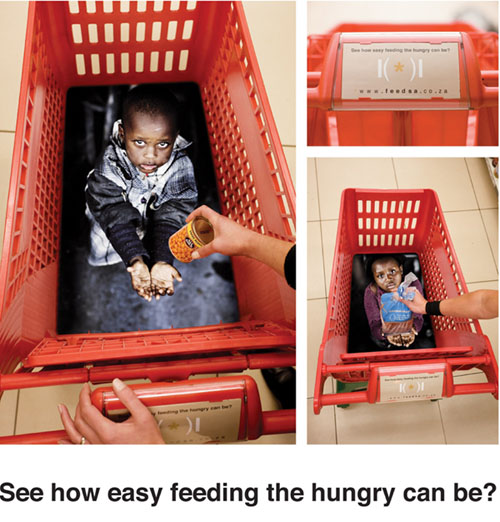
Here’s a somewhat similar example. These ads are for Feed SA, a New Zealand-based organization to provide food to people in South Africa. They paid some supermarkets to put these ads in shopping baskets (images posted by copyranter at Animal New York):

I guess part of the point here is to make people feel uncomfortable while they’re filling their baskets with lots of food, in the hopes that they’ll go home and make a donation. And that, in and of itself, doesn’t surprise me; I used to foster dogs for a dog rescue, and let me tell you, we weren’t above occasionally using guilt or desperate appeals if we were in dire shape, and I think it’s a fairly standard (though not necessarily effective) practice among charity organizations. I’m not entirely certain why I find them disconcerting. Maybe there’s no good reason for it.

Readers, what do you think?

If there are any method-heads out there who want to tell me this isn’t as bad as it looks, I’m ready to listen.

Actually, I just thought of one.  The line looks like it drops to the bottom, but the scale starts at 61 and ends at 65.  Even still… method-heads?

(Found here, via Alas!)

Last year the British Heart Foundation released this ad (found at the Mail Online) encouraging people to get a half hour of exercise each day:

It sparked some complaints, presumably because it says sex so openly and has a naked man in it. But it’s kinda neat to see an ad that shows middle-aged people with bodies that don’t necessarily fit our cultural beauty ideals, and acknowledging that they have sex. Of course we know people in their 40s and 50s have sex, but the images we get of women in those age groups being sexual usually depicts them as MILFs, not average women. I think many people are comfortable with the idea that men would be having sex later in life, but we often see them paired with much younger, hot women, not women their own age.

I went to BHF’s website. There is a page called Sex and Heart Disease. They also have a DVD available about sex and recovering from heart disease.

You might use these for a discussion of older couples and sexality, and how uncomfortable we are thinking about older people having sex in our culture. It would be a good topic to tie in to myths about sexual activity among older people. According to this Washington Post article, about 75% of people aged 57-85 who have partners are sexually active. About half of those aged 75-85 who are sexually active report having sex 2-3 times per month, and nearly a quarter have sex at least once a week. And yet our cultural images are generally that either older people don’t have sex at all, or that when they do, it’s gross. We also often assume that all older men have problems with impotence; certainly many do, but it’s not universal and often occurs much later in life that we might expect.

The American Psychological Association has a bibliography of journal articles related to older people and sexuality available here. Although they’re all from a psych perspective, they might be useful for gathering some basic data about the topic.

And, as I tell my students when we talk about aging and sex, I wouldn’t enter Grandma and Grandpa’s bedroom without knocking.

See also this post about a company that used stories of happily sexual older couples to sell mortgages.

Gwen Sharp is an associate professor of sociology at Nevada State College. You can follow her on Twitter at @gwensharpnv.

Rachel M. sends us this story:  The cover for the 1976 Scorpions album “Virgin Killer” apparently not considered problematic enough for censorship at the time, was pulled from a Wikipedia webpage for being “a potentially illegal indecent image of a child under the age of 18.”  The image, included after the jump, features a naked prepubescent girl in a provocative pose:

more...

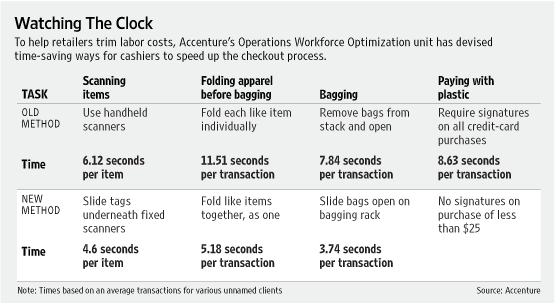
Have you ever wondered why many stores now no longer require a signature when you make a purchase of $25 or less with a credit card?  Today, I found out why.

It has to do with the pressure to increase employee efficiency.  So how do you make employees more efficient?  According to this article from the Wall Street Journal, you change practices.  Consider:

Then, you start clocking employees.  For example:

Daniel A. Gunther has good reason to keep his checkout line moving at the Meijer Inc. store north of Detroit. A clock starts ticking the instant he scans a customer’s first item, and it doesn’t shut off until his register spits out a receipt.

To assess his efficiency, the store’s computer takes into account everything from the kinds of merchandise he’s bagging to how his customers are paying. Each week, he gets scored. If he falls below 95% of the baseline score too many times, the 185-store megastore chain, based in Walker, Mich., is likely to bounce him to a lower-paying job, or fire him.

According to the article, the cost is, in large part, paid by the employee in the form of comfort on the job, the ability to make human contact with regular customers, and having to be mean to old ladies to get them to hurry up. 

Jay Livingston has a nice analysis.


MissCegenation (see her take over at Reciprocal Crap Exchange), Miguel E. (of El Forastero), Breck C. (also of Reciprocal Crap Exchange), Rachel N., Laura M.D., and Z. (of It’s the Thought that Counts) all sent in links to Burger King’s “Whopper Virgins” viral video campaign (we’ve never had so many people send in the same thing; clearly it touched a nerve):

There are several interesting things going on here. One is the exoticization of the “whopper virgins.” The taste tests were conducted in Thailand, Romania, and Greenland. We’re clearly supposed to find it charmingly cute that they’re unfamiliar with hamburgers. They don’t even know how to eat them! We get to see people taking their “first bite of a hamburger,” and wonder at their unfamiliarity with how to pick one up and eat it. This short video about the Thailand taste tests illustrates this with the dramatic voiceover about people who have “never even seen a burger. Who don’t even have a word for burger.”

There’s also a certain level of ethnocentrism here; note the comment that these are people who “really live outside of things.” That all depends on what you mean by “things,” which here seems to be defined by exposure to TV and hamburgers. The implicit understanding, of course, is that these are people who live in a backward, “traditional” culture, which is fascinating to outsiders but, ultimately, very bizarre. However, I am sure that if asked these people would feel they live “inside of” many things, just not the things considered important to this marketing team.

You might also use this to talk about the pervasiveness of advertising. As the video makes clear, they went to Thailand, Romania, and Greenland in hopes of finding people who hadn’t been exposed to Burger King or McDonald’s advertising, since it would be “impossible” to find such people in the U.S.

I also think the documentary element to the video is fascinating. I’m assuming the teams did travel to these areas, and the video claims they are all “real people,” not actors (who are, apparently, imaginary). But I have a suspicion that some elements were staged. Of course the taste-tests were staged, but I notice that almost everyone in the videos is wearing “traditional” clothing. I might be wrong, but it doesn’t strike me as the type of clothing people would wear every day–they seem like pretty fancy clothes that you’d wear for special occasions, but maybe I’m wrong. If anybody knows more about how people in these areas usually dress, let me know. Of course, it’s entirely possible that people dressed up in their fancier clothes entirely on their own because they wanted to look nice when being filmed. But I wonder if they were encouraged to dress in clothing that would make them seem more exotic, rather than showing up in a t-shirt (which is, by now, fairly universal, though I’m certain there are still groups who have not adopted t-shirts).

The second half of the video, where the Burger Team goes to villages in each country and makes them Whoppers, is also interesting in the way it portrays the team as philanthropists giving these communities a unique cultural experience. I mean, I guess they are, and I don’t want to fall into the trap of romanticizing “traditional” groups and implying that they should be shielded from “modern” innovations because it would ruin their culture. And it doesn’t seem like the marketing team is really trying to build brand loyalty, since it’s unlikely they’re going to be opening stores in any of these areas (although they do make sure to wrap the burgers in Burger King wrappers). It does, on the other hand, make the video seem more like a documentary and less obviously like a commercial, which adds to its effectiveness as a viral ad. I dunno. Maybe this is just an example of a corporation doing something nice, and I can’t get over my general distrust of marketers.

Another interesting angle you might bring up in discussion is the spread of fast-food culture and standardized, relatively cheap production processes in general, often referred to as “McDonaldization.” There’s also an entire book on the subject of McDonald’s in Asia, called Golden Arches East: McDonald’s in East Asia (edited by James L. Watson). I sometimes assign the chapter “McDonald’s in Hong Kong: Consumerism, Dietary Change, and the Rise of a Children’s Culture” in my intro classes to talk about cultural change; it’s fascinating how McDonald’s is to some degree undermining parental authority by appealing directly to children and empowering them to demand their favorite meals.

Laura sent us a link to a story about criticism of the campaign, found here.

And just an aside here: What’s the difference between a “village” and a “small town”? The word village seems to bring up certain assumptions about both quaintness and backwardness (and cultural isolation). I grew up in a town of slightly less than 300 people. Nobody ever called it a village. Is it a village if you don’t have paved roads, and a small town if you do? I’m just askin’.

Thanks to everybody who sent the video in!

The United States is highy individualistic.  Most advertisers appeal to our indivdual self-interest, as do politicians when trying to “sell” public policy.  The idea that we should do something for the greater good is not, somehow, as appealing an appeal.

In light of this, it is interesting to see a counter-example.  Chris Uggen posted this image of a sticker he received after he got his flu shot from the University of Minnesota health clinic.


Most of the time we are encouraged to get a flu shot so that we, personally, do not get sick.  In this case, we are encouraged to get a flu shot for the good of the greater community.  This is a nice example of the way that a collectivist ideology can be used in place of an individualist ideology.