Search results for The

Flashback Friday.41EXTGX1VRL__AA400_

A reader named Judith B. wrote in confounded by the copy describing the watch pictured above. It began:

Don’t be fooled by the girly blue and white face on this multifunction Pro Spirit® digital sports watch. It’s more than a match for any tough guy’s watch…

“Girly blue and white?” she asked. “Huh?”

I think I’ve got an answer for you, Judith. And it has to do with fractals. Trees are good examples of fractals: branches can split into two branches, and each of those branches can split into two branches, etc.

Flickr creative commons by Richard Thomas.

The gender binary — that is, the rule that everything (oh animalsjobs, food, kleenex, housework, sound, games, deordorant, love and sex, candy, vitaminsetc) gets split into male and female — is fractal. That means that, for every male or female version of something (say sports versus dance), there is a further gendered split that can be made. If we take sports, we might divide it into the masculine football and the feminine swimming. If we take swimming, we could probably divide it down further. Take education (which is, arguably, feminized): we can split it into physical sciences (masculine) and social sciences (feminine). And we can split the physical sciences into biology (dominated these days by women) and physics (dominated by men). So the gender binary has a fractal character.

What does that mean for blue? Well, it means that, even though “blue” is socially constructed to be masculine, blue can be broken down into more and less masculine types of blue. Turquoise and light blue, for example, are often seen as more feminine that the primary color blue or royal/dark blue. The text, then, is referring to, literally, “girly blue.” Lots of ads aimed at women employ the feminine blues. These ads sent in by some of my former students are good examples:
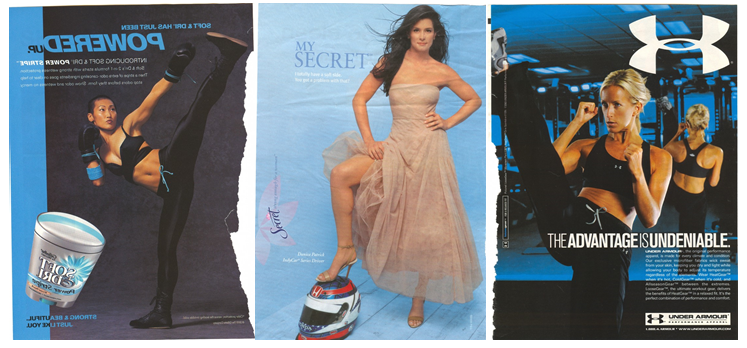
Usually the use of a “girly blue” serves to balance masculinity and femininity.  It’s no accident that these ads are sports-related, or use copy such as “strong & beautiful” and “I totally have a soft side. You comfortable with that?”

So, that’s my explanation for “girly blue”: fractal gender binaries.

Originally posted in 2010.

Lisa Wade, PhD is an Associate Professor at Tulane University. She is the author of American Hookup, a book about college sexual culture; a textbook about gender; and a forthcoming introductory text: Terrible Magnificent Sociology. You can follow her on Twitter and Instagram.
At the end of this month, the Supreme Court will hear arguments as to whether the Constitution requires states to allow same-sex marriages and to recognize same-sex marriages allowed in other states. In the arguments heard in the lower courts and the record-setting number of amici filed for this case, debate has often veered from whether same-sex couples should be able to marry and waded into the question of how they parent children. Social science research has been front and center in this debate, with a variety of studies examining whether families with two parents of a different sex provide better environments for raising children than two parents of the same sex.

No differences? In general, these studies have examined differences in children’s developmental outcomes to make inferences about differences in what is happening in the home, conflating how children do with the ways that people parent in same-sex and different-sex couples. The “no differences” conclusion refers to the fact that few studies have revealed significant differences in these outcomes between children raised by different-sex parents and same-sex parents. This conclusion about parenting based on data on children, however, may be biased in both directions. For example, same-sex couples are more likely to adopt “hard-to-place” children from the foster care system. They are also more likely to have children who have experienced family instability because they transitioned into new family settings after being in families headed by ‘straight’ couples. Both of these factors are known to affect children’s wellbeing, but they are not as strongly tied to parenting.

New study clarifies. In our new study in the June issue of Demography, we directly address the arguments being made about differences in parenting in two-parent families by examining parents’ actual behaviors. Using the nationally representative American Time Use Survey, we examine how much time parents in same-sex and different-sex couples spend in child-focused activities during a 24-hour period, controlling for a wide range of factors that are also associated with parenting, such as income, education, time spent at work, and the number and age of children in the family. By ‘child-focused’ time, we mean time spent engaged with children in activities that support their physical and cognitive development, like reading to them, playing with them, or helping them with their homework.

Supporting a no differences conclusion, our study finds that women and men in same-sex relationships and women in different-sex relationships do not differ in the amount of time they spend in child-focused activities (about 100 minutes a day). We did find one difference, however, as men in different-sex relationships spend only half as much child-focused time as the other three types of parents. Averaging across mothers and fathers, we determined that children with same-sex parents received an hour more of child-focused parent time a day (3.5 hours) than children in different-sex families (2.5 hours).

A key implication of our study is that the focus on whether same-sex parents provide depreciably different family contexts for healthy child development is misplaced. If anything, the results show that same-sex couples are more likely to invest time in the types of parenting behaviors that support child development. In line with a recent study that has continued to highlight that poverty — more so than family structure — is the greatest detriment to parenting practices, it’s hard not to see how delegitimizing same-sex families in ways that create both social and economic costs for them, pose a greater source of disadvantage for children.

Cross-posted at Families as They Really Are and Pacific Standard.

Kate Prickett is a PhD candidate in the Department of Sociology and the Population Research Center at the University of Texas at Austin; Alexa Martin-Storey is a developmental psychologist and Assistant Professor at the Université de Sherbrooke, in Sherbrooke, Quebec. You can find their new study (with Robert Crosnoe) here.

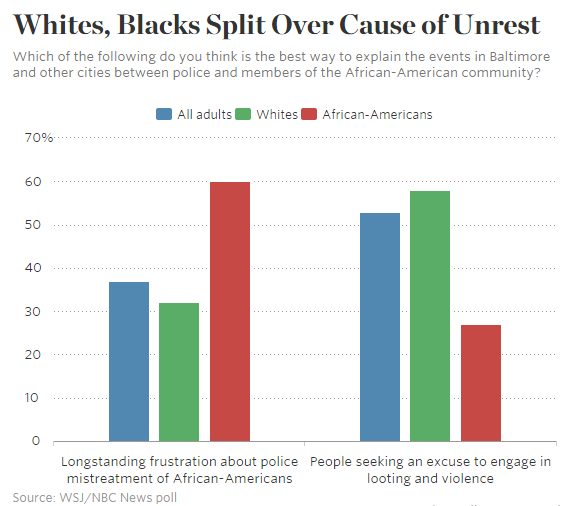
On average, white and black Americans have different ideas as to what’s behind the recent unrest in Ferguson and Baltimore. A Wall Street Journal/NBC poll of 508 adults found that nearly two-thirds of African Americans felt that the unrest reflected “long-standing frustrations about police mistreatment of African Americans,” compared to less than one-third of whites.

2 (1)

In contrast, among whites, 58% believed that African Americans were just looking for an “excuse to engage in looting and violence.” A quarter of black respondents thought the same.

Though they may see it differently, almost everyone expects the uprising to reach more cities over the summer.

Lisa Wade, PhD is an Associate Professor at Tulane University. She is the author of American Hookup, a book about college sexual culture; a textbook about gender; and a forthcoming introductory text: Terrible Magnificent Sociology. You can follow her on Twitter and Instagram.
At the New York Times, Ross Douthat has called out liberals who think, and declare, that churches today are more focused on “culture war” issues like abortion and homosexuality than on poverty.

Ridiculous, says Douthat. Religious organizations spend only “a few hundred million dollars” on pro-life causes and “traditional marriage” but tens of billions on charities, schools, and hospitals. Douthat and his sources, though, lump all spending together rather than separating domestic U.S. budgets from those going to the developing world.  But even in the U.S. and other wealthy countries, abortion and gay marriage are largely legislative and legal matters. Building schools and hospitals and then keeping them running – that takes real money.

Why then do liberals get this impression about the priorities of religious organizations? Douthat blames the media. He doesn’t do a full O’Reilly and accuse the media (liberal, it goes without saying) and others of ganging up in a war on religion, but that’s the subtext.

Anyone who tells you that America’s pastors are obsessed with homosexuality or abortion only hears them through a media filter. You can attend Masses or megachurches for months without having those issues intrude.

Actually, the media do not report on the sermons and homilies of local clergy at all, whether they are urging their flocks to live good lives, become wealthy, help the needy, or oppose gay marriage. Nor is there a data base of these Sunday texts, so we don’t know precisely how much American chuchgoers are hearing about any of these topics. Only a handful of clergy get media coverage, and that coverage focuses on their pronouncements about controversial issues.  As Douthat says, liberals are probably reacting to “religious leaders who make opposition to abortion more of a political priority than publicly-funded antipoverty efforts.”

Of his own Catholic church, Douthat adds, “You can bore yourself to tears reading denominational statements and bishops’ documents (true long before Pope Francis) with a similar result.” Maybe he has done this reading, and maybe he does think that his Church does not let “those issues intrude.” Or as he puts it, “The belief that organized religion is organized around culture war is largely a conceit of the irreligious.”

But here, thanks to the centralized and hierarchical structure of the Church, we can get data that might reveal what the Church is worried about. As Douthat implies, the previous pope (Benedict XVI, the former Joseph Ratzinger), was more concerned about culture-war issues than is the current pope.

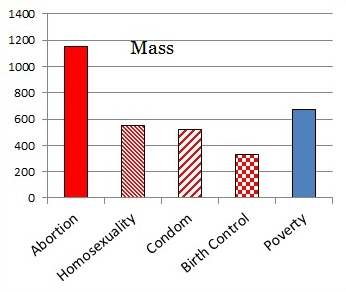
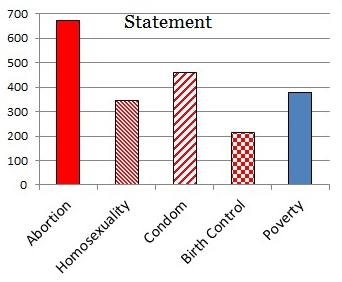
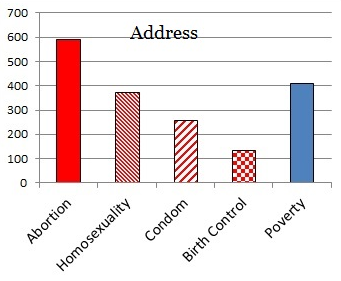
How concerned? I went to Lexis-Nexis. I figured that papal pronouncements on these issues would be issued in masses, in official statements, and in addresses.  For each of those three terms, I searched for “Pope Benedict” with four “culture-war” terms (Abortion, Homosexuality, Condom, and Birth control) and Poverty.

3 2 2 (1)
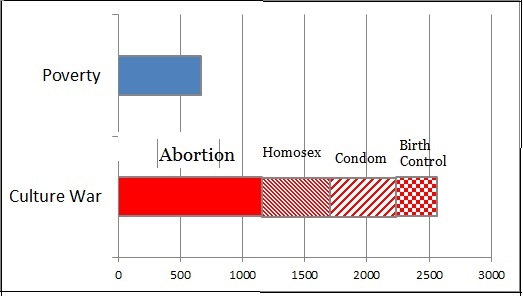
Abortion was the big winner.  Poverty was referred to in more articles than were the other individual culture-war terms.  But if those terms are combined into a single bar, its clear that poverty as a papal concern is dwarfed by the attention to these other issues. The graph below shows the data for “mass.”

1b
This is not the best data. It might reflect the concerns of the press more than those of the Church. Also, some of those Lexis-Nexis articles are not direct hits. They might reference an “address” or “statement” by someone else. But there’s no reason to think that these off-target citations are skewed towards Abortion and away from Poverty.So it’s completely understandable that liberals, and perhaps non-liberals as well, have the impression that Big Religion has a big concern with matters of sex and reproduction.Cross-posted at Montclair SocioBlog and Pacific Standard.

Jay Livingston is the chair of the Sociology Department at Montclair State University. You can follow him at Montclair SocioBlog or on Twitter.

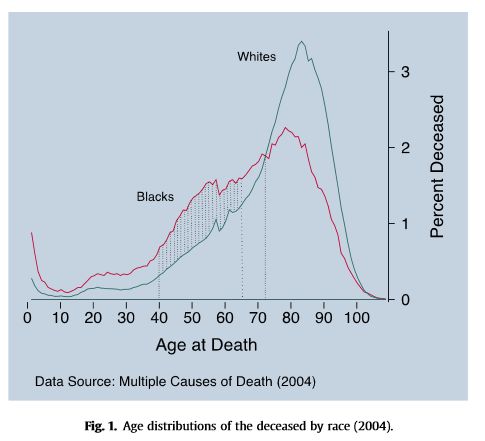
Black people in the U.S. vote overwhelmingly Democratic. They also have, compared to Whites, much higher rates of infant mortality and lower life expectancy. Since dead people have lower rates of voting, that higher mortality rate might affect who gets elected. What would happen if Blacks and Whites had equal rates of staying alive?

1b

The above figure is from the recent paper, “Black lives matter: Differential mortality and the racial composition of the U.S. electorate, 1970-2004,” by Javier Rodriguez, Arline Geronimus, John Bound and Danny Dorling.  A summary by Dean Robinson at the The Monkey Cage summarizes the key finding.

between 1970 and 2004, Democrats would have won seven Senate elections and 11 gubernatorial elections were it not for excess mortality among blacks.

At Scatterplot, Dan Hirschman and others have raised some questions about the assumptions in the model. But more important than the methodological difficulties are the political and moral implications of this finding. The Monkey Cage account puts it this way:

given the differences between blacks and whites in their political agendas and policy views, excess black death rates weaken overall support for policies — such as antipoverty programs, public education and job training — that affect the social status (and, therefore, health status) of blacks and many non-blacks, too.

In other words, Black people being longer-lived and less poor would be antithetical to the policy preferences of Republicans. The unspoken suggestion is that Republicans know this and will oppose programs that increase Black health and decrease Black poverty in part for the same reasons that they have favored incarceration and permanent disenfranchisement of people convicted of felonies.

That’s a bit extreme.  More stringent requirements for registration and felon disenfranchisement are, like the poll taxes of an earlier era, directly aimed at making it harder for poor and Black people to vote.  But Republican opposition to policies that would  increase the health and well-being of Black people is probably not motivated by a desire for high rates of Black mortality and thus fewer Black voters. After all, Republicans also generally oppose abortion. But, purely in electoral terms, reducing mortality, like reducing incarceration, would not be good for Republicans.

Cross-posted at Montclair SocioBlog.

Jay Livingston is the chair of the Sociology Department at Montclair State University. You can follow him at Montclair SocioBlog or on Twitter.

Yesterday, the New York Times had a story about the enormous sums that hedge funders took home last year.

Last year, the hedge fund industry had returns of only 3 percent on average… But the top 25 managers still managed to earn $11.62 billion in compensation in 2014.

Kenneth C. Griffin of Citadel… $1.3 billion… James H. Simons of Renaissance Technologies was second with $1.2 billion, and Raymond Dalio of Bridgewater Associates was third with $1.1 billion. William A. Ackman of Pershing Square Capital was a close fourth, earning $950 million in 2014.

I know it sounds like a lot, but 2014 was an off year. That $11.62 billion was barely half what the top 25 hauled in the year before. I guess there’ll be some belt tightening.

The point though is that in an efficient market system like ours, people get what they are worth to the economy, don’t they?

“Does Finance Benefit Society?” is the title of a paper by Luigi Zingales, an economist who has had posts at Harvard and Chicago’s Booth School of Business. Here is the short version of his answer to the question:

At the current state of knowledge there is no theoretical reason or empirical evidence to support the notion that all the growth of the financial sector in the last forty years has been beneficial to society.

Zingales is no flaming radical. The right-wing website The Daily Caller says he is “an advocate of free market economics and limited government.” The trouble is that the hedge funders and bankers keep messing up those free market models with their rent-seeking and fraud.  (A table at the end of the paper summarizes cases of fines paid to the U.S. Government 2012-2014. And those are just the ones where someone got caught.)

A couple of other quotes on the same theme:

If political power is disproportionately in the hands of large donors – as it is increasingly the case in the United States – why is the negative public perception of finance a problem? Rich financiers can easily buy their political protection. In fact, this is precisely the problem.

Many financial activities tend to have a private return that is much higher than the (perceived) social return.

Furthermore, I am not aware of any evidence that the creation and growth of the junk bond market, the option and futures market, or the development of over-the-counter derivatives are positively correlated with economic growth.

A pdf of the paper is here.

Originally posted at Montclair SocioBlog and Pacific Standard.

Jay Livingston is the chair of the Sociology Department at Montclair State University. You can follow him at Montclair SocioBlog or on Twitter.

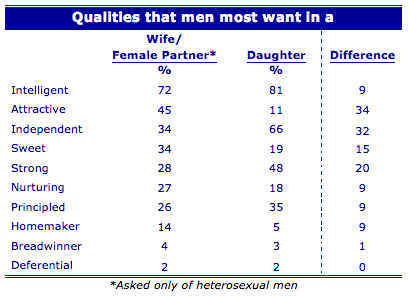
New data collected for the Shriver Report offers a telling insight into modern marriage. They asked 818 men representative of the adult U.S. population to choose three “qualities that [they] most want” in a daughter from a set of 10. Offering the same list, they asked which qualities they wanted in a wife or female partner. Intelligence topped both lists but, from there, responses diverged.

This is your image of the week:

4

Men were pretty consistent in what they wanted for their daughters. A majority said intelligence (81%) and two thirds (66%) said independence. Almost half (48%) said they wanted their daughters to be strong.

But, as a group, they were significantly more ambivalent about what they wanted from wives. Some wanted intelligence, independence, and strength, but many fewer wanted that in wives compared to daughters: 34% said they wanted independent wives and 28% said they wanted strong ones. Compared to what they wanted for daughters, they were much more likely to say they wanted attractiveness (45% vs. 11%), sweetness (34% vs. 19%), nurturing (27% vs. 18%), and homemaking (14% vs. 5%) from wives.

This is fascinating data. It looks like the majority of men want strong, successful, independent daughters, but there is still a significant number who hope for wives who are willing to put their husbands before themselves.

Lisa Wade, PhD is an Associate Professor at Tulane University. She is the author of American Hookup, a book about college sexual culture; a textbook about gender; and a forthcoming introductory text: Terrible Magnificent Sociology. You can follow her on Twitter and Instagram.
Flashback Friday.

Adolf Hitler targeted the Jews in the Holocaust not simply out of hate, but for strategic reasons. Describing his plan to take over Germany, and then Europe, he wrote:

I scanned the revolutionary events of history and… [asked] myself: against which racial element in Germany can I unleash my propaganda of hate with the greatest prospects of success? …I came to the conclusion that a campaign against the Jews would be as popular as it would be successful.

Jews, Hitler figured, were already well hated and, thus, would lend themselves to demonization quite easily.

Once it was decided that the Jews would be targeted, wrote Ronald Berger writes in his essay The “Banality of Evil” Reframed:

the most immediate difficulty that confronted the Nazis was the construction of a legal definition of the target population.

Who was Jewish?

At first, the Nazis defined Jews as non-Aryan. But this became problematic because nations with whom Germany wanted to ally (e.g., Japan) were arguably non-Aryan.

So, the regime settled on a definition that linked non-Aryan-ness to religion. Both racial and religious characteristics could qualify one as “Jewish.”

Like the rules of hypodescent that separated black from white in the U.S. during and after slavery, the Nazis had rules as to what percentage of Jewish blood one needed to have to be truly Jewish. Berger explains that a Jew was defined as a person who was 3/4ths Jewish or more. The term mischling worked like the U.S. word mulatto to identify a person with mixed blood (in this case, someone who was 1/2 Jewish and also was married to a Jew or practiced Judaism).

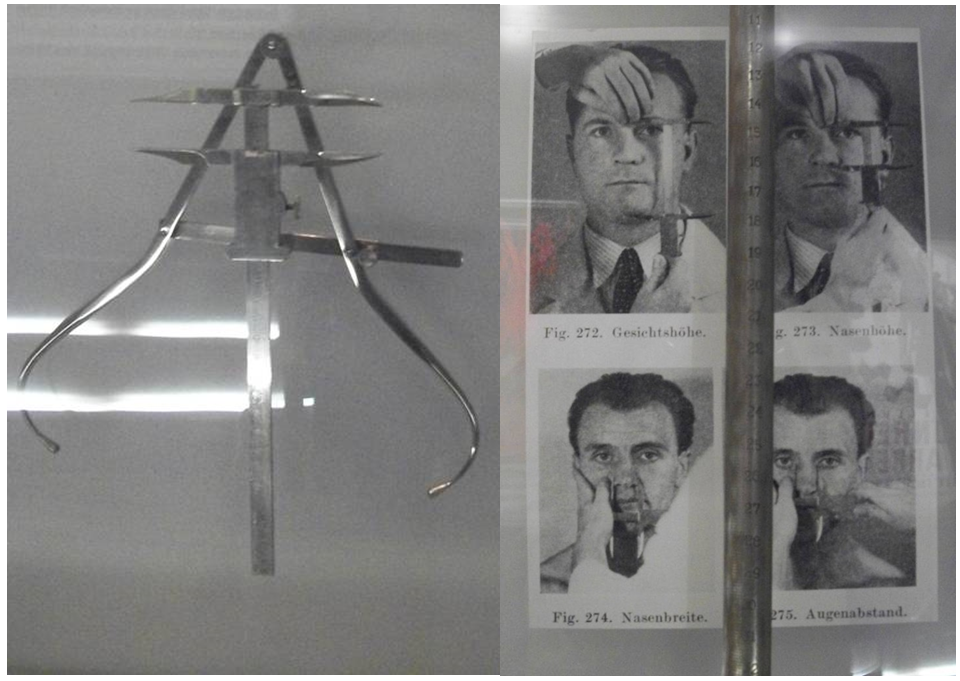
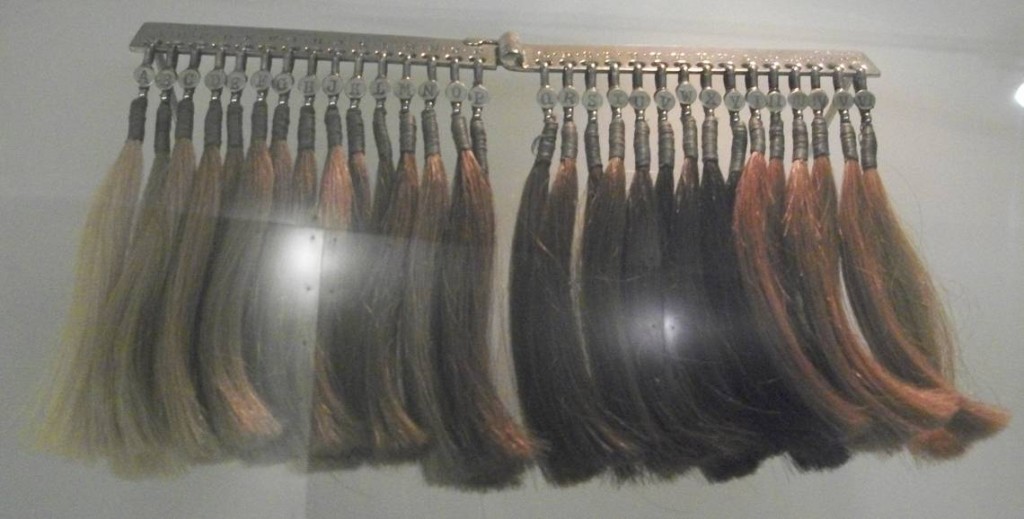
The next step was measurement. In confusing cases, how could the Nazi’s prove that someone was Jewish or mischling? They developed instruments. These photographs (mine) are from a museum in Munich that has collected some of the instruments used to place a person on the Aryan/non-Aryan spectrum.

An instrument for measuring facial features:

4

Instruments for measuring skin, eye, and hair color:

6

Picture1

This is just one more example of the way in which racial categories are constantly being invented and reinvented, usually for reasons related to power. For others, see our recent post on the deracialization of Irish dance, the shifting meanings of Creole, and the way Census data collection changed race in an instant.

Originally posted in 2009.

Lisa Wade, PhD is an Associate Professor at Tulane University. She is the author of American Hookup, a book about college sexual culture; a textbook about gender; and a forthcoming introductory text: Terrible Magnificent Sociology. You can follow her on Twitter and Instagram.