Search results for The

When one thinks of American Chinatowns, they usually think of San Francisco and New York, but at one time the third largest Chinatown in the U.S. was in Louisiana. It’s story is an example of how economics and geopolitics shape the growth of ethnic enclaves.

After the American Civil War ended legalized slavery in the U.S., Southern planters faced the challenge of finding labor to work their crops. It was common to employ the same black men and women who had been enslaved, now as sharecroppers or wage laborers, but the planters were interested in other sources of labor as well.

At nola.com, Richard Campanella describes how some planters in Louisiana turned to Chinese laborers. Ultimately, they hired about 1,600 Chinese people, recruited directly from China and also from California.

This would be a doomed experiment. The Chinese workers demanded better working conditions and pay then the Louisiana planters wanted to give. There was a general stalemate and many of the Chinese workers migrated to the city.

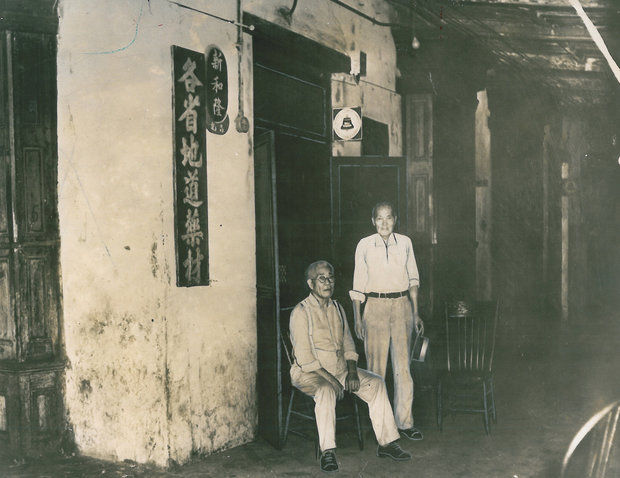
By 1871, there was a small, bustling Chinatown just outside of the French quarter and, by the late 1930s, two blocks of Bourbon St. were dominated by Chinese businesses: import shops, laundries, restaurants, narcotics, and cigar stores (some of the migrants had come to the U.S. via Cuba). Campanella quotes the New Orleans Bee:

A year ago we had no Chinese among us, we now see them everywhere… This looks, indeed, like business.

Big Gee and Lee Sing, New Orleans 1937 (photo courtesy of nola.com):
2

Other residents, it seemed, welcomed the way the Chinese added color and texture to the city. Campanella writes that “New Orleanians of all backgrounds also patronized Chinatown.” Louis Armstrong, who was born in 1901, talked of going “down in China Town [and] hav[ing] a Chinese meal for a change.” Jelly Roll Morton mentioned dropping by to pick up drugs for the sex workers employed in the nearby red light district.

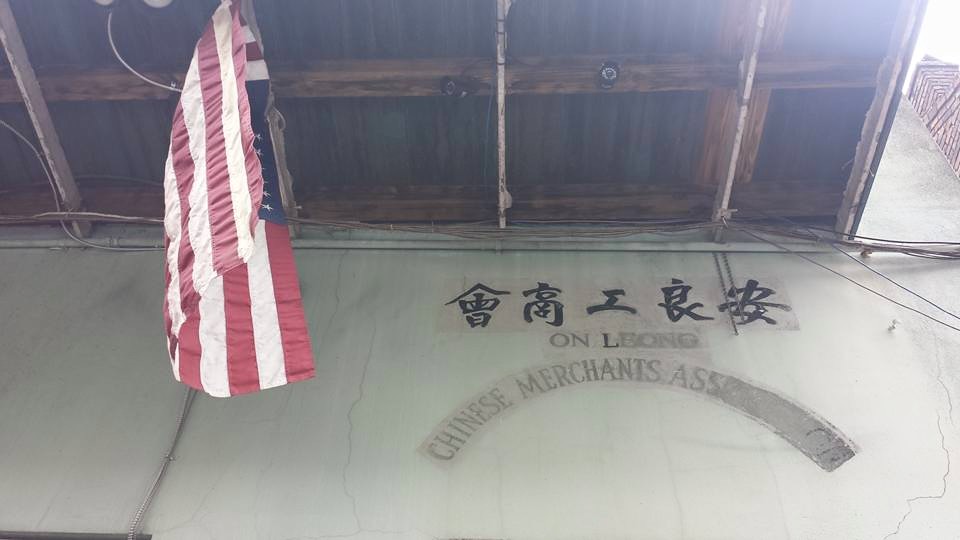
A strip club now inhabits the old Chinese laundry; none of the original Chinatown businesses remain. But it held on a long time, with a few businesses lasting until the 1990s. All that’s left today is a hand-painted sign for the On Leong Merchants Association at 530 1/2 Bourbon St.
13

For more, get Richard Campanella’s book, Geographies of New Orleans.

Cross-posted at Pacific Standard.

Lisa Wade, PhD is an Associate Professor at Tulane University. She is the author of American Hookup, a book about college sexual culture; a textbook about gender; and a forthcoming introductory text: Terrible Magnificent Sociology. You can follow her on Twitter and Instagram.
I am excited to see that sociologist Linda Blum has come out with a new book, Raising Generation Rx: Mothering Kids with Invisible Disabilities in an Age of Inequality. Here’s a post from the archive highlighting some of her important and powerful findings.

In an article titled Mother-Blame in the Prozac Nation, sociologist Linda Blum describes the lives of women with disabled children. While mothers are held to an essentially impossibly high standard of motherhood in the contemporary U.S. and elsewhere, mothers of disabled children find themselves even more overwhelmed.

The daily care of their child is often more intensive but, in addition to that added responsibility, mothers were actively involved in getting their children needed services and resources. The need for mothers to be proactive about this was exacerbated by the fact that they had to negotiate different social institutions, each with an interest in claiming certain service spheres, but also limited budgets. “While each system claims authoritative expertise,” Blum writes, “either system can reject responsibility, paradoxically, when costs are at issue.”  Because they often had to argue with service providers and find ways to beat a system that often tried to keep them at bay, they had to become experts in their child’s disability, of course, but also public policy, learning styles, the medical system, psychology/psychiatry, pharmaceutics, manipulation of jargon and law, and more.

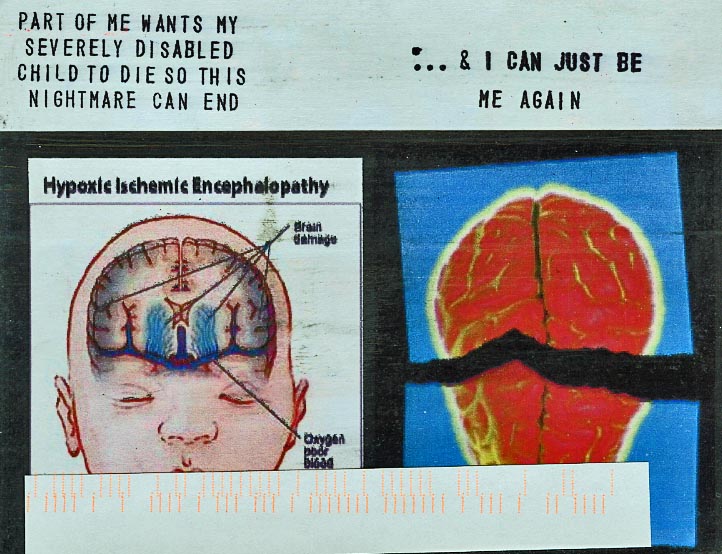
Mothers often felt that they were their child’s only advocate, with his or her health and future dependent on making just one more phone call, getting one more meeting with an expert, or trying one more school. Accordingly, they were simultaneously exhausted and filled with guilt.  I wondered, when I came across this Post Secret confession, if this mother was experiencing some of the same things:

 Originally posted in 2012.

Lisa Wade, PhD is an Associate Professor at Tulane University. She is the author of American Hookup, a book about college sexual culture; a textbook about gender; and a forthcoming introductory text: Terrible Magnificent Sociology. You can follow her on Twitter and Instagram.
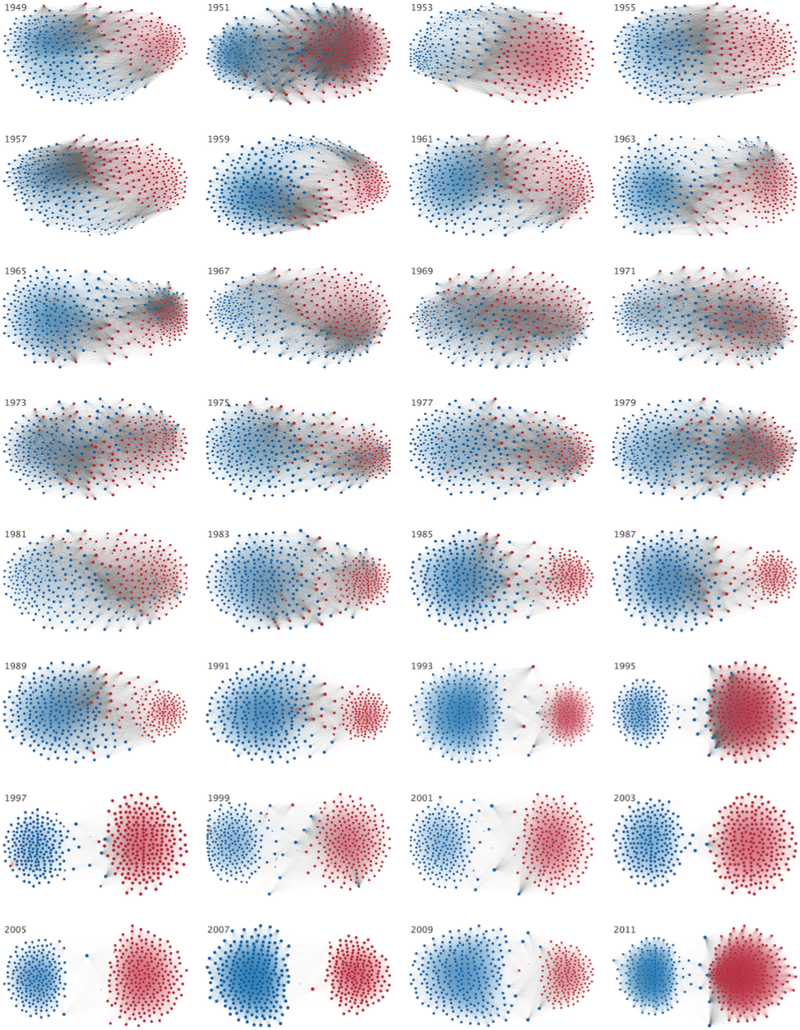
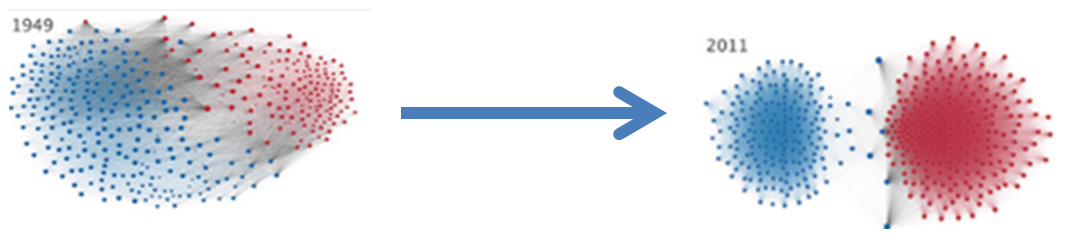
It sure seems like U.S. Democrats and Republicans are less likely to cooperate than they have been in the past and now, thanks to geographer Clio Andris and her colleagues, we can see that it’s true. They plotted six decades of voting in the House of Representatives, noting the likelihood that their vote will cross party lines.

This is your image of the week:

4

Or, here’s the long story short:

8

Lisa Wade, PhD is an Associate Professor at Tulane University. She is the author of American Hookup, a book about college sexual culture; a textbook about gender; and a forthcoming introductory text: Terrible Magnificent Sociology. You can follow her on Twitter and Instagram.
Flashback Friday.

I’ve posted about the use of apparent discounts as a marketing tool and about the rise of the shopping cart. Since I’m on a little marketing-related posting trend, I figured I might as well post about restaurant menus. New York Magazine recently provided an analysis of menus and how things such as placement, images, and so on influence purchases.

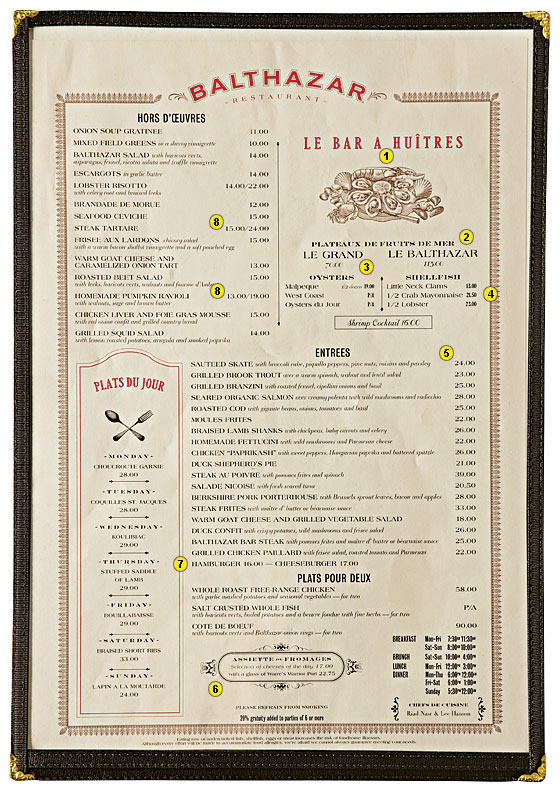
Here’s the menu analyzed in the article:

balthazarmenu091214_560

Some of the most interesting elements numbered on the menu:

1. Pictures of food on menus are tricky. They can convince people to buy a dish, but more expensive restaurants don’t want to be associated with low-cost places like Denny’s or Applebee’s. In general, the more expensive the restaurant, the less likely there are to be images of food, and if there are, they’re drawings, not color photos. And, apparently, the upper right corner is where customers’ eyes go first, so you need to make good use of that section.

2 and 3. You list something expensive (like a $115 seafood dish) in a prominent spot to serve the same function as a “manufacturer’s suggested retail price” on a sales tag at a retail store: to set an anchor price that makes other prices look like a bargain in comparison. The $70 seafood dish listed next to the $115 one seems way more reasonable than it would have it listed without the comparison anchor price.

5. Listing dishes in a column encourages customers to skim down the list, making it more likely that they’ll be focusing on the column of prices rather than the dishes themselves, and will pick from among the cheapest things on the menu. If the dish names are connected by a line of dots or dashes to specific prices, this is even more pronounced.

8. Restaurants often use “bracketing”:

…the same dish comes in different sizes. Here, that’s done with steak tartare and ravioli — but because “you never know the portion size, you’re encouraged to trade up,” Poundstone says. “Usually the smaller size is perfectly adequate.”

Notice the same things I mentioned in my post about meaningless discounts: high prices used to set an anchor that makes everything else look cheap and an emphasis on apparent savings to distract the customer from how much they’re spending.

And the bracketing thing is marketing genius: the larger portion is usually just a little bit more expensive, so the customer is likely to focus on the fact that the additional amount is actually a bargain, but you usually have very little information about how much bigger it actually is.

Knowledge is power! And now you know.

Originally posted in 2009.

Gwen Sharp is an associate professor of sociology at Nevada State College. You can follow her on Twitter at @gwensharpnv.

Sociologists are interested in studying how our institutions — in addition to our ideologies and interactions — reflect social norms in ways that tend to reproduce the status quo. A great example happened recently in South Carolina. In this case, the institution is the Department of Motor Vehicles, the norm is that boys and men don’t wear makeup, and the case is Chase Culpepper, a male-bodied trans teen who wanted to wear makeup in her driver’s license photo.

The officials at the DMV told her that she wasn’t allowed to wear makeup in the photo because it would be a “disguise.” As reported by NPR:

The department… cited a 2009 rule that prohibited applicants from “purposely altering his or her appearance so that the photo would misrepresent his or her identity.”

They told Culpepper to take off her makeup or go home without a license. She did what they said.

[youtube]https://www.youtube.com/watch?v=qvgL7ICS_g0[/youtube]

It’s hard to defend the idea that somehow makeup distorts a man’s identity, but not a woman’s. It has exactly the same illusory power on a female face as a male one; that’s exactly why women wear it. The DMV’s policy did nothing, then, to help it do its job, it only served to press citizens of South Carolina to conform to the gender binary, at least as far as their primary form of identification went.

With the help of the Transgender Legal Defense and Education Fund, Culpepper sued and the DMV settled. As part of the settlement,

[they] agreed to change its policy to allow people seeking drivers’ licenses to be photographed as they regularly present themselves, even if their appearance does not match the officials’ expectations of how the applicant should look. The department also promised to send Culpepper a written apology and train its employees in how to treat transgender and gender-nonconforming individuals in professional settings.

This is what institutional change looks like, at least potentially. Thanks to Culpepper and her advocates, the South Carolina DMV is a little bit less gender binary than it was before.

Lisa Wade, PhD is an Associate Professor at Tulane University. She is the author of American Hookup, a book about college sexual culture; a textbook about gender; and a forthcoming introductory text: Terrible Magnificent Sociology. You can follow her on Twitter and Instagram.
In the U.S., we recognize two main party platforms: Republican and Democrat. Each party packages together specific positions on economic and social issues together into ideologies we call conservative and liberal. The desire for a small government, for example, is lumped with opposition to same sex marriage, while believing in a larger role for government is lumped together with support for abortion rights.

Do all people neatly fit into these two packages? And, if not, what are the consequences for electoral outcomes?

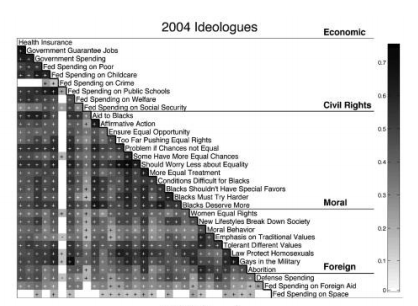
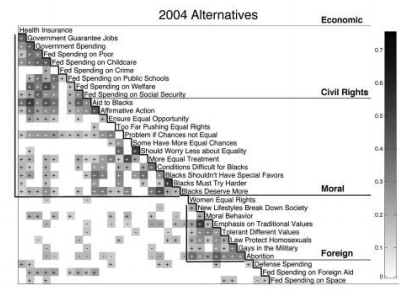
In the American Journal of Sociology, Delia Baldassarri and Amir Goldberg use 20 years of data (1984–2004) from the National Election Studies to show that many Americans have consistent and logical political ideas that don’t align with either major party’s ideological package. These voters, whom the authors call alternatives, are socially liberal and economically conservative (or vice versa).

The images below show correlations between social and economic liberalism or social and economic conservativism. Strong correlations are dark and weak are light. The top image is of the opinions of ideologues — those who adhere pretty closely to the existing liberal and conservative packages — and the bottom images shows the opinions of alternatives.

111 222

In this data, being an alternatives is not just about being unfocused or uncommitted. Baldassarri and Goldberg show that their positions are logical, reasoned, consistent, and remain steady over time.  The study makes it clear that the ties between economic and social issues made by the left and the right, which many people see as normal or natural, represent just two among the many belief systems that Americans actually hold.

When it comes to the ballot box, though, alternatives usually vote Republican. The authors write that the most conservative among the alternatives’ views tend to hold sway when it comes to picking a party. It appears that the salience of moral issues is not the primary reason for Republicans’ electoral success. Instead, for as-yet unknown reasons, alternative voters follow their more conservative leanings at the ballot, whether economic or social.

Cross-posted at The Reading List.

Jack Delehanty is a graduate student in sociology at the University of Minnesota. His work is about how social movement organizations can reframe dominant social narratives about inequality. In his dissertation, he explores how white Protestant-influenced discourses of poverty, family, and individual choice are being critically reshaped in the public sphere today.

Chris Christie’s net worth (at least $4 million) is 50 times that of the average American. His household income of $700,000 (his wife works in the financial sector) is 13 times the national median.  But he doesn’t think he’s rich.

I don’t consider myself a wealthy man. . . . and I don’t think most people think of me that way.

That’s what he told the Manchester Union-Leader on Monday when he was in New Hampshire running for president.

Of course, being out of touch with reality doesn’t automatically disqualify a politician from the Republican nomination, even at the presidential level, though misreading the perceptions of “most people” may be a liability.

But I think I know what Christie meant. He uses the term “wealth,” but what he probably has in mind is class.  He says, “Listen, wealth is defined in a whole bunch of different ways . . . ”  No, Chris. Wealth is measured one way – dollars. It’s social class that is defined in a whole bunch of different ways.

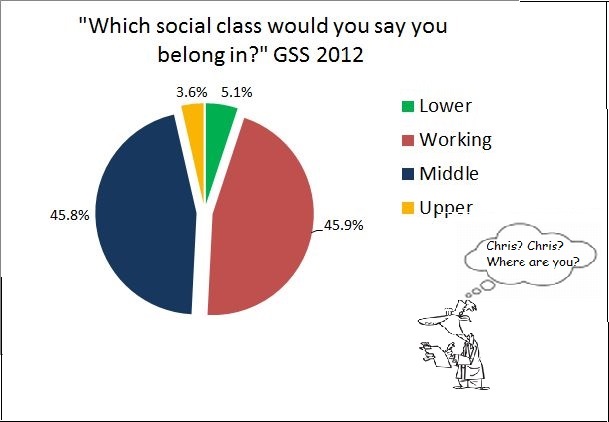
One of those ways, is self-perception.

“If you were asked to use one of four names for your social class, which would you say you belong in: the lower class, the working class, the middle class, or the upper class?”

That question has been part of the General Social Survey since the start in 1972. It’s called “subjective social class.” It stands apart from any objective measures like income or education. If an impoverished person who never got beyond fifth grade says that he’s upper class, that’s what he is, at least on this variable. But he probably wouldn’t say that he’s upper class.

Neither would Chris Christie. But why not?

My guess is that he thinks of himself as “upper middle class,” and since that’s not one of the GSS choices, Christie would say “middle class.”  (Or he’d tell the GSS interviewer where he could stick his lousy survey. The governor prides himself on his blunt and insulting responses to ordinary people who disagree with him.)

1c

This  self-perception as middle class rather than upper can result from “relative deprivation,” a term suggesting that how you think about yourself depends on who are comparing yourself with.* So while most people would not see the governor as “deprived,” Christie himself travels in grander circles. As he says, “My wife and I . . . are not wealthy by current standards.” The questions is “Which standards?”  If the standards are those of the people whose private jets he flies on, the people he talks with in his pursuit of big campaign donations – the Koch brothers, Ken Langone (founder of Home Depot), Sheldon Adelson, Jerry Jones, hedge fund billionaires, et al. – if those are the people he had in mind when he said, “We don’t have nearly that much money,” he’s right. He’s closer in wealth to you and me and middle America than he is to them.

I also suspect that Christie is thinking of social class not so much as a matter of money as of values and lifestyle – one of  that bunch of ways to define class. To be middle class is to be one of those solid Americans – the people who, in Bill Clinton’s phrase, go to work and pay the bills and raise the kids. Christie can see himself as one of those people. Here’s a fuller version of the quote I excerpted above.

Listen, wealth is defined in a whole bunch of different ways and in the end Mary Pat and I have worked really hard, we have done well over the course of our lives, but, you know, we have four children to raise and a lot of things to do.

He and his wife go to work; if they didn’t, their income would drop considerably. They raise the kids, probably in conventional ways rather than sloughing that job off on nannies and boarding schools as upper-class parents might do. And they pay the bills. Maybe they even feel a slight pinch from those bills. The $100,000 they’re shelling out for two kids in private universities may be a quarter of their disposable income, maybe more. They are living their lives by the standards of “middle-class morality.” Their tastes too are probably in line with those of mainstream America. As with income, the difference between the Christies and the average American is one of degree rather than kind. They prefer the same things; they just have a pricier version. Seats at a football game, albiet in the skyboxes, but still drinking a Coors Light. It’s hard to picture the governor demanding a glass of Haut Brion after a day of skiing on the slopes at Gstaad, chatting with (God forbid) Euorpeans.

Most sociological definitions of social class do not include values and lifestyle, relying on more easily measured variables like income, education, and occupation. But for many people, including the governor, morality and consumer preference may weigh heavily in perceptions and self-perceptions of social class.

Jay Livingston is the chair of the Sociology Department at Montclair State University. You can follow him at Montclair SocioBlog or on Twitter.

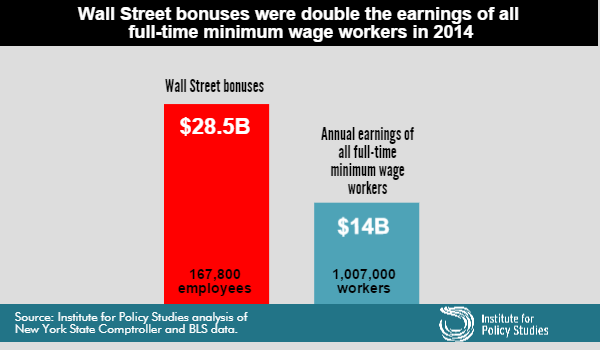
1,007,000 Americans working full-time earn the federal minimum wage of $7.25 per hour. All of that pay, to all of those people, for all of 2014 adds up to $14 billion dollars. And that is less than half of what employees on Wall Street earned in bonuses alone.

This is your image of the week:

4

Source: Institute for Policy Studies.

Lisa Wade, PhD is an Associate Professor at Tulane University. She is the author of American Hookup, a book about college sexual culture; a textbook about gender; and a forthcoming introductory text: Terrible Magnificent Sociology. You can follow her on Twitter and Instagram.