Search results for The

Within the last decade, the grain quinoa has emerged as an alleged “super food” in western dietary practices. Health food stores and upscale grocery chains have aisles dedicated to varieties of quinoa, packaged under many different brand labels, touting it to be a nutritional goldmine. A simple Google search of the word returns pages of results with buzzwords like “healthiest,” “organic,” and “wholesome.” Vegan and health-enthusiast subcultures swear by this expensive food product, and the Food and Agricultural Organization (FAO) even declared the year 2013 International Year of the Quinoa, owing to the grain’s popularity.

The journey of the grain — as it makes it to the gourmet kitchen at upscale restaurants in countries like the United States — however, is often overlooked in mainstream discourse. It often begins in the Yellow Andes region of Bolivia, where the farmers that grow this crop have depended on it as almost a sole nutritional source for decades, if not centuries. The boom in western markets, with exceedingly high demands for this crop has caused it to transition from a traditional food crop to a major cash crop.

While critical global organizations like the FAO have been portraying this as positive, they tend to discount the challenge of participating in a demanding global market. Within-country inequality, skewed export/import dynamics, and capitalist trade practices that remain in the favor of the powerful player in these dynamics – the core consumer – cause new and difficult problems for Bolivian farmers, like not being able to afford to buy the food they have traditionally depended upon.


2 3

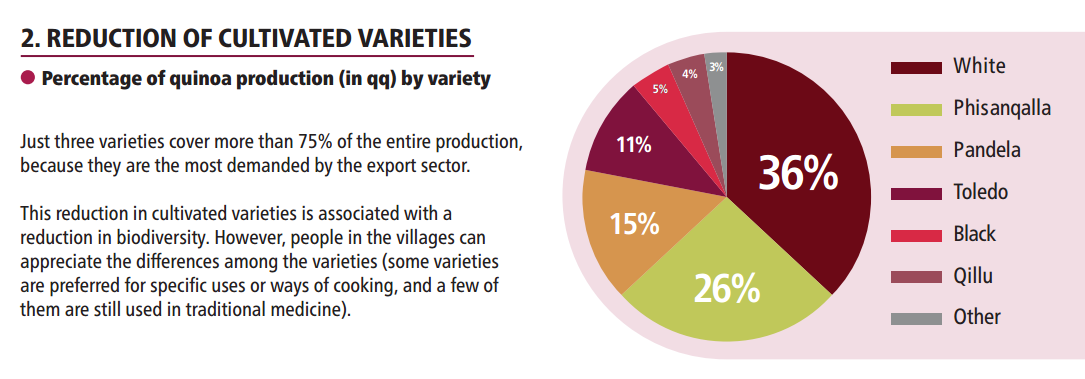
Meanwhile, growing such large amounts of quinoa has been degrading the Andean soil: even the FAO outlines concerns for biodiversity, while otherwise touting the phenomenon.
7

While efforts have been put in place by farmer unions, cooperatives and development initiatives to mitigate some negative effects on the primary producers of quinoa, they have not been enough to protect the food security of these Andean farmers. Increased consumer consciousness is therefore essential in ensuring that these farmers don’t continue to suffer because of Western dietary fads.

Cross-posted at Sociology Lens.

Aarushi Bhandari is a doctoral student at Stony Brook University interested in globalization and the impact of neoliberal policies on the developing world. She wants to study global food security within a global neoliberal framework and the world systems perspective.

In the working and middle class neighborhoods of many Southern cities, you fill find rows of “shotgun” houses. These houses are long and narrow, consisting of three or more rooms in a row. Originally, there would have been no indoor plumbing — they date back to the early 1800s in the U.S. — and, so, no bathroom or kitchen.

Here’s a photograph of a shotgun house I took in the 7th ward of New Orleans. It gives you an idea of just how skinny they are.

1c

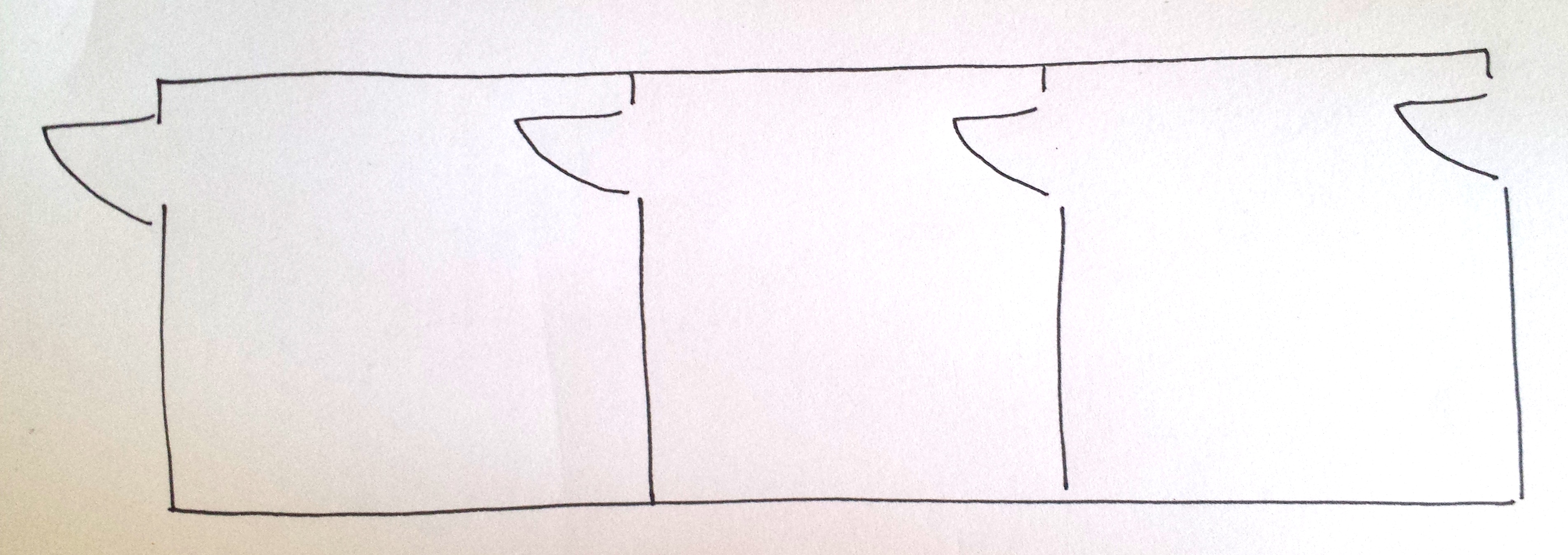
In a traditional shotgun house, there are no hallways, just doors that take a person from one room to the next. Here’s my rendition of a shotgun floor plan; doors are usually all in a row:

20150411_155115

At nola.com, Richard Campanella describes the possible origins and sociological significance of this housing form. He follows folklorist John Michael Vlach, who has argued that shotgun houses are indigenous to Western and Central Africa, arriving in the American South via Haiti. Campella writes:

Vlach hypothesizes that the 1809 exodus of Haitians to New Orleans after the St. Domingue slave insurrection of 1791 to 1803 brought this vernacular house type to the banks of the Mississippi.

In New Orleans, shotgun houses are found in the parts of town originally settled by free people of color, people who would have identified as Creole, and a variety of immigrants. Outside of New Orleans, we tend to see shotgun houses in places with large black populations.

The house, though, doesn’t just represent a building technique, it tells a story about how families were expected to interact. Shotgun houses offer essentially zero privacy. Everyone has to tromp through everyone’s room to get around the house. There’s no expectation that a child won’t just walk into their parents’ room at literally any time, or vice versa. There’s no way around it.

“According to some theories,” then, Campanella says:

…cultures that produced shotgun houses… tended to be more gregarious, or at least unwilling to sacrifice valuable living space for the purpose of occasional passage.

Cultures that valued privacy, on the other hand, were willing to make this trade-off.

Sure enough, in the part of New Orleans settled by people of Anglo-Saxon descent, shotgun houses are much less common and, instead, homes are more “privacy-conscious.”

Over time, as even New Orleans became more and more culturally Anglo-Saxon — and as the housing form increasingly became associated with poverty — shotguns fell out of favor.  They’re enjoying a renaissance today but, as Campanella notes, many renovations of these historic buildings include a fancy, new hallway.

Lisa Wade, PhD is an Associate Professor at Tulane University. She is the author of American Hookup, a book about college sexual culture; a textbook about gender; and a forthcoming introductory text: Terrible Magnificent Sociology. You can follow her on Twitter and Instagram.

A comic by Tom Gauld.

Lisa Wade, PhD is an Associate Professor at Tulane University. She is the author of American Hookup, a book about college sexual culture; a textbook about gender; and a forthcoming introductory text: Terrible Magnificent Sociology. You can follow her on Twitter and Instagram.

Flashback Friday.

Behold, the taken-for-granted, unexceptional:

Cropped version of image by XoMEox, Flickr Creative Commons

Until last week I had never truly thought about shopping carts. I mean, I occasionally notice one stranded in an unexpected place, and as a kid I loved the occasional chance I had to push one a bit and then jump on and race down an aisle. But I read Cheap: The High Cost of Discount Culture by Ellen Ruppel Shell, and it turns out that the story of the shopping cart is fascinating!

Way back in the day, stores weren’t like they were today. You went in and there was a long counter and you had the clerk show you the wares. If you’ve read some Jane Austen or Laura Ingalls Wilder, you’ve undoubtedly come across a scene where a clerk is showing someone bolts of cloth. That’s how things worked: almost everything was behind the counter; you told the clerk what you were interested in and they showed you your options. You haggled over the price, decided on a nice gingham, the clerk wrapped it for you, and off you went. Most retail outlets worked more or less along these lines (think of a butcher, for instance).

But if you were a shop owner interested in keeping prices down, this situation might be less than ideal. It required a lot of clerks, and experienced clerks who knew all the goods and could be trusted to set an acceptably profitable price for them, too.

Eventually retailers, including F.W. Woolworth, tried putting more products out on display in the store so customers could help themselves. Some customers liked the ability to pick items off the shelves directly, but more importantly, you didn’t need as many clerks, and certainly not such highly-paid ones, if their job was mostly reduced to ringing up the purchases at the register.

Of course, this presents a new problem: how are customers going to carry all their purchases around the store while they make their selections? Well, a basket they could carry over an arm would work. But these baskets had a downside: they didn’t hold much and they quickly got heavy.

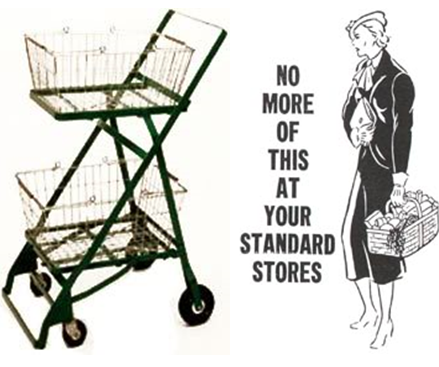
As Shell notes, in 1937 a man from my home state of Oklahoma, Sylvan Goldman, came up with a solution. He owned the Humpty-Dumpty grocery store chain (I still remember Humpty-Dumpty!). He and a mechanic he hired came up with a cart on which two shopping baskets could be suspended. And thus the shopping cart — or, as Goldman named it, the “folding basket carrier” — was born. As Goldman suspected, people bought more when they didn’t have to carry a heavy basket on their arm. The folding basket carrier was advertised as a solution to the burden of shopping:

10

The only problem was…people didn’t like the new contraptions. From a 1977 interview (via):

I went into our largest store, there wasn’t a soul using a basket carrier, and we had an attractive girl by the entrance that had a basket carrier and two baskets in it, one on the top and one on the bottom, and asked them to please take this cart to do your shopping with. And the housewive’s, most of them decided, “No more carts for me. I have been pushing enough baby carriages. I don’t want to push anymore.” And the men would say, “You mean with my big strong arms I can’t carry a darn little basket like that?” And he wouldn’t touch it. It was a complete flop.

Goldman eventually had to hire attractive models to walk around the store pushing the carts to make shopping carts seem like an acceptable or even fashionable item to use.

Over time the basic design was changed to have a single basket, with a flat shelf on the bottom for large items. The baskets could also then “nest” inside each other (instead of being folded up individually), reducing the amount of space they required for storage.

The Baby Boom ushered in the final major design change, a seat for kids.

Notice in the image above how small the cart was compared to what we’re used to today. I remember as a kid going to the local grocery store, and the carts were quite small; eventually a big warehouse-type grocery store came to the nearest city and their baskets seemed gigantic in comparison. Because obviously, if people will buy more if they have a cart instead of a full arm-carried basket, they’ll buy even more if they have a bigger cart — not just because there’s more room, but because it seems like less stuff if it’s in a bigger cart. Restaurants discovered the same principle — people will want bigger portions if you give them bigger plates because it visually looks like less food and so they don’t feel like they’re over-eating.

Without enormous carts, Big Box discounters and wholesale club stores couldn’t exist. You can’t carry a box of 50 packages of Ramen noodles, 36 rolls of toilet paper, a box of 3 gallons of milk, enough soup for the entire winter, and a DVD player you just found on sale around without a huge cart.

So there you have it: labor de-skilling + marketing – stigma of feminine association + Baby Boom + profits based on increased purchasing of ever-cheaper stuff = the modern shopping cart!

I love it when I learn totally new stuff.

Originally posted in 2009.

Gwen Sharp is an associate professor of sociology at Nevada State College. You can follow her on Twitter at @gwensharpnv.

This story from Daily Kos has been quickly circling through the left portion of the Internet. The headline reads:

American police killed more people in March (111) than the entire U.K. police have killed since 1900.

Let’s assume that the numbers are accurate.*

The author, Shaun King, writes:

Don’t bother adjusting for population differences, or poverty, or mental illness, or anything else. The sheer fact that American police kill TWICE as many people per month as police have killed in the modern history of the United Kingdom is sick, preposterous, and alarming.

But let’s bother adjusting, anyway.

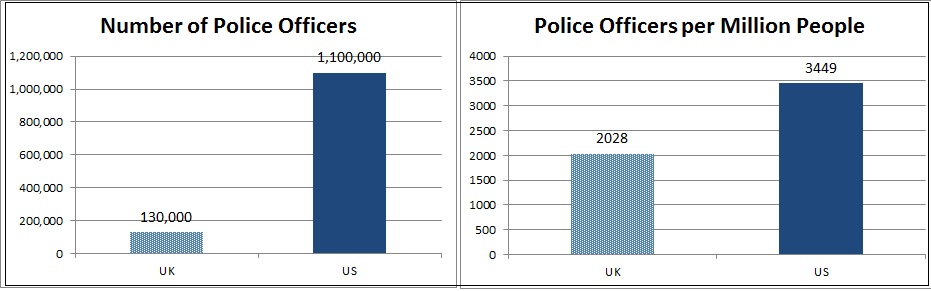
The U.S. has a much larger population, and it has more police officers:2

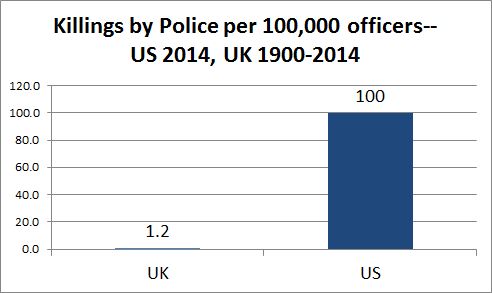
…but even adjusting for that, the U.S. killings by cops dwarf the U.K. figure.**12

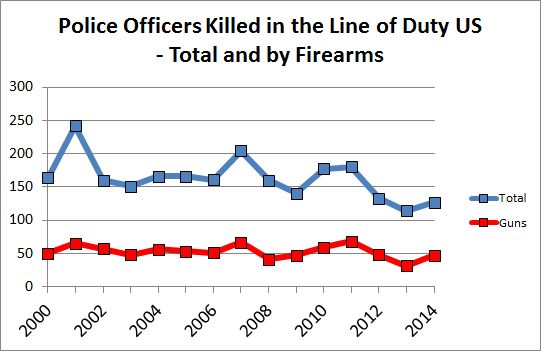
Adjusting for the number of cops, U.S. cops killed 8 times as many people in a single year as U.K. cops did in 115 years. But before we conclude that U.S. law enforcement is “sick and preposterous” and dominated by homicidal racists, we might look at the other side – the number of cops who get killed. The entire U.K. police force since 1900 has had 249 deaths in the line of duty. The U.S. tally eclipses that in a couple of years.14

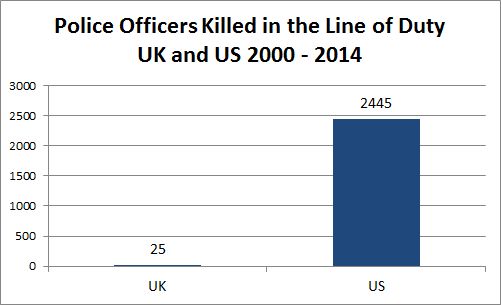
In this century, 25 U.K. officers died in the line of duty. The figure for the U.S., 2445, is nearly one hundred times that. Adjusting for numbers of officers, U.S. deaths are still ten times higher.

My guess is that what accounts for much of the U.K./U.S. difference is guns. Most British cops don’t carry guns. Last August, I posted a video of a berserk man wildly swinging a machete in a London street (here – it’s gotten over 25,000 page views ). The police come, armed only with protective shields and truncheons. Eventually, they are able to subdue the man. In the U.S., it’s almost certain that the police would have shot the man, and it would have been completely justifiable. More cops with guns, more cops killing people.

But more civilians with guns, more cops getting killed. Since 2000, six U.K. cops have died from gunshots; in the U.S., 788.  We have 11 times as many cops, but 130 times as many killed by guns. (The other two leading causes of police deaths are heart attacks and car accidents.)777

(I did not include the yearly data for the UK since it would not have been visible on the graph. In most years, total cop deaths there ranged between 0 and 2.)

Thanks to the ceaseless efforts of gun manufacturers and their minions in legislatures and in the NRA and elsewhere, U.S. cops work in a gun-rich environment. They feel, probably correctly, that they need to carry guns. If that man in London had been wielding an AR-15 (easily available in many states in the U.S. – in the U.K., not so much, not at all in fact), the cops could not have responded as they did. They would have needed guns. There would probably have been some dead civilians, perhaps some dead cops, and almost certainly, a dead berserker.

Cross-posted at Montclair SocioBlog.

—————-

* We don’t have a good source of data on how many people the police kill. An unofficial source since 2013 is KilledByPolice.net.

** The denominator for the U.K. – the number of police officers over the last 115 years  – is my own very rough estimate.

Jay Livingston is the chair of the Sociology Department at Montclair State University. You can follow him at Montclair SocioBlog or on Twitter.

The White House has made preventing sexual assaults on college campuses a priority, The Hunting Ground documents extensive institutional denial and malfeasance, the Department of Justice finds that one in five college women are assaulted, research shows that 1 in 25 college men is a serial rapist, and students at almost 100 campuses have filed federal complaints against their schools.

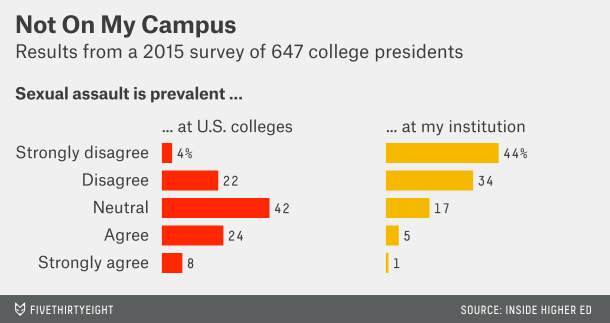
Yet, according to a study of 647 college presidents, only a third (32%) believe that sexual assault is prevalent on college campuses in general and only a tiny minority (6%) think it’s prevalent on their own campus.

13

This is stunning. Never before in history has the problem of sexual assault on campus been better documented. The media has never covered the issue so thoroughly, frequently, and sympathetically. We are in a moment of national reflection. Under these circumstances, a quarter of college presidents claim that sexual assault isn’t prevalent anywhere and 78% deny that it’s prevalent on their own campus.

These were confidential surveys, so impression management can’t explain these numbers. Those 94% of college presidents who don’t think that sexual crimes are prevalent at their schools either think the numbers are wrong, think their own institutions are exceptions, or think that one in five isn’t fairly described as “prevalent.” Or maybe some combination of the above.

No wonder faculty are frustrated and students around the country have felt forced to turn to the federal government for help. It’s clear. College presidents are either recklessly ignorant or willfully in denial — that, or they simply don’t believe women or don’t care about them.

Lisa Wade, PhD is an Associate Professor at Tulane University. She is the author of American Hookup, a book about college sexual culture; a textbook about gender; and a forthcoming introductory text: Terrible Magnificent Sociology. You can follow her on Twitter and Instagram.

According to the U.S. Bureau of Labor Statistics, fully employed women earn $0.81 for every dollar men make. Some of this discrepancy is due to women working in male dominated occupations, but when men work alongside women in female-dominated occupations, they still earn more.

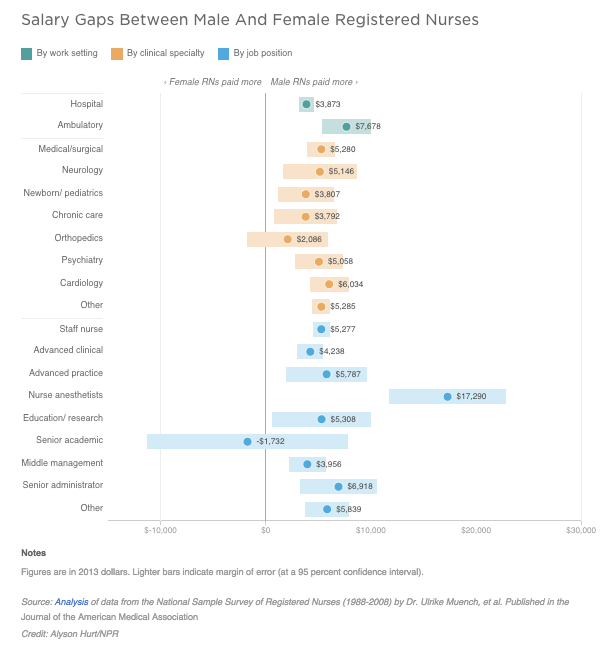
Nursing is this week’s example. According to a new study in the Journal of the American Medical Association, male nurses out earn female nurses in every work setting, every clinical setting, and every job position except one.

17

On average, male nurses make $5,100 more a year than female ones. In the specialty with the biggest discrepancy, nurse anesthetists, they out earned women by $17,290. More at NPR and the New York Times.

Lisa Wade, PhD is an Associate Professor at Tulane University. She is the author of American Hookup, a book about college sexual culture; a textbook about gender; and a forthcoming introductory text: Terrible Magnificent Sociology. You can follow her on Twitter and Instagram.

Sociologists are interested in the workings of power. How is inequality produced and sustained? What discursive and institutional forces uphold it? How are obvious injustices made invisible or legitimized? Why is it so hard to change hearts, minds, and societies?

How does all this work?

Earlier this month, a sliver of insight was posted. It’s a clip of a speech by Anita Sarkeesian in which she reveals what it’s like for one person to be the target of sustained, online harassment.

In 2009, Sarkeesian launched Feminist Frequency, a series of web logs in which she made feminist arguments about representation of women in pop culture. In 2012, she launched a kickstarter to fund an ambitious plan to analyze the representation of women in video games. This drew the attention of gamers who opposed her project on principle and thus began an onslaught of abuse: daily insults and threats of rape and murder, photoshop harassment, bomb threats, and a video game in which her face can be beaten bloody, just to mention a few examples. Last fall she canceled a speech at Utah State University because someone threatened to commit “the deadliest school shooting in American history” if she went on. It’s been brutal and it’s never stopped.

So, is this power at work? Has she been silenced? And has her larger project – awareness of sexism and misogyny in video games – been harmed?

I’m not sure.

As an individual, Sarkeesian has continued to speak out about the issue, but how she does so and with what frequency has been aggressively curtailed by the harassment. In the four-and-a-half minute clip, with the theme “What I Couldn’t Say,” she talks about how the harassment has changed how she engages with the public. I offer some tidbits below, but here’s the full clip:

She explains:

I rarely feel comfortable speaking spontaneously in public spaces, I’m intentional and careful about the  media interviews I do, I decline  most invitations to be on podcasts or web shows, I carefully consider the wording of every tweet to make sure it is clear and can’t be misconstrued. Over the last several years, I’ve become hypervigilant. My life, my words, and my actions are placed under a magnifying glass. Every day I see my words scrutinized, twisted, and distorted by thousands of men hell bent on destroying and silencing me.

How she gets her message across has been affected as well:

[I cant’ say] anything funny… I almost never make jokes anymore on YouTube… I don’t do it because viewers often interpret humor and sarcasm as ignorance… You would not believe how often jokes are taken as proof that I don’t know what I’m talking about… even when those jokes rely on a deep knowledge of the source material.

And she feels that, above all, she’s not allowed to talk about the harm that her harassers are doing:

I don’t’ get to publicly express sadness, or rage, or exhaustion, or anxiety, or depression… I don’t get to express feelings of fear or how tiring it is to be constantly vigilant of my physical and digital surroundings… In our society, women are not allowed to express feelings without being characterized as hysterical, erratic bitchy, highly emotional, or overly sensitive. Our experiences of insecurity, doubt, anger, or sadness are all policed and often used against us.

A youtube search for the video reveals a slew of anti-Sarkeesian responses were published within days.

——————–

Sarkeesian’s revelations put an inspiring human face on the sacrifice individuals make to fight-the-good-fight, but also reveal that, in some ways, her harassers are winning.

That said, their grotesque display of misogyny has raised Sarkeesian’s profile and drawn attention to and legitimized her project and her message. That original kickstarter? The original call was for $6,000. Her supporters donated almost $159,000. The feminist backlash to the misogynist backlash was swift and monied.

Ever since, the abuse she’s suffered as an individual has made the issue of both sexism in video games and online harassment more visible. Her pain may have been good for the visibility of the movement. I wonder, though, what message it sends to other women and men who want to pursue similar social justice initiatives. It is a cautionary tale that may dampen others’ willingness to fight.

The battle is real. The gamers who oppose Sarkeesian and what she stands for have succeeded in quieting, if not silencing her and have probably discouraged others from entering the fray. But Sarkeesian’s cause and the problem of gamer misogyny is more visible than ever. The fight goes on.

Lisa Wade, PhD is an Associate Professor at Tulane University. She is the author of American Hookup, a book about college sexual culture; a textbook about gender; and a forthcoming introductory text: Terrible Magnificent Sociology. You can follow her on Twitter and Instagram.