Search results for The

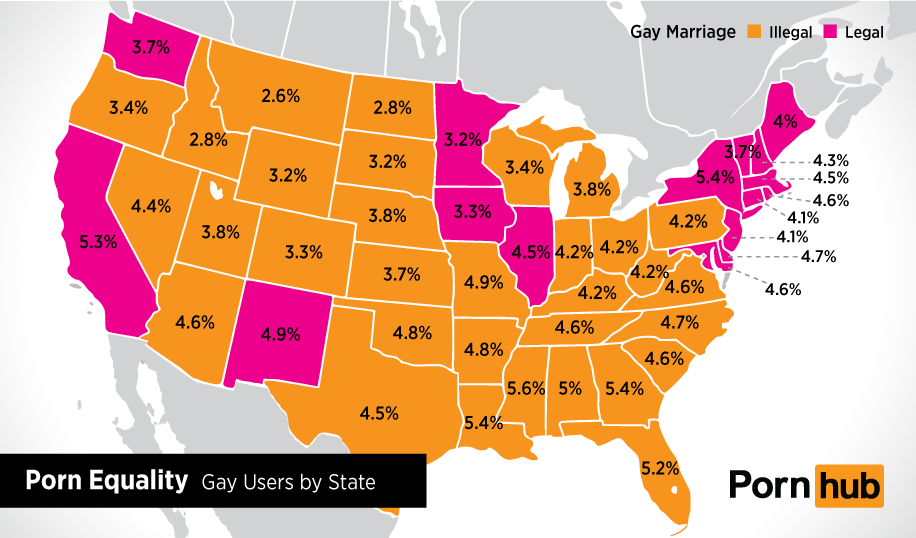
According to data released by Pornhub, 5.6% of porn users in Mississippi seek out gay porn, compared to 2.8% in North Dakota.
4

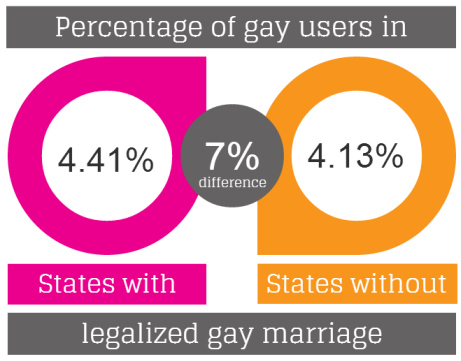
On average, gay porn is more heavily consumed in states where same-sex marriage is legal than in states where it’s illegal, but every single state in the South has a gay porn use that exceeds the average in states with same-sex marriage.
1aFor me, this raises questions about what’s driving sentiment against same-sex marriage and porn use and if and why it’s related. I can think of at least three theories:

1. There is the (barely) repressed homosexuality theory, of course. This is the idea that some people express homophobic attitudes because they fear being non-heterosexual themselves. So, out of fear of exposure, or fear of their own feelings, they are vocally anti-LGBT rights. There’s data that backs this up in at least some cases.

2. Another possibility is that both homosexual inclinations and anti-gay hatred are high in Southern states, but not in the same people. This is one version of the contact hypothesis: the presence and visibility of gay, lesbian, and bisexual people threatens the norm of heterosexuality, increasing opposition. This is consistent with data showing, for example, that white racial resentment is higher in counties with larger populations of black folk.

3. Or, it may be that politicians in Southern states stoke anti-gay attitudes in order to win elections. They may be doing so as a simple strategy. Or, it may be part of that notorious “culture war,” a politics that supposedly distracts poor and working class people from their own economic interests by getting them to focus on so-called social issues like abortion and same-sex marriage.

As fun as it is to snicker at the fact that the part of the country that claims a moral high ground on homosexuality is over-represented in pursuing it (at least digitally), there’s also probably some pretty interesting social/psychology sociology here.

Cross-posted at Pacific Standard.

Lisa Wade, PhD is an Associate Professor at Tulane University. She is the author of American Hookup, a book about college sexual culture; a textbook about gender; and a forthcoming introductory text: Terrible Magnificent Sociology. You can follow her on Twitter and Instagram.
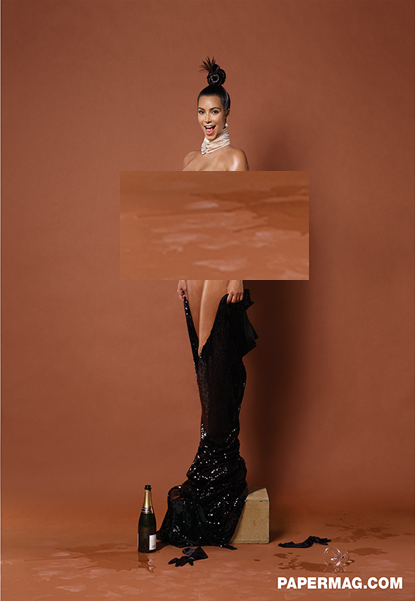
In 1975, Mulvey conceptualized the gaze as the power derived by the viewer when they cast their glance upon a hierarchized, usually female, body. This idea perfectly captures the way a subject on film is both frozen in a time and space, and consumed. I want to turn that around, in a more kyriarchal and postmodern fashion, and allot power to the subject.

Refinery 29 has a series of photographs by Blaise Cepis. Through them, women discuss and display their body hair.  In a beautifully hued array, these women speak of personal choice, empowerment and acceptance in ways that act as a counternarrative to the Brazilian-plucked-chicken-prepubescent-non-mammal-landscaping construct that is currently in vogue.

And yet. Yet. Among this abundance of hairy joy – there is no direct gaze. Among the 21 slides there are faces in profile, lower portions of faces, averted glances with pupils looking away. There is only one woman directly glancing at the viewer, and even as her defiant brows dominate her face she is neither fully seen nor subsequently fully known. Also, nowhere in the 21 slides does the women’s whole body occupy the visual frame. The pictures show a bushy underarm with barely a chest wall or breast, a lushly forested pudenda without whole legs or torso, or a lightly furred arm without a hand attached.

Counter this power and gaze conundrum with Kim Kardashian’s photoessay for Paper’s Winter issue where she appears, full frontal, body hair free, and fully faced. With the hashtag #breaktheinternet, the intent of the shoot is clear. Neither during the photoshoot’s extended video interview or the accompanying print piece does Kardashian invoke feminism’s ideals of choice, power or acceptance. Yet, in her direct gaze and whole body there is a definitive power of being fully present in the visual medium.

Censored to be safe for work, but you can see the original here:5

In his classic Disidentifications, Munoz interrogates the intersections between queer theory and life as performance to illustrate the ways hegemony is constructed. All the women in the photoessay above are performing: to disrupt a gaze by capturing the consumer; to deliver through visual imagery a counternarrative to normed assumptions; to shine a spotlight upon their bodies so that other stories can be told about them that subsequently reflect the world. These are all photos of “naked women”, but they are not equal in power.

Make no mistake, Kardashian’s photoshoot does not aspire to be anything but  performance – a denuded spectacle that we can believe – illustrating her power to create reverberating social narratives. But the theme of empowered, hirsuit women who embrace the social, sexual, and personal repercussions of their decision is undercut by the disembodied visual presentation. The power of these women has no whole body in which to reside. They are intended to be read as both brave and everyday, but they are visually reduced to decontextualized hair clumps; the performances of pride do not ring true because the viewer does not witness the incorporation of their body pride into a fully human landscape. Frankly, if women are going to “grow hair there” – we need to fully embody it.

Cross-posted at Pacific Standard.

Kerrita K. Mayfield, PhD is an experienced social justice oriented educator and teacher trainer, with over 20 years working in urban and rural classrooms and alternative educational settings. Currently teaching ESL at UMass Amherst to liminal non-benefitted workers, she was the first student to earn a graduate minor in Women’s Studies at the University of Wyoming.

A new study led by philosopher Sarah-Jane Leslie challenges the idea that women are underrepresented in STEM fields. They first note that there are some STEM fields where women do well (they are 54% of molecular biologists, for example) and some humanities fields where they don’t (they are only 31% of philosophers). Something else, they gathered, must be going on.

They had a hunch. They asked 1,820 U.S. academics what it took to be successful in their field. They were particularly interested in answers that suggested hard work and ones that invoked brilliance.

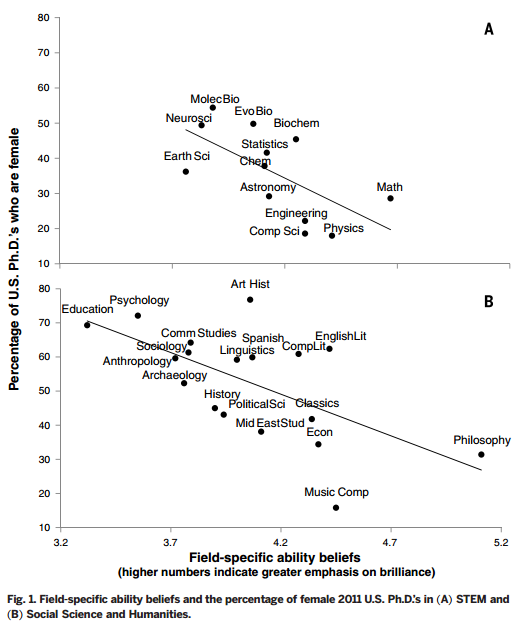
Their results showed a clear relationship between the presence of women in a field and the assumption that success required brilliance.  The downward sloping line represents the proportion of female PhDs in stem fields (top) and social science and humanities fields (bottom) as they become increasingly associated with brilliance:

5

Interviewed at Huffington Post, Leslie says:

Cultural associations link men, but not women, with raw intellectual brilliance… consider, for example, how difficult it is to think of even a single pop-cultural portrayal of a woman who displays that same special spark of innate, unschooled genius as Sherlock Holmes or Dr. House from the show “House M.D.,” or Will Hunting from the movie “Good Will Hunting.”

In contrast, accomplished women are often portrayed as very hard working (and often having given up on marriage and children, I’ll add). She continues:

In this way, women’s accomplishments are seen as grounded in long hours, poring over books, rather than in some special raw effortless brilliance.

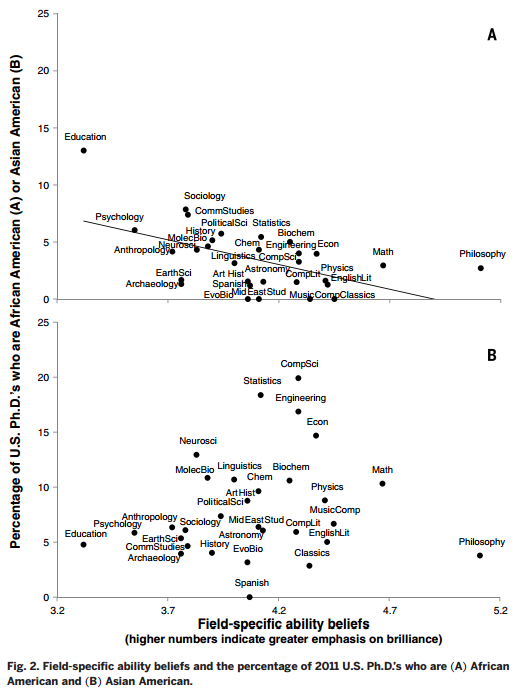
They extended their findings to race, testing whether the relationship held for African Americans, another group often stereotyped as less intelligent, and Asians, a group that attracts the opposite stereotype. As hypothesized, they found the relationship for the first group, but not the second (note the truncated y-axis).

6

The long term solution to this problem, of course, is to end white and Asian men’s claim on brilliance. In the meantime, the research team suggests, it may be a good idea to stop talking about some fields as if they’re the rightful home of the naturally brilliant and start advocating hard work for everyone.

Cross-posted at Pacific Standard.

Lisa Wade, PhD is an Associate Professor at Tulane University. She is the author of American Hookup, a book about college sexual culture; a textbook about gender; and a forthcoming introductory text: Terrible Magnificent Sociology. You can follow her on Twitter and Instagram.
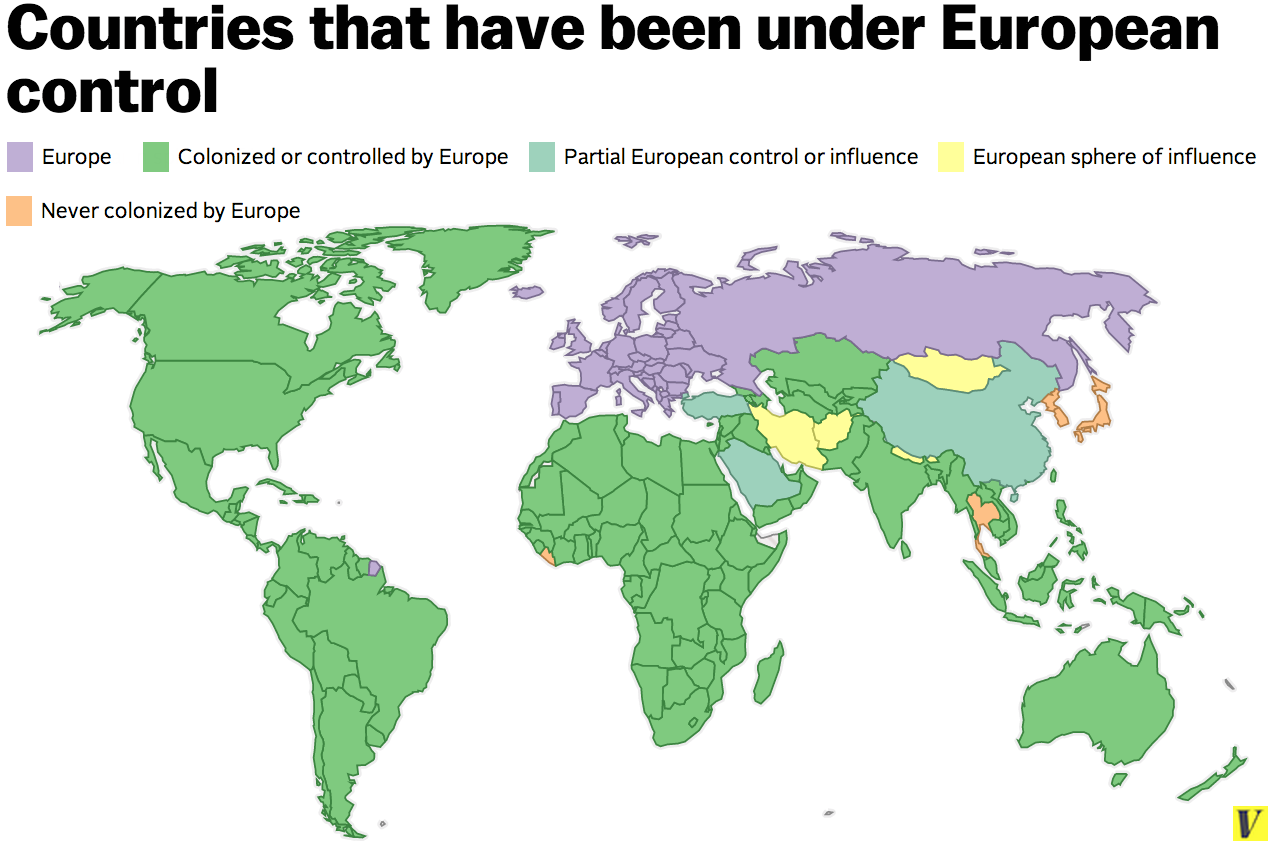
This is a map of the countries Europe colonized, controlled, or influenced between 1500 and 1960. The purple is Europe. The orange countries are ones never under European rule. Almost the entire rest of the map — all the green, blue, and yellow — were dominated by Europe to some extent. “Influenced” is pretty much a euphemism and often not all that different than outright domination.

15

Max Fisher, writing at Vox, summarizes:

There are only four countries that escaped European colonialism completely. Japan and Korea successfully staved off European domination, in part due to their strength and diplomacy, their isolationist policies, and perhaps their distance. Thailand was spared when the British and French Empires decided to let it remained independent as a buffer between British-controlled Burma and French Indochina…

Then there is Liberia, which European powers spared because the United States backed the Liberian state, which was established in the early 1800s by freed American slaves who had decided to move to Africa.

More details and discussion at here.

Lisa Wade, PhD is an Associate Professor at Tulane University. She is the author of American Hookup, a book about college sexual culture; a textbook about gender; and a forthcoming introductory text: Terrible Magnificent Sociology. You can follow her on Twitter and Instagram.
Flashback Friday.

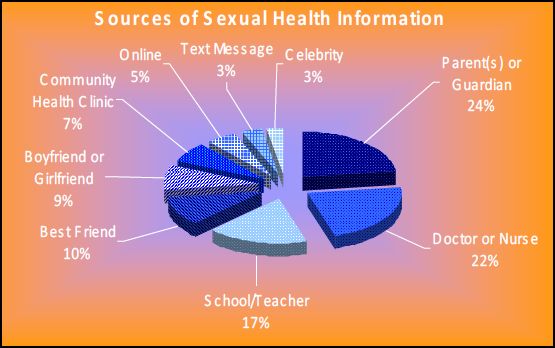
The D.C. Council’s Committee on Health released a report after surveying high school students about sex education. One of their questions was about the source of sexual health information. The pie chart below shows that students name, in order, their parents or guardians, health workers, teachers, friends, and boyfriends or girlfriends as the most common sources of information.

Capture

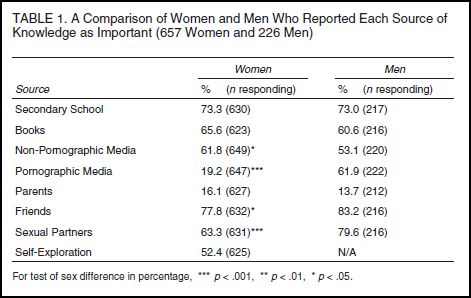
I asked a similar question in a study I did with college students (full text). The students in my sample rated their friends, secondary school teachers, books, their sexual partners, and the media as their most important sources. Men also included pornography. Very few students counted parents among their most valued sources. (Significance indicators are for sex difference.)

Capture1

My co-authors and I were interested in how those sources correlated with actual knowledge, specifically knowledge about the clitoris. And so we gave them a “cliteracy test,” we had them answer a set of true/false questions about the clitoris and find it on a diagram of the vulva.

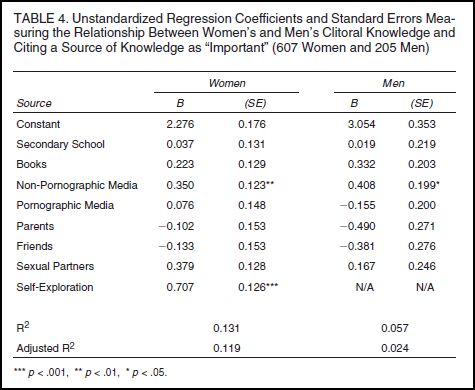
We then compared their scores on the test to their reported sources of knowledge. The table below is a regression showing which sources of knowledge were most predictive of a high score. The findings were interesting: only two sources predicted significantly higher scores on the test: media (for men and women) and self-exploration (for women).

Capture2

So, only one of the most frequently used sources of information, media, actually translated into real knowledge. And, ironically, the best source of information for women, their own bodies, was among the least often cited source of information for women, beating out only pornography and parents.

In other words, the best source of information about the clitoris is probably the… clitoris, but female college students would rather read books to learn about it.

This puts the D.C. study into some perspective.  The high school students in that study reported that their parents or guardians, health workers, teachers, friends, and boyfriends or girlfriends were sources of sexual information, but that doesn’t mean that they are good sources. It could be that they’re giving them misinformation or good information only about certain things.

Originally posted in 2009. You can see a summary of our findings on the correlation (or lack thereof) between knowledge about the clitoris and orgasm for women here.

Lisa Wade, PhD is an Associate Professor at Tulane University. She is the author of American Hookup, a book about college sexual culture; a textbook about gender; and a forthcoming introductory text: Terrible Magnificent Sociology. You can follow her on Twitter and Instagram.
“No. We’re Italian. We don’t Irish dance,” said Kristi Corcione’s mother in 1973. The proscription wouldn’t last a generation. Today her daughter trains for the World Irish Dance Championships.

Irish dance has left Ireland and the ethnic communities in which it used to be quietly practiced.

Irish dancing schools have sprung up in Israel, Japan, Norway, Romania, Russia and many other countries not known for their Irish populations. Competitions… can now be found in Hong Kong, Prague and St. Petersburg, among other far-flung cities. More than 5,000 competitors from 20 countries are expected in April at this year’s World Championships in London.

At the New York Times, Siobhan Burke gives the credit to Riverdance, a phenom that “exporting [Irish dance] to an international audience of more than 24 million.”

The spread of Irish dance is a great example of the social construction and evolution of our invented concepts of race and ethnicity.

When it was whites who made up the majority of U.S. immigrants, it really mattered if you were Irish, Italian, or some other white ethnicity. The Irish, in particular, were denigrated and dehumanized. If one wasn’t Irish, it certainly wasn’t a group that most people would want to associate themselves with.

Over generations, though, and as new immigrant groups came in and were contrasted to Europeans, the distinctions between white ethnics began to fade. Eventually, ethnicity became optional for white people. They could claim an ethnicity, or several, of their choice; others would accept whatever they said without argument; or they could say they were just American.

Once the distinctions no longer mattered and the stigma of being Irish had faded, then Irish dance could be something anyone did and others would want to do. And, so, now anyone does. The three-time winner of the All-Ireland Dancing Championship in Dublin is a biracial, black, Jewish kid from Ohio.

Today, the big Irish dance production is “Heartbeat of Home,” a show that Burke describes as a “multicultural fusion” that delivers “plenty of solid Irish dance steps.” Irish dance is evolving, borrowing and melding with other cultural traditions — and it increasingly belongs to everyone — in the great drama of ethnic and racial invention and re-invention.

Thanks so much to @Mandahl, a proud grandmother of two world class Irish dancers, for suggesting I write about this!

Lisa Wade, PhD is an Associate Professor at Tulane University. She is the author of American Hookup, a book about college sexual culture; a textbook about gender; and a forthcoming introductory text: Terrible Magnificent Sociology. You can follow her on Twitter and Instagram.
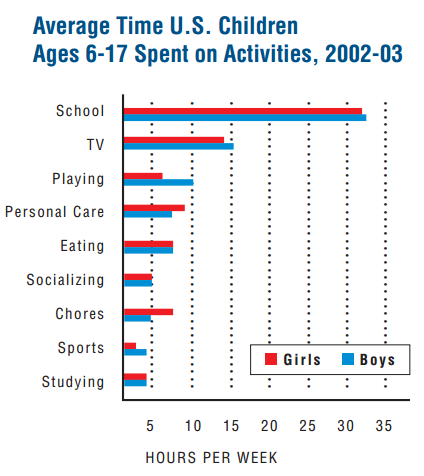
Girls do more chores than boys and are less likely to get an allowance in exchange for their work. When they do, they are paid less.

Research projects on children’s time use find that boys do 43 to 46 minutes of housework for every hour that girls do. When asked to list the chores they do, girls list 42 percent more chores than boys. Girls are as likely as boys to participate in outside chores and more likely to clean their own rooms, help prepare meals, and care for sibling and pets; the only thing boys report doing more often than girls is basic housecleaning.

3

Another study by the children’s magazine Highlights confirmed the finding: 73 percent of their girl readers reported being assigned routine chores, compared to 65 percent of their boy readers. Girls spend more time on chores than they do playing; the opposite is true for boys.

Not only are girls more likely to be asked to help out around the house, they are less likely to get paid. The Michigan study found that boys are 15 percent more likely than girls to get an allowance for the chores they do. And when they do get paid, they get a lower wage than their brothers. Male babysitters get paid $0.50 more an hour than females. Girls do 35 percent more work than boys, but bring home only $0.73 cents on boys’ dollar.

The gender pay gap starts early.

Cross-posted at Pacific Standard and Business Insider.

Lisa Wade, PhD is an Associate Professor at Tulane University. She is the author of American Hookup, a book about college sexual culture; a textbook about gender; and a forthcoming introductory text: Terrible Magnificent Sociology. You can follow her on Twitter and Instagram.
Well done, Joy Regullano, well done:

Lisa Wade, PhD is an Associate Professor at Tulane University. She is the author of American Hookup, a book about college sexual culture; a textbook about gender; and a forthcoming introductory text: Terrible Magnificent Sociology. You can follow her on Twitter and Instagram.