Search results for The

Cross-posted at Family Inequality.

The other day I was surprised that a group of reporters failed to call out what seemed to be an obvious exaggeration by Republican Congresspeople in a press conference. Did the reporters not realize that a 25% unemployment rate among college graduates in 2013 is implausible, were they not paying attention, or do they just assume they’re being fed lies all the time so they don’t bother?

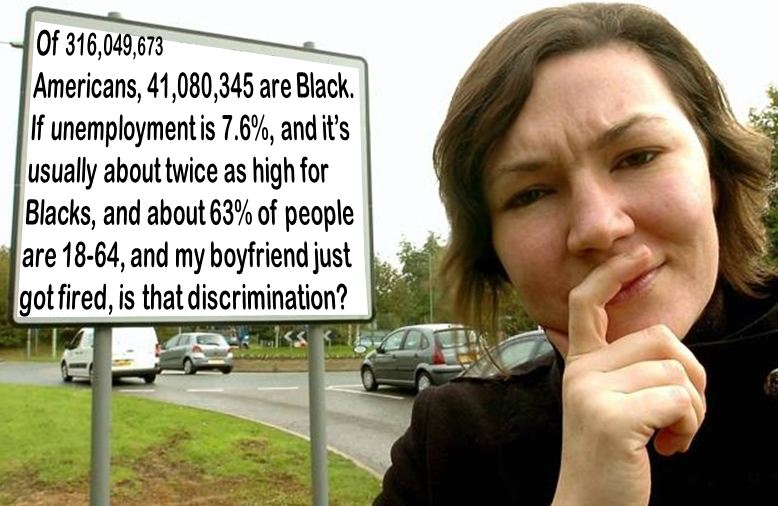
Last semester I launched an aggressive campaign to teach the undergraduate students in my class the size of the US population. If you don’t know that – and some large portion of them didn’t – how can you interpret statements such as, “On average, 24 people per minute are victims of rape, physical violence, or stalking by an intimate partner in the United States.” In this case the source followed up with, “Over the course of a year, that equals more than 12 million women and men.” But, is that a lot? It’s a lot more in the United States than it would be in China. (Unless you go with, “any rape is too many,” in which case why use a number at all?)
1

Anyway, just the US population isn’t enough. I decided to start a list of current demographic facts you need to know just to get through the day without being grossly misled or misinformed – or, in the case of journalists or teachers or social scientists, not to allow your audience to be grossly misled or misinformed. Not trivia that makes a point or statistics that are shocking, but the non-sensational information you need to know to make sense of those things when other people use them. And it’s really a ballpark requirement; when I tested the undergraduates, I gave them credit if they were within 20% of the US population – that’s anywhere between 250 million and 380 million!

I only got as far as 22 facts, but they should probably be somewhere in any top-100. And the silent reporters the other day made me realize I can’t let the perfect be the enemy of the good here. I’m open to suggestions for others (or other lists if they’re out there).

They refer to the US unless otherwise noted:

Description Number Source
World Population 7 billion 1
US Population 316 million 1
Children under 18 as share of pop. 24% 2
Adults 65+ as share of pop. 13% 2
Unemployment rate 7.6% 3
Unemployment rate range, 1970-2013 4% – 11% 4
Non-Hispanic Whites as share of pop. 63% 2
Blacks as share of pop. 13% 2
Hispanics as share of pop. 17% 2
Asians as share of pop. 5% 2
American Indians as share of pop. 1% 2
Immigrants as share of pop 13% 2
Adults with BA or higher 28% 2
Median household income $53,000 2
Most populous country, China 1.3 billion 5
2nd most populous country, India 1.2 billion 5
3rd most populous country, USA 315 million 5
4th most populous country, Indonesia 250 million 5
5th most populous country, Brazil 200 million 5
Male life expectancy at birth 76 6
Female life expectancy at birth 81 6
National life expectancy range 49 – 84 7

Sources:
1. http://www.census.gov/main/www/popclock.html
2. http://quickfacts.census.gov/qfd/states/00000.html
3. http://www.bls.gov/
4. Google public data: http://bit.ly/UVmeS3
5. https://www.cia.gov/library/publications/the-world-factbook/rankorder/2119rank.html
6. http://www.cdc.gov/nchs/hus/contents2011.htm#021
7. https://www.cia.gov/library/publications/the-world-factbook/rankorder/2102rank.html

Philip N. Cohen is a professor of sociology at the University of Maryland, College Park, and writes the blog Family Inequality. You can follow him on Twitter or Facebook.


Re-posted in honor of the 19 firefighters who lost their lives in Arizona yesterday. Cross-posted at BlogHer and The Huffington Post.

Firefighters put their lives on the line to protect other people’s property and lives.  Why do they choose to take such dangerous work?  Sociologist Matthew Desmond asks this question in his book, On the Fireline: Living and Dying with Wildland Firefighters, and the answer is truly surprising.

Desmond, who put himself through college fighting fires in Arizona, returned to his old job as a graduate student in order to study his fellow firefighters.  When he asked them why they were willing to put their lives at risk to fight fires, the firefighters responded, “Risk? What risk?”

It turned out that the firefighters didn’t think that their work was dangerous.  How is this possible?

Desmond explains that most of the firefighters were working-class men from the country who had been working with nature all of their lives.  They raised cattle and rode horses; they cut down trees, chopped firewood, and built fences; they hunted and fished as often as they could.  They were at home in nature.  They felt that they knew nature.  And they had been manipulating nature all their lives.   Desmond wrote:  “…my crewmembers are much more than confident on the fireline.  They are comfortable.”

To these men, fire was just another part of nature.  They believed that if you understood the forest, respected fire, and paid attention, then you could keep yourself safe.  Period. Fire wasn’t dangerous.  One of the firefighters put it like this:

Cause, personally, I don’t consider my life in danger.  I think that the people I work with and with the knowledge I know, my life isn’t in danger… If you know, as a firefighter, how to act on a fire, how to approach it, this and that, I mean you’re, yeah, fire can hurt you.  But if you know, if you can soak up the stuff that has been taught to you, it’s not a dangerous job.

When these men were called “heroes,” they laughed.  Desmond wrote: “The thought of dying on the fireline is so distant from firefighters’ imaginations that they find the idea comedic.”

When a fellow firefighter did tragically die on the fireline during Desmond’s study, he discovered just how deep this went.  Unwilling to consider the possibility that fire was dangerous (at least in front of each other), the only way to make sense of the death was to find fault in an individual, or even blame the dead firefighter for being “stupid.”  Desmond recounts this conversation:

“That sucks,” J.J. said.

“Someone fucked up,” Donald responded, immediately.  “I’ll tell you what happened:  Someone fucked up…”

Heads nodded.

Craig Neilson, the Fire Prevention Officer, added, “Their communications might have been fucked. . . . The fire was under them and burned up.”

“They probably weren’t paying attention,” Donald said…

“They’re probably stupid.  Probably weren’t talking to their crew,” Peter guessed.

“Yep.  They’re fuckin’ stupid, not talking to anyone.  They should’ve known better than to build a helispot on top of the fire,” said Donald.

Heads continued to nod…

Desmond’s answer to why firefighters take such a risky job — because they don’t think it’s risky — was a fabulous counterpoint to dominant theories of risk taking at the time, which tended to suggest that men who did risky things were trying to prove their masculinity or seek adoration as a hero.

It’s easy to conclude that the firefighters are delusional for thinking that fire isn’t risky, but Desmond does a wonderful job of showing that their denial of risk is mundane.  We do it every day that we jump into a car and approach 70 miles per hour on the freeway.  If we are worried about our safety, it’s usually because we are concerned about the skills and attention of other drivers.  Most of us think that we, personally, are pretty decent, even great drivers.  The firefighters tend to feel the same about fire.

Today’s deaths remind us that fire is dangerous.  We should also remember that risky jobs are disproportionately filled by the least powerful members of our society.  Wildland firefighters are typically low income men from rural backgrounds; in Desmond’s study, they were also disproportionately Latino and American Indian.  As Desmond wrote: “Certain bodies, deemed precious, are protected, while others, deemed expendable, protect.”  Let’s take a moment to remember the 19 who lost their lives yesterday, as well as the other men and women who do the dangerous work of America.  And be careful everybody.

Note for Instructors: I teach this book in Soc 101, with great success.  I wrote a review in Teaching Sociology and you can download my lecture notes here. And Talking Points Memo posted a slideshow of photos of a wildfire in Arizona.

Lisa Wade, PhD is an Associate Professor at Tulane University. She is the author of American Hookup, a book about college sexual culture; a textbook about gender; and a forthcoming introductory text: Terrible Magnificent Sociology. You can follow her on Twitter and Instagram.

Cross-posted at Pacific Standard.

Last week the U.S. Supreme Court struck down the part of the Voting Rights Act of 1965 that required states with a documenting history of discrimination to get federal approval before changing their voting laws.  When the law was passed in 1965, one of its main targets were “literacy tests.”

Ostensibly designed to ensure that everyone who voted could read and write, they were actually tools with which to disenfranchise African Americans and sometimes Latinos and American Indians.  Minority voters were disproportionately required to take these tests and, when they did, the election official at the polling place had 100% jurisdiction to decide which answers were correct and score the test as he liked.  The point was to intimidate and turn them away from the polls.  If this sounds bad, you should see the range of disturbing and terrifying things the White elite tried to keep minorities from voting.

The tactics to manipulate election outcomes by controlling who votes is still part and parcel of our electoral politics.  In fact, since most voters are not “swing” voters, some would argue that “turnout” is a primary ground on which elections are fought.  This is not just about mobilizing or suppressing Democrats or Republicans, it’s about mobilizing or suppressing the turnout of groups likely to vote Democrat or Republican.  Since most minority groups lean Democrat, Republicans have a perverse incentive to suppress their turn out. In other words, this isn’t a partisan issue; I’d be watching Democrats closely if the tables were turned.

Indeed, states have already moved to implement changes to voting laws that had been previously identified as discriminatory and ruled unconstitutional under the Voting Act.  According to the Associated Press:

After the high court announced its momentous ruling Tuesday, officials in Texas and Mississippi pledged to immediately implement laws requiring voters to show photo identification before getting a ballot. North Carolina Republicans promised they would quickly try to adopt a similar law. Florida now appears free to set its early voting hours however Gov. Rick Scott and the GOP Legislature please. And Georgia’s most populous county likely will use county commission districts that Republican state legislators drew over the objections of local Democrats.

So, yeah, it appears that Chief Justice John Roberts’ justification that “our country has changed” was pretty much proven wrong within a matter of hours or days.  This is bad.  It will be much more difficult to undo discriminatory laws than it was to prevent them from being implemented and, even if they are challenged and overturned, they will do damage in the meantime.

In any case, here are two examples of literacy tests given to (mostly) minority voters in Louisiana circa 1964.  Pages from history (from Civil Right Movement Veterans):

Louisiana circa 1964a Louisiana circa 1964bThanks to @drcompton for the tip!

Lisa Wade, PhD is an Associate Professor at Tulane University. She is the author of American Hookup, a book about college sexual culture; a textbook about gender; and a forthcoming introductory text: Terrible Magnificent Sociology. You can follow her on Twitter and Instagram.

SocImages News:

I didn’t catch the moment, but suffice to say we reached 25,000 Facebook friends and counting.  Hello to all our friends out there and thanks so much!

Screenshot_1

New Logo!

Congratulations to Avery Wagner, Grace Wong, James Dunphy, Letta Page, and Laura Bertocci!  These were the five finalists in our logo contest!  Keep your eyes open for a new logo, currently being polished by Letta and Laura.

Elsewhere on the Net:

Gwen Sharp’s post featuring photographs of Victorian women stoicly breastfeeding their babies struck a nerve! It received over 6,500 likes here, was featured at Jezebel and the Daily Mail, and was cross-posted at the Huffington Post.

I did an unprecedented number of TV/webcast programs this month, appearing on National Geographic’s Taboo, in a Huffington Post Live debate about food stamps, and in a Bloomberg News short on sexual assault on college campuses.

Cross-post highlights!

Nathan Vanderford kindly featured me in his project tracing the career trajectories of people with PhDs. A neat idea offering great perspective!

Finally, I had the pleasure of contributing to stories at CNN, the LA Weekly, The Raw Story, and Opposing Views.  Some of this was ongoing interest in our advice that college students shouldn’t try to follow their dreams.

Upcoming Lectures and Appearances:

I am on sabbatical writing in earnest, but I’d love to use my flexible schedule to do lots of public speaking as well.  Visit my website if you’d be interested in having me.  I’ve already scheduled my first talks for next year: Westminster College in Utah and Macalester College in Minnesota.  Looking forward to it already!

Social Media ‘n’ Stuff:

Finally, this is your monthly reminder that SocImages is on TwitterFacebookGoogle+, and Pinterest.  Lisa is on Facebook and most of the team is on Twitter: @lisawade@gwensharpnv@familyunequal@carolineheldman, and @jaylivingston.

In Other News…

Here’s a picture I took of lava entering the ocean on the big island of Hawaii. I am lucky to have family there and the opportunity to hike out to the flow. It was extraordinary and felt as dangerous as it looks!

DSCN0793

Lisa Wade, PhD is an Associate Professor at Tulane University. She is the author of American Hookup, a book about college sexual culture; a textbook about gender; and a forthcoming introductory text: Terrible Magnificent Sociology. You can follow her on Twitter and Instagram.

Cross-posted at Family Inequality.

The other day when the Pew report on mothers who are breadwinners came out, I complained about calling wives “breadwinners” if they earn $1 more than their husbands:

A wife who earns $1 more than her husband for one year is not the “breadwinner” of the family. That’s not what made “traditional” men the breadwinners of their families — that image is of a long-term pattern in which the husband/father earns all or almost all of the money, which implies a more entrenched economic domination.

To elaborate a little, there are two issues here. One is empirical: today’s female breadwinners are much less economically dominant than the classical male breadwinner — and even than the contemporary male breadwinner, as I will show. And second, conceptually breadwinner not a majority-share concept determined by a fixed percentage of income, but an ideologically specific construction of family provision.

Let’s go back to the Pew data setup: heterogamously married couples with children under age 18 in the year 2011 (from Census data provided by IPUMS). In 23% of those couples the wife’s personal income is greater than her husband’s — that’s the big news, since it’s an increase from 4% half a century ago. This, to the Pew authors and media everywhere, makes her the “primary breadwinner,” or, in shortened form (as in their title), “breadwinner moms.” (That’s completely reasonable with single mothers, by the way; I’m just working on the married-couple side of the issue — just a short chasm away.)

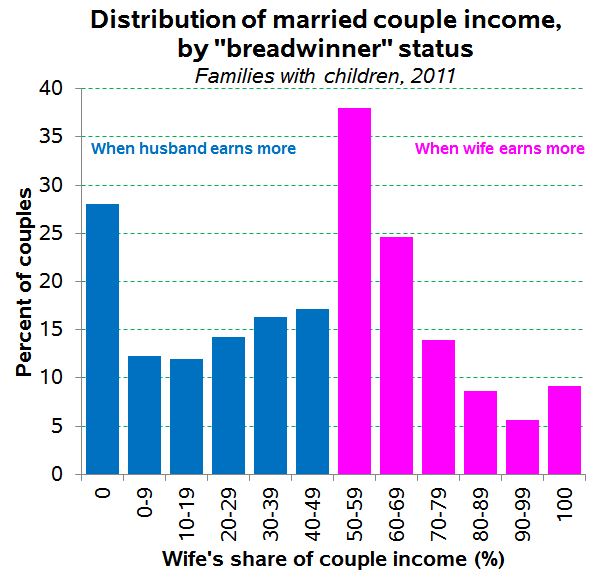
The 50%+1 standard conceals that these male “breadwinners” are winning a greater share of the bread than are their female counterparts. Specifically, the average father-earning-more-than-his-wife earns 81% of the couple’s income; the average mother-earning-more-than-her-husband earns 69% of the couple’s income. Here is the distribution in more detail:

1

This shows that by far the most common situation for a female “breadwinner” is to be earning between 50% and 60% of the couple’s income — the case for 38% of such women. For the father “breadwinners,” though, the most common situation — for 28% of them — is to be earning all of the income, a situation that is three-times more common than the reverse.

Collapsing data into categories is essential for understanding the world. But putting these two groups into the same category and speaking as if they are equal is misleading.

This is especially problematic, I think, because of the historical connotation of the term breadwinner. The term dates back to 1821, says the Oxford English Dictionary. That’s from the heyday of America’s separate spheres ideology, which elevated to reverential status the woman-home/man-work ideal. Breadwinners in that Industrial Revolution era were not defined by earning 1% more than their wives. They earned all of the money, ideally (meaning, if their earnings were sufficient) but, just as importantly, they were the only one permanently working for pay outside the home. (JSTOR has references going back to the 1860s which confirm this usage.)

Modifying “breadwinner” with “primary” is better than not, but that subtlety has been completely lost in the media coverage. Consider these headlines from a Google news search just now:

Further down there are some references to “primary breadwinners,” but that’s rare.

Maybe we should call those 100%ers breadwinners, and call the ones closer to 50% breadsharers.

Philip N. Cohen is a professor of sociology at the University of Maryland, College Park, and writes the blog Family Inequality. You can follow him on Twitter or Facebook.

An anonymous professor has started a tumblr humorously characterizing life as a college professor… with gifs!  Here are some of my favorites but, if you’re a professor or want to know what it’s like to be one, and you can handle a bit of snark, you should definitely go on over!

Arriving Late to My Friend’s Panel

1

When Academics Attend Conference Presentations

6

When Tenure Track Faculty Hear About a Course Release

2

Revise and Resubmit

3

Fourteenth Week of the Semester

4

At the Department Party, When My Chair “Asked” Me to Join the Assessment Committee

7

When Someone Says, “You only teach two classes? What do you do all day?”

5

Thanks to Ben C. for the tip!

Lisa Wade, PhD is an Associate Professor at Tulane University. She is the author of American Hookup, a book about college sexual culture; a textbook about gender; and a forthcoming introductory text: Terrible Magnificent Sociology. You can follow her on Twitter and Instagram.