Search results for The

Last week the controversial killing of 29-year-old Mark Duggan by police in North London was ruled lawful by a jury.  His killing sparked riots across London and elsewhere in England.  To many, it seemed like another unnecessary killing of a young man found prematurely guilty in the minds of police by virtue of the color of his skin.  While the court case is over, many still believe that Duggan was murdered without cause.

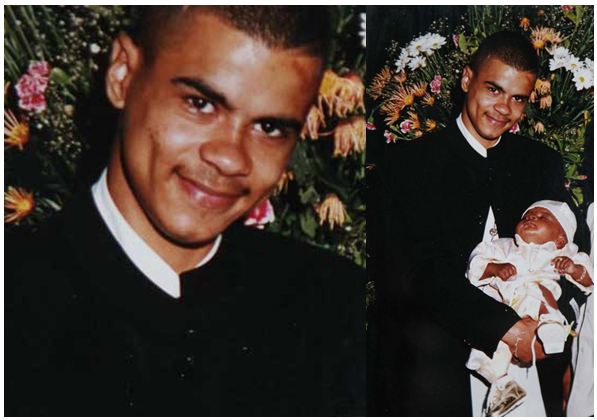
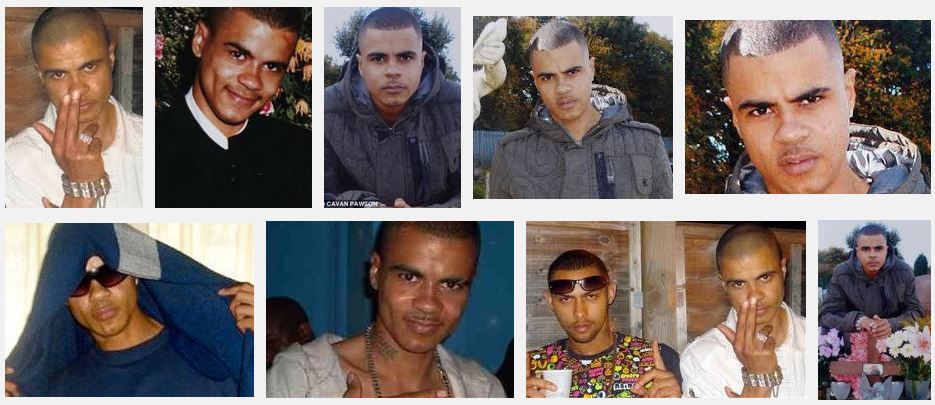
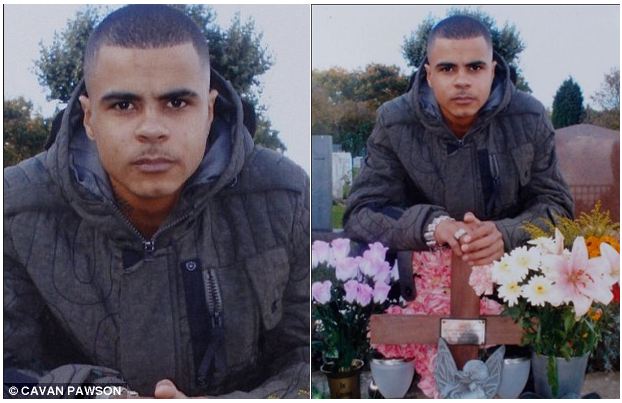
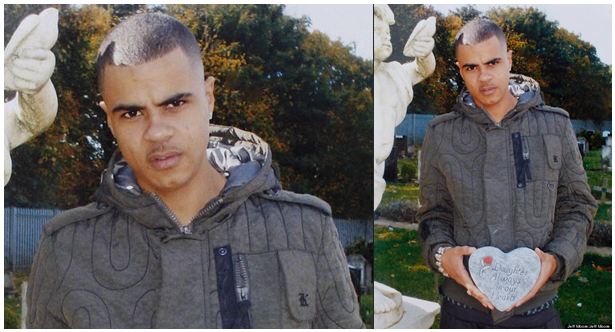
In the meantime, the news covered Duggan’s case quite extensively and, while there is a lot to say, here I want to draw attention to how the story was illustrated.  A Google search for his name offers a glimpse into the many faces of Duggan, as uploaded by the media.   Outlets choose which to picture to include, ranging from a smiling face with cherubic dimples (upper left), to a  posturing blue “hoodie” photo (bottom left), to the stoic stare with a knitted brow (upper right hand corner).
2

Each of these, together with a headline, potentially leaves the reader with a different impression.

Cropping matters too.  You might notice that third image from the left in the top row is a cropped version of the bottom right.  Two other frequently used photos were also cropped.  All exclude connections to others: a visit to a grave site, a plaque commemorating a daughter (“Always in our hearts”), and a baby in his arms.
3 4 5

It may make journalistic sense to exclude context and focus on the individual.  Likewise, I don’t know why some photos were chosen over others and surely there are factors that I’m unaware of.  So, I don’t mean to criticize the media agents making these decisions.  I do want to draw attention, though, to the fact that these decisions are being made.  And they inevitably color our reading of the news stories they accompany.

Hat tip to Feminist Philosophers.

Lisa Wade, PhD is an Associate Professor at Tulane University. She is the author of American Hookup, a book about college sexual culture; a textbook about gender; and a forthcoming introductory text: Terrible Magnificent Sociology. You can follow her on Twitter and Instagram.
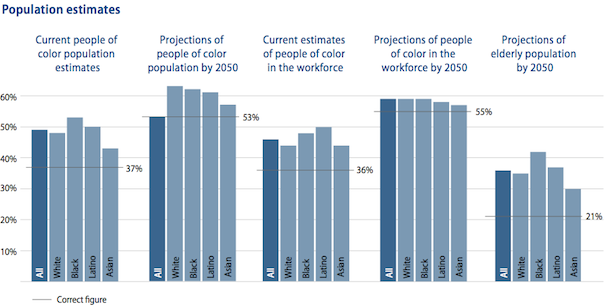
New survey data shows that the average person overestimates the diversity of the American population, both now and in the future.  Today, for example, racial minorities make up 37% of the population, but the average guess was 49%.

projections

Many Americans fear rising diversity.  Over half worry that more minorities means fewer jobs, nearly half think that it means more crime, and almost two-thirds think these groups strain social services.  If people think that minorities are bad for America and overestimate their prevalence, they may be more likely to support draconian and punishing policy designed to minimize their numbers or mitigate the consequences they are believed to bring.

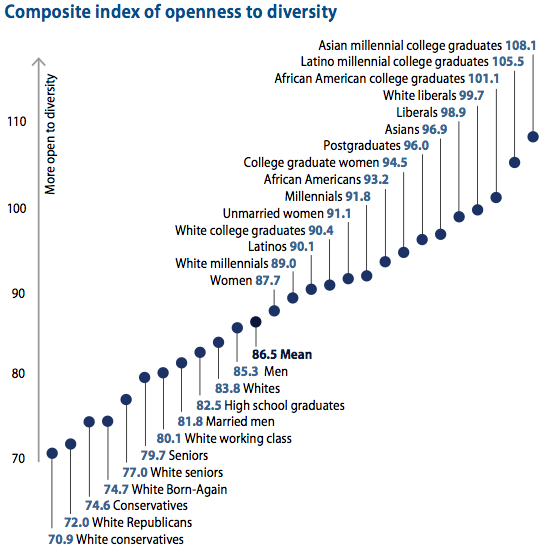
Not all Americans, of course, fear diversity equally.  Below are the scores of various groups on an “openness to diversity” measure with a range of 0-160.

Screen Shot 2013-10-22 at 1.34.24 PM

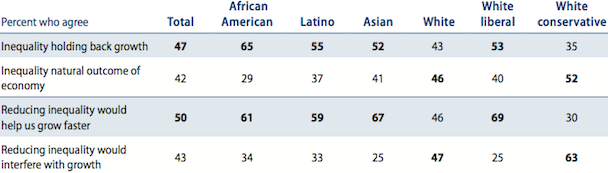
For the future, Americans are still strongly divided as to what to do about diversity and the racialized inequality we currently see.

last chart

Via The Atlantic; thanks to @_ettey for the link.  Cross-posted at Pacific Standard.

Lisa Wade, PhD is an Associate Professor at Tulane University. She is the author of American Hookup, a book about college sexual culture; a textbook about gender; and a forthcoming introductory text: Terrible Magnificent Sociology. You can follow her on Twitter and Instagram.
If you’re looking for just one image that says a thousand words about what’s wrong with America, here’s a contender.  It is a screenshot of the website for the Silver State Schools Credit Union:

facebook_1889026740

Yep, it’s an invitation to K-12 teachers to go into debt to do their job.

Speechless.

Lisa Wade, PhD is an Associate Professor at Tulane University. She is the author of American Hookup, a book about college sexual culture; a textbook about gender; and a forthcoming introductory text: Terrible Magnificent Sociology. You can follow her on Twitter and Instagram.
It’s that time of year again!  Please feel free to use the SocImages Course Guides to help illustrate your lectures:

Thanks to everyone who has submitted a guide and to those of you who are out there working on one!

If you’re a sociology professor or graduate student, we’d love to have more.  One only needs to browse our archives, pull out the most compelling posts, and arrange them in ways other instructors would find familiar and convenient.  The guides can cover entire courses or be designed to help illustrate a theory, article, or book.   We’re even happy to have duplicate guides, since every instructor is different.

We hope these are super useful!

Lisa Wade, PhD is an Associate Professor at Tulane University. She is the author of American Hookup, a book about college sexual culture; a textbook about gender; and a forthcoming introductory text: Terrible Magnificent Sociology. You can follow her on Twitter and Instagram.

One criticism of my post on gender dimorphism in Disney movies was that good animation inevitably exaggerates sex differences. There are a lot of these comments here on SocImages and at Slate. Here’s one example:

Cartoons aren’t meant to accurately portray people, EVER. They are meant to exaggerate features, so that they are more prominent and eye catching. So feminine features are made more feminine, and masculine features are made more masculine. … The less realistic the proportions, the more endearing and charming we find the character. The closer to realistic they are, the creepier/blander they can become.

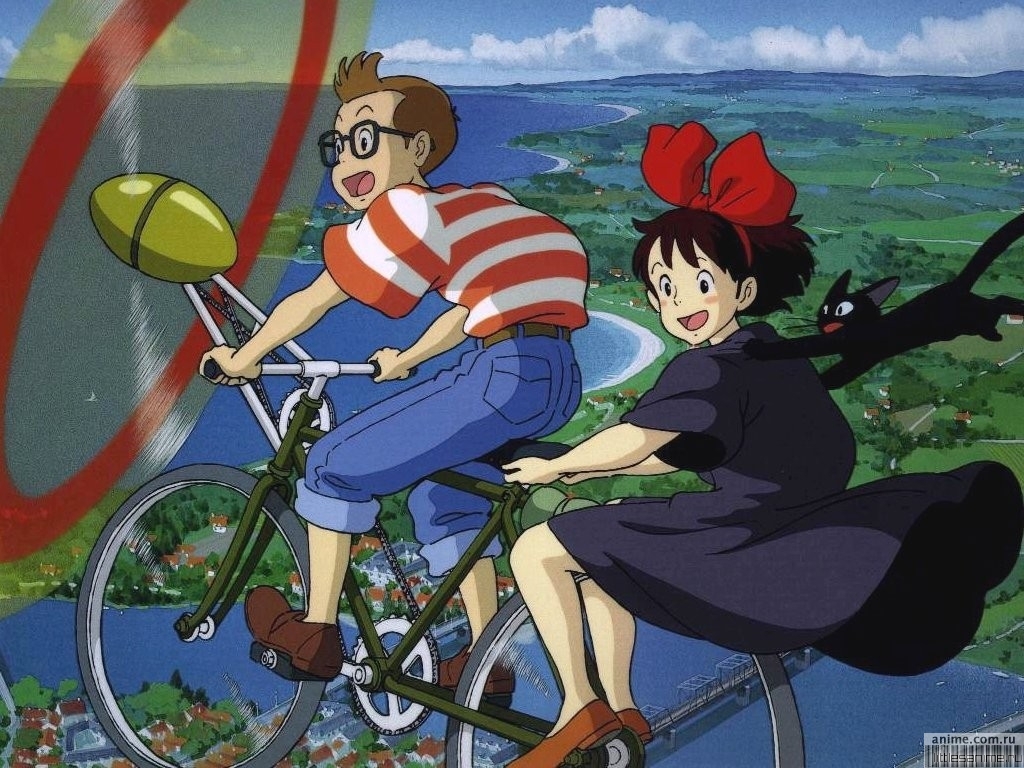
Flipping through IMDB’s list of the top 500 animated movies reveals that Disney is certainly not alone in emphasizing the larger size of males. But there are a few successful counterexamples as well.

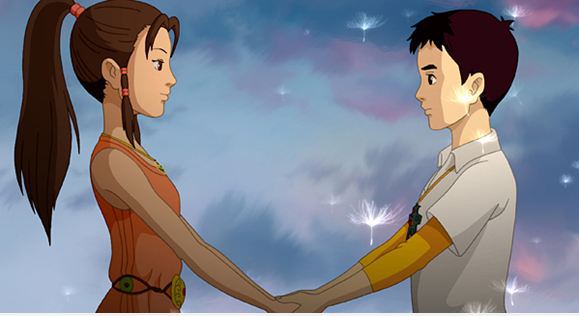
Here are some good ones where the male and female characters are similarly proportioned. Note these are not just random male and female characters but couples (more or less).

From Kiki’s Delivery Service by Hayao Miyazaki:

1

From Dreams of Jinsha:

2

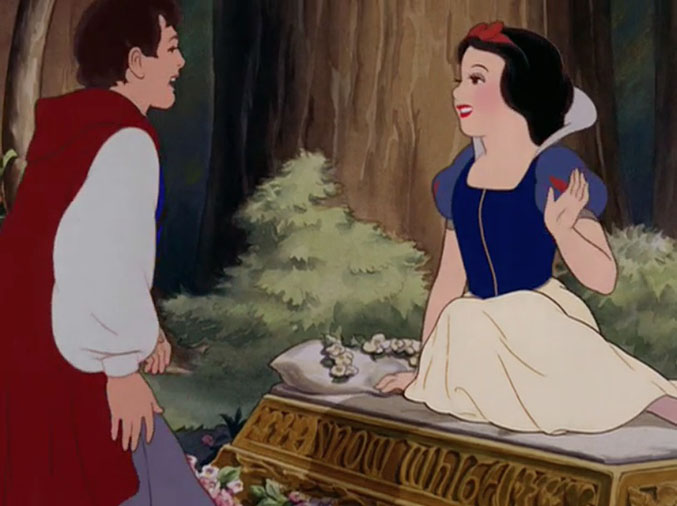
Even some old Disney movies have romantic moments between physically-similar males and females. The original Snow White (from the 1937 movie) was paired with a Prince Charming whose wrists were barely bigger than hers:

3

Disney non-human animal pairs were sometimes quite physically matched. Consider Bambi and Faline (Bambi, 1942):

4

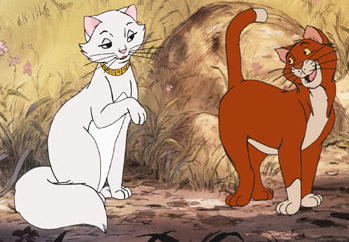
Or Dutchess and O’Malley from Aristocats (1970) in which their exaggerated femininity and masculinity are not conveyed through extreme body-size difference:

5

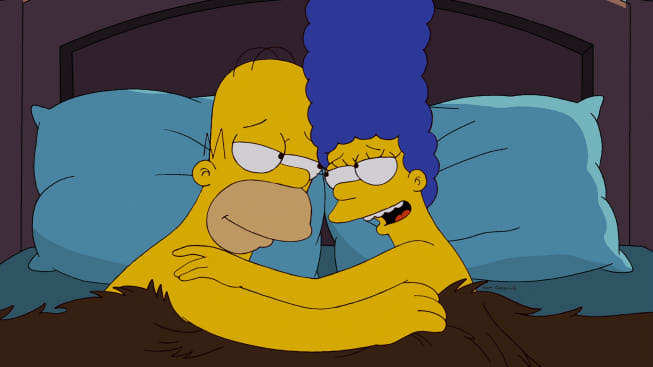
In other realms of animation, Marge and Homer Simpson, the most durable couple in animation history, have very similar features: heads, eyes, noses, ears. His arms are fatter and neither of them really have wrists, but I’d put this in the category of normal sex difference:

6

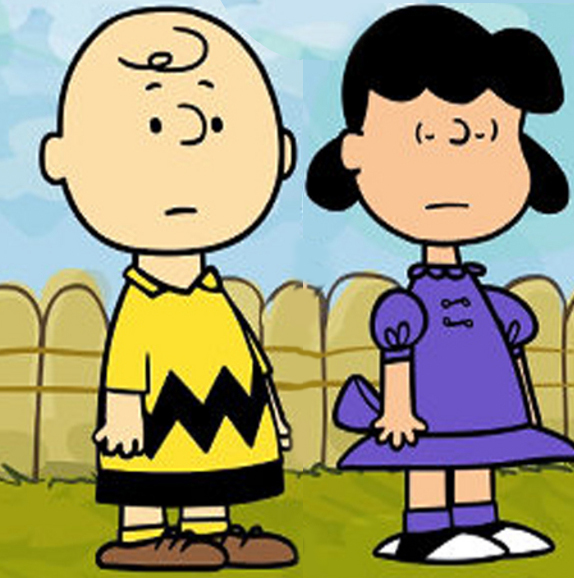
Of course, Lucy and Charlie Brown were virtually identical if you think about it:

7

I’m open to other suggestions.

Cross-posted at Family Inequality and Pacific Standard.

Philip N. Cohen is a professor of sociology at the University of Maryland, College Park, and writes the blog Family Inequality. You can follow him on Twitter or Facebook.

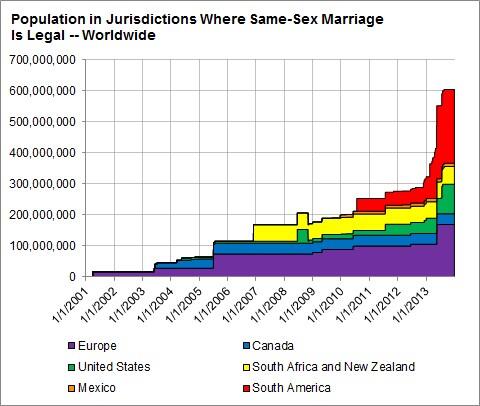
More than exponential growth in the percent of the population with access to same sex marriage in their state:

1

Graph by Philip Cohen.

And here’s the global data, thanks to @filipspagnoli.

Bc_7N2UIIAE8pHN

Lisa Wade, PhD is an Associate Professor at Tulane University. She is the author of American Hookup, a book about college sexual culture; a textbook about gender; and a forthcoming introductory text: Terrible Magnificent Sociology. You can follow her on Twitter and Instagram.
We rounded out the year with 6,850,000 visits and nearly 10,000,000 page views.  We are proud and honored to enjoy over 35,000 Facebook friends and 15,000 Twitter followers, plus nearly 10,000 on Pinterest and almost 1,000 on our two-month-old Tumblr page.  A huge thank you to everyone for your enthusiasm and support!

Highlights:

Best of 2013!

1 (3)

Over the last week we’ve highlighted our favorite and most loved posts from 2013.  Here’s the list in case you missed it!

Reader’s Choice (plus # of Facebook likes before we re-posted)

Editor’s Picks

And this Happened…

…the fruits of my obsession with flight attendants.   If you read these, you might be obsessed too!

Happy New Year everyone!  Here’s to wonderful things in 2014!

Lisa Wade, PhD is an Associate Professor at Tulane University. She is the author of American Hookup, a book about college sexual culture; a textbook about gender; and a forthcoming introductory text: Terrible Magnificent Sociology. You can follow her on Twitter and Instagram.
SocImages News:

New Orleans!

I’ll be in nola from early February through Mardi Gras.  If you’re in the city, I’d love to get together!  Send us an email at socimages@thesocietypages.org and I’ll be in touch!

Tweet of the Month:

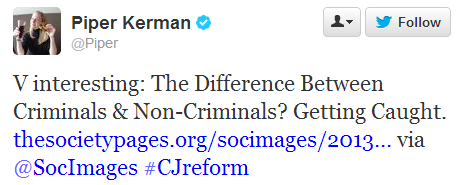
Piper Kerman, author of Orange is the New Black!

Piper Kerman tweets SI

Popular Posts this Month:

Social Media:

Finally, this is your monthly reminder that SocImages is on TwitterFacebook,TumblrGoogle+, and Pinterest.  I’m on Facebook and most of the team is on Twitter: @lisawade@gwensharpnv@familyunequal, and @jaylivingston.

Finally…

In case you missed it.

1 (1)

Lisa Wade, PhD is an Associate Professor at Tulane University. She is the author of American Hookup, a book about college sexual culture; a textbook about gender; and a forthcoming introductory text: Terrible Magnificent Sociology. You can follow her on Twitter and Instagram.