Search results for The

We’re celebrating the end of the year with our most popular posts from 2013, plus a few of our favorites tossed in.  Enjoy!

A recent RadioLab podcast, titled The Bitter End, identified an interesting paradox. When you ask people how they’d like to die, most will say that they want to die quickly, painlessly, and peacefully… preferably in their sleep.

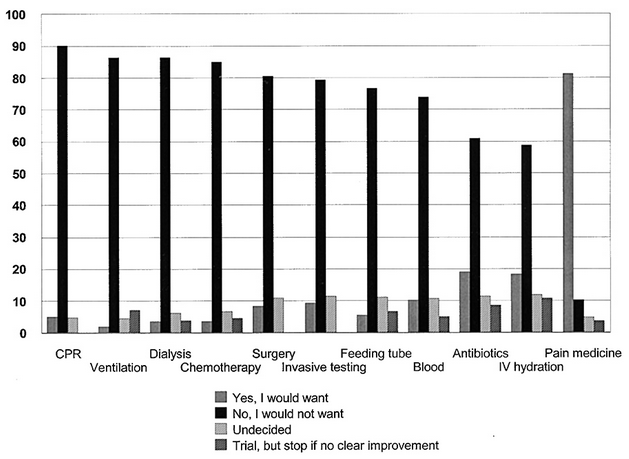
But, if you ask them whether they would want various types of interventions, were they on the cusp of death and already living a low-quality of life, they typically say “yes,” “yes,” and “can I have some more please.”  Blood transfusions, feeding tubes, invasive testing, chemotherapy, dialysis, ventilation, and chest pumping CPR. Most people say “yes.”

But not physicians.  Doctors, it turns out, overwhelmingly say “no.”  The graph below shows the answers that physicians give when asked if they would want various interventions at the bitter end.  The only intervention that doctors overwhelmingly want is pain medication.  In no other case do even 20% of the physicians say “yes.”
Screenshot_1

What explains the difference between physician and non-physician responses to these types of questions.  USC professor and family medicine doctor Ken Murray gives us a couple clues.

First, few non-physicians actually understand how terrible undergoing these interventions can be.  He discusses ventilation.  When a patient is put on a breathing machine, he explains, their own breathing rhythm will clash with the forced rhythm of the machine, creating the feeling that they can’t breath.  So they will uncontrollably fight the machine.  The only way to keep someone on a ventilator is to paralyze them. Literally.  They are fully conscious, but cannot move or communicate.  This is the kind of torture, Murray suggests, that we wouldn’t impose on a terrorist.  But that’s what it means to be put on a ventilator.

A second reason why physicians and non-physicians may offer such different answers has to do with the perceived effectiveness of these interventions.  Murray cites a study of medical dramas from the 1990s (E.R., Chicago Hope, etc.) that showed that 75% of the time, when CPR was initiated, it worked.  It’d be reasonable for the TV watching public to think that CPR brought people back from death to healthy lives a majority of the time.

In fact, CPR doesn’t work 75% of the time.  It works 8% of the time.  That’s the percentage of people who are subjected to CPR and are revived and live at least one month.  And those 8% don’t necessarily go back to healthy lives: 3% have good outcomes, 3% return but are in a near-vegetative state, and the other 2% are somewhere in between.  With those kinds of odds, you can see why physicians, who don’t have to rely on medical dramas for their information, might say “no.”

The paradox, then — the fact that people want to be actively saved if they are near or at the moment of death, but also want to die peacefully — seems to be rooted in a pretty profound medical illiteracy.  Ignorance is bliss, it seems, at least until the moment of truth. Physicians, not at all ignorant to the fraught nature of intervention, know that a peaceful death is often a willing one.

Cross-posted at Pacific StandardThe Huffington Post, and BlogHer.

Lisa Wade, PhD is an Associate Professor at Tulane University. She is the author of American Hookup, a book about college sexual culture; a textbook about gender; and a forthcoming introductory text: Terrible Magnificent Sociology. You can follow her on Twitter and Instagram.

We’re celebrating the end of the year with our most popular posts from 2013, plus a few of our favorites tossed in.  Enjoy!

The philosopher Susan Sontag has written achingly about the way in which men are allowed to age and women are not.

The great advantage men have is that our culture allows two standards of male beauty: the boy and the man. The beauty of a boy resembles the beauty of a girl. In both sexes it is a fragile kind of beauty and flourishes naturally only in the early part of the life-cycle. Happily, men are able to accept themselves under another standard of good looks — heavier, rougher, more thickly built…

There is no equivalent of this second standard for women. The single standard of beauty for women dictates that they must go on having clear skin. Every wrinkle, every line, every gray hair, is a defeat.

Perhaps nowhere is this more plain than in the movies, where men’s love interests stay the same age as they get older, and @sphericalfruit sent in a fantastic example.  The four posters below are part of a new marketing plan for the forthcoming movie, The Counselor.

Notice anything?

Screenshot_1 Screenshot_2

What a stunning example of Sontag’s observation.  The men are not considered unattractive by virtue of the fact that you can tell they have skin.  The women, in contrast, have faces that are so smooth that they look inhuman; their images are halfway between photograph and cartoon.  Amazingly, this treatment of images of men and women is so ubiquitous that it now looks more or less normal to us.

Cross-posted at Business Insider and VitaminW.

Lisa Wade, PhD is an Associate Professor at Tulane University. She is the author of American Hookup, a book about college sexual culture; a textbook about gender; and a forthcoming introductory text: Terrible Magnificent Sociology. You can follow her on Twitter and Instagram.

We’re celebrating the end of the year with our most popular posts from 2013, plus a few of our favorites tossed in.  Enjoy!

Flight attendants are not only friendly with their passengers, they’re also often super friendly with each other.  This may be because especially gregarious people go into the profession, but it’s also an adaptation to a surprising structural feature of their job. It turns out that, on any given flight anywhere in the world, most flight attendants are meeting their co-workers for the very first time.

There are about 100,000 flight attendants in the U.S. alone and they get their flights through a process of bidding, one month at a time, one month ahead.  Most really do “see the world,” as the old glamorized image of the intrepid stewardess suggests, instead of working the same route over and over again.  As a result, explains Drew Whitelegg in Working the Skies, they rarely run into the same flight attendant twice.

This means that flight attendants must get to know one another quickly once they get on board.  They need to do so to make food and beverage service efficient, to coordinate their actions in the tight galleys in which they work and, most importantly, so that they will trust one another if they are called upon to do what they are really there for: acting in an emergency, one that could theoretically happen within seconds of take-off.  There’s no time to lose. “[F]rom the moment they board the plane,” writes Whitelegg, “these workers — even if complete strangers — begin constructing bonds.”

Screenshot_1
Image credit: National Library of Australia


Their instant bonding is facilitated by their shared experiences and their “peculiar identity,” Whitelegg explains — few people understand their job and the airline industry deliberately misportays it — and also by a culture of confession.  The galley has its own rules to which new flight attendants are socialized.  So, even though the workers are always new, the workplace is predictable.  Whitlegg describes how galley conversations during downtime tend to be extremely, sometimes excruciatingly personal.  “The things you hear,” laughs Clare, a flight attendant for Continental, “I could write a book. The things you hear at 30,000 feet.”  It’s the odd combination of a habit of bonding and the anonymity of strangers.

So, if you have the pleasure of taking a flight, spend a few minutes watching the surprising coordination of strangers who seem like old friends, and take a moment to appreciate the amazing way these workers have adapted to their very peculiar position.

Cross-posted at The Huffington Post, Pacific Standard, and Work in Progress.

Lisa Wade, PhD is an Associate Professor at Tulane University. She is the author of American Hookup, a book about college sexual culture; a textbook about gender; and a forthcoming introductory text: Terrible Magnificent Sociology. You can follow her on Twitter and Instagram.

We’re celebrating the end of the year with our most read posts from 2013.

Today a jury found George Zimmerman not guilty of second-degree murder. It is widely argued that Florida’s stand your ground statute, which was considered by the defense, and which Zimmerman previously studied in a criminal litigation course, was at play. The statute allows people to use proportionate force in the face of an attack without first trying to retreat or escape. More than 20 other states have such laws.

At MetroTrends, John Roman and Mitchell Downey report their analysis of 4,650 FBI records of homicides in which a person killed a stranger with a handgun. They conclude that stand your ground “tilts the odds in favor of the shooter.”  In SYG states, 13.6% of homicides were ruled justifiable; in non-SYG states, only 7.2% were deemed such.  This is strong evidence that rulings of justifiable homicide are more likely under stand your ground.

But which homicides?

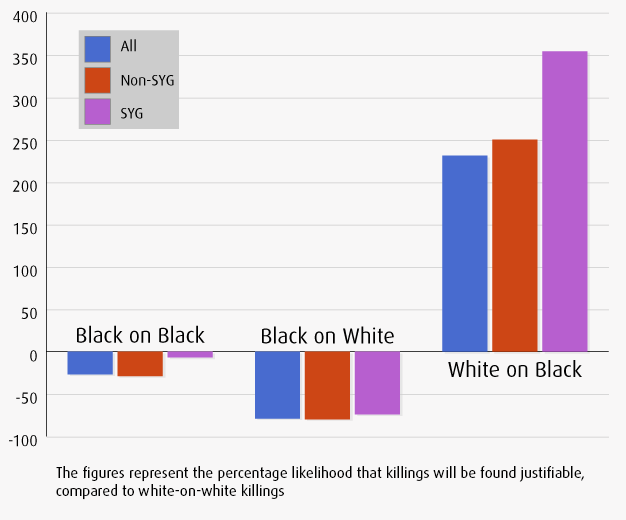
Ones similar to the one decided in favor of George Zimmerman today.  A finding of “justifiable homicide” is much more common in the case of a white-on-black killing than any other kind including a white and a black person.  At PBS’s request, Roman compared the likelihood of a favorable finding for the defendant in SYG and non SYG cases, consider the races of the people involved.  The data is clear, compared to white-on-white crimes, stand your ground increases the likelihood of a not-guilty finding, but only when a person is accused of killing a black person.

1

Notice, however, that white people who kill black people are far more likely to be found not-guilty even in states without SYG and black people who kill whites are less likely to be found not-guilty regardless of state law.

It’s simple: We are already biased in favor of the white defendant and against the black victim. Stand your ground laws give jurors more leeway to give defendants the benefit of the doubt.  This increase even further the chances that a white-on-black homicide will be considered justifiable because jurors will likely give that benefit of the doubt to certain kinds of defendants and not others. Stand your ground may or may not be a good law in theory but, in practice, it increases racial bias in legal outcomes.

It is contested whether stand your ground played a role in this case, Media Matters offers strong evidence to suggest that it did. Cross-posted at Ms., PolicyMic, Pacific Standard, and Global Policy TV.

Lisa Wade, PhD is an Associate Professor at Tulane University. She is the author of American Hookup, a book about college sexual culture; a textbook about gender; and a forthcoming introductory text: Terrible Magnificent Sociology. You can follow her on Twitter and Instagram.
We’re celebrating the end of the year with our most popular posts from 2013, plus a few of our favorites tossed in.  Enjoy!

Oddly, three high profile female musicians find themselves in a public debate about what it means to be a feminist.  We can thank Miley Cyrus for the occasion.  After claiming that the video for Wrecking Ball was inspired by Sinead O’Connor’s Nothing Compares to You, O’Connor wrote an open letter to the performer.  No doubt informed by Cyrus’ performance at the VMAs, she argued that the music industry would inevitably exploit Cyrus’ body and leave her a shell of a human being.  Amanda Palmer, another strong-minded female musician, responded to O’Connor.  She countered with the idea that all efforts to control women’s choices, no matter how benevolent, were anti-feminist.

I keep receiving requests to add my two cents.  So, here goes: I think they’re both right, but only half right.  And, when you put the two sides together, the conclusion isn’t as simple as either of them makes it out to be.  Both letters are kind, compelling, and smart, but neither capture the deep contradictions that Cyrus – indeed all women in the U.S. – face every day.

Cyrus in Wrecking Ball:

Screenshot_7

O’Connor warns Cyrus that the music industry is patriarchal and capitalist.  In so many words, she explains that the capitalists will never pay Cyrus what she’s worth because doing so leaves nothing to skim off the top.  The whole point is to exploit her.  Meanwhile, her exploitation will be distinctly gendered because sexism is part of the very fabric of the industry.  O’Connor writes:

The music business doesn’t give a shit about you, or any of us. They will prostitute you for all you are worth… and when you end up in rehab as a result of being prostituted, “they” will be sunning themselves on their yachts in Antigua, which they bought by selling your body…

Whether Cyrus ends up in rehab remains to be seen but O’Connor is, of course, right about the music industry. This is not something that requires argumentation, but is simply true in a patriarchal, capitalist society.  For-profit industries are for profit.  You may think that’s good or bad, but it is, by definition, about finding ways to extract money from goods and services and one does that by selling it for more than you paid for it.  And media companies of all kinds are dominated at almost all levels by (rich, white) men. These are the facts.

Disagreeing, Palmer claims that O’Connor herself is contributing to an oppressive environment for women.  All women’s choices, Palmer argues, should be considered fair game.

I want to live in a world where WE as women determine what we wear and look like and play the game as our fancy leads us, army pants one minute and killer gown the next, where WE decide whether or not we’re going to play games with the male gaze…

In Palmer’s utopia, no one gets to decide what’s best for women.  The whole point is to have all options on the table, without censure, so women can pick and choose and change their mind as they so desire.

This is intuitively pleasing and seems to mesh pretty well with a decent definition of “freedom.”  And women do have more choices – many, many more choices – than recent generations of women. They are now free to vote in elections, wear pants, smoke in public, have their own bank accounts, play sports, go into men’s occupations and, yes, be unabashedly sexual.  Hell they can even run for President.  And they get to still do all the feminine stuff too!  Women have it pretty great right now and Palmer is right that we should defend these options.

So, both are making a feminist argument.  What, then, is the source of the disagreement?

O’Connor and Palmer are using different levels of analysis.  Palmer’s is straightforwardly individualistic: each individual woman should be able to choose what she wants to do.  O’Connor’s is strongly institutional: we are all operating within a system – the music industry, in this case, or even “society” – and that system is powerfully deterministic.

The truth is that both are right and, because of that, neither sees the whole picture.  On the one hand, women are making individual choices. They are not complete dupes of the system.  They are architects of their own lives.   On the other hand, those individual choices are being made within a system.  The system sets up the pros and cons, the rewards and punishments, the paths to success and the pitfalls that lead to failure.  No amount of wishing it were different will make it so.  No individual choices change that reality.

So, Cyrus may indeed be “in charge of her own show,” as Palmer puts it.  She may have chosen to be a “raging, naked, twerking sexpot” all of her own volition.  But why?  Because that’s what the system rewards.  That’s not freedom, that’s a strategy.

In sociological terms, we call this a patriarchal bargain.  Both men and women make them and they come in many different forms. Generally, however, they involve a choice to manipulate the system to one’s best advantage without challenging the system itself.  This may maximize the benefits that accrue to any individual woman, but it harms women as a whole.  Cyrus’ particular bargain – accepting the sexual objectification of women in exchange for money, fame, and power – is a common one.  Serena Williams, Tila Tequila, Kim Kardashian, and Lady Gaga do it too.

We are all Miley, though.  We all make patriarchal bargains, large and small.  Housewives do when they support husbands’ careers on the agreement that he share the dividends.  Many high-achieving women do when they go into masculinized occupations to reap the benefits, but don’t challenge the idea that occupations associated with men are of greater value.  None of us have the moral high ground here.

So, is Miley Cyrus a pawn of industry patriarchs?  No.  Can her choices be fairly described as good for women?  No.

That’s how power works. It makes it so that essentially all choices can be absorbed into and mobilized on behalf of the system.  Fighting the system on behalf of the disadvantaged – in this case, women – requires individual sacrifices that are extraordinarily costly.  In Cyrus’ case, perhaps being replaced by another artist who is willing to capitulate to patriarchy with more gusto.  Accepting the rules of the system translates into individual gain, but doesn’t exactly make the world a better place.  In Cyrus’ case, her success is also an affirmation that a woman’s worth is strongly correlated with her willingness to commodify her sexuality.

Americans want their stories to have happy endings.  I’m sorry I don’t have a more optimistic read.  If the way out of this conundrum were easy, we’d have fixed it already.  But one thing’s for sure: it’s going to take collective sacrifice to bring about a world in which women’s humanity is so taken-for-granted that no individual woman’s choices can undermine it.  To get there, we’re going to need to acknowledge the power of the system, recognize each other as conscious actors, and have empathy for the difficult choices we all make as we try to navigate a difficult world.

Cross-posted at Pacific Standard.

Lisa Wade, PhD is an Associate Professor at Tulane University. She is the author of American Hookup, a book about college sexual culture; a textbook about gender; and a forthcoming introductory text: Terrible Magnificent Sociology. You can follow her on Twitter and Instagram.

We’re celebrating the end of the year with our most popular posts from 2013, plus a few of our favorites tossed in.  Enjoy!

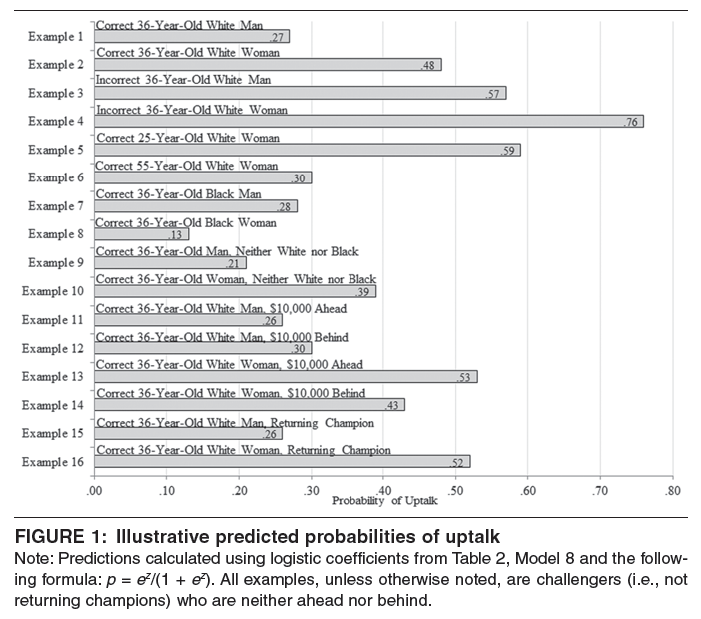
What’s the big deal about uptalk? In The College of William & Mary’s Tom Linneman took a look at how women and men both use uptalk in his new study, “Gender in Jeopardy! Intonation Variation on a Television Game Show” in Gender & Society.

The punchline? Women use uptalk more frequently, but men use it as well. For men, however, uptalk signals something completely different.

1

What is uptalk?

“Uptalk is the use of a rising, questioning intonation when making a statement, which has become quite prevalent in contemporary American speech,” explains Linneman. Uptalk in the U.S. is reported to have emerged in the 1980s among adolescent women in California, aka “Valley Girls,” and it has become more widely used by men and women since then. Uptalk has been associated with a way of talking that makes women sound less confident.

Jeopardy! was Linneman’s clever setting for observing how women and men use the speech pattern. The associate professor of sociology analyzed the use of uptalk by carefully coding 5,500 responses from 300 contestants in 100 episodes of the popular game show. He looked at what happened to speech patterns when contestants — from a variety of backgrounds — gave their answers to host Alex Trebek.  Although the contestants were asked to phrase their response in the form of a question, they used uptalk just over a third of the time.

How do men use uptalk? 

Linneman found that men use uptalk as a way to signal uncertainty.   Linneman explained, “On average, women used uptalk nearly twice as often as men. However, if men responded incorrectly, their intonation betrayed their uncertainty: Their use of uptalk shot up dramatically.”  On average, men who answered correctly used uptalk only 27% of the time. Among incorrect responses, men used uptalk 57% of the time.  In contrast, a woman who answered correctly used uptalk 48% of the time, nearly as often as an incorrect man.

Men’s uptalk increased when they were less confident, and also when they were correcting women — but not men. When a man corrected another man — that is, following a man’s incorrect answer with a correct one — he used uptalk 22% of the time. When a man corrected another woman, though, he used uptalk 53% of the time. Linneman speculates that men are engaging in a kind of chivalry: men can be blunt with another man in public, but feel obliged to use a softer edge with a woman.

How do women use uptalk?

As Linneman explains, “One of the most interesting findings coming out of the project is that success has an opposite effect on men and women on the show.”  Linneman measured success in two ways: He compared challengers to returning champions, and he tracked how far ahead or behind contestants were when they responded.  Linneman found that, “The more successful a man is on the show, the less he uses uptalk. The opposite is true for women… the more successful a woman is on the show, the more she uses uptalk.” Linneman suspects that this is “because women continue to feel they must apologize for their success.”

Probabilities of Uptalk by Certainty, Age, Race, and Gender

Screenshot_17

Virginia Rutter is a professor of sociology at Framingham State University.  She is the author, with Pepper Schwartz, of The Gender of Sexuality and The Love Test.  You can follow her on Twitter and at Girl w/Pen.


We’re celebrating the end of the year with our most popular posts from 2013, plus a few of our favorites tossed in.  Enjoy!

 You know all those badass ladies out there that are inexplicably single? Well, maybe it’s not so inexplicable.

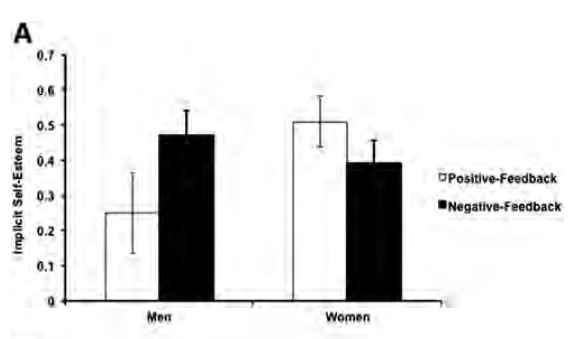
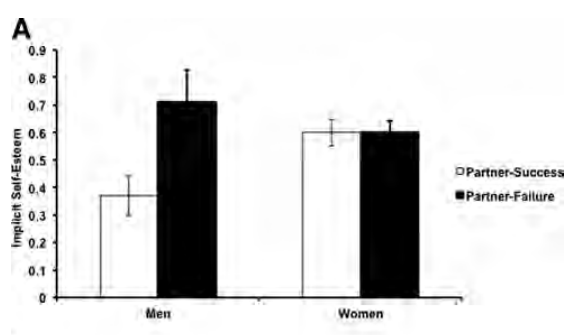
In a study contending for most-depressing-research-of-the-year, psychologists Kate Ratliff and Shigehiro Oishi tested how a romantic partner’s success or failure affects the self-esteem of people in heterosexual relationships.  The short story: men feel bad about themselves when good things happen to their female partners.  Women’s self-esteem is unaffected.  Here’s some of the data.

The vertical axis represents self-esteem. In this experiment, respondents were told that their partner scored high on a test of intelligence (“positive feedback”) or low (“negative feedback”).  The leftmost bars show that men who were told that their partners were smart reported significantly lower self-esteem than those who heard that their partners weren’t so smart.

Screenshot_1

In the second condition, respondents were asked to imagine a partner’s success or failure.  Doing so had no effect on women’s self-esteem (rightmost bars).  For men, however, imagining their partners’ success made them feel bad about themselves, whereas imagining their failure made them feel good.Screenshot_2

The various experiments were conducted with American and Dutch college students as well as a diverse Internet sample.  The findings were consistent across populations and were particularly surprising in the context of the Netherlands, which is generally believed to be more gender egalitarian.

We’ve got a long way to go.

Cross-posted at The Huffington Post and Pacific Standard.

Lisa Wade, PhD is an Associate Professor at Tulane University. She is the author of American Hookup, a book about college sexual culture; a textbook about gender; and a forthcoming introductory text: Terrible Magnificent Sociology. You can follow her on Twitter and Instagram.

We’re celebrating the end of the year with our most popular posts from 2013, plus a few of our favorites tossed in.  Enjoy!

I have driven across the United States several different times.  I always enjoy the experience.  It reminds me of just how vast and diverse this country really is, in terms of both its nature and culture.  Catching up with a friend after such a trip, I discovered that he’d never driven across the country and I insisted that he absolutely must.  “Lisa,” he said intensely, lowering his head, “not everyone is welcome in every small town in America.”  My friend, you might guess, was Black.

It was a memorable lesson about my own white privilege.

This was in the 2000s, but I couldn’t help but think of it when I learned about the Green Book. A story on NPR about the book starts with the following summary:

In part, the Jim Crow era could be defined by the places African-Americans could go and the places they couldn’t. In the towns and cities where they lived, of course, blacks knew where they were welcome. On the road, though, who knew which restaurants and hotels, beauty shops and night clubs would slam doors in their faces?

The answer was “The Negro Motorist Green Book.”  First published in 1936, and revised and re-published for almost 30 years, it helped Black people travel across a hostile America.

Green wasn’t just the color.  It was named after the book’s author — Victor Green — who was a postal worker.  Most African Americans were familiar with where they could and couldn’t go in their own cities.  So Green used his connections through the post office to collect lists from all over America, and even some other countries.  These lists were invaluable to Black travelers.

Even in the depth of Jim Crow, however, Green dreamed of a better time. In the introduction he wrote (source):

There will be a day sometime in the near future when this guide will not have to be published. That is when we as a race will have equal rights and privileges in the United States.

His dream, I suppose, sort of did and sort of didn’t come true.  The Green Book is out-of-print.  Yet men and women like my friend still have good reason to feel uncomfortable showing their face in unfamiliar places.

Book covers borrowed from Electronic Village, AutoLife, and Phoenix Magazine.  You can see a complete pdf of the book here.

Lisa Wade, PhD is an Associate Professor at Tulane University. She is the author of American Hookup, a book about college sexual culture; a textbook about gender; and a forthcoming introductory text: Terrible Magnificent Sociology. You can follow her on Twitter and Instagram.