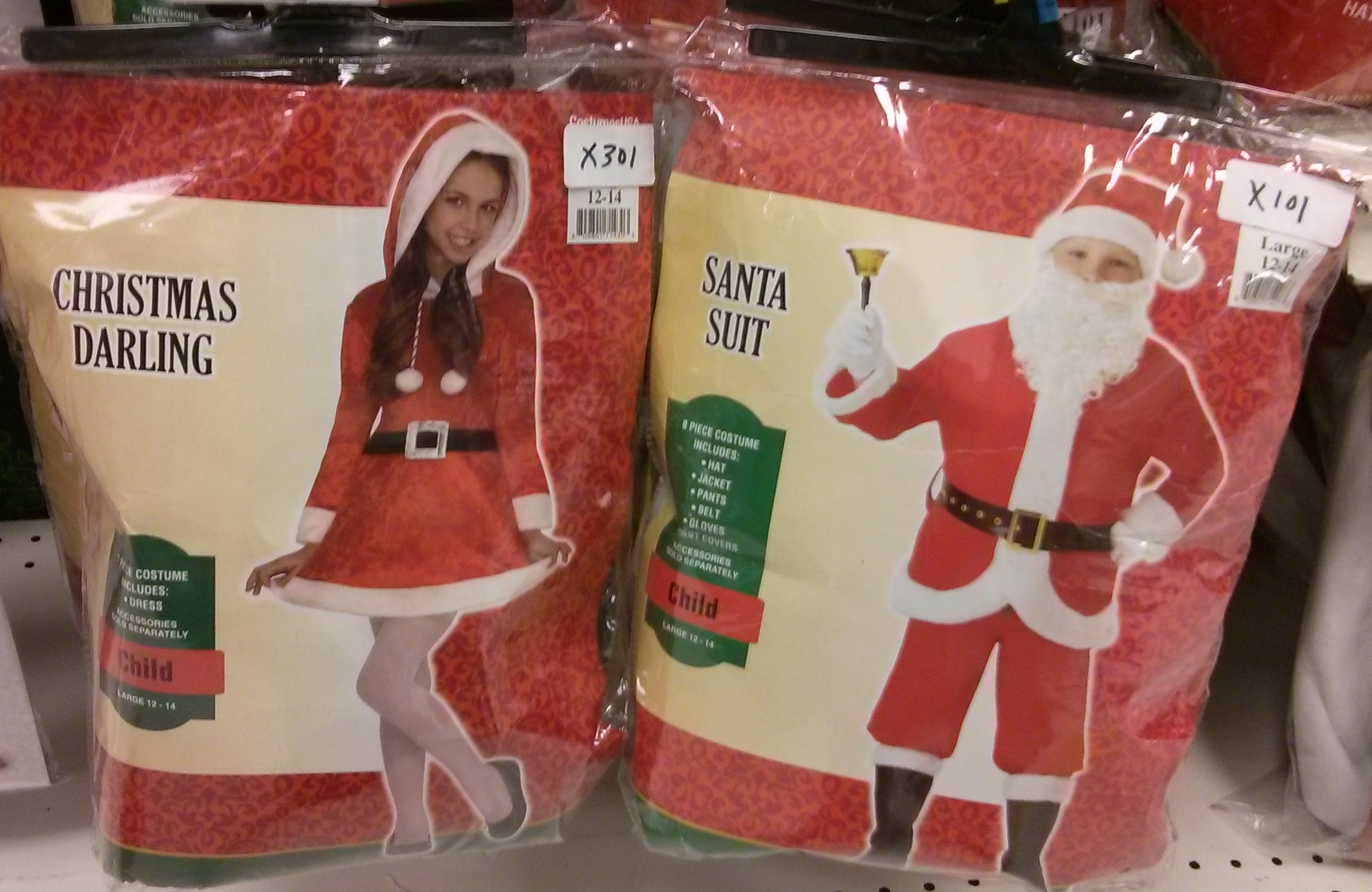
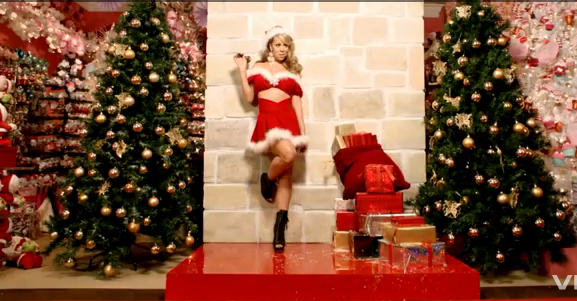
‘Tis the season to remind us that men and women are different and one of women’s jobs is to pander to a hypothetical heterosexual male gaze. The University of Akron’s Will LeSuer photographed the Christmas-themed costumes for sale at a local store, noting the not-so-implicit gendered expectations.
Surprise, the main theme of the women’s costumes was cute and flirty:
The men’s themes are, let’s see, comfortable and… superhero?
And, yes, it starts when they’re kids.
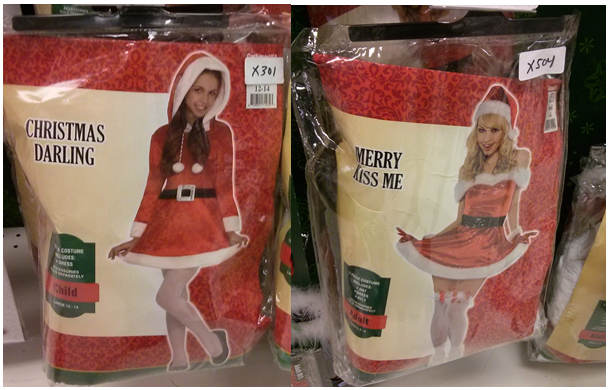
Here’s a fun compare-and-contrast for maximum icky feeling. The sexualization of girls and the infantilization of women, in one holiday-themed shot (“child” costume on left, “adult” on right):
Last year a drug store chain in Canada, Shoppers Drug Mart, started playing Christmas music more than a month before the holiday. Customers complained, perhaps, Tom Megginson suggested, because it is customary in Canada to wait until after Remembrance Day on November 11 (a holiday honoring those who’ve died in wars) to start celebrating Christmas.
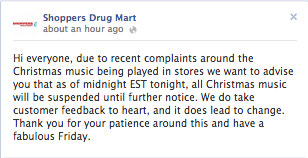
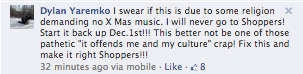
In response to complaints, Shoppers pulled the Christmas music and announced their decision on Facebook:
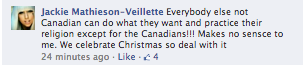
How might people interpret this decision? Here’s a sampling of one type of response, collected by Megginson:
Notice that not wanting to hear Christmas in early November is conflated with not celebrating Christmas and that is conflated with a whole host of identities: not being a “real” Canadian and being non-Christian, non-white, an immigrant, and of a different “culture.”
For these commenters, the so-called War on Christmas is about much more than a competition between religious and secular forces, it’s also about the centrality of whiteness and a defense of “true” Canadianness against an influx of foreign cultures. It is worth considering whether, in general, this debate is really code for racism and anti-immigrant sentiment more generally.
Posted last year, but I love it, so here it is again!
In this fun four minute history of Santa Claus, CGP Gray explains how the character evolved, the role of Coca Cola, his conquest of the globe (i.e., Santa’s cultural imperialism), and the ongoing debates about where, exactly, he lives.
I can’t offer much in the crowded field of Disney gender criticism. But I do want to update my running series on the company’s animated gender dimorphism. The latest installment is Frozen.
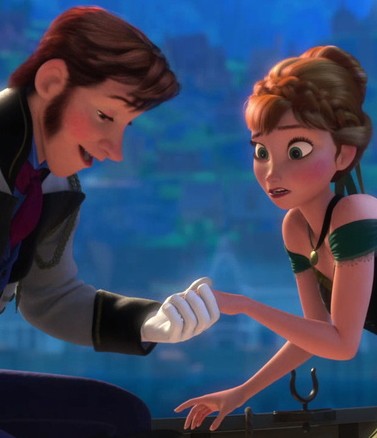
Just when I was wondering what the body dimensions of the supposedly-human characters were, the script conveniently supplied the dimorphism money-shot: hand-in-hand romantic leads, with perfect composition for both eye-size and hand-size comparisons:
With the gloves you can’t compare the hands exactly, but you get the idea. And the eyes? Yes, her eyeball actually has a wider diameter than her wrist:
Giant eyes and tiny hands symbolize femininity in Disneyland.
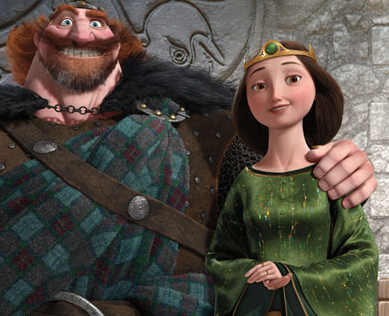
While I’m at at, I may as well include Brave in the series. Unless I have repressed it, there is no romance story for the female lead in that movie, but there are some nice comparison shots of her parents:
Go ahead, give me some explanation about the different gene pools of the rival clans from which Merida’s parents came.
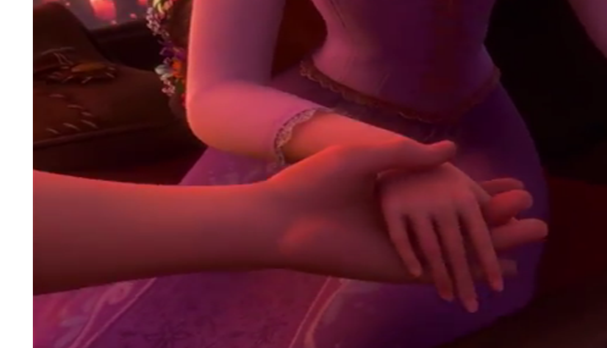
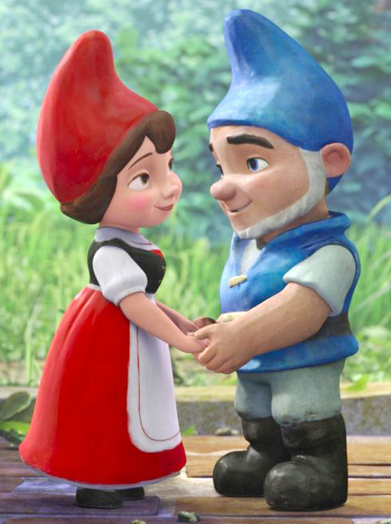
Since I first complained about this regarding Tangled, I have updated the story to include Gnomeo and Juliet. You can check those posts for more links to research (and see also this essay on human versus animal dimorphism by Lisa Wade). To just refresh the image file, though, here are the key images. From Tangled:
From Gnomeo:
At this point I think the evidence suggests that Disney favors compositions in which women’s hands are tiny compared to men’s, especially when they are in romantic relationships.
REAL WRIST-SIZE ADDENDUM
How do real men’s and women’s wrist sizes differ? I looked at 7 studies on topics ranging from carpal tunnel syndrome to judo mastery, and found a range of averages for women of 15.4 cm to 16.3 cm, and for men of 17.5 to 18.1 cm (in both cases the judo team had the thickest wrists).
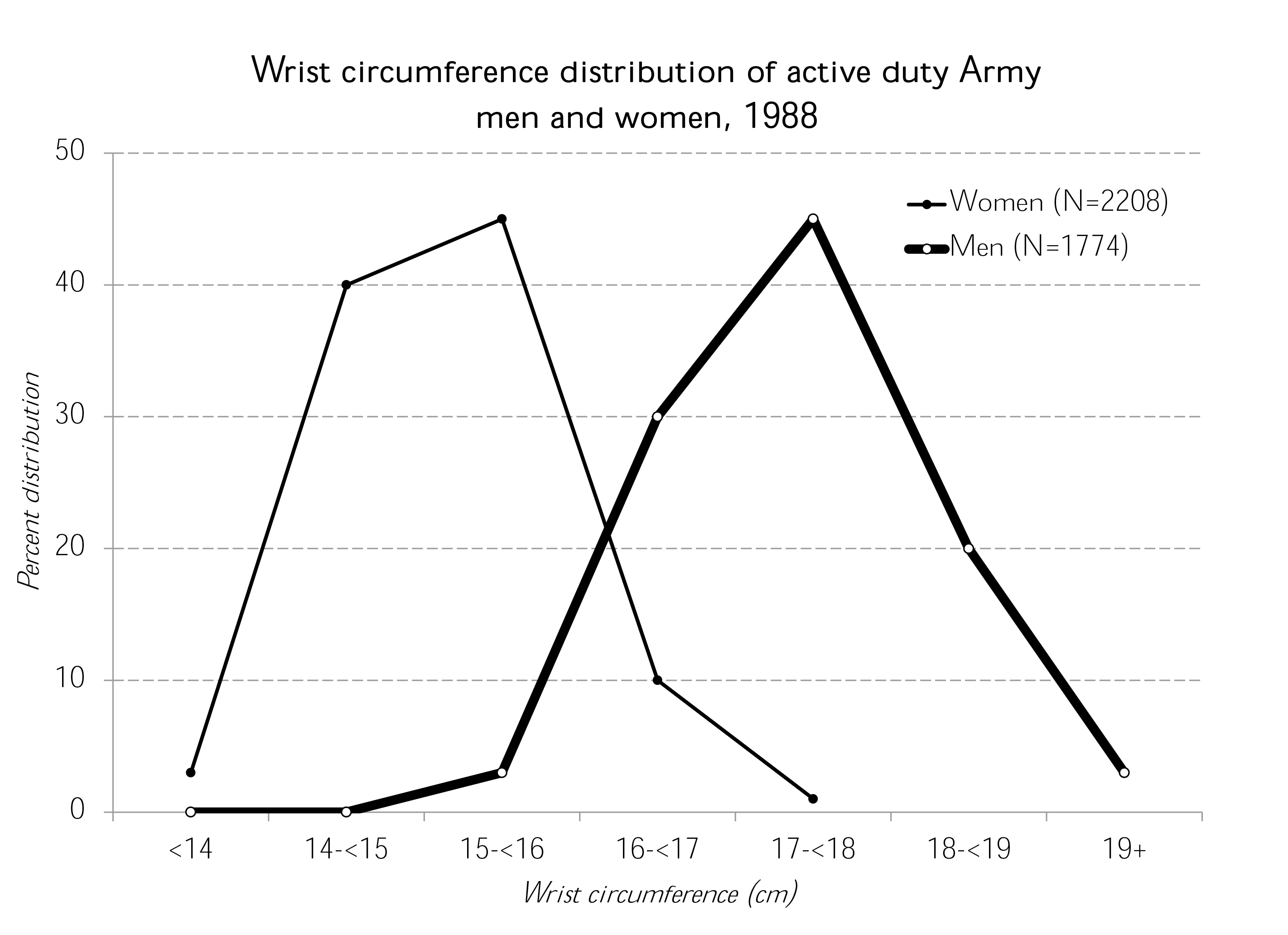
‘Then I found this awesome anthropometric survey of U.S. Army personnel from 1988. In that sample (almost 4,000, chosen to match the age, gender, and race/ethnic composition of the Army), the averages were 15.1 for women and 17.4 for men. Based on the detailed percentiles listed, I made this chart of the distributions:
The average difference between men’s and women’s wrists in this Army sample is 2.3 cm, or a ratio of 1.15-to-1. However, if you took the smallest-wristed woman (12.9 cm) and the largest-wristed man (20.4), you could get a difference of 7.5 cm, or a ratio of 1.6-to-1. Without being able to hack into the Disney animation servers with a tape measure I can’t compare them directly, but from the pictures it looks like these couples have differences greater than the most extreme differences found in the U.S. Army.
Philip N. Cohen is a professor of sociology at the University of Maryland, College Park, and writes the blog Family Inequality. You can follow him on Twitter or Facebook.
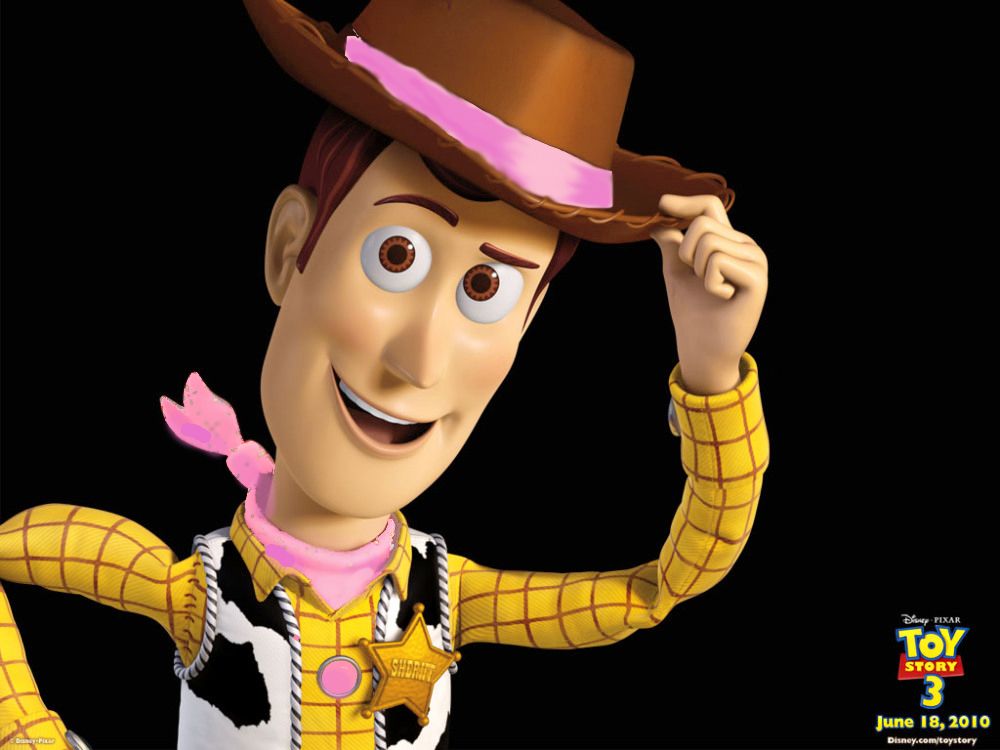
What would you think of Woody from Toy Story if he wore pink?
Would you think the color choice was incongruous — that it didn’t seem masculine enough for a 1950s-era cowboy toy?
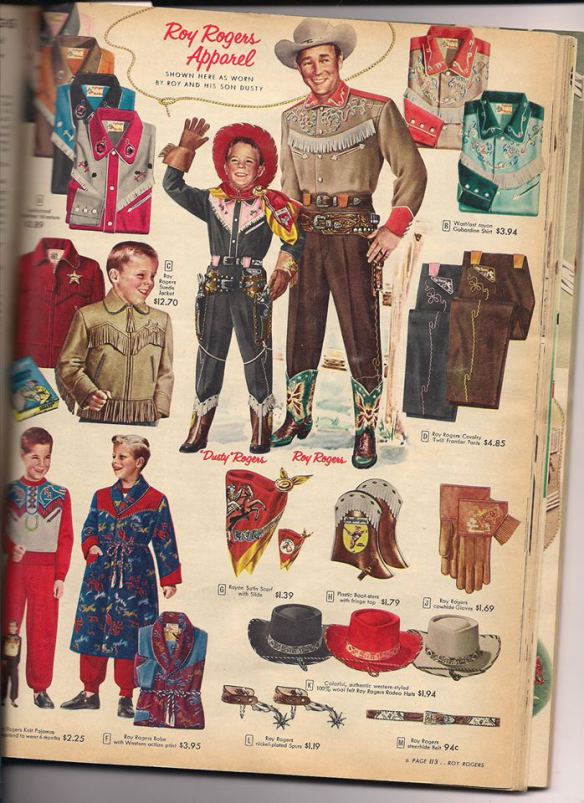
Well, you’d be wrong. Check out these images from the 1955 Sears Christmas Book catalog that Elizabeth Sweet, a newly minted Ph.D. from the University of California at Davis, sent me. Here’s Roy Rogers Apparel, featuring Roy Rogers and his son, Dusty – who is wearing a cowboy outfit with red, yellow, and pink accents:
To modern eyes, this is surprising. “Pink is a girls’ color,” we think. This association has become so firmly entrenched in our cultural imagination that people are flabbergasted to learn that until the 1950s, pink was often considered a strong color and, therefore, was associated with boys.
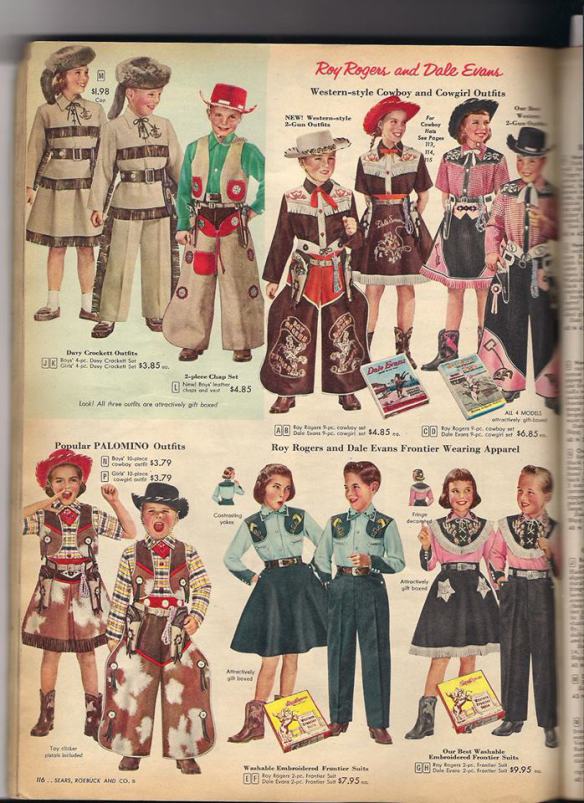
But it wasn’t only for boys. Although gender segregation is de rigeur today, it wasn’t back then. Look at these outfits for boys and girls, also from the 1955 Sears catalog: There are brown and red outfits for boys and girls. Pink and blue outfits for boys and girls. Blue and green outfits for boys and girls.
These spreads make it clear that in the 1950s, when Woody’s Roundup is supposed to have originated, Woody would have been pretty darned stylish in pink.
A decade later, things had started changing; pink was more closely associated with girls. (As Elizabeth notes of the Sears catalogs in her collection, “I didn’t find anything similar in 1965.”)
In today’s marketplace, I believe parents would love to see options like these. In fact, just yesterday, one of my friends posted this to facebook about his failed shopping trip:
Alright, parents, I went to buy my daughter cool costume stuff like pirate stuff and cowgirl stuff and all I found was princess outfits. She doesn’t know the word “princess.” She knows the words ‘cowgirl” and “pirate.” What’s the deal? Why does every company want her to be a princess? Why can’t she be an awesome cowgirl pirate?
Sadly, the reason is that in the retail world, this kind of diversity just doesn’t fly anymore. The status quo is segregation; as Elizabeth Sweet has argued, “finding a toy that is not marketed either explicitly or subtly (through use of color, for example) by gender has become incredibly difficult.” And the more entrenched this practice becomes, the harder it becomes to change, as change is perceived by marketers and retailers as a risk.
Therefore, for the foreseeable future, pink will serve as a clear delineation in the marketplace: If something is pink, it is most definitely not for boys, who regard it as a contagion — something to be avoided at all costs.
So it is that if Woody wore pink today, he would be unintelligible in the marketplace. And so it is that my friend can’t find a good cowgirl outfit for his little girl: he’d have to travel back to 1955 to do so.
The push for “girly” to be synonymous with “pink” saddens me. It has caused girls’ worlds to shrink, and it only reinforces for boys the idea that they should actively avoid anything girlish. Monochromatic girlhood drives a wedge between boys and girls — separating their spheres during a time when cross-sex play is healthy and desirable, and when their imaginations should run free.
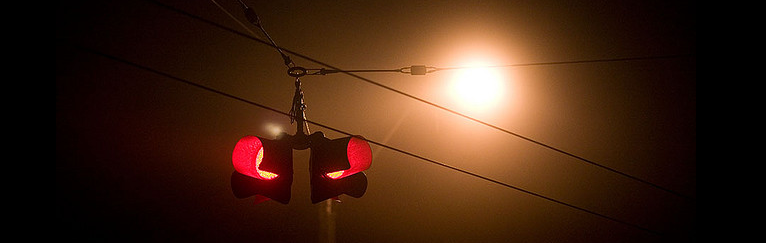
Three in the morning, Dad, good citizen stopped, waited, looked left, right. He had been driving nine hundred miles, had nearly a hundred more to go, but if there was any impatience it was only the steady growl of the engine which could just as easily be called a purr.I chided him for stopping; he told me our civilization is founded on people stopping for lights at three in the morning.
One December long ago, I got a ride home from Boston to Pittsburgh with Murray in his black VW Beetle. He was a graduate student, I was an undergrad, and in those days the trip took twelve hours. We got into Pittsburgh some time after 2 a.m. The streets were deserted
In Shadyside on Fifth Avenue, not far from my parents’ condo, we came to a red light. Murray paused, then drove on through.
“Sociology allowed me to do that,” he said.
I can’t remember his explanation, but I think it had something to do with “rules in use” and the negotiability of norms. That’s interesting, I thought. Maybe it was even convincing, though I still turned in my seat to see if there were any cops behind us. There weren’t.
Murray was right. At that hour of empty streets, waiting for the green serves no rational purpose. When there is no traffic, traffic safety is not an issue. But Bruce Hawkins’s dad is also right. He takes a more Durkheimian view: rationality is not the basis of society. What makes society possible is people’s attachment to the group and its ideas – its values, its beliefs, and its stoplights.I wonder what Murray would have said now about this poem.
Sociological Images encourages people to exercise and develop their sociological imaginations with discussions of compelling visuals that span the breadth of sociological inquiry. Read more…

 Thanks to Blingee.