Search results for The

Women in the U.S. have made some monumental gains at work.  We’re now at least half the labor force and more women today are middle- and upper- managers in corporate America.  Even so, I wasn’t surprised to discover that women have not (yet) made similar inroads into high-level corporate crime.

Rather, it’s “business as usual” when it comes to who is responsible for orchestrating and carrying out major corporate frauds.

For the American Sociological Review, Darrell Steffensmeier, Michael Roche, and I studied accounting malpractices like security fraud, insider trading, and Ponzi schemes in America’s public companies to find out just how involved women were in these conspiracies.  The Corporate Fraud Task Force indicted 436 individuals involved in 83 such schemes during July 2002 to 2009.  We read and recorded information from indictments and other documents or reports that described who was involved and what they did.

I expected the share of women in corporate fraud to be low – definitely less than the near-half that are women among (low-profit) embezzlers arrested each year– like your bank teller or local non-profit treasurer.   However, I was surprised that women corporate fraudsters were about as rare as female killers or robbers – less than 10% of those sorts of offenders.  Of the 400+ indicted for corporate fraud, only 37 were women.

Most of these frauds were complex enough to require co-conspiracy over several years and a criminal division of labor.  Often, women weren’t included at all in these groups.  When they were, they were nearly always in the minority, often alone, and most typically played rather small roles.

The Enron conspiracy, for example, led to over 30 indictments; three were women and each played a minor role. The five women indicted among 19 in the HealthSouth fraud were in accounting-related positions and instructed by senior personnel to falsify financial books and create fictitious records.  Martha Stewart, rather than criminal mastermind of an insider trading conspiracy, committed “one of the most ill-fated white-collar crimes ever” in which she saved just $46,000 after receiving a stock-tip second-hand from her broker.

Women were almost never the ringleader or even a major player in the fraud.  Only one woman CEO led a fraud – the smallest fraud we studied – and two women with their husbands.  One reason surely must be that women are not as often in positions to lead these schemes.  However, even when we compared women and men in similar corporate positions, women were less likely to play leadership roles in the fraud.  Is there a “glass ceiling” in the white-collar crime world?

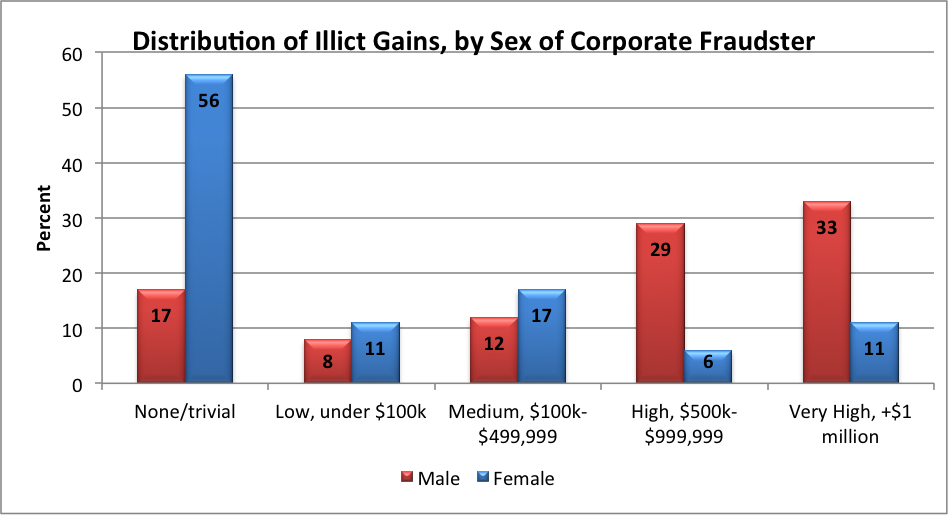
What most surprised me, however, was how little the women benefited from their illicit involvement.  The wage gap in illicit corporate enterprise may be larger than in the legitimate job market.  Over half the women did not financially gain at all whereas half the men pocketed half a million dollars or more.  The difference in illicit-gains persisted even if we compared women to their co-conspirators.  Males profited much more. Women identified “gains” such as keeping one’s job.
2

Even when women are in the positions to orchestrate these frauds, it’s likely that the men who initiate these conspiracies prefer to bypass women, involving them in minor roles when need dictates or when trust develops through a close personal relationship.  And women hardly initiated any schemes.  Women business leaders tend to be more risk-averse and apt to stress social responsibility and equity, perhaps making corporate fraud unlikely.

So, would having more female leaders reduce corporate crime?  We don’t know, but we think it’s likely.  Women executives tend to make more ethical decisions, avoid excessive risk-taking, and create corporate cultures unsupportive of illegal business practices.  Time will tell if, on the other hand, women moving up the corporate ladder increasingly adopt a wheeler-dealer, “dominance at all costs” corporate ethic.

Some may be a little disappointed that women either cannot yet or do not exercise their power over others to illegally advance their business (and personal) interests as men have been doing for generations.  There are moments when I catch myself “rooting” for a more successful pink-collar offender – and examples exist.  However, when I consider the destruction and havoc wrought on the U.S. economy and so many peoples’ lives by these financial crimes, I am reminded that this is not the way in which I hope women wield power when business leadership roles are more equally shared.

This posts originally appeared at the Gender & Society blog.

Jennifer Schwartz, PhD, is an associate professor of sociology at Washington State University.  Her research focuses on the gender and race demographics of criminal offenders, violence, and substance abuse.
“Advocates might want to try different language (or a different approach) in their campaign to reform the criminal justice system,” writes Jamelle Bouie for Slate. He drew his conclusion after summarizing a new pair of studies, by psychologists Rebecca Hetey and Jennifer Eberhardt, looking at the relationship between being “tough on crime” and the association of criminality with blackness.

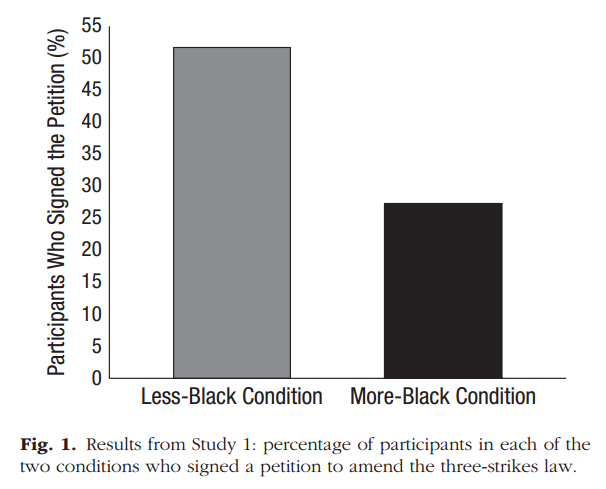
In the first study, 62 White men and women were interrupted as they got off a commuter train and invited to chat about the three strikes law in California. Before being presented with an anti-three strikes petition, they were shown a video that flashed 80 mugshots. In one condition, 25% of the photos were of black people and, in another, 45% of the photos were.

Among the subjects in the first “less black” condition, more than half signed the petition to make the law less strict, but only 28% in the “more black” condition signed it.

2

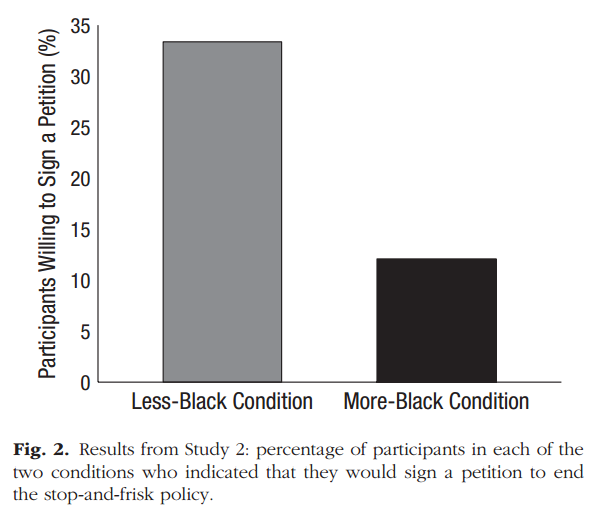
A second study in New York City about the stop-and-frisk policy had a similar finding:

3

The results suggest that white Americans are more comfortable with punitive and harsh policing and sentencing when they imagine that the people being policed and put in prison are black. The second study suggested that this was mediated by fear; the idea of black criminals inspires higher anxiety than that of white criminals, pressing white people to want stronger law enforcement.

So, as Bouie concluded, when prison reformers and anti-racists point out the incredible and disproportionate harm these policies do to black Americans, it may have the opposite of its intended effect. Hetey and Eberhardt conclude:

Many legal advocates and social activists assume that bombarding the public with images and statistics documenting the plight of minorities will motivate people to fight inequality. Our results call this assumption into question. We demonstrated that exposure to extreme racial disparities may make the public less, not more, responsive to attempts to lessen the severity of policies that help maintain those disparities.

“Institutional disparities,” they add, “can be self-perpetuating.” Our history of unfairly targeting and punishing black men more than others now convinces white Americans that we must continue to do so.

Cross-posted at Pacific Standard.

Lisa Wade, PhD is an Associate Professor at Tulane University. She is the author of American Hookup, a book about college sexual culture; a textbook about gender; and a forthcoming introductory text: Terrible Magnificent Sociology. You can follow her on Twitter and Instagram.

One of the more difficult sociological concepts to explain is the social institution.  When sociologists talk about institutions they don’t mean hospitals or churches or any of the concrete organizations that easily come to mind, they mean something much bigger and more difficult to pin down.  They  mean institutionalized ways of doing things or, as I’ve defined them elsewhere:

Persistent patterns of social interaction aimed at meeting the needs of a society that can’t easily be met by individuals alone.

Education, then, is an institution, as is medicine and transportation.  In my textbook, I discuss the examples of sanitation and sport.  One can’t play on a team all by oneself and it’d be pretty gross to take a personal potty with you everywhere you went.  Instead, we have organized sport and the provision of toilet facilities. Eventually, institutionalized ways of solving social needs get taken-for-granted as the way we do things, often to the point that we forget that they were invented in the first place.

I was inspired to write about this by a post at Sociological Cinema by sociologist Tristan Bridges.  He uses a clip from The Devil Wears Prada to illustrate just this phenomenon.  Meryl Streep plays the editor of a fashion magazine.  Fashion is an institution because we can no longer feasibly make our own clothes.  Even the most industrious and clever among us, those who make their own clothes, will buy the fabric with which to do so.  Almost no one in a Western country has the faintest idea of how to make fabric, let alone the resources.

In the clip, Streep’s character responds icily when a holier-than-thou fashion outsider scoffs at her as she goes about her work.

She says:

You think this has nothing to do with you.

You go to your closet and you select, I don’t know, that lumpy blue sweater, for instance, because you’re trying to tell the world that you take yourself too seriously to care about what you put on your back.

But what you don’t know is that that sweater is not just blue, it’s not turquoise, it’s not lapis, it’s actually cerulean.

And you’re also blithely unaware of the fact that, in 2002 Oscar de la Renta did a collection of cerulean gowns and then I think it was Yves St. Laurent — wasn’t it? — who showed cerulean military jackets…

And then cerulean quickly showed up in the collections of eight different designers.  And then it filtered down through the department stores and then trickled down into some Casual Corner where you, no doubt, fished it out of some clearance bin.

However, that blue represents millions of dollars and countless jobs and it’s sort of comical that you think you’ve made a choice that exempts you from the fashion industry when, in fact, you’re wearing a sweater that was selected for you by the people in this room.

An institution has emerged to put clothes on our back.  The scoffer who inspires Streep character’s rant would like to think that she is outside of the fashion industry, that it has nothing to do with her. Likewise, many of us would like to think that we’re outside of the institutions that we don’t like. But we’re not.  That’s the rub.  No matter how enlightened or inspired we are to fight social convention, we can’t get outside the institutions that organize our societies.  We’re in them whether we know it or not.

Here’s the clip; it’s worth it, even given the advertisement:

[youtube]https://www.youtube.com/watch?v=vL-KQij0I8I[/youtube]

Lisa Wade, PhD is an Associate Professor at Tulane University. She is the author of American Hookup, a book about college sexual culture; a textbook about gender; and a forthcoming introductory text: Terrible Magnificent Sociology. You can follow her on Twitter and Instagram.

Flashback Friday.

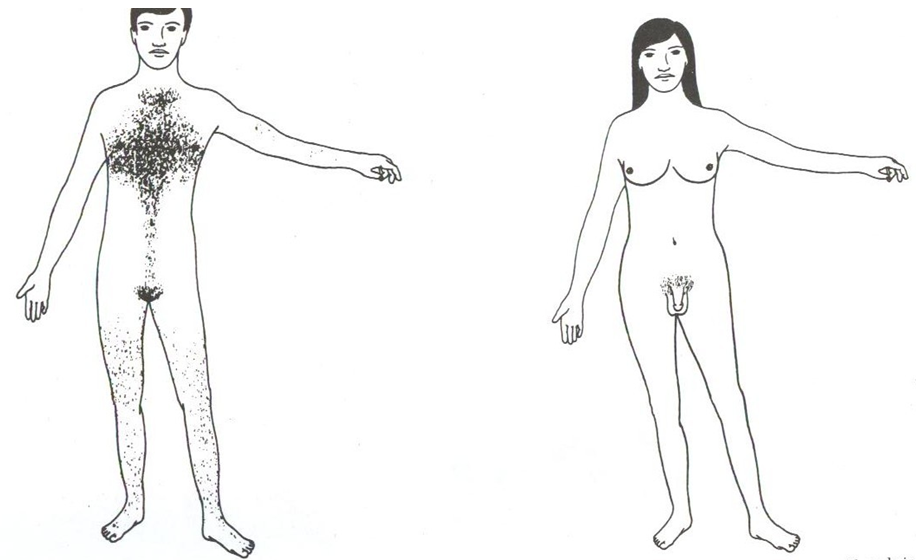
In Michael Kimmel’s sociology of gender textbook, The Gendered Society, he offers us the following two pictures and asks us to decide, based on our gut-level reactions, whether the two individuals pictured are male or female:

1

If you are like most people, you find, perhaps to your own bewilderment, that the first individual seems male despite the female pubic hair pattern and apparent female genitalia and the second individual seems female despite the presence of a penis and scrotum.

Kimmel suggests that this is because, in our daily life, we habitually judge individuals as male or female on the basis of their secondary sex characteristics (e.g., body shape, facial hair, breasts) and social cues (e.g., hair length) and not, so much, their primary sex characteristics (i.e., their genitalia).

In that sense, Kimmel argues, social cues and secondary sex characteristics “matter” more when it comes to social interaction and gender is really about gender (socially constructed ideas about masculinity and femininity), not so much about sex (penises and vaginas).

Images borrowed the images from Gender: An Ethnomethodological Approach, by Kessler and McKenna.  University of Chicago Press.  Originally posted in 2009.

Lisa Wade, PhD is an Associate Professor at Tulane University. She is the author of American Hookup, a book about college sexual culture; a textbook about gender; and a forthcoming introductory text: Terrible Magnificent Sociology. You can follow her on Twitter and Instagram.

In order to be successful in many parts of labor market, women must exhibit traits that are typically considered “masculine.” The title of a fashion article in Glamour magazine hints at — okay, blatantly states — this reality:

Man Up, Ladies! That whole menswear separates look is so hot right now. (Suits, layers, plaids, you name it.) We’d promote you instantly!

The article reinforces the idea that masculine characteristics are favored in many white collar jobs. In contrast, feminine characteristics carry a negative connotation, like when a New York Times article conflated being feminine and an undesirable employee when they contrasted the positive attribute of being “productive and results-oriented” with being a “sissy.”

Women can do masculinity, then, to reap some of the rewards offered to those who embody it, but there’s a catch: women must maintain their “femininity,” too. Women face gender rules that require that they wear makeup in order to be seen as beautiful and competent. Not doing so brings costs.

One study, for example, compared viewers’ perceptions of females with varying degrees of make-up, ranging from no make-up to glamorous. Research participants were shown photos of female faces and asked to rate the images on attractiveness, likeability, competence, and trustworthiness. Respondents rated the faces wearing make-up higher on likeablility, competence, and especially attractiveness, compared to the faces with no make-up.

These gendered behavioral and beauty norms amount to a double-edged sword for women.  They must do masculinity to be successful at work, but they must be feminine to get along.  So, man up, ladies… but not too much.

Chloe Albin is a senior at Chapman University studying dance and psychology. Dr. Georgiana Bostean is an assistant professor teaching sociology and environmental science and policy. She studies population health. 

In general, married couples are homogamous.  That is, they are more likely than not to match on a whole host of characteristics: age, income, education level, race, religion, immigration history, attractiveness level, and more.

But, does homogamy really translate into compatibility?  Or, do we just think it does?

OKCupid set about to find out.  This is the second of two posts about recent revelations that they, like Facebook, have been doing experiments on users. The last one was a depressing look at the role of attractiveness on the site. This one is about the impact of match ratings.  Yep, they lied to see what would happen.

OkCupid users answer a series of questions and the site then offers a “match rating” between any two users.  The idea is that people with a higher match rating are more homogamous — by some measure not identical to those that sociologists typically use, to be clear — and, therefore, more likely to get along.

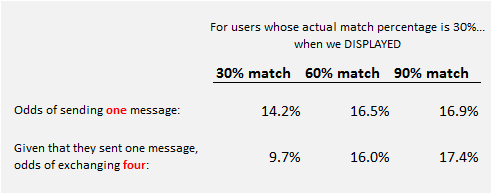
The first thing they did was artificially alter the match rating for couples whose true match was only 30%.  Users could read the profile, look at the pictures, reviews answers to questions, and see a match rating.  In other words, they had a lot of information and one summary statistic that might be true or false.

People were slightly more likely to send a message and continue a conversation  if they thought they were a 60% match or better.  This is interesting since all these couples were poorly matched and it shouldn’t have been too difficult to discover that this was so.

1

Rudder’s interpretation of the data is that you can make two people like each other by just telling them that they should.

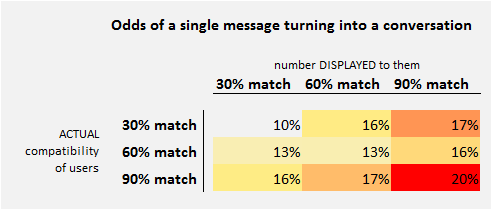
Or maybe, he considered, their algorithm was just terrible. So, they took couples who matched at the 30, 60, and 90% rating and displayed a random match rating that was wrong two-thirds of the time.  Then, they waited to see how many couples got to exchanging four messages (their measure of a “conversation”).

2

The lower right corner suggests that the ideal situation is to be a good match and know it.  Likewise, if you’re a bad match and you know it things probably won’t get very far. But the difference between actually being a good match and just thinking you are isn’t as big as we might think it would be.  At least, not in the space of four messages.

So, does homogamy really translate into compatibility?  Or, do we just think it does?  Maybe a little of both.

Cross-posted at Pacific Standard.

Lisa Wade, PhD is an Associate Professor at Tulane University. She is the author of American Hookup, a book about college sexual culture; a textbook about gender; and a forthcoming introductory text: Terrible Magnificent Sociology. You can follow her on Twitter and Instagram.

This ad for the 2015 Kia Soul featuring hamster people is… charming.

It’s also a very good example of advertising that just up and shrugs and admits that its target is primarily men.  The scientists and engineers are all male and the audience is intended to identify with them.  The females are sexual objects that exist to attract and revel in male attention.  They literally buy them at the pet store, for goodness’ sake.

Hello Kia Soul! Like, women are 51% of the population and we make purchasing decisions. Maybe go with advertising that’s a tad more inclusive? You know, one or two female scientists would have been totally do-able. Your weird science could have included some hunks alongside the hotties. Maybe one of your guy engineers would have liked that, too. I’m just saying. Being more inclusive would have been easy. There’s no excuse for this.

But thanks for the hamsters.

[youtube]https://www.youtube.com/watch?v=56C4kSlGkJ8[/youtube]

Thanks to @MLerner_RBS for the link!

Lisa Wade, PhD is an Associate Professor at Tulane University. She is the author of American Hookup, a book about college sexual culture; a textbook about gender; and a forthcoming introductory text: Terrible Magnificent Sociology. You can follow her on Twitter and Instagram.

Flashback Friday.

Benedict Anderson famously coined the phrase “imagined community” to describe the way that large groups of people without direct contact could nonetheless think of themselves as a meaningful group.  He originally discussed this in the context of nations.  In his book, he writes:

It is imagined because the members of even the smallest nation will never know most of their fellow-members, meet them, or even hear of them, yet in the minds of each lives the image of their communion… it is imagined as a community, because, regardless of the actual inequality and exploitation that may prevail in each, the nation is always conceived as a deep, horizontal comradeship. Ultimately it is this fraternity that makes it possible, over the past two centuries, for so many millions of people, not so much to kill, as willingly to die for such limited imaginings.

Whenever someone refers to “Americans,” he or she is conjuring up this idea of an imagined community.  Why do we feel that we have so much in common with other Americans?   We will only meet a very small percentage of Americans in our lifetimes.  We have things in common with some other Americans, but very little in common with still others.  And, in many important ways, we are probably more like certain segments of other societies (e.g., individuals in the middle class in the U.S., for example, are probably more like those in the middle class in the U.K. than they are like very poor or very rich Americans).

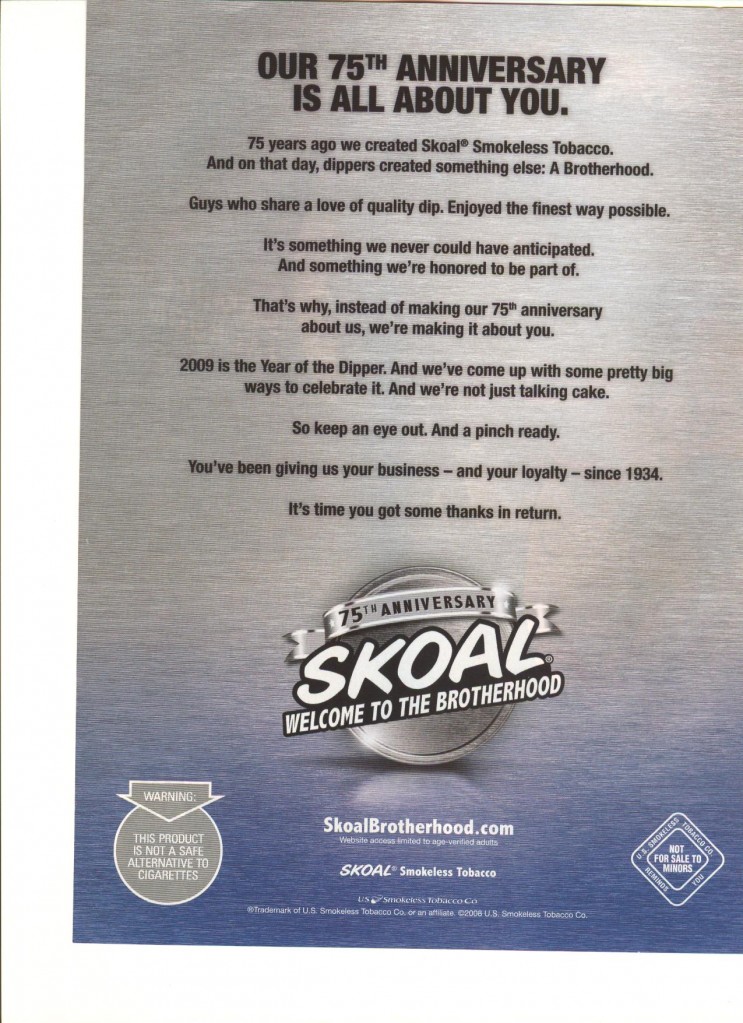
Others have used Benedict Anderson’s term to describe other kinds of imagined communities.  Apparently Skoal is hoping that “dippers” will find a sense of comraderie and devotion to each other (“loyalty”) and the product through the imagining of a Skoal community (“Brotherhood”):

03-011

Text:

OUR 75th ANNIVERSARY IS ALL ABOUT YOU.

75 years ago we created Skoal Smokeless Tobacco.  And on that day, dippers created something else: A Brotherhood.

Guys who share a love of quality dip.  Enjoyed the finest way possible.
It’s something we never could have anticipated.  And something we’re honored to be a part of.
That’s why, instead of making our 75th anniversary about us, we’re making it about you.

2009 is the Year of the Dipper.  And we’ve come up with some pretty big ways to celebrate it.  And we’re not just talking cake.
So keep an eye out.  And a pinch ready.
You’ve been giving us your business — and your loyalty — since 1934.
It’s time you got some thanks in return.

SKOAL
WELCOME TO THE BROTHERHOOD

Originally posted in 2009.

Lisa Wade, PhD is an Associate Professor at Tulane University. She is the author of American Hookup, a book about college sexual culture; a textbook about gender; and a forthcoming introductory text: Terrible Magnificent Sociology. You can follow her on Twitter and Instagram.