Search results for The

Flashback Friday.

Laura A. sent in a video in which African American men ask people in Fuzhou, China, what race they believe people in some photos are:

It’s a good example of the social construction of race. Notice how several people in the photos who would be considered Black in the U.S. don’t seem Black to the Chinese people looking at them, because they don’t have the features that they assume Black people have (such as big lips). Since they don’t have those features…they can’t be Black. We also see here that racial differences that would be easily identified in one culture (such as the U.S.) aren’t necessarily recognized in the same way in another. If race were a fixed, biological characteristic, we’d expect more consistency in how it’s defined, how many races people are divided into, and so on.

At about 3:45 you can see the African American men compare their skin color to some Chinese teens (?), who initially define themselves as “yellow people.” But after comparing their skin color, the Black men tell them they’re Black too. I wouldn’t say that the teens seem to be taking the news with great excitement.

Of course, it’s also interesting that the filmmakers refer to the people in the pictures as “really” Black, and tell the Chinese people who are guessing whether they are right or wrong in guessing their race, which implies there actually is a specific race that they belong to. They’re correct in saying that’s the race most people in the U.S. would place those individuals in, but since race is socially constructed, you can’t really say any way of categorizing people by race is “right” or “wrong.”

Originally posted in 2009.

Gwen Sharp is an associate professor of sociology at Nevada State College. You can follow her on Twitter at @gwensharpnv.
As workers battle to raise the minimum wage it is nice to see more evidence that doing so helps both low wage workers and state economies.

Thirteen states raised their respective minimum wages in 2014:  AZ, CA, CT, FL, MO, MT, NJ, NY, OH, OR, RI, VT, and WA.  Elise Gould, an economist at the Economic Policy Institute, compared labor market changes in these thirteen states with changes in the rest of the states from the first half of 2013 to the first half of 2014.

Economic analyst Jared Bernstein summarizes the results as follows:

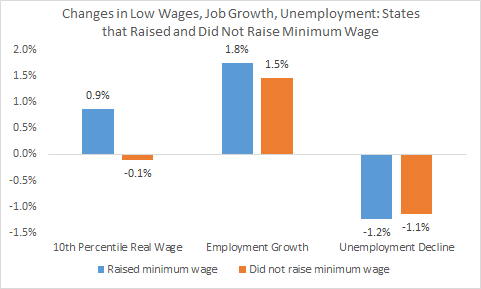
[Gould] compares the 10th percentile [lowest earners] wage growth among these thirteen states that increased their minimums with the rest that did not. The results are the first two bars in the figure below.

2

Real wages for low-wage workers rose by just about 1% over the past year in the states that raised their minimum wages, and were flat (down 0.1%) in the other states.

OK, but did those increases bite into employment growth, as opponents typically insist must be the case? Not according to the other two sets of bars. They show that payroll employment growth was slightly faster in states that raised, and the decline in unemployment, slightly greater.

In short, raising the minimum wage did boost the earnings of those at the bottom of the income distribution.  Moreover, workers in states that raised the minimum wage also enjoyed greater employment growth and a greater decline in unemployment than did workers in states that did not.

Martin Hart-Landsberg is a professor of economics at Lewis and Clark College. You can follow him at Reports from the Economic Front.

When sports stories wind up in the headlines and network news, something’s usually very wrong. The news biz, whether print or TV, usually keeps athletes confined in the sports section.  So now we have the network anchors talking about Adrian Peterson leaving welts on the flesh of his son, age four, or showing us the video of Ray Rice coldcocking his fiancee in the elevator. Other NFL domestic violence stories, previously ignored (no superstar players, no video), are now mentioned since they fit the news theme.

These incidents all suggest that maybe football players are just violent people – men with a streak of violence in their dispositions. This personality trait that allows them to flourish on the field, but too often it gets them in trouble after they leave the stadium.

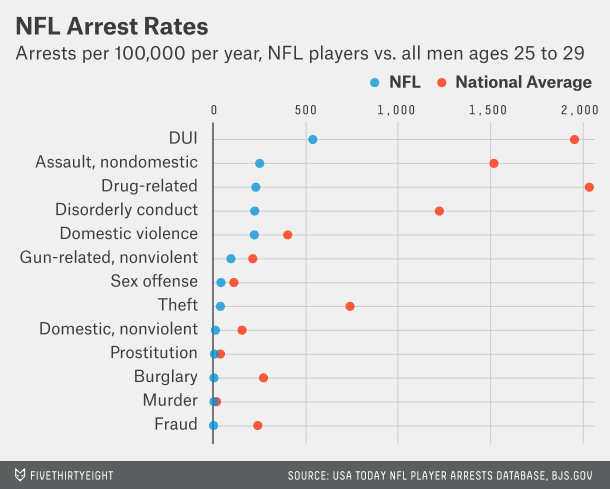
This is the kind of psychological “kinds of people” explanation that I ask students to avoid or at least question, and to question it with data. Conveniently, we have some data. USA Today has the entire NFL rap sheet, and it looks like a long one – more than 700 arrests since 2000.  Nearly 100 arrests for assault, another 85 or so for domestic violence. And those are just the arrests. No doubt many battered wives or girlfriends and many bruised bodies in bars didn’t make it into these statistics. Are football players simply violent people – violent off the field as well as on?

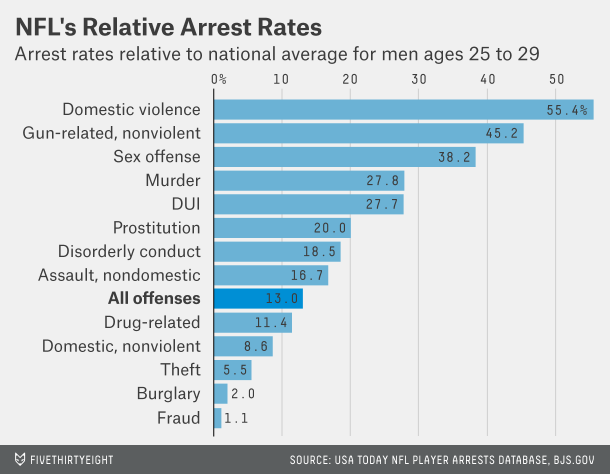
Well, no. The largest category of arrests is drunk driving  – potentially very harmful, but not what most people would call violent.  And besides, NFL players are arrested at a lower rate than are their uncleated counterparts – men in their late twenties.

2

This suggests that the violence we see in the stadiums on Sunday is situational (perhaps like the piety and moral rectitude we encounter elsewhere on Sunday).  The violence resides not in the players but in the game.  On every down, players must be willing to use violence against another person. Few off-the-field situations call for violence, so we shouldn’t be surprised that these same men have a relatively low rate of arrest (low relative to other young men).

But let’s not discard the personal angle completely. If we look at arrests within the NFL, we see two things that suggest there might be something to this idea that violence, or at least a lack of restraint, might have an individual component as well.  First, although NFL arrests are lower for all crimes, they are much, much lower for non-violent offenses like theft. But for domestic violence, the rate is closer that of non-footballers.  The NFL rate for domestic violence is still substantially lower than the national average – 55 NFL arrests for every 100 among non-NFL men. But for theft, the ratio is one-tenth of that – 5.5 NFL arrests per 100 non-NFL. Also on the higher side are other offenses against a person (murder, sex offenses) and offenses that might indicate a careless attitude toward danger – DUI, guns.

3

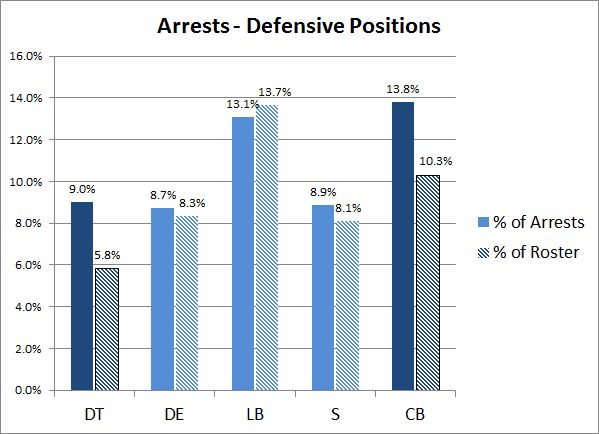
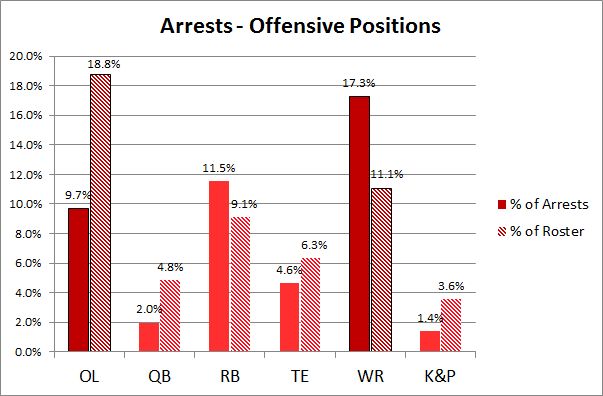
Second, some positions have a disproportionate number of offenders. The graphs below show the percent of all arrests accounted for by each position and also the percent the position represents of the total NFL roster.  For example, cornerbacks make up about 10% of all players, but they accounted for about 14% of all arrests. (The difference is not huge, but it’s something; there would be a very slight overlap in the error bars if my version of Excel made it easy to include them.)

23

The positions disproportionately likely to be arrested are wide receivers and defensive tackles. Those most under-represented in arrests are the offensive linemen.

This fits with my own image of these positions. The wide-outs seem to have more than their share of free-spirits – players who care little for convention or rules. Some are just oddball amusing, like Chad Ochocinco formerly of the Bengals. Others are trouble and get traded from team to team despite their abilities, like Terrell Owens of the 49ers, Eagles, Cowboys, Bills, and Bengals.

As for the linemen, the arrest differential down in the trenches also might be expected.  Back in the 1970s, a psychiatrist hired by the San Diego Chargers noted this difference on his first visit to the locker room. It wasn’t the players – the offensive and defensive lineman themselves looked about the same (huge, strong guys) – it was their lockers. They were a metaphor for on-the-field play.  Defensive linemen charge, push, pull, slap – whatever they can do to knock over opponents, especially the one holding the ball. Their lockers were messy, clothes and equipment thrown about carelessly. Offensive lineman, by contrast, are more restricted. Even on a run play, their movements are carefully co-ordinated, almost choreographed. Watch a slo-mo of the offensive line on a sweep, and you’ll see legs moving in chorus-line unison.  Correspondingly, their lockers were models of organization and restraint.

Maybe these same personal qualities prevail off the field as well. Those offensive lineman get arrested at a rate only half of what we would expect from their numbers in the NFL population. Arrests of defensive linemen and wide receivers are 50% more likely than their proportion on the rosters. That can’t be the entire explanation of course. Running counter to this “kinds of people” approach are the other hard-hitting defensive players – defensive ends and linebackers. According to the principle of violent people in violent positions, they should be over-represented in arrest figures just like the  defensive tackles and cornerbacks. But they are not.

If this were a real article, a journal article, this final paragraph would be where the author calls for more data. But the trend in NFL arrests has been downward, and if fewer arrests means less data but also less domestic violence, that’s fine with me.

Cross-posted at Montclair SocioBlog.

Jay Livingston is the chair of the Sociology Department at Montclair State University. You can follow him at Montclair SocioBlog or on Twitter.

Flashback Friday.

When I was in grad school studying sociology of agriculture, one thing we talked about was organic agriculture and the difference between “organic” and “sustainable.” Most consumers think of these words interchangeably.  So, when many people think of an organic dairy farm they imagine something along the lines of these images, the top results for an image search of “organic dairy farm”:

2

So happy! So content! And, we assume, raised on a small family farm in a way that is humane and environmentally responsible. Those, are, after all, two of the things we expect when something is defined as “sustainable”: it is environmentally benign and humane. We also usually assume that workers would be treated decently as well.

But there is no reason that those elements considered essential to sustainability have to have much to do with organic agriculture. Depending on who is doing the defining, being “organic” can involve very little difference from conventional agriculture. Having an organic dairy mostly just requires that the cows not have antibiotics or homones used on them, eat organic feed, and have access to grass a certain number of days per year. In and of itself, organic certifications don’t guarantee long-term environmental sustainability or overall humane treatment of livestock.

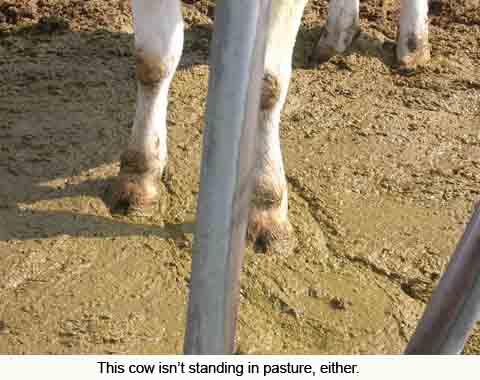
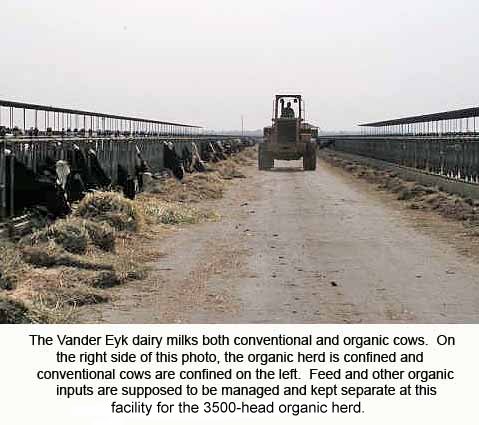
A great illustration of how little the modes of production on organic farms may differ from conventional agriculture is the Vander Eyk dairy. It is an operation in California with over 10,000 dairy cows. Here are some images (found here and here):

feedlot

cow_standing2

546173011_0a1034757e_o

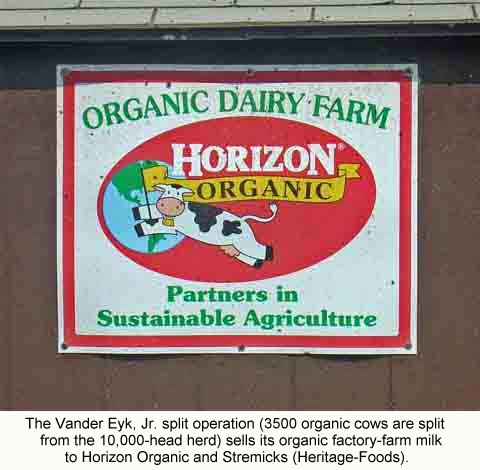
As the caption to the last image makes clear, the Vander Eyk dairy had two herds on the same property, but segregated from one another: the majority of the herd produced conventional milk, while 3,500 cows produced organic milk for sale under the Horizon brand:

horizon_sign

In 2007 the Vander Eyk dairy lost its organic certification for violating the requirement that organic dairy cows spend a certain amount of time on pasture. They had cows on pasture, but they were non-milking heifers, not cows that were being milked at the time. What we see here is that the label “organic” doesn’t guarantee most of the things we associate with the idea of organic or sustainable agriculture (and in cases like Vander Eyk, may not even guarantee the things the label is supposed to cover).

This isn’t just in the dairy industry. As Julie Guthman explains in her book Agrarian Dreams: The Paradox of Organic Farming in California, many types of organic agriculture include things you might not expect. For instance, organic producers in California joined with other producers to oppose making the short-handled hoe illegal — the bane of agricultural workers everywhere (and most infamously associated with sharecropping in the South in the early 20th century) — because they want workers to do lots of close weeding to make up for not spraying crops with pesticides. So, though we often assume organic farmers would be labor-friendly, in that case they opposed a change that agricultural workers supported.

Many organic crops are grown on farms that are the equivalent of the Vander Eyk dairy; most of the land is in conventional production, but a certain number of acres are used to grow organic versions of the same thing. Often the producer, which may be an individual farmer or a corporation such as Dole, isn’t very committed to organics; if a pest infestation threatens to ruin a crop, they’ll just spray it and then sell it on the conventional market rather than lose it. They may then have to have the land re-certified as “in transition,” meaning it hasn’t been pesticide-free long enough to be declared completely organic, but many consumers don’t pay too much attention to such distinctions.

The Vander Eyk dairy — and lots more examples of large containment-facility operations selling to Horizon and other brands at the Cornucopia Institute’s photo gallery — are interesting examples of how terms like “organic,” “green,” and “eco-friendly” don’t necessarily mean that the item is produced according to any of the standards we often assume they imply.

Originally posted in 2009.

Gwen Sharp is an associate professor of sociology at Nevada State College. You can follow her on Twitter at @gwensharpnv.
SocImages news:

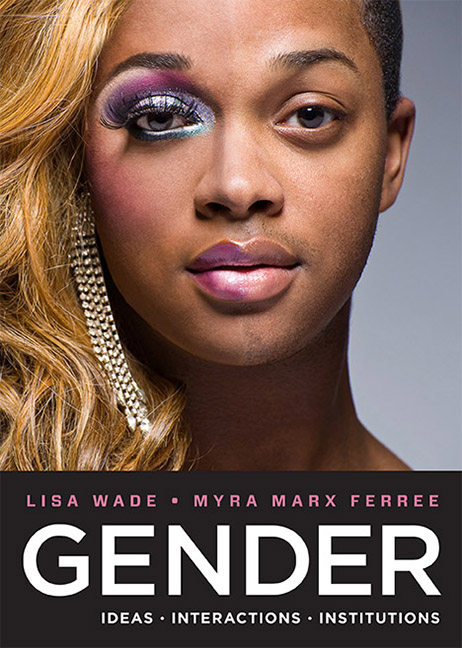
On the heels of the release of Philip Cohen’s new textbook — The Family — comes one from yours truly and the extraordinary sociologist, Myra Marx Ferree: Gender: Ideas, Interactions, Institutions.

Thanks to Leland Bobbe, the photographer; Crystal Demure, the model; and the talent at W.W. Norton for the truly stunning cover!

Gender, by Wade and Ferree

Here are some ways to order, sample, and follow the book:

At SocImages this month…

You like!  Here are our most appreciated posts in September:

Thanks everybody!

Editor’s pick:

New Pinterest board!

  • Sexy what!? A collection of advertisements for products that shouldn’t be sexy, ever, but are. So help us God.

Social Media ‘n’ Stuff:

This is your monthly reminder that SocImages is on TwitterFacebookTumblrGoogle+, and Pinterest.  I’m on Facebook and most of the team is on Twitter: @lisawade@gwensharpnv@familyunequal, and @jaylivingston.

In other news…

Founder Gwen Sharp is the second SocImages sociologist featured at Cute Overload! Three kittens less than a week old were found nestled under a tire in the parking lot at Nevada State College. She’s been raising them ever since and documenting their progress at the NSC kittens tumblr.

2

Lisa Wade, PhD is an Associate Professor at Tulane University. She is the author of American Hookup, a book about college sexual culture; a textbook about gender; and a forthcoming introductory text: Terrible Magnificent Sociology. You can follow her on Twitter and Instagram.

In 2009, Benoit Denizet-Lewis wrote in the New York Times that youth were coming out as gay, bisexual, and lesbian at increasingly early ages. Coming out in middle school, though, often prompted parents to ask the classic question: “But how do you know you’re gay?”

The equally classic response to this question is, “Well, how do you know you’re not?” The response is meant to bring questioners’ attention to the invisible norm: heterosexuality. It’s a sexual orientation, too, and if a person must somehow determine that they are gay, then the same must be true of heterosexuality.

Of course, most heterosexuals simply respond: “I always knew.” At which point the gay or bisexual person just nods smugly. It’s very effective.

In any case, I was reminded of this when I came across a Buzzfeed collection of “painfully funny secrets” children think they’re hiding from their parents. A few of them were romantic or sexual secrets kept by four-, five- and six-year-olds.

I’m not saying that any of these secrets actually mean anything about these children’s sexual orientation, but they might. The first crush I can remember was in 2nd grade. His name was Brian and we cleaned up the teacher’s classroom after school in exchange for stickers. I never looked directly at him, nor him at me, but he was soooooo cuuuuuuuute!

Anyway, it’s interesting to me that parents have a difficult time believing that their children might have a pretty good idea who they like. The signs of their sexual and romantic interests start early. Then again, if parents are looking for signs that their children develop crushes on the other sex, it’s likely easier for them to see. The invisibility of heterosexuality as a sexual orientation can make it, paradoxically, impossible to miss. While the non-normativeness of homo- and bisexuality can make these orientations invisible.

Cross-posted at Pacific Standard.

Lisa Wade, PhD is an Associate Professor at Tulane University. She is the author of American Hookup, a book about college sexual culture; a textbook about gender; and a forthcoming introductory text: Terrible Magnificent Sociology. You can follow her on Twitter and Instagram.

Economist Robin Hanson has an “it isn’t about” list. It begins:

  • Food isn’t about Nutrition
  • Clothes aren’t about Comfort

Also on the list is:

  • Church isn’t about God

Maybe church isn’t about religious ideas either.

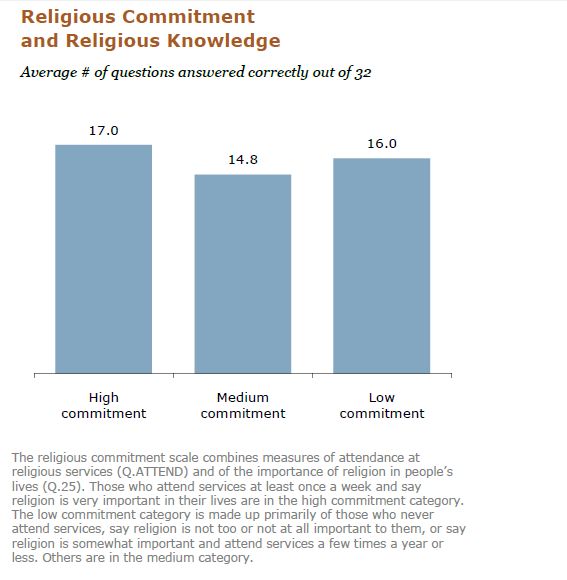
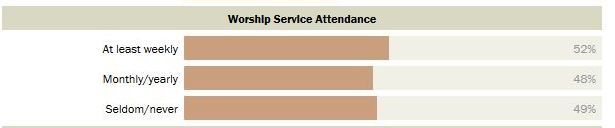
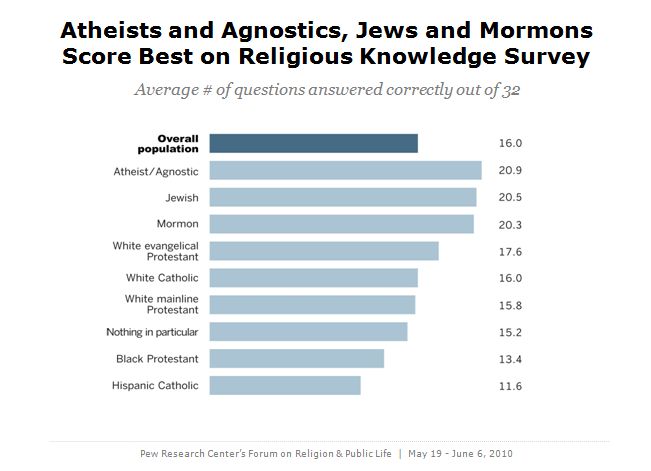
I was reminded of this recently when I followed a link to a Pew quiz on religious knowledge. It’s a lite version of the 32-item quiz Pew used with a national sample in 2010.  One of the findings from that survey (the full report is here) was that people who went to church regularly and who said that religion was important in their lives didn’t do much better on the quiz than did those who had a weak attachment to church and religion.

2

The strongly committed averaged 17 correct answers out of the 32 questions; the uncommitted, 16.  This same pattern was repeated in the more recent 15-question quiz.

3

The committed may derive many things from their church attendance and faith, but knowledge of religion isn’t one of them.

To be fair, the quiz covers many religions, and people do know more about their own religion than they do about others.  “What was Joseph Smith’s religion?” Only about half the population gets that one right, but 93% of the Mormons nailed it. Mormons also knew more about the Ten Commandments. Catholics did better than others on the transubstantiation question.  But when it came to knowing who inspired the Protestant Reformation, Protestants got outscored by Jews and atheists.

Overall, nonbelievers, Jews, and Mormons did much better than did Protestants and Catholics.

4

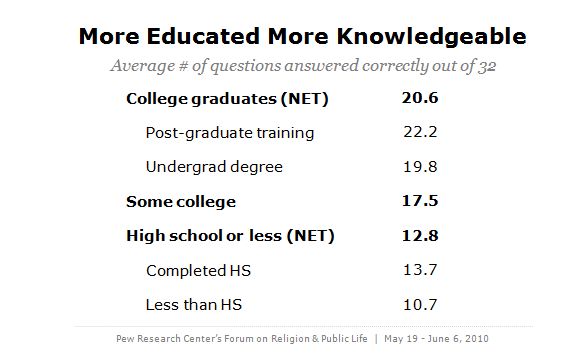
One reason for their higher scores might be education – college graduates outscore high school or less by nearly 8 points out of 32.

11

It may be that nonbelievers, Jews, and Mormons are more likely to have finished college. Unfortunately, the Pew report does not give data that controls for education.

But another reason that these groups scored higher may be their position as religious minorities. Jews and Mormons have to explain to the flock how their ideas are different from those of the majority. Atheists and agnostics too, in their questioning and even rejecting,  have probably devoted more thought to religion, or more accurately, religions. On the questions about Shiva and Nirvana, they leave even the Jews and Mormons far behind.

For Protestants and Catholics, by contrast, learning detailed information about their religion is not as crucial. Just as White people in the US rarely ask what it means to be White, Christians need not worry about their differences from the mainstream. They are the mainstream. So going to church or praying can be much more about feelings – solidarity, transcendence, peace, etc.  That variety of religious experience need not include learning the history or even the tenets of the religion itself. As Durkheim said, the central element in religion is ritual – especially the feelings a ritual generates in the group. Knowing the actual beliefs might be a nice addition, but it’s not crucial.

Cross-posted at Pacific Standard.

Jay Livingston is the chair of the Sociology Department at Montclair State University. You can follow him at Montclair SocioBlog or on Twitter.

Flashback Friday.

This series of pictures is from a San Francisco Chronicle article about flash mobs, or “an international fad, partly anarchistic, partly absurdist, in which a mob of participants suddenly materializes at a public place, engages in odd behavior [like pillow or shaving cream fights] and then disperses.”

One picture is of Martin Condol, one of the city workers brought it to clean up after the revelers. He is the only worker to be included in the photographs — appearing in two images of the 20 — despite the fact that the article was specifically about the problem and expense involved in cleaning up.

Though many of us see such workers in our everyday lives, they are very rarely made visible in news accounts of the world. Even when they’re relevant, news producers seem to prefer to show the faces of happy white people to those of the men and women whose hard work keeps cities, businesses, and families flourishing.

Originally posted in 2009.

Lisa Wade, PhD is an Associate Professor at Tulane University. She is the author of American Hookup, a book about college sexual culture; a textbook about gender; and a forthcoming introductory text: Terrible Magnificent Sociology. You can follow her on Twitter and Instagram.