Search results for The

Originally Posted at Discoveries

After the 2016 Presidential election in the United States, Brexit in the UK, and a wave of far-right election bids across Europe, white supremacist organizations are re-emerging in the public sphere and taking advantage of new opportunities to advocate for their vision of society. While these groups have always been quietly organizing in private enclaves and online forums, their renewed public presence has many wondering how they keep drawing members. Recent research in American Sociological Review by Pete SimiKathleen BleeMatthew DeMichele, and Steven Windisch sheds light on this question with a new theory—people who try to leave these groups can get “addicted” to hate, and leaving requires a long period of recovery.

Photo by Dennis Skley, Flickr CC

The authors draw on 89 life history interviews with former members of white supremacist groups. These interviews were long, in-depth discussions of their pasts, lasting between four and eight hours each. After analyzing over 10,000 pages of interview transcripts, the authors found a common theme emerging from the narratives. Membership in a supremacist group took on a “master status”—an identity that was all-encompassing and touched on every part of a member’s life. Because of this deep involvement, many respondents described leaving these groups like a process of addiction recovery. They would experience momentary flashbacks of hateful thoughts, and even relapses into hateful behaviors that required therapeutic “self talk” to manage.

We often hear about new members (or infiltrators) of extremist groups getting “in too deep” to where they cannot leave without substantial personal risk. This research helps us understand how getting out might not be enough, because deep group commitments don’t just disappear when people leave.

Evan Stewart is an assistant professor of sociology at University of Massachusetts Boston. You can follow his work at his website, or on BlueSky.

Originally Posted at Discoveries

Many different factors go into deciding your college major — your school, your skills, and your social network can all influence what field of study you choose. This is an important decision, as social scientists have shown it has consequences well into the life course — not only do college majors vary widely in terms of earnings across the life course, but income gaps between fields are often larger than gaps between those with college degrees and those without them. Natasha Quadlin finds that this gap is in many ways due to differences in funding at the start of college that determine which majors students choose.

Photo by Tom Woodward, Flickr CC

Quadlin draws on data from the Postsecondary Transcript Study, a collection of over 700 college transcripts from students who were enrolled in postsecondary education in 2012. Focusing on students’ declared major during their freshman year, Quadlin analyzes the relationship between the source of funding a student gets — loans, grants, or family funds — and the type of major the student initially chooses — applied versus academic and STEM versus non-STEM. She finds that students who pay for college with loans are more likely to major in applied non-STEM fields, such as business and nursing, and they are less likely to be undeclared. However, students whose funding comes primarily from grants or family members are more likely to choose academic majors like sociology or English and STEM majors like biology or computer science.

In other words, low- and middle-income students with significant amounts of loan debt are likely to choose “practical” applied majors that more quickly result in full-time employment. Conversely, students with grants and financially supportive parents, regardless of class, are more likely to choose what are considered riskier academic and STEM tracks that are more challenging and take longer to turn into a job. Since middle- to upper-class students are more likely to get family assistance and merit-based grants, this means that less advantaged students are most likely to rely on loans. The problem, Quadlin explains, is that applied non-STEM majors have relatively high wages at first, but very little advancement over time, while academic and STEM majors have more barriers to completion but experience more frequent promotions. The result is that inequalities established at the start of college are often maintained throughout people’s lives.

Jacqui Frost is a PhD candidate in sociology at the University of Minnesota and the managing editor at The Society Pages. Her research interests include non-religion and religion, culture, and civic engagement.

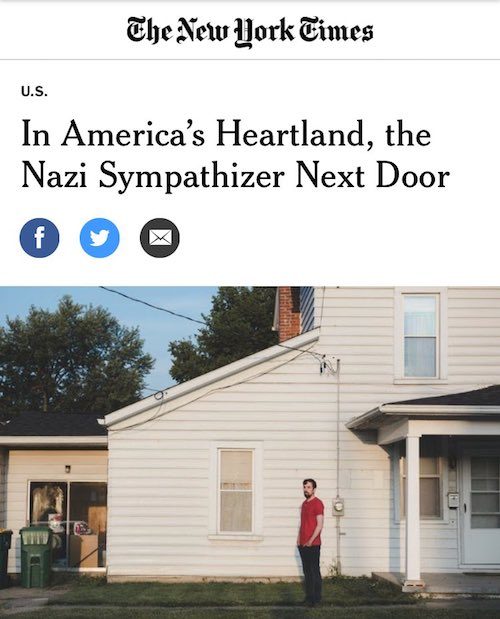
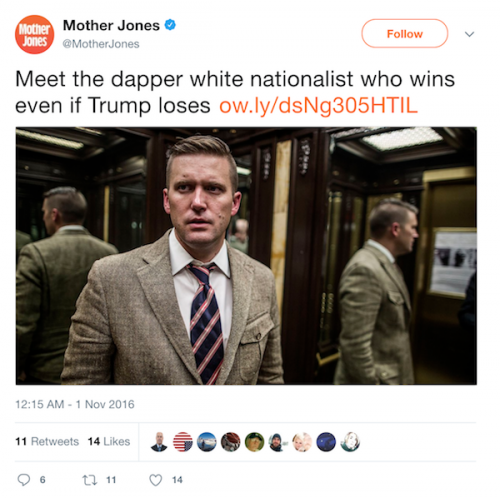
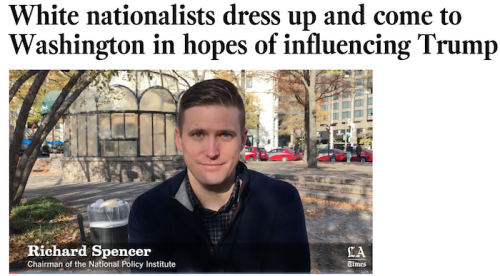
The New York Times has been catching a lot of criticism this week for publishing a profile on the co-founder of the Traditionalist Worker Party. Critics argue that stories taking a human interest angle on how alt-right activists live, and how they dress, are not just puff pieces that aren’t doing due diligence in reporting—they also risk “normalizing” neo-nazi and white supremacist views in American society.

It is tempting to scoff at the buzzword “normalization,” but there is good reason for the clunky term. For sociologists, what is normal changes across time and social context, and normalization means more than whether people choose to accept deviant beliefs or behaviors. Normalization means that the everyday structure of organizations can encourage and reward deviance, even unintentionally.

Media organizations play a key role here. Research on the spread of anti-Muslim attitudes by Chris Bail shows how a small number of fringe groups with extremist views were able to craft emotionally jarring messages that caught media attention, giving them disproportionate influence in policy circles and popular culture.

Organizations are also quite good at making mistakes, and even committing atrocities, through “normal” behavior. Research on what happened at NASA leading up to the Challenger disaster by Diane Vaughan describes normalization using a theory of crime from Edwin H. Sutherland where people learn that deviant behavior can earn them benefits, rather than sanctions. When bending the rules becomes routine in organizations, we get everything from corporate corruption up to mass atrocities. According to Vaughan:

When discovered, a horrified world defined these actions deviant, yet they were normative within the culture of the work and occupations of the participants who acted in conformity with organizational mandates

The key point is that normalization doesn’t just stop by punishing or shaming individuals for bad behavior. Businesses can be fined, scapegoats can be fired, and readers can cancel subscriptions, but if normalization is happening the culture of an institution will continue to shape how individual people make decisions.This raises big questions about the decisions made by journalists and editors in pursuit of readership.

Research on normalization also begs us to remember that some of the most horrifying crimes and accidents in human history are linked by a common process: the way organizations can reward deviant work. Just look at the “happy young folks” photographed by Karl Höcker in 1944…while they worked at Auschwitz.

Evan Stewart is an assistant professor of sociology at University of Massachusetts Boston. You can follow his work at his website, or on BlueSky.
Thanksgiving Mythology

Theorizing Thanksgiving:

Some Fun History:

Cigarette Advertising, on this Holiday:

Thanksgiving, Race, and Gender:

Just for Fun:

Lisa Wade, PhD is an Associate Professor at Tulane University. She is the author of American Hookup, a book about college sexual culture; a textbook about gender; and a forthcoming introductory text: Terrible Magnificent Sociology. You can follow her on Twitter and Instagram.

Thanksgiving is upon us. Typically, a time in which we all get together and collectively celebrate the genocide of Native Americans at the hands of Puritanical European conquerors. This tradition now includes family gatherings, expressions of thanks, love and self-congratulations, bountiful feasts, and uncomfortable social and political conversations, all revolving around the all-important turkey dinner.

Turkeys are notoriously difficult to cook perfectly and with good flavor. And, while women are generally held responsible for the grunt work involved in turkey preparation, it is men’s contributions that matter the most: carving, traditionally, and, now, seasoning.

Luckily, the invisible hand of capitalism has developed a masculine method for men to fulfill their manly role of seasoning—one that doesn’t involve any sissy sprinkling. It’s Season Shot: a way for a hunter to deliver exactly the right amount of flavor to a turkey, via shotgun, at the precise moment of his victory over nature. It’s boldness and self-reliance in a (nut) shell.

For those girly men and women who don’t know about hunting, shotguns are different from rifles. Instead of a bullet, they shoot a hollow shell full of small balls of steel. Shotguns are especially well-suited to murder most fowl, as it makes it easier to target small, moving game. Season Shot replaces the standard steel with seasoning granules. Why delicately season a fresh¹ turkey, when you can blast in the flavor? Varieties includes Cajun flavor, Lemon Pepper, Garlic, Teriyaki, and Honey Mustard.

We dare you to find a more manly way to do women’s work.

The additional positives of using Season Shot are plentiful. Firstly, dental. You won’t suffer a broken tooth due to a pellet your wife or some other woman failed to fish out of the carcass. All your teeth will encounter is flesh.

Secondly, there is the efficiency.  You season the bird on impact; marinating starts immediately as the body heat melts the seasoned pellets. Men don’t like to waste time.

Thirdly, benevolent patriarchal protection of the environment. As it says on the Season Shot website:

Our environment is the basis for the sport of hunting. Without a healthy environment how would our hunting fare? Why damage the very thing that allows us to do what we love? Season Shot is the answer. This is the first truly environmentally safe ammunition, Season Shot stands out above the rest. Using fully biodegradable shot, Season Shot is the right choice to protect what we love.

The final advantage is a thank you from your ol’ lady. She can’t nag you for spending the whole day eating, napping, and watching football while she furiously coordinates guests, pets, decorations, and a meal large enough for a small army after weeks of extensive thought and preparation—no, not when all of her work would be wasted without you and Season Shot.

In short, Season Shot gives us men a safe and environmentally friendly way to indulge our obsession with guns, protect our masculinity, and produce more egalitarian holiday chores. Thanks, capitalism. You’ve done it again.

¹Note: Authors suggest using extreme caution on frozen turkeys due to potential ricochet. Authors also suggest only using outdoors.

D’Lane R. Compton, PhD is a lover of all things antler, feather, and fur. An associate professor of sociology at the University of New Orleans with a background in social psychology, methodology, and a little bit of demography, they are usually thinking about food, country roads, stigma, queer nooks and places, sneakers and hipster subcultures. You can follow them on twitter.

Tony Love is a fan of most sports, a rural person stuck in the city, and conducts social psychology experiments on his own children and pets for fun. He researches social psychology and criminology as an assistant professor of sociology at the University of Kentucky. He is especially happy when confronted with cookies and especially unhappy when confronted with exercise. Sometimes he writes serious sociology articles that only other sociologists read.

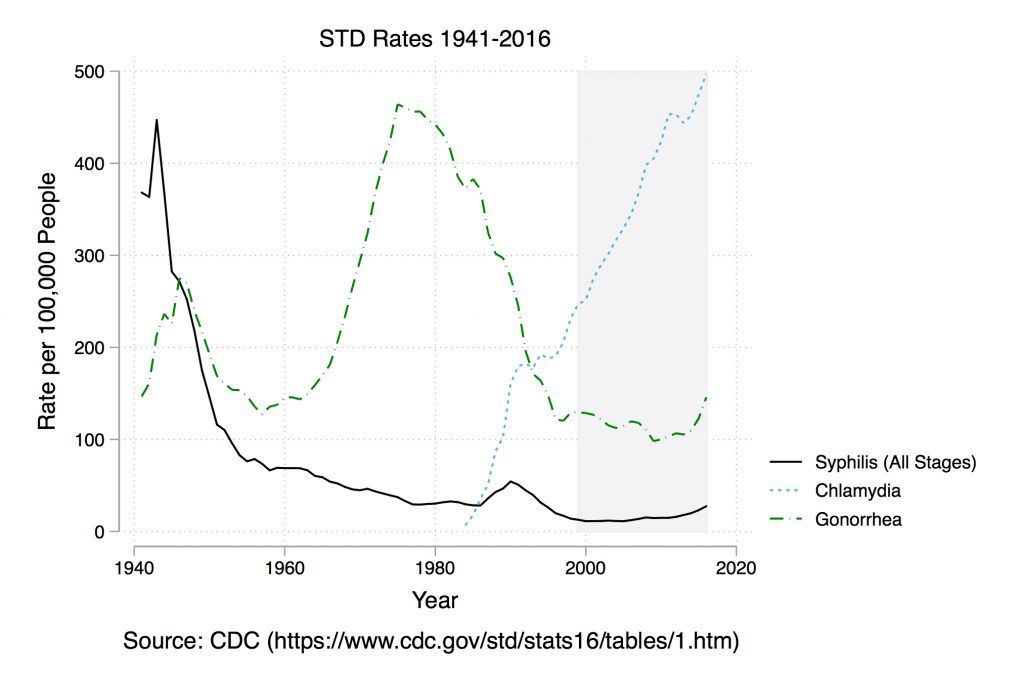
The CDC recently issued a press release announcing that rates of reported cases for sexually transmitted diseases are setting record highs. The new report offers reports of rates going back to 1941 in a table, so I made a quick chart to see the pattern in context and compare the more common conditions over time (HIV wasn’t included in this particular report).

It is important to note that a big part of changes in disease rates is usually detection. Once you start looking for a condition, you’ll probably find more of it until enough diagnoses happen for treatment to bring the rates down. Up until 2000, the U.S. did pretty well in terms of declining rates for cases of gonorrhea and syphilis. Zoom in on the shaded area from 2000 to 2016, however, and you can see a pretty different story. These rates are up over the last 16 years, and chlamydia rates have been steadily increasing since the start of reporting in 1984.

STDs are fundamentally a social phenomenon, especially because they can spread through social networks. However, we have to be very careful not to jump to conclusions about the causes of these trends. It’s tempting to blame dating apps or hookup culture, for example, but early work at the state level only finds a mixed relationship between dating app use and STD rates and young people also have higher rates of sexual inactivity. Rate increases could even be due in part to detection now that more people have access to health coverage and care through the Affordable Care Act. Just don’t wait for peer review to finish before going to get tested!

Inspired by demographic facts you should know cold, “What’s Trending?” is a post series at Sociological Images featuring quick looks at what’s up, what’s down, and what sociologists have to say about it.

Evan Stewart is an assistant professor of sociology at University of Massachusetts Boston. You can follow his work at his website, or on BlueSky.
Originally Posted at There’s Research On That! 

Photo by Tom Lee, Flickr CC

If you like Halloween, you know that witches are a popular costume choice and decoration this time of year. But the history of witches involves much more than bubbling cauldrons and flying broomsticks. Social science shows us that witchcraft has a long history of empowering marginalized groups, like women and sexual minorities, who question more traditional religious practices.

While popular images of witches often focus on magic spells, brooms, and pointed hats, witchcraft and other forms of neo-paganism have historically been used by women to push back against male-dominated religions. More traditional, hierarchical interpretations of religions like Christianity and Islam often place women in a subordinate role to men, and research finds that many women are drawn to witchcraft and other alternative spiritualities because they emphasize female empowerment, embodied rituals, and sexual freedom.

People who practice witchcraft and neo-paganism typically see sexuality and gender as key sites for social transformation and personal healing, pushing back against the Christian idea that sex and bodies are sinful. Since neo-paganism values sexual freedom and sexual diversity, LGBTQ folks and people practicing polyamory often feel a sense of belonging that they don’t find in other religious spaces.

This has also been true for young adults. In general, young adults practice religion and spirituality differently than do older generations. For example, millennials are the least likely to participate in traditional religious institutions or identify with one single religious belief system, but many still desire some combination of spirituality and community. The increase in portrayals of witchcraft and other neo-pagan religions in popular media has exposed younger generations to these communities, and research finds that teens are more often drawn to these alternative spiritual practices as a means of self-discovery and community, rather than the promise of magical powers.

Allison Nobles is a PhD candidate in sociology at the University of Minnesota and a member of The Society Pages’ graduate editorial board. Her research primarily focuses on sexuality and gender, and their intersections with race, immigration, and law.

Jacqui Frost is a PhD candidate in sociology at the University of Minnesota and the managing editor at The Society Pages. Her research interests include non-religion and religion, culture, and civic engagement.

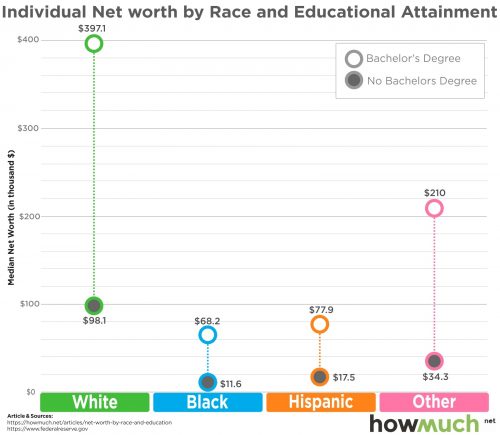
The staff at How Much recently visualized summaries from a Federal Reserve analysis showing how much a college degree can matter for your net worth. It turns out education can really pay…if you’re white.

This illustrates an important sociological point. When we talk about structural inequality, critics often note that we shouldn’t disregard individuals’ efforts to work and earn a better life. Getting a college degree is one of the centerpieces of this argument. These gaps show it’s not that effort doesn’t matter at all, but that inequality in social conditions means those efforts yield wildly different outcomes.

Want to read more on higher education and America’s wealth gap? Check out Tressie McMillan Cottom’s Lower Ed, Thomas Shapiro’s Toxic Inequality, and Dalton Conley’s Being Black, Living in the Red.

Evan Stewart is an assistant professor of sociology at University of Massachusetts Boston. You can follow his work at his website, or on BlueSky.