Search results for The

Human research subjects are all over popular media. Lab rats, guinea pigs, and even the obscure “Pharmer’s daughter” (From The Facility, 2012) all refer to people who participate in biomedical research as test subjects—often ingesting experimental drugs to test their toxicity or therapeutic effectiveness.

The clinical trial industry has decried the representations of human subjects in the media for being fantastical and overly dramatic. The concern is that portraying human subjects in a negative light hurts their ability to recruit participants, test experimental products, and profit from approved drugs.

But how are human research subjects actually portrayed?

In two new publications, my co-author Jill Fisher and I look at how human subjects are represented in popular entertainment media. We analyzed 65 television shows and films like Big Bang Theory, Two and a Half Men, Grey’s Anatomy, The Facility and The Amazing Spiderman.

We find that human research subjects are predominately white men from lower socio-economic backgrounds. When women are represented, they are more likely to be shown being coerced into research (rather than enrolling for therapeutic or financial reasons).
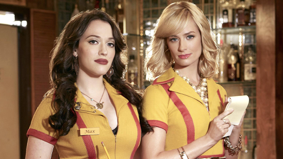
2 Broke Girls is actually an outlier in this regard. In this show, Max and Caroline were not coerced but financially motivated to participate in clinical trials—or as Max likes to call it: “getting paid $500 to roll the side effect dice and hope it lands on hallucinations! [audience laughter]”

Indeed, films and shows did use fantastical and dramatic representations of side effects—from discussions of men growing breasts, limb regrowth, and fits of rage and violence—and death and injury were common. Most of these medical studies failed—and failed in spectacularly horrific or comedic ways.

While negative, this portrayal is not necessarily wrong or bad:

Importantly, negative outcomes of fictional medical research are not the same as negative depictions of science… There are real risks to research participants who enroll in medical studies as well as high rates of scientific failure (Fisher and Cottingham 2017:575–76).

While industry representatives may dislike portrayals for their inaccuracies, the fact that many clinical trials do fail and have serious potential to harm subjects cannot be absolved by painting subjects as “medical heroes” as some have tried (Peddicord 2012).

What do human subjects think of these portrayals?

We took the study further by looking at how human research subjects themselves use film and television to understand clinical trials. Surprisingly, the discussion of dramatic side effects were common among their responses. As one participant noted: 

Like I never heard of this [clinical trials], and ‘They do what?!’ You know, you gonna grow an extra eye, you gonna grow, you-you know, you hear all these things, you know. – Rob

And yet, after they had participated in a clinical trial and saw that the more common side effects listed in the informed consent documents included dizziness, headaches, nausea, and fatigue, they became less concerned about the risks of clinical trials. Rather than scaring these participants away, representations in the media seemed to make the mundane and ordinary list of potential side effects (even cardiac issues!) appear even more acceptable.

We frame media portrayals and participant perspectives on the risks of clinical trials as collective and individual efforts to manage the anxieties surrounding the risks of experimental biomedical research. As a society, we have come to accept the fact that experimental research requires risking human welfare and comfort, but remain ambivalent about the idea that science is inherently good and linked to social progress.

Collectively, we manage this ambivalence by dehumanizing research subjects or indulging in tales of science gone wrong. At the individual level, research participants use media portrayals of “lab rats” and “guinea pigs” to manage the fears and anxieties of the research they undergo. No one has grown a third arm, had their penis shrink, or turned blue in a Phase I clinical trial, so it must not be too harmful…right?

Read More Here:

Cottingham, Marci D. and Jill A. Fisher. Forthcoming. “From Fantasy to Reality: Managing Biomedical Risk Emotions in and through Fictional Media.” Health, Risk & Society 1–17.

Fisher, Jill A. and Marci D. Cottingham. 2017. “This Isn’t Going to End Well: Fictional Representations of Medical Research in Television and Film.” Public Understanding of Science 26(5):564–78.

Peddicord, Doug. 2012. “Television’s Assault on Medical Research.Huffington Post.

Marci Cottingham is an assistant professor of sociology at the University of Amsterdam. Her research focuses on the sociology of emotion, social inequalities, healthcare, and biomedical risk. More on her research (including the two papers discussed here) can be found on her website.
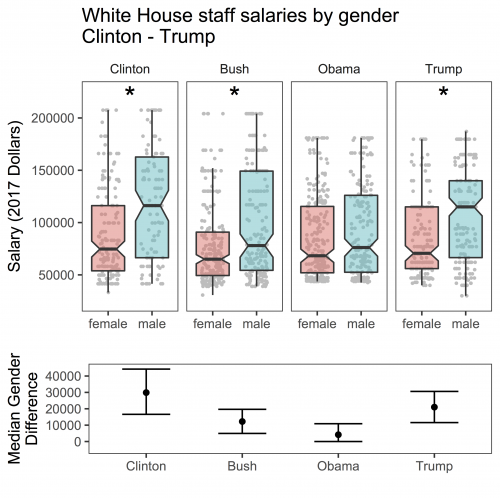
On the Data is Beautiful subreddit, a user going by the name fencelizard recently took a look at gender differences in full-time staff salaries in the last four U.S. Presidential administrations. This is only a quick descriptive picture (notes on the methodology below), but it highlights an important point about organizations: inequality doesn’t always neatly align with ideology.

Both the wide and the narrow median pay gaps are bipartisan. While the Clinton and the early Trump administrations have the widest gaps in median earnings, the George W. Bush and Obama administrations were the closest to gender parity (the gap was not statistically significant in the Obama years).

Of course, these gaps mean different things in different administrations. The parity among Bush staffers looks like it came from pay cuts on both sides, with more men remaining in a higher salary range, while the Obama administration had a much more even distribution across men and women. Part of the pattern for the Trump administration could be due to understaffing in general.

Nevertheless, it is interesting to see how the salary distribution for women staffers has remained relatively consistent and lower than fluctuating salaries for men. Sociologists know that inequality can be embedded in the day-to-day operations of institutions like schools, prisons, and government offices. Bias certainly can and does play a role in this process, but the ideological support that we often associate with such biases—like political preferences—doesn’t always have to be the deciding factor for whether inequality happens.

Some background on the analysis from fencelizard:

Salary data was sourced from white house press releases for Trump (PDF tables; FML) and Obama (UTF-8 csv’s; thanks Obama), and from the Washington Post for Bush (http://www.washingtonpost.com/wp-srv/politics/administration/whbriefing/2004stafflistb.html) and Clinton (https://www.washingtonpost.com/archive/politics/1993/11/01/salaries-at-clintons-white-house/9c96f5b6-02c5-4888-87ee-dc547d8d93f0/?utm_term=.aa70a4af1649). Supposedly full salary data for Bush I exists too, but I couldn’t find it anywhere online.
I cleaned up the data in R, used the ‘gender’ package to guess staffers’ gender from their first names, and made the plots with ggplot2 and gridExtra. I used a Wilcox test to compare the distribution of salaries across genders for each president. Asterisks in the figure above indicate significantly different distributions.

Evan Stewart is an assistant professor of sociology at University of Massachusetts Boston. You can follow his work at his website, or on BlueSky.

Cosmopolitan is a highly influential fashion magazine, the 15th highest circulating magazine in the United States. Its covers matter, seen by 18 million readers a month and many more at checkout and newspaper stands across the country. Who are their covers representing, and have they become more racially diverse?

I did a content analysis of Cosmo covers, randomly selecting a sample of 214 between 1975 and 2014. Since the 1970s and 2010s have fewer years represented, about half the number of covers were examined during these decades as compared to the 1980s, 1990s, and 2000s. Following sociologist Mary Nell Trautner and Erin Hatton’s study of Rolling Stone covers, I coded each image for race. Since the cover models are well-known, I could double check race codes with accessible biographical information about them.

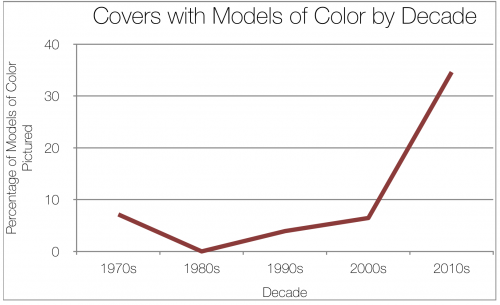
Overall, only 8% of the covers featured a person of color, including eight Hispanic women, four African-American women, four Middle Eastern women, and one Asian woman. The figure below shows that representation did increase over time. Among the 1970s, 1980s, and 1990s covers together, just 3% represented minorities, while the 2000s and 2010s covers together pictured minorities 16% of the time.

What accounted for the increase? I posit that it had less to do with an interest in diversifying Cosmo’s cover models, and more to do with a shift in focus. In the late 1990s, Cosmo began using celebrities and pop culture icons on their covers instead of models, a trend which continues today. It was in this same time span that minority representation had the largest increase.

This fits Mavrody’s (2014) study that there are lower numbers of models of color in the industry, at about 19%, and there is no action being taken to change this representation. What may be changing, however, is the representation of minorities in the entertainment industry. Movie and television stars shown on magazine covers in the most recent few decades include many more people of color than were seen when strictly models were on the covers.

Despite little change in the modeling industry, the entertainment industry has begun to work toward more equality in representation. In television, while there are roles that have been written just for people of color, there has also been a trend of mandating the inclusion of minorities. It seems as though this industry knows their audience and what they desire, and they are actively trying to diversify all shows, not just those that solely represent minorities and the minority experience. This work toward inclusion would bring about more fame for minority actors and actresses, which would explain their higher representation in the media, as well.

Alyssa Scull graduated from The College of New Jersey with a BA in Sociology. She is currently a MSW student at Columbia University, focusing on family, youth, and children in the practice and programming track. 

The harrowing mass shooting in Las Vegas this week is part of a tragic pattern, and it raises big questions about how we deal with such tragedies in public life. In the face of such horror, many people rightly turn to their deep convictions for comfort and strength, and their leaders are no different. Referencing religion is a common choice for politicians, especially in troubling times. Experimental evidence shows these references draw voters in, but lately it seems like the calls for comfort may have gotten a little…rehearsed.

For a growing number of Americans, calls for “thoughts and prayers” ring especially hollow. About a fifth of the U.S. population has no religious affiliation, and new experimental research shows we may be drastically underestimating the number of atheists in the population as well. Despite these trends, we don’t often seen direct challenges to religious beliefs and practices in policy debates. Healthcare reform advocates don’t usually argue that we should keep people alive and well because “there probably isn’t an afterlife.” While the battle to legalize same sex marriage discussed the separation of church and state, we didn’t see many large advocacy groups arguing for support on the grounds that biblical claims simply weren’t true.

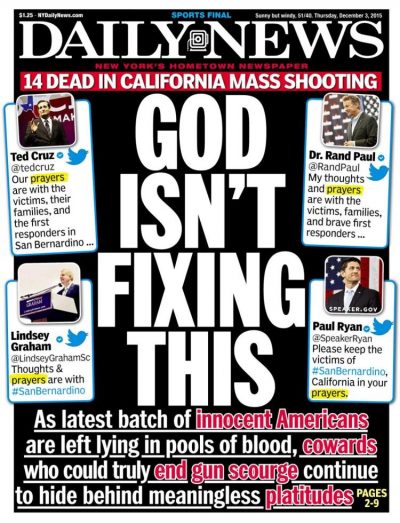
In lieu of prayer, calls for concrete action on gun control in the face of mass shootings are a new challenge to these cultural norms. In the wake of the 2015 San Bernardino shooting,  the New York Daily News ran this cover:

Now, in press conferences and on the floor of Congress, more political leaders are openly saying that thoughts are prayers are not enough to solve this problem. Sociologists know that the ways we frame issues matter, and here we might be seeing a new framing strategy emerging from the gun control debate that could reshape the role of religion in American politics in the long term.


Evan Stewart is an assistant professor of sociology at University of Massachusetts Boston. You can follow his work at his website, or on BlueSky.

Mild Spoiler Alert for Season 3 of House of Cards

Where is Rachel Posner?

Representations of sex workers on popular shows such as Game of Thrones, The Good Wife, and, of course, any version of CSI, are often stereotypical, completely incorrect, and infuriatingly dehumanizing. Like so many of these shows, House of Cards offers more of the same, but it uses a somewhat different narrative for a former sex worker and central character, Rachel Posner. Rachel experiences many moments of sudden empowerment that are just as quickly taken away. She is not entirely disempowered, often physically and emotionally resisting other characters and situations, but her humanization only lasts so long.  

The show follows Rachel for three full seasons, offering some hope to the viewer that her story would not end in her death, dehumanization, or any other number of sensational and tumultuous storylines. So, when she is murdered in the final episode of Season 3, viewers sensitive to her character’s role as a sex worker and invested in a new narrative for current and former sex worker characters on popular TV shows probably felt deeply let down. Her death inspired us to go back and analyze how her role in the series was both intensely invisible and visible.  

Early in the show, we learn that Rachel has information that could reveal murder and corrupt political strategizing orchestrated by the protagonist Frank Underwood.  She is the thread that weaves the entire series together. Despite this, most characters on the show do not value Rachel beyond worrying about how she could harm them. Other characters talk about her when she’s not present at all, often referring to her as “the prostitute” or “some hooker,” rather than by her name or anything else that describes who she is.

The show, too, devalues her. At the beginning of an episode, we watch Rachel making coffee one morning in her small apartment.  Yet, instead of watching her, we watch her body parts; the camera pans over her torso, her breasts in a lace bra, and then her legs before we finally see her entire body and face.  There is not one single scene even remotely like this for any other character on the show. Even the promotional material for Season 1 (pictured above) fails to include a photo of Rachel while including images of a number of other characters who were less central to the storyline and appeared in fewer episodes. Yet, whoever arranged the photoshoot didn’t think she was important enough to include.

Another major way that Rachel is marginalized in the context of the show is that she is not given many scenes or storylines that are about her—her private life, time spent with friends, or what’s important to her. This is in contrast to other characters with a similar status. For instance, the audience is made to feel sympathy for Gavin, a hacker, when an FBI agent threatens the life of his beloved guinea pig. In contrast, it is Rachel’s ninth episode before the audience sees her interact with a friend, and we never really learn what motivates her beyond fear and survival. In this sense, Rachel is almost entirely invisible in her own storyline. She only exists when people want something from her.

Rachel is also made invisible by the way she is represented or discussed in many scenes.  For instance, although she’s present, she has zero lines in her first couple scenes. After appearing (without lines) in Episodes 1 and 2, Rachel reappears in Episode 7, although she’s not really present; she re-emerges in the form of a handwritten note to Doug Stamper (Underwood’s indispensable assistant).  She writes: “I need more money.  And not in my mouth.” These are Rachel’s first two lines in the entire series; however, she’s not actually saying them, she’s asking for something and one of the lines draws attention to a sexualized body part and sexual act that she engaged in with Doug. Without judging the fact that she engaged in a sexual act with a client, what’s notable here is the fact that she isn’t given a voice or her own resources. She is constantly positioned in relation to other characters and often without the resources and ability to survive on her own.

This can clearly be seen in the way Rachel is easily pushed around by other characters in the show, who are able to force their will upon her. When viewers do finally see her in a friendship, one that blossoms into a romance, the meaning that Rachel gives the relationship is overshadowed by the reaction Doug Stamper has to it. Doug has more contact with Rachel than any other character on the show; in the beginning of the series, he acts as a sort of “protector” to Rachel, by finding her a safe place to stay, ensuring that she can work free from sexual harassment in her new job, and getting her an apartment of her own. However, all these actions highlight the fact that she does not have her own resources or connections to be able to function on her own, and they are used to manipulate her. Over Rachel’s growing objections, Doug is able to impose his wishes upon her fairly easily. The moment she is able to overpower him and escape, she disappears from the show for almost a whole season, only to reappear in the episode where she dies. In this episode, we finally see Rachel standing on her own two feet. It seems like a hard life, working lots of double shifts and living in a rundown boardinghouse, but we also see her enjoying herself with friends and building something new for herself. And yet, it is also in this episode where she has leveraged her competence into a new life that she also meets her demise. Unfortunately, after seeing this vision of Rachel on the road to empowerment, more than half of her scenes relate to her death, and in most of them she is begging Doug for her life, once again reduced to powerlessness. 

Every time we begin to see a new narrative for Rachel, one that allows her to begin a life that isn’t entirely tethered to Doug Stamper and her past, she is almost immediately drawn back into his web.  Ultimately, in this final episode, she can no longer grasp her new narrative and immediately loses hold of it.  In her final scenes, after kidnapping her, Doug temporarily lets her go.  She begins to walk in the opposite direction of his van before, only moments later, he flips the van around and heads back in her direction.  The next scene cuts suddenly to her lifeless body in a shallow grave.  The sudden shock of this scene is jarring, yet oddly expected, given how the show has treated Rachel’s character throughout the series.  It’s almost as if the show does not have any use for a sex worker character who can competently manage their own affairs.  Perhaps that idea didn’t even occur to the writers because of the place in our society in which sex workers are currently situated, perhaps it disrupts the fallen woman narrative, or perhaps for some reason, a death seems more “interesting” than a storyline where a sex worker has agency and takes an active role in shaping her own life and affecting those around her.  Whatever the reason, House of Cards ultimately fails Rachel and sex workers, in general.

Paige Connell is an undergraduate sociology student at Chico State University. Her areas of interest include intimate relationships, gender, and pop culture. 

Dr. Danielle Antoinette Hidalgo is an Assistant Professor in Sociology at California State University, Chico, specializing in theory, gender and sexuality, and embodiment studies.

Originally posted at Discoveries

Punk rock has a long history of anti-racism, and now a new wave of punk bands are turning it up to eleven to combat Islamophobia. For a recent research article, sociologist Amy D. McDowell  immersed herself into the “Taqwacore” scene — a genre of punk rock that derives its name from the Arabic word “Taqwa.” While inspired by the Muslim faith, this genre of punk is not strictly religious — Taqwacore captures the experience of the “brown kids,” Muslims and non-Muslims alike who experience racism and prejudice in the post-9/11 era. This music calls out racism and challenges stereotypes.

Through a combination of interviews and many hours of participant observation at Taqwacore events, McDowell brings together testimony from musicians and fans, describes the scene, and analyzes materials from Taqwacore forums and websites. Many participants, Muslim and non-Muslim alike, describe processes of discrimination where anti-Muslim sentiments and stereotypes have affected them. Her research shows how Taqwacore is a multicultural musical form for a collective, panethnic “brown” identity that spans multiple nationalities and backgrounds. Pushing back against the idea that Islam and punk music are incompatible, Taqwacore artists draw on the essence of punk to create music to that empowers marginalized youth.

Neeraj Rajasekar is a Ph.D. student in sociology at the University of Minnesota.

In February, CBS Sunday Morning aired a short news segment on the bro hug phenomenon: a supposedly new way heterosexual (white) men (i.e., bros) greet each other. According to this news piece, the advent of the bro hug can be attributed to decreased homophobia and is a sign of social progress.

I’m not so sure.

To begin, bro-ness isn’t really about any given individuals, but invokes a set of cultural norms, statuses, and meanings. A stereotypical bro is a white middle-class, heterosexual male, especially one who frequents strongly masculinized places like fraternities, business schools, and sport events. (The first part of the video, in fact, focused on fraternities and professional sports.) The bro, then, is a particular kind of guy, one that frequents traditionally male spaces with a history of homophobia and misogyny and is invested in maleness and masculinity.

The bro hug reflects this investment in masculinity and, in particular, the masculine performance in heterosexuality. To successfully complete a bro hug, the two men clasp their right hands and firmly pull their bodies towards each other until they are or appear to be touching whilst their left hands swing around to forcefully pat each other on the back. Men’s hips and chests never make full contact. Instead, the clasped hands pull in, but also act as a buffer between the men’s upper bodies, while the legs remain firmly rooted in place, maintaining the hips at a safe distance. A bro hug, in effect, isn’t about physical closeness between men, but about limiting bodily contact.

Bro hugging, moreover, is specifically a way of performing solidarity with heterosexual men. In the CBS program, the bros explain that a man would not bro hug a woman since a bro hug is, by its forcefulness, designed to be masculinity affirming. Similarly, a bro hug is not intended for gay men, lesbians, or queer people. The bro hug performs and reinforce bro identity within an exclusively bro domain. For bros, by bros. As such, the bro hug does little to signal a decrease in homophobia. Instead, it affirms men’s identities as “real” men and their difference from both women and non-heterosexual men.

In this way, the bro-hug functions similarly to the co-masturbation and same-sex sexual practices of heterosexually identified white men, documented by the sociologist Jane Ward in her book, Not Gay. Ward argues that when straight white men have sex with other straight white men they are not necessarily blurring the boundaries between homo- and heterosexuality. Instead, they are shifting the line separating what is considered normal from what is considered queer.  Touching another man’s anus during a fraternity hazing ritual is normal (i.e., straight) while touching another man’s anus in a gay porn is queer.  In other words, the white straight men can have sex with each other because it is not “real” gay sex. 

Similarly, within the context of a bro hug, straight white men can now bro hug each other because they are heterosexual. Bro hugging will not diminish either man’s heterosexual capital. In fact, it might increase it. When two bros hug, they signal to others their unshakable strength of and comfort in their heterosexuality. Even though they are touching other men in public, albeit minimally, the act itself reinforces their heterosexuality and places it beyond reproach.

Hubert Izienicki, PhD, is a professor of sociology at Purdue University Northwest. 

Originally posted at Reports from the Economic Front.

What is work like for Americans?  The results of the Rand Corporation’s American Working Conditions Survey (AWCS) paint a troubling picture. As the authors write in their summary:

The AWCS findings indicate that the American workplace is very physically and emotionally taxing, both for workers themselves and their families.

The authors do note more positive findings.  These include:

that workers appear to have a certain degree of autonomy, most feel confident about their skill set, and many receive social support on the job.

Despite the importance of work to our emotional and physical well-being, social relations, and the development of our capacities to shape our world, little has been published about our experience of work. Here, then, is a more detailed look at some of the Survey’s findings:

The Hazardous Workplace

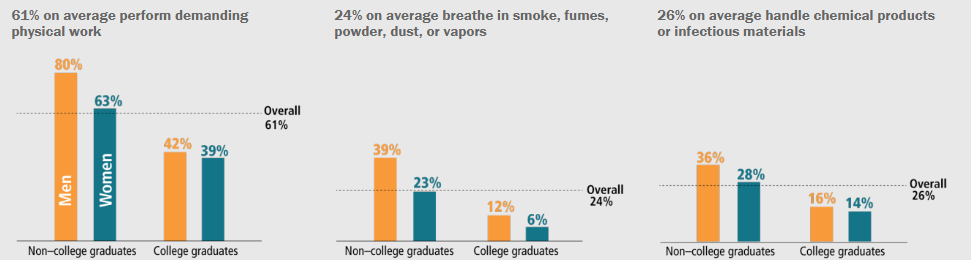
An overwhelming fraction of Americans engage in intense physical exertion on the job. In addition to physical demands, more than one-half of American workers (55 percent) are exposed to unpleasant or potentially dangerous working conditions.

The Pressures of Work

Approximately two-thirds of Americans have jobs that involve working at very high speed at least half the time; the same fraction works to tight deadlines at least half the time.

The Long Work Day

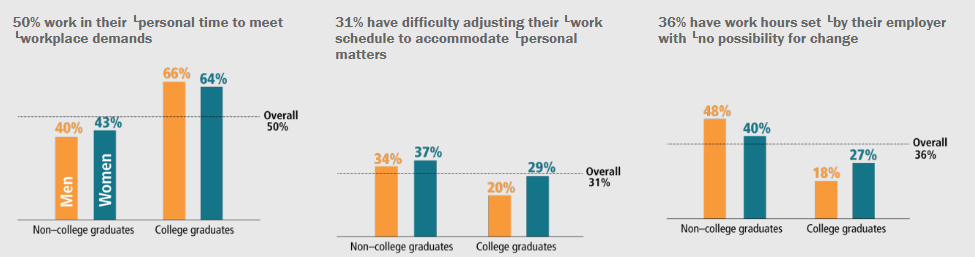
While presence at the work place during business hours is required for most Americans, many take work home. About one-half of American workers do some work in their free time to meet work demands. Approximately one in ten workers report working in their free time “nearly every day” over the last month, two in ten workers report working in their free time “once or twice a week,” and two in ten workers report working in their free time “once or twice a month.” 

The Work Environment

Nearly one in five American workers were subjected to some form of verbal abuse, unwanted sexual attention, threats, or humiliating behavior at work in the past month or to physical violence, bullying or harassment, or sexual harassment at work in the past 12 months. 

At the same time, it is also true that:

While the workplace is a source of hostile social experiences for an important fraction of American workers, it is a source of supportive social experiences for many others. More than one-half of American workers agreed with the statement “I have very good friends at work,” with women more likely to report having very good friends at work than men (61 and 53 percent, respectively).

In sum, the survey’s results make clear that work in the United States is physically and emotionally demanding and dangerous for many workers. And with the government weakening many of the labor and employment regulations designed to protect worker rights and safety, it is likely that workplace conditions will worsen.

Worker organizing and workplace struggles for change need to be encouraged and supported. A recent Pew Research Center survey showed growing support for unions, especially among younger workers.  It is not hard to understand why.