Search results for The

Flashback Friday.

In Race, Ethnicity, and Sexuality, Joane Nagel looks at how these characteristics are used to create new national identities and frame colonial expansion. In particular, White female sexuality, presented as modest and appropriate, was often contrasted with the sexuality of colonized women, who were often depicted as promiscuous or immodest.

This 1860s advertisement for Peter Lorillard Snuff & Tobacco illustrates these differences. According to Toby and Will Musgrave, writing in An Empire of Plants, the ad drew on a purported Huron legend of a beautiful white spirit bringing them tobacco.
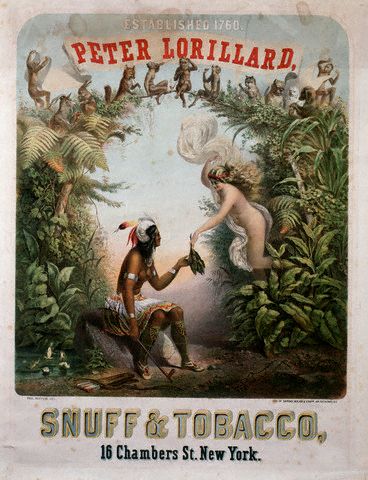
There are a few interesting things going on here. We have the association of femininity with a benign nature: the women are surrounded by various animals (monkeys, a fox and a rabbit, among others) who appear to pose no threat to the women or to one another. The background is lush and productive.

Racialized hierarchies are embedded in the personification of the “white spirit” as a White woman, descending from above to provide a precious gift to Native Americans, similar to imagery drawing on the idea of the “white man’s burden.”

And as often occurred (particularly as we entered the Victorian Era), there was a willingness to put non-White women’s bodies more obviously on display than the bodies of White women. The White woman above is actually less clothed than the American Indian woman, yet her arm and the white cloth are strategically placed to hide her breasts and crotch. On the other hand, the Native American woman’s breasts are fully displayed.

So, the ad provides a nice illustration of the personification of nations with women’s bodies, essentialized as close to nature, but arranged hierarchically according to race and perceived purity.

Originally posted in 2010.

Gwen Sharp is an associate professor of sociology at Nevada State College. You can follow her on Twitter at @gwensharpnv.
Flashback Friday.

Stiff competition for entrance to private preschools and kindergartens in Manhattan has created a test prep market for children under 5. The New York Times profiled Bright Kids NYC. The owner confesses that “the parents of the 120 children her staff tutored [in 2010] spent an average of $1,000 on test prep for their 4-year-olds.”  This, of course, makes admission to schools for the gifted a matter of class privilege as well as intelligence.

The article also tells the story of a woman without the resources to get her child, Chase, professional tutoring:

Ms. Stewart, a single mom working two jobs, didn’t think the process was fair. She had heard widespread reports of wealthy families preparing their children for the kindergarten gifted test with $90 workbooks, $145-an-hour tutoring and weekend “boot camps.”

Ms. Stewart used a booklet the city provided and reviewed the 16 sample questions with Chase. “I was online trying to find sample tests,” she said. “But everything was $50 or more. I couldn’t afford that.”

Ms. Stewart can’t afford tutoring for Chase; other parents can. It’s unfair that entrance into kindergarten level programs is being gamed by people with resources, disadvantaging the most disadvantaged kids from the get go. I think many people will agree.

But the more insidious value, the one that almost no one would identify as problematic, is the idea that all parents should do everything they can to give their child advantages. Even Ms. Stewart thinks so. “They want to help their kids,” she said. “If I could buy it, I would, too.”

Somehow, in the attachment to the idea that we should all help our kids get every advantage, the fact that advantaging your child disadvantages other people’s children gets lost.  If it advantages your child, it must be advantaging him over someone else; otherwise it’s not an advantage, you see?

I felt like this belief (that you should give your child every advantage) and it’s invisible partner (that doing so is hurting other people’s children) was rife in the FAQs on the Bright Kids NYC website.

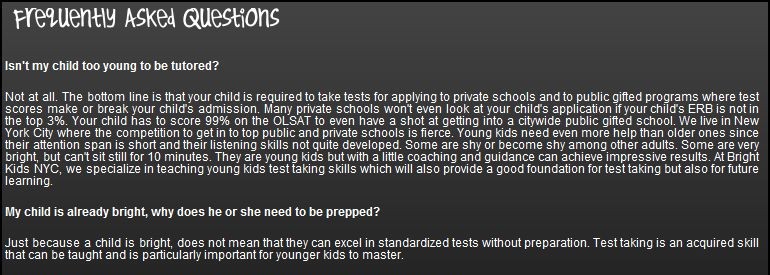
Isn’t my child too young to be tutored?

These programs are very competitive, the answers say, and you need to make sure your kid does better than other children.  It’s never too soon to gain an advantage.

My child is already bright, why does he or she need to be prepared?

Because being bright isn’t enough.  If you get your kid tutoring, she’ll be able to show she’s bright in exactly the right way. All those other bright kids that can’t get tutoring won’t get in because, after all, being bright isn’t enough.

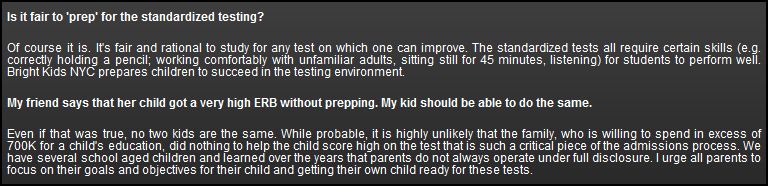
Is it fair to “prep” for the standardized testing?

Of course it’s fair, the website claims!  It’s not only fair, it’s “rational”!  What parent wouldn’t give their child an advantage!?  They avoid actually answering the question. Instead, they make kids who don’t get tutoring invisible and then suggest that you’d be crazy not to enroll your child in the program.

My friend says that her child got a very high ERB [score] without prepping.  My kid should be able to do the same.

Don’t be foolish, the website responds. This isn’t about being bright, remember. Besides, your friend is lying. They’re spending $700,000 dollars on their kid’s schooling (aren’t we all!?) and we can’t disclose our clients but, trust us, they either forked over a grand to Bright Kids NYC or test administrators.

Test prep for kindergartners seems like a pretty blatant example of class privilege. But, of course, the argument that advantaging your own kid necessarily involves disadvantaging someone else’s applies to all sorts of things, from tutoring, to a leisurely summer with which to study for the SAT, to financial support during their unpaid internships, to helping them buy a house and, thus, keeping home prices high.

I think it’s worth re-evaluating. Is giving your kid every advantage the moral thing to do?

Lisa Wade, PhD is an Associate Professor at Tulane University. She is the author of American Hookup, a book about college sexual culture; a textbook about gender; and a forthcoming introductory text: Terrible Magnificent Sociology. You can follow her on Twitter and Instagram.

Originally posted at Montclair Socioblog.

“Freedom of opinion does not exist in America,” said DeTocqueville 250 years ago. He might have held the same view today.

But how could a society that so values freedom and individualism be so demanding of conformity?  I had blogged about this in 2010 with references to old sitcoms, but for my class this semester I needed something more recent. Besides, Cosby now carries too much other baggage. ABC’s “black-ish”* came to the rescue.

The idea I was offering in class was, first, that our most cherished American values can conflict with one another. For example, our desire for family-like community can clash with our value on independence and freedom. Second, the American solution to this conflict between individual and group is often what Claude Fischer calls “voluntarism.”  We have freedom – you can voluntarily choose which groups to belong to. But once you choose to be a member, you have to conform.  The book I had assigned my class (My Freshman Year by Rebekah Nathan*) uses the phrase “voluntary conformism.”

In a recent episode of “black-ish,” the oldest daughter, Zoey, must choose which college to go to. She has been accepted at NYU, Miami, Vanderbilt, and Southern Cal. She leans heavily towards NYU, but her family, especially her father Dre, want her to stay close to home. The conflict is between Family – family togetherness, community – and Independence. If Zoey goes to NYU, she’ll be off on her own; if she stays in LA, she’ll be just a short drive from her family. New York also suggests values on Achievement, Success, even Risk-taking (“If I can make it there” etc.)

Zoey decides on NYU, and her father immediately tries to undermine that choice, reminding her of how cold and dangerous it will be. It’s typical sitcom-dad buffonery, and his childishness tips us off that this position, imposing his will, is the wrong one. Zoey, acting more mature, simply goes out and buys a bright red winter coat.

The argument for Independence, Individual Choice, and Success is most clearly expressed by Pops (Dre’s father, who lives with them), and it’s the turning point in the show. Dre and his wife are complaining about the kids growing up too fast. Pops says, “Isn’t this what you wanted? Isn’t this why you both worked so hard — movin’ to this White-ass neighborhood, sendin’ her to that White-ass school so she could have all these White-ass opportunities? Let. Her. Go.”

That should be the end of it. The final scene should be the family bidding a tearful goodbye to Zoey at LAX. But a few moments later, we see Zoey talking to her two younger siblings (8-year old twins – Jack and Diane). They remind her of how much family fun they have at holidays. Zoey has to tell them that New York is far, so she won’t be coming back till Christmas – no Thanksgiving, no Halloween.

Jack reminds her about the baby that will arrive soon. “He won’t even know you.”

In the next scene, Zoey walks into her parents room carrying the red winter coat. “I need to return this.”

“Wrong size?” asks her father.

“Wrong state.”

She’s going to stay in LA and go to USC.

Over a half-century ago, David McClelland wrote that a basic but unstated tenet of American culture is: “I want to freely choose to do what others expect me to do.” Zoey has chosen to do what others want her to do – but she has made that individual choice independently. It’s “voluntary conformism,” and it’s the perfect American solution (or at least the perfect American sitcom solution).

* For those totally unfamiliar with the show, the premise is this: Dre Johnson, a Black man who grew up in a working-class Black neighborhood of LA, has become a well-off advertising man, married a doctor (her name is Rainbow, or usually Bow), and moved to a big house in an upscale neighborhood. They have four children, and the wife is pregnant with a fifth.

Jay Livingston is the chair of the Sociology Department at Montclair State University. You can follow him at Montclair SocioBlog or on Twitter.

Based on analyses of General Social Survey data, a well-designed and respected source of data about American life, members of the Millennial generation are acquiring about the same number of sexual partners as the Baby Boomers. This data suggests that the big generational leap was between the Boomers and the generation before them, not the Boomers and everyone that came after. And rising behavioral permissiveness definitely didn’t start with the Millennials. Sexually speaking, Millennials look a lot like their parents at the same age and are perhaps even less sexually active then Generation X.

Is it true?

It doesn’t seem like it should be true. In terms of attitudes, American society is much more sexually permissive than it was for Boomers, and Millennials are especially more permissive. Boomers had to personally take America through the sexual revolution at a time when sexual permissiveness was still radical, while Generation X had to contend with a previously unknown fatal sexually transmitted pandemic. In comparison, the Millennials have it so easy. Why aren’t they having sex with more people?

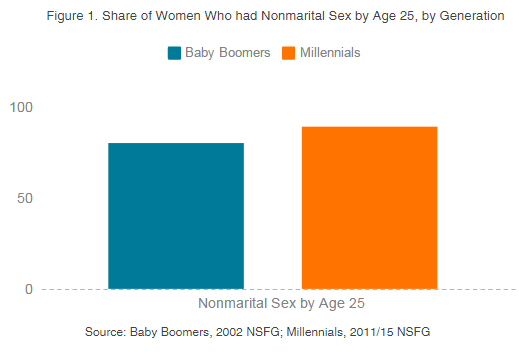
A new study using data from the National Survey of Family Growth (NSFG) (hat tip Paula England) contrasts with previous studies and reports an increase. It finds that nine out of ten Millennial women had non-marital sex by the time they were 25 years old, compared to eight out of ten Baby Boomers. And, among those, Millennials reported two additional total sexual partners (6.5 vs. 4.6).

Nonmarital Sex by Age 25, Paul Hemez

Are Millennials acquiring more sexual partners after all?

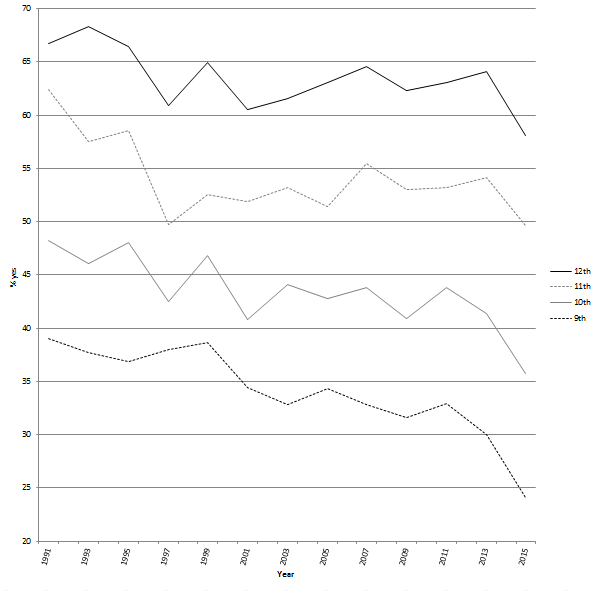
I’m not sure. The NSFG report used “early” Millennials (only ones born between 1981 and 1990). In a not-yet-released book, the psychologist Jean Twenge uses another survey — the Youth Risk Behavior Surveillance System — to argue that the next generation (born between 1995 and 2002), which she calls the “iGen,” are even less likely to be sexually active than Millennial. According to her analysis, 37% of 9th graders in 1995 (born in 1981, arguably the first Millennial year) had lost their virginity, compared to 34% in 2005, and 24% in 2015.

Percentage of high school students who have ever had sex, by grade. Youth Risk Behavior Surveillance System, 1991-2015.

iGen, Jean Twenge

If Twenge is right, then we’re seeing a decline in the rate of sexual initiation and possibly partner acquisition that starts somewhere near the transition between Gen X and Millennial, proceeds apace throughout the Millennial years, and is continuing — Twenge argues accelerating — among the iGens. So, if the new NSFG report finds an increase in sexual partners between the Millennials and the Boomers, it might be because they sampled on “early” Millennials, those closer to Gen Xers, on the top side of the decline.

Honestly, I don’t know. It’s interesting though. And it’s curious why the big changes in sexually permissive attitudes haven’t translated into equally sexually permissive behaviors. Or, have actually accompanied a decrease in sexual behavior. It depends a lot on how you chop up the data, too. Generations, after all, all artificial categories. And variables like “nonmarital sex by age 25” are specific and may get us different findings than other measures. Sociological questions have lots of moving parts and it looks as if we’re still figuring this one out.

Lisa Wade, PhD is an Associate Professor at Tulane University. She is the author of American Hookup, a book about college sexual culture; a textbook about gender; and a forthcoming introductory text: Terrible Magnificent Sociology. You can follow her on Twitter and Instagram.

Originally posted at Inequality by (Interior) Design.

I’ve been following a couple different data sets that track the size of the LGB(T) population in the United States for a few years. There’s a good amount of evidence that all points in the same direction: those identifying as lesbian, gay, bisexual, and possibly transgender too are all on the rise. Just how large of an increase is subject to a bit of disagreement, but the larger trend is undeniable. Much of the reporting on this shift treats this as a fact that equally blankets the entirety of the U.S. population (or only deals superficially with the really interesting demographic questions concerning the specific groups within the population that account for this change).

In a previous post, I separated the L’s, G’s and B’s because I suspected that more of this shift was accounted for by bisexuals than is often discussed in any critical way (*the GSS does not presently have a question that allows us to separate anyone identifying as transgender or outside the gender binary). Between 2008 and 2016, the proportion of the population identifying as lesbian or gay went from 1.6% to 2.4%. During the same period, those identifying as bisexual jumped from 1.1% to 3.3%. It’s a big shift and it’s even bigger when you look at how pronounced it is among the groups who primarily account for this change: women, people of color, and young people.

The thing about sexual identities though, is that they’re just like other kinds of meaningful identities in that they intersect with other identities in ways that produce different sorts of meanings depending upon what kinds of configurations of identities they happen to be combined with (like age, race, and gender). For instance, as a sexual identity, bisexual is more common than both lesbian and gay combined. But, bisexuality is gendered. Among women, “bisexual” is a more common sexual identity than is “lesbian”; but among men, “gay” is a more common sexual identity than “bisexual”–though this has shifted a bit over the 8 years GSS has been asking questions about sexual orientation. And so too is bisexuality a racialized identity in that the above gendered trend is more true of white and black men than men of other races.

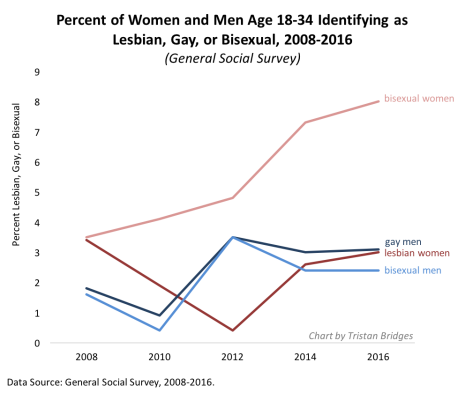
Consider this: between 2008 and 2016, among young people (18-34 years old), those identifying as lesbian or gay went from 2.7% to 3.0%, while those identifying as “bisexual” increased twofold, from 2.6% to 5.3%.  But, look at how this more general change among young people looks when we break it down by gender.
Picture1

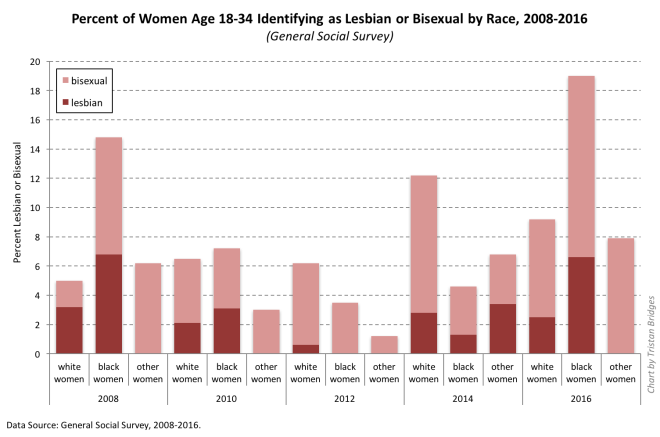
Looked at this way, bisexuality as a sexual identity has more than doubled in recent years. Among 18-34 year old women in 2016, the GSS found 8% identifying as bisexual.  You have to be careful with GSS data once you start parsing the data too much as the sample sizes decrease substantially once we start breaking things down by more than gender and age. But, just for fun, I wanted to look into how this trend looked when we examined it among different racial groups (GSS only has codes for white, black, and other).Picture1

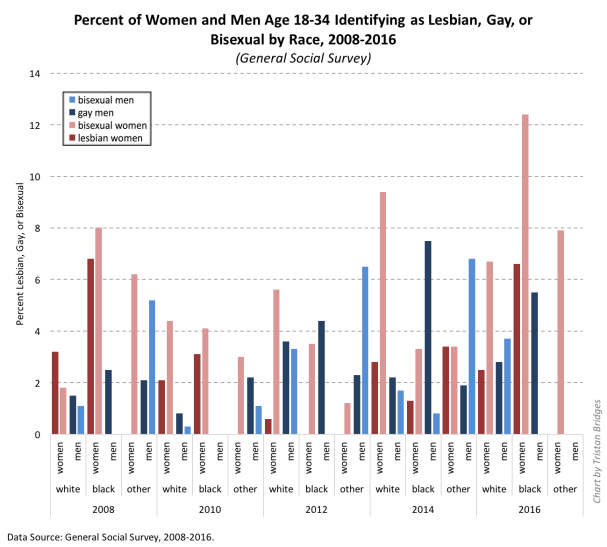
Here, you can see a couple things.  But one of the big stories I see is that “bisexual” identity appears to be particularly absent among Black men in the U.S. And, among young men identifying as a race other than Black or white, bisexuality is a much more common identity than is gay. It’s also true that the proportions of gay and bisexual men in each group appear to jump around year to year.  The general trend follows the larger pattern – toward more sexual minority identities.  But, it’s less straightforward than that when we actually look at the shift among a few specific racial groups within one gender.  Now, look at this trend among women.

Picture1
Here, we clearly see the larger trend that “bisexual” appears to be a more common sexual identity than “lesbian.” But, look at Black women in 2016.  In 2016, just shy of one in five Black women between the ages of 18 and 34 identified as lesbian or bisexual (19%) in the GSS sample! And about two thirds of those women are identifying as bisexual (12.4%) rather than as lesbian (6.6%). Similarly, and mirroring the larger trend that “bisexual” is more common among women while “gay” is more popular among men, “lesbian” is a noticeably absent identity among women identifying as a race other than Black or white just as “gay” is less present among men identifying as a race other than Black or white.

Below is all that information in a single chart.  I felt it was a little less intuitive to read in this form. But this is the combined information from the two graphs preceding this if it’s helpful to see it in one chart.

Picture1

What these shifts mean is a larger question. But it’s one that will require an intersectional lens to interpret. And this matters because bisexuality is a less-discussed sexual identification–so much so that “bi erasure” is used to address the problem of challenging the legitimacy or even existence of this sexual identity. As a sexual identification in the U.S., however, “bisexual” is actually more common than “gay” and “lesbian” identifications combined.

And yet, whether bisexual identifying people will or do see themselves as part of a distinct sexual minority is more of an open question. All of this makes me feel that we need to consider more carefully whether grouping bisexuals with lesbian women and gay men when reporting shifts in the LGB population. Whatever is done, we should care about bisexuality (particularly among women), because this is a sexual identification that is becoming much more common than is sometimes recognized.

Tristan Bridges, PhD is a professor at the University of California, Santa Barbara. He is the co-editor of Exploring Masculinities: Identity, Inequality, Inequality, and Change with C.J. Pascoe and studies gender and sexual identity and inequality. You can follow him on Twitter here. Tristan also blogs regularly at Inequality by (Interior) Design.

Originally posted at Montclair SocioBlog.

Did Donald Trump’s campaign and election cry havoc and unleash the dogs of racism?

Last June, hauling out Sykes and Matza’s concept of “neutralization,” I argued that Trump’s constant denigration of “political correctness” allowed his supporters to neutralize norms against racism. If the denigration of political correctness means that the people who condemn racism are wrong or bad, then what they are condemning must be OK. The logic might not be impeccable, but it works. I argued that I wasn’t sure that Trump had caused an increase in racist attitudes, but he gave people a license to express those attitudes.

Aziz Ansari made a similar point on Saturday Night Live  the day after the inauguration. (Apologies if you have to wait through an ad.)

.

Ansari’s version is much better than mine, and it reached a slightly larger audience. But there’s another important difference. I was talking about the message Trump supporters took from Trump himself before the election. Ansari is talking about the message they got from the electorate. The election changed their perceptions of the norms about expressing anti-immigrant views.

It’s as though minds of half the country had been clouded by “pluralistic ignorance.” That’s the scenario where each person thinks X but assumes that everyone else thinks Y, so everyone keeps their true ideas to themselves. Then something happens that reveals those previously hidden preferences, and suddenly everyone feels liberated. From the Trump supporters’ perspective, Trump was Dorothy throwing a bucket of water to dissolve the Wicked Witch of Political Correctness, and now all the Munchkins were free to express their feelings about Mexicans and Muslims (and perhaps others).

The 20% increase in hate crimes after the election certainly suggests that racists felt liberated by the election. Unfortunately, because of the uncontrolled variables and the small sample size of just one candidate winning one election, this bit of evidence is hardly conclusive.

But we now have some experimental evidence on the topic. In the two weeks before the election, three economists surveyed Mechanical Turkers in eight very Red states. The MTurkers were asked, in addition to other on-topic questions, if they would authorize the economists to make a donation on their behalf to a strongly anti-immigrant group, FAIR.  Mturkers were told, “The founder of FAIR is John Tanton, author of `The Immigration Invasion’ who wrote ‘I’ve come to the point of view that for European-American society and culture to persist requires a European-American majority, and a clear one at that.’”

For half the MTurkers, the donation question included this:

Note: just like any other answer to this survey, also your donation decision will be completely anonymous. No one, not even the researchers, will be able to match your decision to your name. [emphasis in original]

The other half were told:

Important: in order to ensure the quality of the data collected, a member of the research team might personally contact you to verify your answers to the next question and the following ones. [emphasis in original]

In addition, some of the people were told that Trump was certain to win their state. Others were given no information.

The results strongly support the idea that norms – or at least people’s perceptions of the norms – make a big difference. People who thought their choice would be public were much less likely to make the anti-immigrant donation – 34% vs. 54%. But that difference held true only for people who were not told how popular Trump was in their state. Among the people who were told basically, “Trump is a sure thing to win your state,” knowing that their donation would be public (i.e., known to the surveyors) made no difference in their willingness to donate.

If the researchers had stopped there, they would have been able to say

  • there seems to be a norm against giving money to anti-immigrant groups
  • the knowledge of that norm makes people less willing to make a donation to blatantly racist anti-immigrant group if even one stranger can know about that donation
  • if people think that many others in their state support an anti-immigrant candidate, they no longer feel that they need to keep their anti-immigrant views to themselves

Thanks the results of the election, though, they didn’t have to stop there. The gave the researchers a natural experiment to find out if the norms – or at least perceptions of the norms – had changed. Had Trump’s victory caused the scales of pluralistic ignorance to fall from the eyes of these Red-state Turkers?

The answer was yes. The election had the same effect as did the information about Trump support in the person’s state. It obliterated the difference between the public and private conditions.

To people who were reluctant to let their agreement with FAIR be known, Trump’s victory said, “It’s OK. You can come out of the closet. You’re among friends, and there are more of us than you thought.”

Jay Livingston is the chair of the Sociology Department at Montclair State University. You can follow him at Montclair SocioBlog or on Twitter.

Flashback Friday.

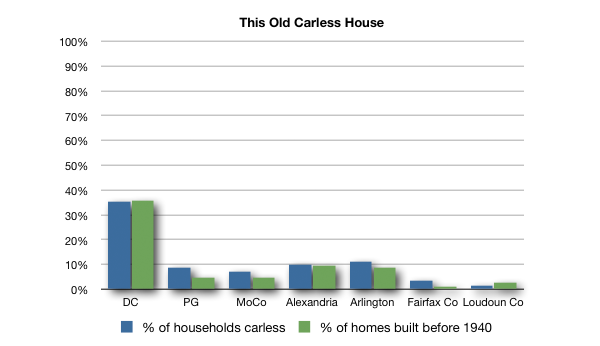
The percent of carless households in any given city correlates very well with the percent of homes built before 1940. So what happened in the 40s?

According to Left for LeDroit, it was suburbs:

The suburban housing model was — and, for the most part, still is — based on several main principles, most significantly, the uniformity of housing sizes (usually large) and the separation of residential and commercial uses. Both larger lots and the separation of uses create longer distances between any two points, requiring a greater effort to go between home, work, and the grocery store.

These longer distances between daily destinations made walking impractical and the lower population densities made public transit financially unsustainable. The only solution was the private automobile, which, coincidentally, benefited from massive government subsidies in the form of highway building and a subsidized oil infrastructure and industry.

Neighborhoods designed after World War II are designed for cars, not pedestrians; the opposite is true for neighborhoods designed before 1940. Whether or not one owns a car, and how far one drives if they do, then, is dependent on the type of city, not personal characteristics like environmental friendliness.  Ezra Klein puts it nicely:

In practice, this doesn’t feel like a decision imposed by the cold realities of infrastructure. We get attached to our cars. We get attached to our bikes. We name our subway systems. We brag about our short walks to work. People attach stories to their lives. But at the end of the day, they orient their lives around pretty practical judgments about how best to live. If you need a car to get where you’re going, you’re likely to own one. If you rarely use your car, have to move it a couple of times a week to avoid street cleaning, can barely find parking and have trouble avoiding tickets, you’re going to think hard about giving it up. It’s not about good or bad or red or blue. It’s about infrastructure.

Word.

Neither Ezra nor Left for LeDroit, however, point out that every city, whether it was built for pedestrians or cars, is full of people without cars. In the case of car-dependent cities, this is mostly people who can’t afford to buy or own a car. And these people, in these cities, are royally screwed. Los Angeles, for example, is the most expensive place in the U.S. to own a car and residents are highly car-dependent; lower income people who can’t afford a car must spend extraordinary amounts of time using our mediocre public transportation system, such that carlessness contributes significantly to unemployment.

Originally posted in 2010.

Lisa Wade, PhD is an Associate Professor at Tulane University. She is the author of American Hookup, a book about college sexual culture; a textbook about gender; and a forthcoming introductory text: Terrible Magnificent Sociology. You can follow her on Twitter and Instagram.

Flashback Friday. 

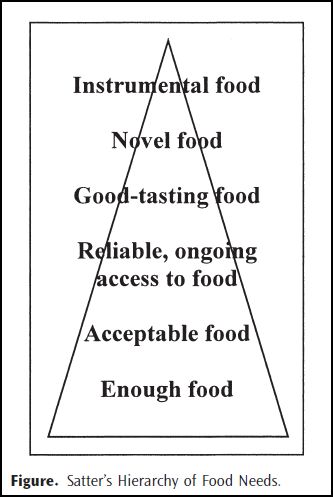
Responding to critics who argue that poor people do not choose to eat healthy food because they’re ignorant or prefer unhealthy food, dietitian Ellyn Satter wrote a hierarchy of food needs. Based on Maslow’s hierarchy of needs, it illustrates Satter’s ideas as to the elements of food that matter first, second, and so on… starting at the bottom.

The graphic suggests that getting enough food to eat is the most important thing to people. Having food be acceptable (e.g., not rotten, something you are not allergic to) comes second. Once those two things are in place, people hope for reliable access to food and only then do they begin to worry about taste. If people have enough, acceptable, reliable, good-tasting food, then they seek out novel food experiences and begin to make choices as to what to eat for instrumental purposes (e.g., number of calories, nutritional balance).

As Michelle at The Fat Nutritionist writes, sometimes when a person chooses to eat nutritionally deficient or fattening foods, it is not because they are “stupid, ignorant, lazy, or just a bad, bad person who loves bad, bad food.”  Sometimes, it’s “because other needs come first.”

Originally posted in 2010; hat tip to Racialicious; cross-posted at Jezebel.

Lisa Wade, PhD is an Associate Professor at Tulane University. She is the author of American Hookup, a book about college sexual culture; a textbook about gender; and a forthcoming introductory text: Terrible Magnificent Sociology. You can follow her on Twitter and Instagram.