The Secret Lives of Mormon Wives took the world by storm in 2024. The show stars seven young women living in Utah and working as social media momfluencers. The women are collectively known as “#MomTok” and create dancing, lifestyle, and humorous videos on TikTok. The show’s success is partly driven by a viral swinging scandal in which some of the cast actively engaged in “soft swinging.”

While the series is raunchy and entertaining, we also observed some complex negotiations between faith and femininity. We wanted to find out how the Secret Lives of Mormon Wives cast members resist, reinforce, or reinterpret Mormon teachings, especially those related to gender, femininity, and sexuality. After analyzing transcripts from the first two seasons using qualitative data coding software, we found data rich with ways that the cast bend Mormon rules while not explicitly breaking them.

The series makes clear that traditional gender roles are prevalent in Mormon doctrine and culture, while the women purport to be actively trying to change them. The stars actively push back against patriarchal norms, critiquing submission, perfection standards, and unequal power imbalances. 

One of the ways that the women in #MomTok challenge traditional gender expectations is through subversion of the breadwinner/homemaker model. All seven women report being the primary breadwinners in their families. One states that she is providing for her family while her husband attends medical school. Another reports that her husband is in his “stay-at-home dad era” because the amount of money she earns doing brand deals on social media exceeds “his entire yearly salary.”

#MomTok describes themselves as “a new generation of Mormon women,” even referring to themselves as “progressive” or “modern” Mormons. The cast openly subverts traditional Mormon behavioral expectations through drinking alcohol, drug use, gambling, and non-monogamous sexual relationships. They frame their actions as normalizing taboo topics, especially around sex and gender roles. 

Despite attempting to challenge gender roles and Mormon cultural expectations, the stars also reinforce them other ways. They share a hyper-feminine aesthetic characterized by long curled hair, tan skin, natural makeup, and an emphasis on youthfulness. This aesthetic is influenced by trends within Utah or Mormon culture. They even recognize that they have a shared look, despite two of them identifying as biracial. The women also openly discuss cosmetic procedures. One MomTok member happily discusses her “mommy makeover” in which she had undergone three breast enhancements and a labiaplasty.

The LDS church celebrates divine femininity, or the idea that “feminine” qualities like nurturing, intuition, sensuality, and relational strength are not just socially constructed traits, but inherently powerful and sacred. Rather than emphasizing modesty and submission, the cast frames femininity as something internal and empowering. They emphasize boundary setting, feminine sensuality, and women-centered community. At the same time, this framework still reflects gender essentialism. While it feels empowering, it maintains thinking that women are naturally more emotional, sensual, and nurturing. Rather than dismantling gender binaries, divine femininity repackages them in a more positive and agentic way.

More interesting are their attempts to justify their behavior, a pattern we recognized as bending, not breaking, Mormon rules. We see an example in season one when the women get nitrous oxide, or laughing gas, while getting Botox injections. While the LDS Word of Wisdom prohibits recreational drug use, this moment is framed as beauty maintenance and becomes permissible by #MomTok. The women themselves note that nitrous oxide is not needed for Botox injections, yet they permit themselves to get the drugs in the name of cosmetic upkeep. This allows them to bend the rules, using drugs for cosmetic, not recreational, reasons, without breaking them. Other similar examples include the cast members’ use of ketamine. In both seasons, various cast members discuss their use of ketamine for therapeutic reasons, with one member describing it as being in a “gray area” regarding the church. Both examples illustrate how the cast are willing to bend, not break, the rules when it comes to drug use, citing bodily health, mental well-being, and beauty as rationale.

Another “gray area” in the Mormon church is sexual behavior. In season one, a #MomTok member is describing a scenario in which she was asked to promote a sex toy on her social media page in exchange for hefty compensation. She ultimately decides to take the deal but frames her choice in a way that allows her to promote the sex toy to married couples experiencing intimacy issues. This allows her to portray sex toys as empowering only for partners who are married, not single people, therefore bending the LDS law of chastity. Other ‘bent’ laws include those related to monogamy. Although historically the LDS church openly practiced polygamy, or plural marriage, the Book of Mormon today teaches that monogamy is the standard for marriage. During a viral scandal, a Mormon momfluencer publicly disclosed that some #MomTok members were engaging in “soft swinging.” Soft swinging is described by the cast as “everything but sex,” including consensual intimate activities like kissing, touching, swapping partners, and sexual activities between couples in the same room. Stopping short of sexual intercourse allows for members to bend Mormon monogamy rules without explicitly breaking them.

Our research highlights that the cast of Secret Lives of Mormon Wives are actively negotiating traditional teachings rather than simply reinforcing or outright rejecting them. What we’ve observed is not a clear break from LDS teachings, but a more complex process akin to gender maneuvering, which helps us to explain how the cast manipulates rules and traditional gender performances to navigate social hierarchies. These strategies act as a form of resistance against rigid, socially prescribed gender roles and strict Mormon expectations, but by not fully breaking away from tradition, the women are still granted a degree of autonomy and power.

Marissa Morey is a Ph.D. candidate in sociology at Wayne State University in Detroit, Michigan. Her academic research focuses on feminism, politics, and identity, with recent work exploring media portrayals of Mormon femininity and gender performance.

Kristin Johnston is a Ph.D. candidate in sociology at Wayne State University studying sociology, specifically race and gender. She is interested in how both race and gender are performed and perceived in the media.

Video games have often been a target of moral panic in the United States. The 1990s were fraught with worry that consuming violent content in video games would lead to violent behavior in the real world. The 2010s had its own controversies with the immense popularity of franchises like Call of Duty and Grand Theft Auto. Video games have had a litany of bad press for things they might cause, but we don’t give them nearly enough credit for what they actually have – a remarkable ability to foster social joy and whimsy. 

Take Kerbal Space Program, a spaceflight simulator that is delightfully cartoony, with its little green player characters and charming music, and brutally punishing with its orbital physics. I have my own fond memories with early versions of the game. As a middle schooler with an interest in outer space, the game motivated me to get into model rocketry and scratched the itch to explore the solar system on my own terms.

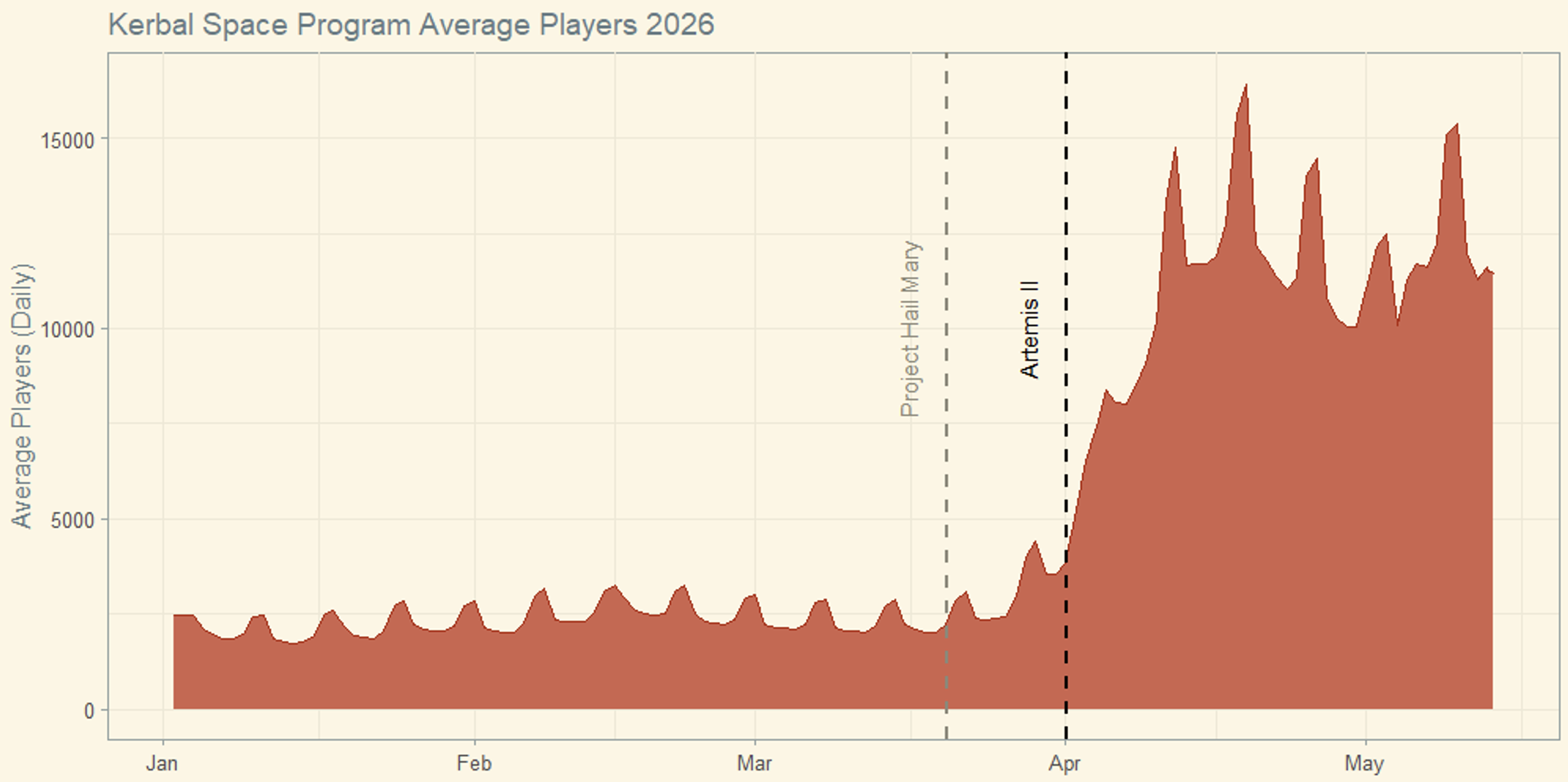
As an adult who has abandoned a career in aerospace engineering for one in the social sciences, I still find myself picking up the game every once in a while. I’m not alone. Per SteamDB, the game has roughly quintupled its player base this past spring. This is far from the norm for games this far into their lifespan. While games occasionally see spikes in popularity due to sales, it’s incredibly rare to see sustained popularity on this scale.

Data visualized by the author. Source: SteamDB.info

I think the reasons for this spike are quite clear. March and April of 2026 were big months for public interest in space exploration. The breakaway box office success of Project Hail Mary, a film adaptation of Andy Weir’s 2021 sci-fi novel, brought a hopeful and optimistic portrayal of space travel and cooperation into the public consciousness. It was then quickly followed by the successful launch and completion of the Artemis II mission, sending four astronauts on a lunar flyby further away from Earth than ever before. 

Sociologists and social theorists have long written about the role of play as a tool to make sense of the world. Georg Simmel and Erving Goffman wrote about play as a form of human interaction, wherein there are distinct rules and routines to play that players know how to abide by to perform a successful interaction. In this setting, play is just something that humans do, not fundamentally different from other forms like work or competition. 

In contrast, historian Johan Huizinga argued that play is a primary force in the construction of human culture. In Homo Ludens, Huizinga asserts that play always exists as a representation of something else, that it serves as a layer underneath the “serious” that allows for people to alter the character of otherness. Put more simply, play serves as a space and time set aside to learn, to test, and to grow without consequence. In this way, play as a practice predates culture, predates civilization, and humans have “added no essential feature to the general idea of play.” 

Following Huizinga, Thomas S. Hendricks writes about play as a fundamental pathway of behavior and experience, on the same level as work, ritual, and communal engagement. In Selves, Societies, and Emotions, Hendricks argues that play serves as a space to focus on processes rather than an end goal. Play therefore becomes a “test ground”, where glory can be sought in the unpredictable. Through play we can cultivate awareness of our own capabilities. This testing ground is precisely what players – especially new ones – will experience in KSP.

“good news, i landed on the mun for the first time. Bad news, i don’t have any fuel and now jeb is stuck” -stompe444_ Source: r/KerbalSpaceProgram 

KSP‘s sustained boost in popularity is an example of how we can use play as a measure of public interest. As Huizinga argues, play never happens without it representing something meaningful. And whether this boost in popularity continues to hold stable or eventually declines back to baseline, I can’t help but be optimistic about the fact that more people than ever before are getting involved in the time-tested tradition of launching Jebediah Kerman to the stars, and what that means for the optimism that people have for a future in space.

The Artemis II mission cost billions of dollars, and the Artemis program itself has cost an order of magnitude more. At time of writing, Kerbal Space Program currently costs about $40 through Steam, and less if it is on sale. Even if only a fraction of those players end up turning their play into work, it’s worth it just for the fun of the ride. We often criticize video games for being time wasted at best and harmful power fantasies at worst. But it’s important to recognize how sociologists can use them to study social joy and public interest.

Jack Leatherman is a PhD Candidate at the University of Massachusetts Boston focusing on intersections of culture and technology. You can follow him on BlueSky.

I’m squarely middle-aged with friends in their 30s through 60s who have made serious relationship commitments that are now experiencing problems. They bend my ear and speak about these issues in three primary ways (I bet you can guess them): lack of communication, lack of emotional intimacy, and financial stress.

These themes come up repeatedly, and I have given advice that’s never really helped. My friends are deeply invested in their relationships, so they have read droves of self-help books, listened to relationship podcasts, worked through relationship-based workbooks, and sought spiritual and professional help. Nothing seems to work!

I began thinking of these relationship priorities—communication, emotional intimacy, and financial well-being—like leaves on a houseplant. If one of these leaves begins to shrivel and brown at the edges, it might benefit from a little direct attention, but we wouldn’t only speak of and address the dying leaf: we would water the plant. Eventually, I realized the issues weren’t really about communication, intimacy, or financial stress, but rather symptoms of a bigger issue: they had forgotten how to care. And, in some cases, they’ve never truly learned how to care about, for, and with self or others.

Care has historically been a feminist project, socially and intellectually. The scholarship of philosophers like Nel Noddings and Carol Gilligan in the 1980s-90s gave shape to the ethics of care. Noddings (1984) argued that care is relational; if whoever the care is directed towards does not feel it, or is not improved by it, then care didn’t happen.

Relationships need similar attention. If you asked my friends and their partners, most of them would agree that they feel cared about because they have continued the basic commitment to being a couple. They feel less cared for and with, but that is not entirely their fault. Aside from service-based care at the beginning and ends of our lives, “self-care” that has been co-opted by capitalist campaigns (think: spa days, treating yourself to an expensive bottle of wine, a new pair of shoes), and healthcare (which doesn’t feel extraordinarily caring to many Americans these days), where else have we been hearing about care?

The self-help industry, predominantly informed by the field of psychology, overwhelming markets one-size fits all solutions (e.g., checklists, habits, behavioral “do this” orders) that tell us what to do rather than helping us develop an understanding of care in the first place.

Edgar Cabanas and Eva Illouz’s (2019) Manufacturing Happy Citizens, argues that self-help social media fails to make a difference because it fundamentally misdiagnoses the user’s problems. A brief video advising an exhausted worker to “just practice mindfulness,” for example, makes zero difference because it leaves the structural source of the stress entirely intact. Instead of fostering collective solutions or institutional changes, it traps the individual in a cyclical loop of self-blame when the “hack” inevitably fails to change their life. This is an example of “cruel optimism” (Berlant 2011) or “toxic positivity” (Halberstam 2011), that enforces a norm that individuals should maintain a cheerful disposition to receive care. Social media creates an environment where cruel optimism keeps you running on a treadmill that pulls you backward, while toxic positivity acts as the cultural voice constantly telling you to “smile and enjoy the cardio.”

Of course, social media can be beneficial at times. Staying informed about old classmates’ lives, sharing information with groups who have common interests, and being able to exchange ideas with people who would normally be acquaintances fosters  “weak ties” that may offer its own kind of care (Small 2017). But this may not provide the full emotional support and higher levels of care humans need and receive from face-to-face relationships: the connective labor that sociologist Allison Pugh calls “engine grease for our relationships.” True connection requires a mutual, collaborative effort to see and be seen.

We need to start demanding care, not just in our romantic relationships, but from all of our social contracts. Re-centering care requires us to step off the algorithmic treadmill imposed upon us by social media. Many of us are managing relationships like business partners with a logistics mindset instead of partners with human needs and feelings.  We have learned to speak of “communication issues,” “emotional unavailability,” and “financial problems” without any mention of care. Additionally, we cannot continue to allow self-help programming and self-improvement media to shape our lives without caring about, for and with us.

In practice, this means refusing to view ourselves merely as passive consumers and instead acting as democratic citizens who assert collective control over the industries, media, and economic systems that dictate how we understand care (Tronto 2013). At the end of the day, I know who cares about care—it’s you, me, all of us. We cannot not be concerned about care, since we are human, but we shouldn’t allow ourselves to be distracted from it.

Scott Richardson, Ph.D. is an educational consultant, artist, and founder of The Constellatory.    

Migrant labor sustains U.S. agriculture. It is essential and constant. Yet the people who do the work remain hidden. That invisibility is not just social. It is spatial. Employers tuck housing behind groves, set it far off the road, or place it on private land behind locked gates. These sites are hard to reach. They are also hard to leave.

As a paralegal at my stepmother’s immigration law firm in Metro Detroit, I met with many migrant workers who described the places they were housed. They worked long days in fields or orchards, often six or seven days a week, and returned to dormitories built far from town. The stories stayed with me. They worked in extreme heat and came back to shared spaces without privacy, comfort, or dignity. Workers are placed in dorms with shared beds and tight quarters. Bathrooms are communal. Kitchens are often bare.

A bedroom for migrant farmworkers at the Nightingale facility in Rantoul, Ill., in July 2014.
Credit: Photo by Darrell Hoemann/Midwest Center for Investigative Reporting. Used with permission.

Images help tell this story. Photographs from North Carolina and California show identical cabins in rows. Inside are narrow beds, small windows, and not enough space to stretch. These photos are more than documentation. They are evidence. They show us what it looks like to build a system that erases the people who keep it running.

Migrant agricultural worker’s family in Nipomo, California, 1936. The mother, age 32, sits with three of her seven children outside a temporary shelter during the Great Depression.
Credit: Photo by Dorothea Lange. Farm Security Administration Collection, Library of Congress. Public domain.

Sociology gives us a framework to see that this is not just bad housing structure. It is a structural problem. When the employer controls housing, every complaint becomes a risk. Speaking up may not only cost your job, it also means losing your bed and risking forcible deportation. The design limits autonomy and keeps people quiet. The fewer choices a person has, the easier it is to control them.

In sociology, conflict theory starts with a simple idea: society develops and changes based on struggles over power and resources. In the case of migrant labor, that struggle is visible in the very organization of housing. Henri Lefebvre argued that space is socially produced. Social production means that space is shaped by those who have authority to determine how people live. This is not driven by comfort, fairness, or function. The arrangement and social production of space reflects the interests of those and control. The shape of a room, the distance between houses, and the layout of a building are not random. They reflect relationships.

Similarly, Michel Foucault shows how institutions use architecture to enforce discipline. In migrant housing, space signals control. These dorms do not need bars or guards. The buildings are made to meet the minimum legal standard for shelter. That standard is barely above what is allowed for a prison cell. The architecture dehumanizes, and in doing so, it controls.

I saw this firsthand. A worker told me his bunk was so close to the next that he could hear every breath of the man above him. His wife told me there were rules about visitors, meals, and noise. They could not live together, even though they were married. They felt monitored. They were afraid to speak. These homes were not theirs. The system made sure of that.

Sociology gives us the language to name what is happening. This is not a housing crisis. It is a labor strategy. These camps are not temporary accidents. They are long-term solutions to a problem no one wants to fix. As scholars and citizens, we should bring these designs to light. We cannot change what we do not see.

Joey Colby Bernert is a statistician and licensed clinical social worker based in Michigan. She is a graduate student in public health at Michigan State University and studies feminist theory, intersectionality, and the structural determinants of health.

This past summer was hot, hotter than it used to be, and this is causing a lot of new challenges for work, infrastructure, our social lives, and our health. Air conditioning was back in style and even a new public policy, with more cities working to require that landlords provide it as a basic part of a habitable apartment.

Of course the stakes are much higher than just a new AC unit. Sociologists have long known that unequal heat exposure is a serious challenge to our collective health and social wellbeing. Eric Klinenberg’s famous study of the 1995 Chicago heatwave, for example, found that social isolation was a key factor in explaining why people were vulnerable to heat sickness and even death, because they didn’t have places to go or people to check in on them to stay cool. Recent work has linked excessive heat to deaths among people who are incarcerated and learning loss in schools. Heat risks are unevenly distributed in our society, and so addressing the risks of a warmer planet is going to require expanded access to building cooling and air conditioning.

The challenge is that the status of air conditioning is changing. Heat has long been considered a necessity for safe, healthy living – often part of the basic, legal requirements for habitable homes on the rental market across the country. But states are much more inconsistent about whether they require air conditioning, which is often marketed to the general public as a “luxury good.” Look at any vintage ad for AC and you’ll find wealthy, well-dressed homeowners splurging on a new system that lets you wear a suit inside.

Do people today actually support aid to help others access cooling? In a new study recently published in Socius, I investigated this with an original survey experiment. In a sample of 1200 respondents drawn from Prolific, I asked about support for government utility assistance programs for people with lower incomes. The questions had a key difference: some respondents got a question about utility assistance in general, some got a question specifically about home heating, and some got a question specifically about home air conditioning.

Support for the heating question was the strongest on average, in line with the theory that we see heating as a necessity. Air conditioning received the lowest support, however, significantly different from both heat and general utility assistance in the sample. To make sure these results held, I went back to Prolific and sampled more Black and Hispanic respondents to repeat the experiment. The strongest results in these tests came from white respondents.

Why might this be the case? We have long known that attitudes about social welfare programs of all kinds are tied up with race. Research finds these differences because of stereotypical thinking – some people are deeply concerned that others who receive aid need to “deserve” it by working hard and only using aid on necessities, not luxuries. We also know that these beliefs are often linked to racial stereotypes. Previous work on food stamps, disaster relief, guaranteed income, and other social aid programs often finds these social forces at work.

These results show that stereotypical thinking about who “deserves” help may be an important public policy hurdle as we work on adapting to climate change. As policymakers face an increasing need for adequate cooling to address public health issues, they will need to account for the fact that the public may still be thinking of air conditioning as a luxury or comfort good. Making policy to survive climate change requires updating our thinking about the status of goods necessary to weather the crisis.

Evan Stewart is an assistant professor of sociology at University of Massachusetts Boston. You can follow his work at his website, or on BlueSky.
Cheeseburger Baby - South Beach Miami
Cheeseburger Baby – South Beach Miami by AdamChandler86, Flickr CC

One of the biggest challenges and joys I have in teaching Introduction to Sociology is making ideas like social construction, cultural objects, or bureaucracy visible and intuitive to students. A big part of our value as a general education course is in showing students how to use these ideas in the world. I make a point to focus on bureaucracy, for example, because drawing attention to the unique skills and challenges of navigating a large bureaucratic system like a university is one way sociology can help students across many different majors.

Max Weber plays a big role here, of course, but one of the challenges in teaching his work is the “This is Water” problem — students are so steeped in bureaucracy that it is hard to recognize its unique traits. George Ritzer’s The McDonaldization of Society is a classic example, but the point-of-sale system is now so normal in the service industry that it can be difficult to wrap your head around any other way to organize a business. That’s why I love the charming 2004 documentary Hamburger America, by George Motz.

How do you make a cheeseburger? Ask your students and you will probably get a pretty standardized answer. At least one of these segments will turn that question on its head.

Not only do we get an intuitive sense of how much rich, unexpected variation there is in a cheeseburger, but this documentary also works in so many interesting insights about different regions and local cultures in the U.S. There are hooks here into lived experiences with segregation, de-industrialization, urban planning, and food systems. People are engaging with tradition, history, and economic change. This documentary is a fantastic way to show how culture is embedded in objects — the burgers pair well with Wendy Griswold’s cultural diamond!

All of these anchors give students an intuitive sense of how wildly different social arrangements can emerge without the systematizing force of bureaucracy or large scale, franchised restaurants. It is a great way to spur discussion – just don’t show it right before lunch.

Evan Stewart is an assistant professor of sociology at University of Massachusetts Boston. You can follow his work at his website, or on BlueSky.

In recent weeks, we’ve seen multiple examples of women on the political right straddling two kinds of womanhood: the girlboss and the tradwife. The visibility of these women exposes a hidden link between conservative womanhood and girlboss feminism that deserves our attention. 

Katie Britt broadcast her response to the State of the Union from her kitchen. Michelle Morrow, the conservative activist from North Carolina who has just been elected state Superintendent of Education in North Carolina, burnishes her credentials as a wife and mother above all else.

They aren’t the first to do this; #tradlife has been trending since at least 2019. Tradwife influencers perform a version of femininity that leans on a strong husband providing financial support so they can devote themselves to caring for children and the home. There is almost always an apron, a kitchen, and a perfectly coiffed, carefully made-up woman in a serene environment cooking from scratch recipes — a vibe that belies the real chaos of having young humans to care for in a home. 

We might assume that tradwives hearken back to an earlier “backward” mode of femininity and marriage. But this way of being in the world is unmistakably modern because it involves “choice” and entrepreneurship. It is not enough for a tradwife to simply focus on her husband and kids, she must be entrepreneurial about it. She must blog about it, vlog about it, become an influencer. This is where the “girlboss” mentality comes in.

Sheryl Sandberg’s 2013 book Lean In told women that if they would just ask for what they wanted in the workplace, like the men, they too would advance. But women continue to face barriers in corporate America and marginalization in labor markets. Despite this girlboss feminism has been incorporated into our culture across the political spectrum. US women widely believe structural problems are with women ourselves. With individual effort, good planning, the right domestic help, and a little luck and chutzpah, we can overcome societal inequalities. We rely on a myth of mutuality that belies the true gender division of labor in American families.

It turned out lean-in feminism was both colorblind and a sham. And the #tradwives know it – there are even Black tradwife influencers. They say proudly: we have decided it’s way too exhausting to run the family and corporate America at the same time. So we will focus on our family and “opt out” of the vulnerability and constant stress of the labor market, which values our labor less. And in doing so, we take a stand with men and shore up the dying ideology of the father as breadwinner. We choose this, and you too can see just how great this choice is on our successful TikTok channels. 

As we discuss in depth in our new book, The Gender Order of Neoliberalism, U.S. has long drawn soft power from the idea that its women are “empowered.” Not “backward,” like those oppressed women in the Middle East or India or Africa, who are poor and come from patriarchal cultures. Our women, we like to tell the world, make choices of their own, work outside the home in high-powered jobs, fly planes, and even save women in other parts of the world.

But focusing on the individual choices of women who must “do it all” was not always what “women’s empowerment” meant. We show in our book that women involved in transnational feminist organizing in the 1950s and 60s lobbied for reproductive justice, fair pay for fair work, universal childcare, universal healthcare, and fair trade between countries. Those visions of empowerment have all but disappeared from our collective political imaginations. What would a joyful life look like if there were community kitchen tables, childcare collectives, and widely available healthcare? Where are the inviting visuals for that kind of empowerment?

Our impoverished feminist imagination leaves us straddling the skinny divide between tradwives and girlbosses and reinforcing the notion that women should continue to be America’s social safety net.

Smitha Radhakrishnan is Marion Butler McLean Professor in the History of Ideas and Professor of Sociology at Wellesley College. She is author of Making Women Pay: Microfinance in Urban India.

Cinzia D. Solari is Associate Professor of Sociology at University of Massachusetts Boston. She is author of On the Shoulders of Grandmothers: Gender, Migration, and Post-Soviet Nation-Building.

Societies grow and change all the time, but it can be tough to think about big-picture shifts when you’re living through the practical details of the day to day. Take the recent popularity of large language models (LLMs). In the short term, we face important sociological questions about how they fit into the norms of everyday life. Is it cheating to use an LLM to help you write, or to generate new ideas? How will new kinds of automation change work, or will they take jobs away?

These are important questions, but it is also useful to take a step back and think about what rapid developments in technology might do to our foundational social relationships and core beliefs. I was fascinated by a recent set of studies published in PNAS that suggest automated work and LLMs could even change the way we think about religion.

“draw an illustration of a church slowly dissolving into a series of zeros and ones, like computer code in The Matrix”

In the article “Exposure to Automation Explains Religious Declines,” authors Joshua Conrad Jackson, Kai Chi Yam, Pok Man Tang, Chris G. Sibley, and Adam Waytz review the findings from five studies. In one, their analysis of longitudinal data across 68 countries from 2006 to 2019 finds nations with higher stocks of industrial robots also tend to have lower proportions of people who say religion is an important part of their daily lives in surveys.

Figure 1 from Jackson et al. (2023) demonstrating nations with a higher stock of industrial robots also express lower rates of religiosity, on average. You can read the full notes at the open-access article here.

I was most surprised by the results of their fifth study—an experiment teaching people about recent advances in science and AI. Respondents who read about the capabilities of LLMs like ChatGPT showed “greater reductions in religious conviction than learning about scientific advances” (8).

The authors suggest one reason for this pattern is that “people may perceive AI as having capacities that they do not ascribe to traditional sciences and technologies and that are uniquely likely to displace the instrumental roles of religion” (2). This is important for us, whether or not you’re personally religious, because religion is a socially powerful force – people use shared beliefs to accomplish things in the world and solve problems, even to cope with hardships like losing a job.

But these results show that new changes in technology, like the advent of LLMs, might be expanding people’s imaginations about what we can do and achieve, possibly even changing the core beliefs that are central to their lives over the long term.

Evan Stewart is an assistant professor of sociology at University of Massachusetts Boston. You can follow his work at his website, or on BlueSky.