Search results for The

In this McCain-Palin ad which, I believe, started running yesterday, it is stated that an Obama presidency will bring on international military conflict (at least that’s my reading of the images), while a McCain presidency means no international military conflict.

Sociologically what is interesting about this ad is the way in which danger can be socially constructed. What we fear most is not necessarily what is most likely to cause us harm. Consider, most of us are more afraid of riding in hot air balloons than cars but, even proportionally, your chances of dying in a hot air balloon crash are much smaller than your chances of dying in a car crash. People around us–e.g., our parents and friends, but also politicians–try to shape the degree of fear we have for any given situation. Politicans, especially, are not necessarily doing it out of a concern for our well-being.

What do we really need to fear in the next four years? This McCain ad nicely tries to draw our attention away from the fear of, say an economic depression or climate change, in favor of an international military conflict. Though he doesn’t say so explicitly, it seems obvious to me that he’s implying a terrorist attack. It’s not obvious to me, though, that a military conflict or terrorist attack is more likely to cause extreme and extended suffering than any other potential crisis, but it would useful to McCain if I thought so, because it’s the one sphere in which it is widely agreed that McCain is superior to Obama. Thus, as an extremely powerful figure, he attempts to shape our collective understanding of what is (most) dangerous, what we should (most) fear, and win the presidency through the cultivation of a culture of fear.

Marriage–as a social and legal institution–has not always been what it is today.

In early American history, when families largely lived on farms and worked for sustenance, people didn’t marry because they loved each other.  And they certainly didn’t split up because they did not.  Marriage choices were highly influenced by their families and, once married, husbands and wives formed a working partnership aimed at production.  They teamed up to support themselves and make children who would take care of them when they were old and help them in the meantime.

Today, we still (generally) think of marriage as comprised of a man, a woman, and kids, but mutual love and happiness are now central goals of marriage.  This idea only emerged in the 1900s.  It hasn’t actually been around all that long.

I bring this up in order to shed some light on the pro- and anti- gay marriage rhetoric.

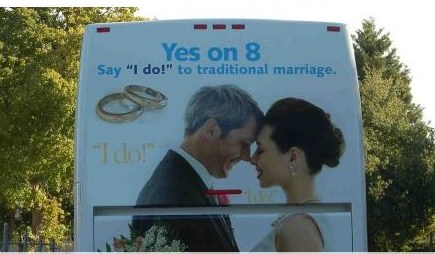
On the one hand, those against gay marriage need to define “marriage” in a way that excludes same-sex couples.  One way to do this is to refer to a “traditional” marriage (image found here).

But there is no such thing as a “traditional” marriage, just a long history of evolving forms of marriage.  For example, few anti-gay marriage types would actually be in favor of returning marriage to one in which women were property that can’t contract, vote, testify in court, own anything, and have no rights to their own bodies or custody of their children (though the idea that women are property is still out there today).  Because there is no such thing as a “traditional” marriage (that is, no reason to privilege one historical form over another), when someone speaks of “traditional” marriage, they actually just mean “the kind of marriage that I like that I am pretending existed throughout all time before this current threat right now.”

On the other hand, to make an argument in favor of gay marriage rights, the movement must either (1) change the collective agreement as to what marriage is (the social construction of marriage) or (2) convince the collective that gay marriage already is what we believe marriage to be.

This ad in favor of gay marriage does the latter. Mobilizing the social construction of marriage as about love, the commercial then defines same-sex relationships as about love. If you accept both premises, then, presto, you are pro-gay marriage.  That is exactly what this commercial is trying to do:

NEW!  This Swedish commercial for Bjorn Borg’s dating website, sent in by Ed L., similarly mobilizes the idea that marriage is for love and that gay men’s marriages are, therefore, beautiful:

Before there were flight attendants, there were stewardesses.  Below a vintage commercial for airlines (found here thanks to AdFreak, see also this print ad):

While pressure on airlines to be less sexist means that we don’t see ads like this anymore, Stephen W. alerted us to the ongoing sexism in “general aviation,” that is private planes and jets owned by individuals and companies.

Airports have FBOs (or “fixed based operators”) which are, essentially, glorified gas stations for planes.  A private pilot can choose which airport and thus FBO, or which FBO at which airport, to patronize.  So FBOs will compete for customers.  Stephen pointed to one strategy: plying pilots, assumed to be men, with sex.

This website allows pilots to see what “FBO Girls” all over the country, the women working behind the counters at FBOs, look like.  Another website, FBO Hotties, allows pilots to submit their favorite girls.

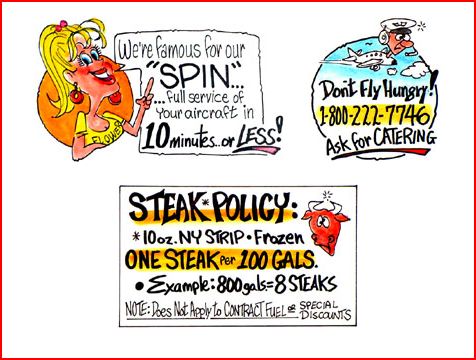
Flower Aviation promises that you will be guided into your parking spot by “girls in short ‘skorts’ and tank tops.”

Here are some of the images from the website, notice that when you spend money on fuel, they reward you with red meat (and fresh baked chocolate chip cookies):

So, there you have it.  Private aviation, still very much a man’s world.

Other than the objectification, I think an interesting sociological question might be: Why have the airlines dropped overt sexist advertising, while general aviation has not? One possibility is that general aviation is, literally, less public and, thus, less vulnerable to public censor. Another may be that pilots are still overwhelmingly men, unlike the customers served by airlines, and so there may still be profit in sexism for general aviation, but not in commercial aviation. I’d welcome your thoughts as well.

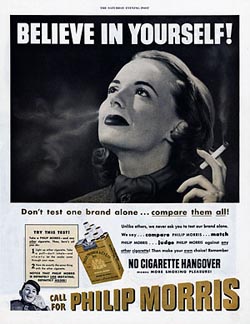
This New York Times article discusses the cigarette industries co-optation of nascent feminism.  Hat tip to Jezebel, where Sadie writes:

In the early 20th century, smoking was regarded as unladylike. In the 1920[s], realizing they were missing out on millions of potential customers PR expert Edward Bernays encouraged the American Tobacco Company to play on women’s nascent sense of modern independence… and the smoking feminist was born!

Also in co-opting feminism: make-upmore make-up and, of course, botox; cars and bras; more cigarettes; cleaning products, eyeglasses, and pants; diamond rings; credit cards, cigarettes, and cars; easing kitchen duty; and fashion (I think).

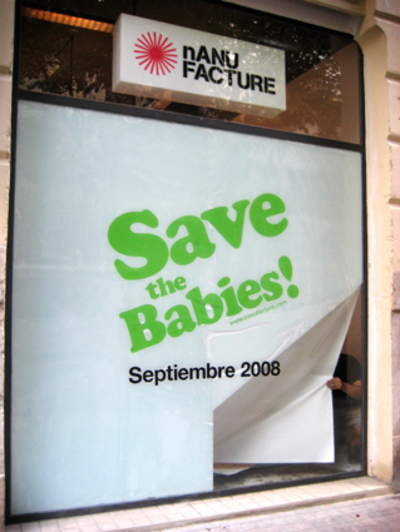
Miguel sent in these photos from nANUFACTURE, a children’s clothing store based in Valencia, Spain. The advertising campaign is “save the babies.” This first one was found at the company website:

This one was found here:

The babies in the top photo are holding signs in Spanish that say “there’s life beyond pink” and “no more teddy bears!” The sign in the lower left photo says “no sky blue, thanks.”

Given that the website includes photos of Angelina Jolie and Brad Pitt and of a scene from the “Sex and the City” movie that shows toys sold at the store, and the super-hipness of the clothing line (flared-leg kids’ jeans, anyone?), I assume the store sells expensive stuff. Their mission statement includes statements about supporting breastfeeding and natural childbirth, as well as selling children’s clothing. According to one of the owners (I think my translation is accurate enough),

Dads and moms…have their first son or daughter when they’re around age 30. That is, they’re young! But it appears that no other store owner in this sector [children’s clothes] has noticed this small detail.

They go on to talk about saving babies from ugly polka dots, teddy-bear stencils, and pastel pink and blue.

I think this is an interesting mixture of elements. It’s nice to see any store selling alternatives to the pink/blue dichotomy and providing forums for breastfeeding advocacy groups and such. But I also think the clear marketing to a certain type of parent is worthy of discussion. Obviously, kids don’t know whether they’re supposed to think polka dots are awesome or lame. This is about “saving” kids from things these young, hip parents think are lame or uncool. We’ve had a couple of posts recently about politically labeling kids (see here), but here we have an example of non-political labeling: as too hip and cool for the tastes of the masses. These images might be a useful addition to a discussion of how children’s clothing often reflects parents’ tastes and ideas about themselves (as cool, progressive, liberal/conservative, etc.), or about the rise in expensive children’s clothing marketed to the middle and upper-middle class.

Full disclosure: I do think many items of children’s clothing are hideous, but I’m probably in no position to judge, since my mom once made us shirts out of some rags she found in my grandpa’s shop that he planned to use to sop up oil. Yes, we actually wore rags.

Thanks, Miguel!

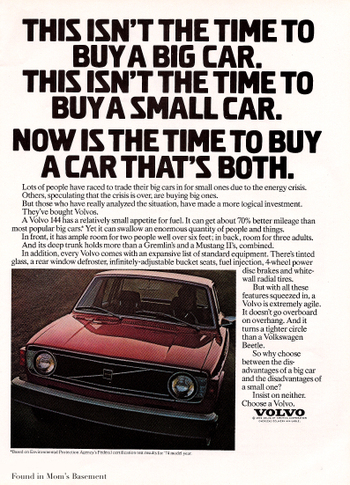
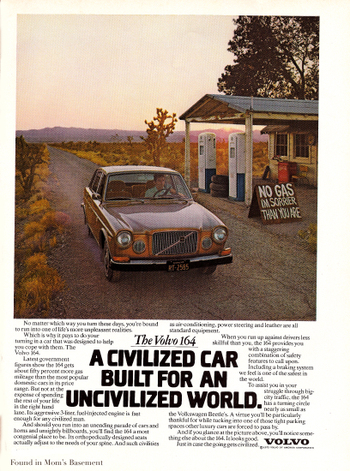
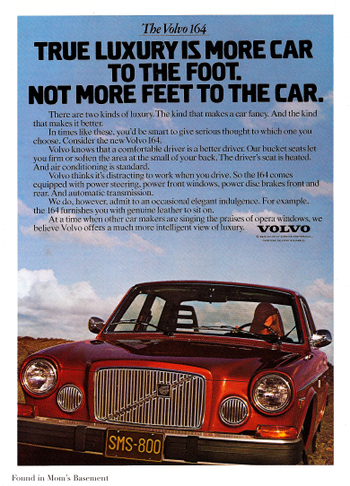
These three Volvo ads from 1974 (from Found in Mom’s Basement) remind us that this isn’t the first time there was an “energy crisis” and gas was difficult and/or expensive to get.  They put this particular crisis in historical perspective and also point to (1) how resistant Americans are to change and (2) how short our collective memory is.  That is, the problems we are facing to day are not new, but cyclic, yet we manage to forget crises as soon as they are past and revert to our familiar ways. 

The ads also demonstrate the willingness of companies to capitalize on a crisis.  See a modern version here.  And enjoy the ads:

See also these public service announcements encouraging carpooling during WWII.

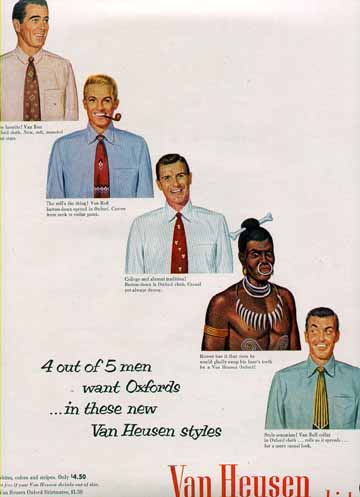
Even though I can’t read the text, I thought this ad was worth putting up.  I think I get the gist of it just fine.

Via Vintage Ads.

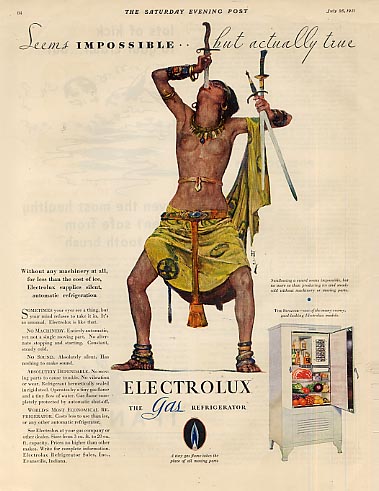
Vintage Ads put up another example of an ad, this one from 1931, using the idea of the “savage.”  In this one, her “impossible” behavior is compared to an Electrolux refridgerator.

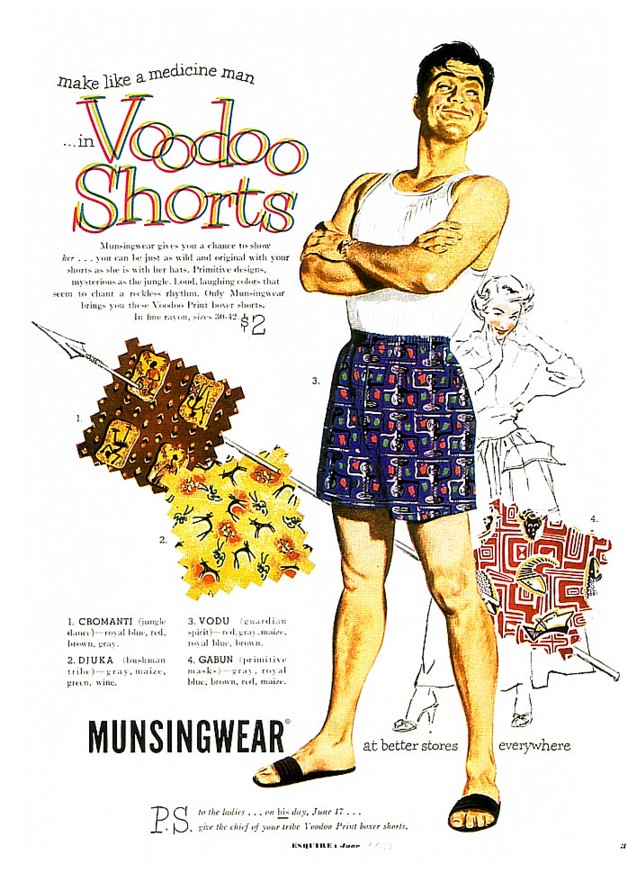
 NEW!  Vintage Ads offered us another on this theme.  The text reads: “make like a medicine man in Voodoo Shorts.”  Don’t miss the spear.

voodoo_shorts

In the 1800s, the Irish (whether in Ireland, Britain, or the U.S.) were often very negatively stereotyped. In many cases the same negative characteristics attributed to Africans and African Americans (sloth, immorality, destructiveness) were often also associated with the Irish. In fact, some scientists believed the Irish were, like Africans, more closely related to apes than to other Europeans, and in some cases in the U.S., Irish immigrants were classified as Blacks, not Whites.

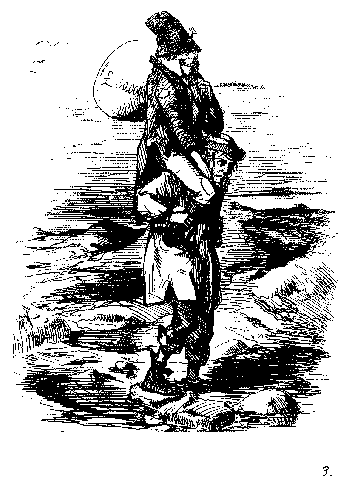
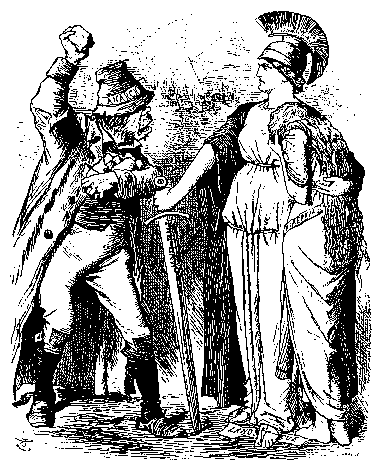
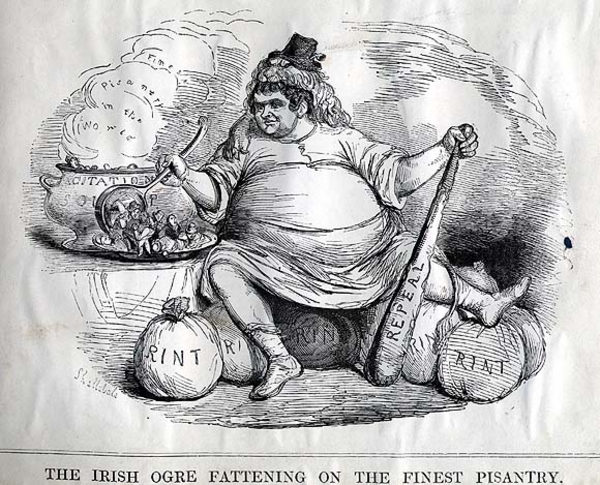
The next three political cartoons from the 1800s were found on the Nevada Department of Education website section about racism (as was the quote about the first cartoon).

This one is titled “The Workingman’s Burden” and depicts “a gleeful Irish peasant carrying his Famine relief money while riding on the back of an exhausted English laborer.” It might make a good comparison to how welfare recipients are viewed in the U.S.

This illustration ran in Harper’s Weekly magazine. Notice how the Irish are depicted as more similar to “Negros” than to “Anglo Teutonic” individuals, and both the Irish and Africans are caricatured as ape-like. It could also be useful for a discussion of scientific racism.

This cartoon, titled “Two Forces,” shows a figure representing Britain protecting a weeping, frightened woman, representing Ireland, from a rampaging Irishman; notice his hat says “anarchy.”

This image, found at the University College Cork website, depicts Daniel O’Connell, a leader of the Irish land reform movement, as an “ogre.” He is ladling poor Irish peasants out of a pot labeled “agitation soup,” and, presumably, cheating them out of money in the guise of helping them.

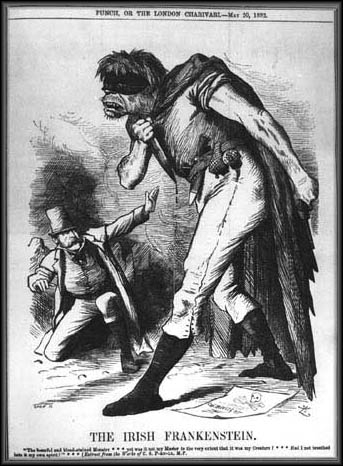
Here we see the Irish depicted as a Frankensteinian monster in a cartoon that ran in Punch in 1882 (image found at the website for a course at the University of St. Andrews):

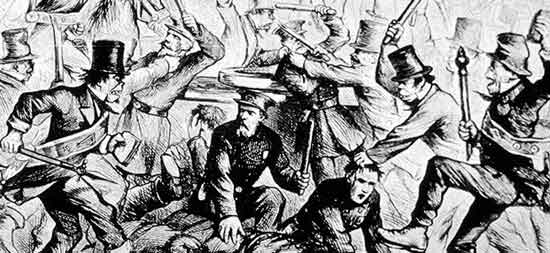
These next three all come from the Center for History and New Media at George Mason University. Here we see drunken Irishmen rioting and attacking police:

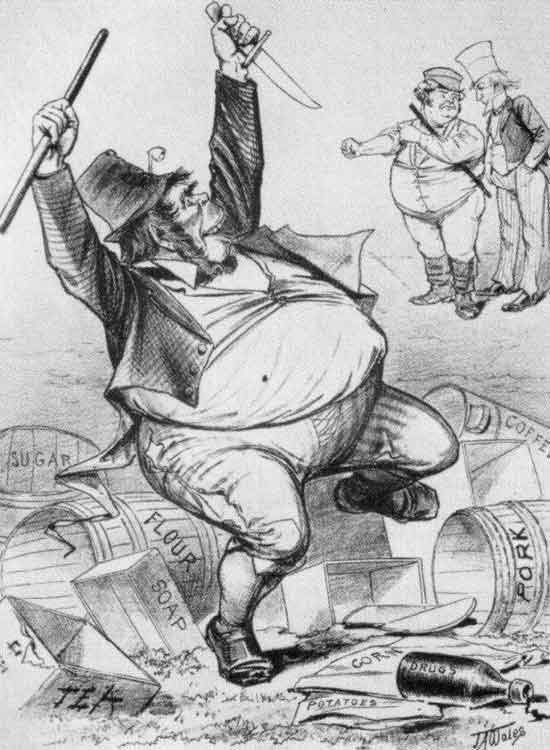
In this one, John Bull (representing Britain) and Uncle Sam look on as an Irish man engages in reckless destruction; notice the empty bottle in the lower right corner, labeled “drugs”:

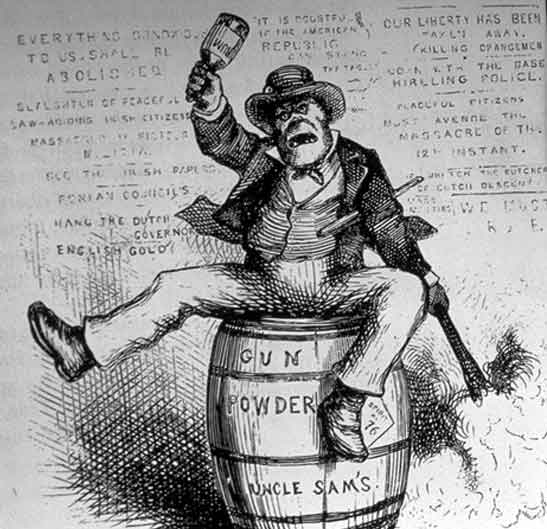
Here an ape-like Irish man, again drunk, sits on a powder keg, presumably threatening the entire country:

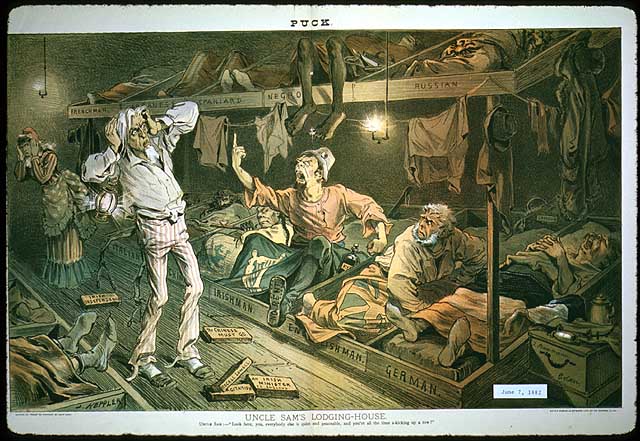
Finally, this one, published in 1882 (and found at the Michigan State University Museum website), is called “Uncle Sam’s Lodging House” and shows an Irish immigrant causing a commotion while other immigrants (notice the beds are labeled Russian, German, Negro, etc.) try to sleep. The smaller caption under the title says, “Look here, you, everybody else is quiet and peaceable, and you’re all the time a-kicking up a row!”

The message is, of course, that other immigrant groups (including Blacks) settle in and don’t cause problems, while the Irish don’t know how to assimilate or stay in their place.

You might compare these images to this recent post about how symbols of Irishness have lost any real negative implications, such that even politicians in non-Irish-dominated districts feel comfortable using them in campaign materials.

And yes, I know I’ve been posting a lot of stuff about race and ethnicity lately. I’m teaching a class on it this semester–it’s the stuff that I keep coming across while writing lectures.

And I’m dedicating this post to my boyfriend, Burk, who decided to go on a date with me even though, when he asked if I’d have trouble dealing with his hard-drinking Irish-American family, I said I could handle that but wouldn’t put up with any blubbering on about how Angela’s Ashes is the best book ever.

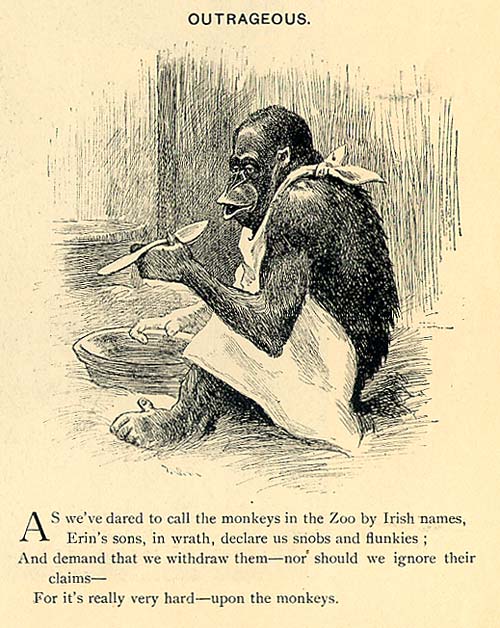
NEW!  This cartoon with poem was published in Life Magazine on May 11th, 1893.  The poem is suggesting that the monkeys in the zoo are sad that they get called by Irish names.

race-white-irish-discriminatory-cartoon-1

Text:

As we’ve dared to call the monkeys in the Zoo by Irish names, Erin’s sons, in wrath, declare us snobs and flunkies ;
And demand that we withdraw them–nor should we ignore their claims–
For it’s really very hard–upon the monkeys.

UPDATE: In a comment, Macon D asked how I address the ways in which Whites of some ancestries (Irish, Italian, etc.) often point to the fact that there was discrimination against those groups as a way of invalidating arguments about systemic racism. The logic is that both non-Whites and some White groups faced prejudice and discrimination but European groups overcame it through their own hard work, and thus any other group could too. If they continue to experience high levels of poverty, unemployment, or any other social problem, it is due to their own lack of hard work, intelligence, or some other characteristic.

I do indeed discuss this argument at length whenever I teach about race. A great reading to address it is Charles Gallagher’s article “Playing the White Ethnic Card: Using Ethnic Identity to Deny Contemporary Racism,” p. 145-158 in White Out: The Continuing Significance of Racism (2003, Ashley W. Doane and Eduardo Bonilla-Silva, editors, New York: Routledge). The tone might put some students off, because it doesn’t baby them or try to sugar-coat the issue of how Whites use their (often imagined) family stories of discrimination as a way to argue that systemic racism doesn’t exist and that they got to where they are by their family’s hard work, and nothing more. I know other professors often use the “How Jews Became White Folks” reading by Karen Brodkin, which also looks at this issue.

I also spend a good part of the semester looking at how government policies have had the effect of transferring enormous amounts of wealth into the hands of European immigrants and helping them accumulate resources over time–we look at the Homestead Act of 1862, the G.I. Bill (which Black veterans were often excluded from using), and how government subsidies for building suburban subdivisions were actively denied to groups wanting to build integrated communities. All these are examples of ways in which White Americans were aided in acquiring wealth and moving up the socio-economic ladder, while non-Whites often were explicitly excluded from these benefits.

I also point out that, while in these images the Irish are negatively stereotyped, it is clear that they are still viewed less negatively than, say, Africans or African Americans. If the Irish are the “missing link” between Africans and Caucasians…that still means they’re considered more evolved than Africans–at least somewhat more fully human. So even at the height of discrimination against White European groups, that did not necessarily mean they were treated “the same” as, say, American Indians or Blacks.