Search results for The

This graph shows the total number of people allowed into the U.S. under refugee status since 1983, by region of the world:
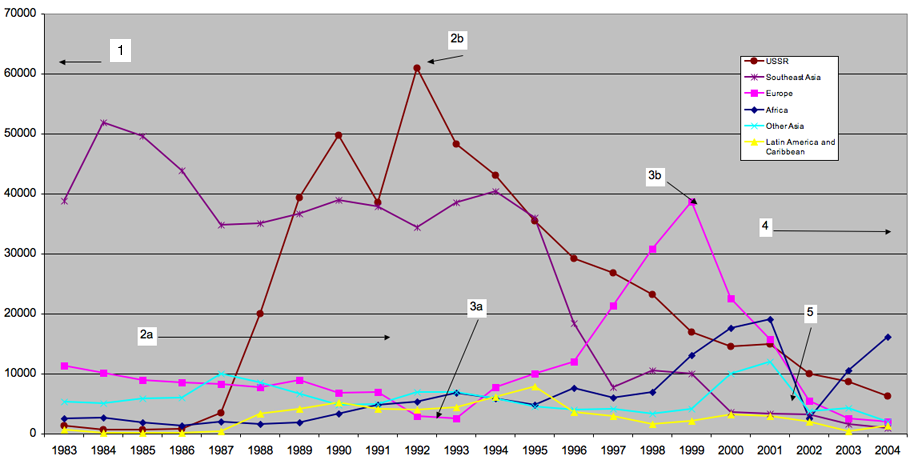
Here is the key to the numbers on the graph (found here):

*Refers to fiscal years with the exception of 2004, for which data ends in June.
1. Large Cuban and Indochinese waves of refugees, prior to 1983
2a. Cold War period, Glastnost/Perestroika, 1985-1991
2b. Soviet Union dismantled, December 1991
3a. Balkans period: Break-up of Yugoslavia, 1992
3b. Balkans period: Expulsions of ethnic Albanians in Kosovo, 1998
4. Civil conflict period: Somalia, Sudan, Liberia, Ethiopia, late 1990s-present
5. Terrorist attacks of September 11, 2001
Authors’ tabulation of ORR data.
This map shows U.S. cities with the largest numbers of refugees resettled there:

Both of these images were found following links in this essay at Migration Information Source.

Update: The confusion in the comments brought to my attention that I embedded the wrong commercial.  See!  I’m not crazy!  Just incompetent.

Enjoy the corrected post:

At least that’s the message I’m taking from this Utah Tourism advertisement featuring anthropomorphized snowflakes (found here):

[youtube]http://www.youtube.com/watch?v=78RZ-UgIMrM[/youtube]

When a member of a regularly-excluded group gains entry into what was previously a homogeneous club–say, a Black man is elected President of the United States–that person is sometimes used as “proof” that there are, in fact, no barriers to entry after all. Thus, some of us worry that Obama’s election will be used against those fighting for racial justice. Well, it began before it began. In this clip on CNN, aired before Obama was confirmed the winner, former Secretary of Education Bill Bennet, when asked what his election would mean, remarks:

Well, I’ll tell you one thing it means… You don’t take any excuses anymore from anybody who says, ‘The deck is stacked, I can’t do anything, there’s so much in-built this and that.’

Yes, there’s no more “this and that” and Bill doesn’t want to hear about it anymore.

Scroll forward to about 45 seconds:

[youtube]http://www.youtube.com/watch?v=SvpB-MnM8I8[/youtube]

Clip via Macon D. at Stuff White People Do, who has a nice analysis.

The Pink Patch is similar to nicotine patches, except it’s a diet product aimed at young women. Here’s a photo from the website of a woman wearing it:

The website for this product clearly targets young women; it warns young women that they are at the time in their lives when their metabolism is highest, and refers to college weight-gain.

The product promises women a solution to their negative body image. Of course, the solution isn’t to think differently about their bodies; the solution is to use the Pink Patch to get skinny:

This quote from a supposed customer makes it clear that losing weight brings boys and popularity:

It also encourages competition and envy among girls:

And apparently, it’s an upper. You might experience “possible mood elevation” and can “relieve your stress,” allowing you to get everything done:

So use the Pink Patch and you will lose weight, which will bring popularity and male attention. Girls will envy you. You’ll be happier, you’ll get a lot done, and that will help you graduate with that great job you always wanted.

It’s the overall message of the diet industry, condensed in one website: the answer to all your problems in a product that will help you melt the pounds away, thus transforming your life. And it’s pink! So feminine!

Via Big Fat Deal.

Many of the polls that we have been consuming voraciously have not included people without a land line (like me).  In the figure below, we can see what a difference that makes in the results.  Yellow bars are polls that included cell phones and grey bars are polls that did not.  Those that excluded cell phones are significantly skewed towards McCain, and falsely so insofar as people without a landline vote.

From 538 via Thick Culture.

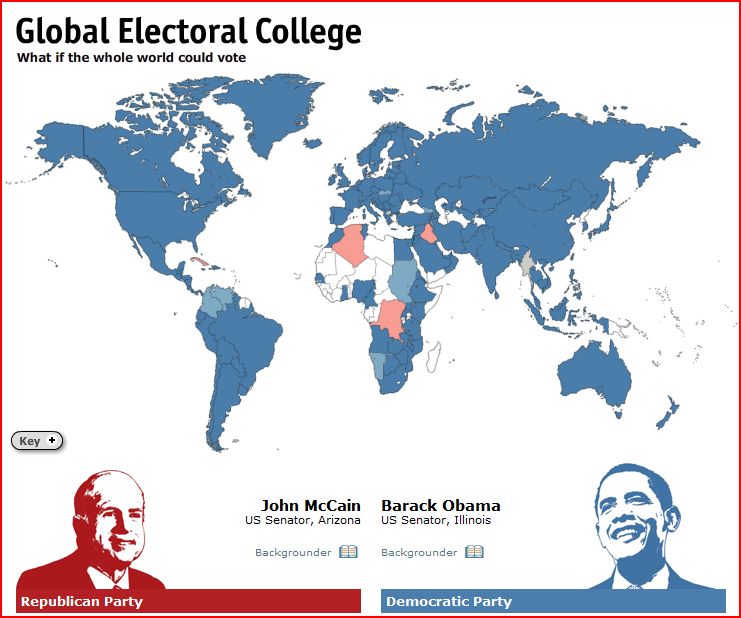
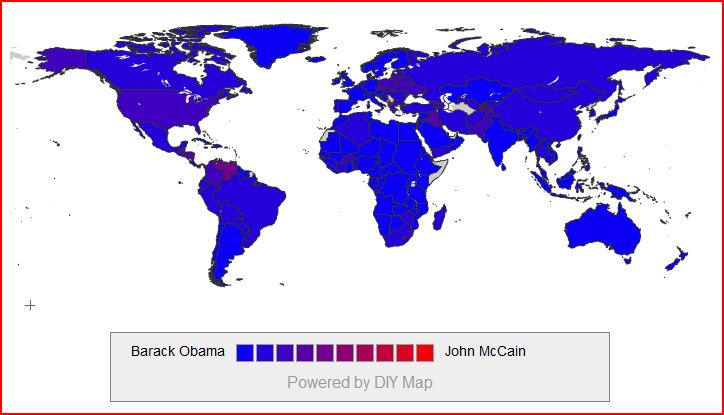
Matt S. sent in a link to a global electoral map showing how the world would vote in the U.S. presidential election. The images below–the first from The Economist and the second from two guys in Iceland–might be useful for illustrating the relationship between the U.S. and the rest of the world.

Thanks Matt!

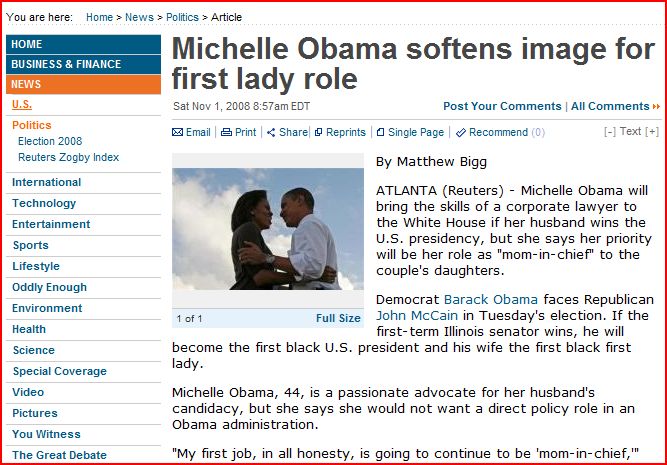
In U.S. culture, the stereotype of Black women includes being too loud, aggressive, etc (i.e., masculine).  Thus, to fit into the role of first lady, according to Reuters, Michelle Obama must “soften” herself.  Note that the text accompanying this headline emphasizes that she’s just going to be a mom.

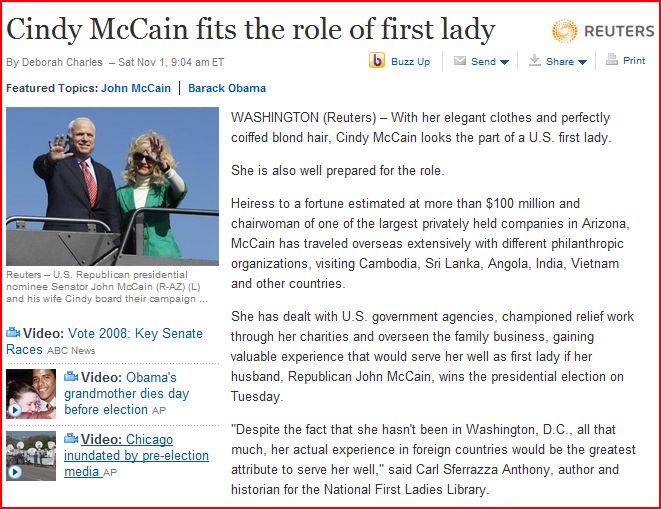
In contrast, Cindy McCain already “fits” “with her elegant clothes and pefectly coiffed blond hair.”

Click on either image to enlarge.  Full articles can be found here and here. Via Jezebel.

See also this post where Michelle Obama is called an “angry black woman.”

In her book The Body Project: An Intimate History of American Girls, Joan Jacobs Brumberg argues that increased access to mirrors in the 1800s helped spur middle-class Victorian obsessions with the body, particularly skin and the presence of acne on the face. Mirrors gave the average person more of an ability to imagine themselves through others’ eyes and to inspect every part of their body (and presumably find it lacking).

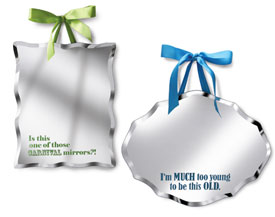
Samantha J. showed me the logical end-point of this association between mirrors and negative appraisals of one’s body: mirrors that don’t make you do the work of negatively judging your body, but just go ahead and do it for you.

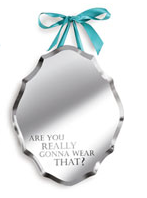
The one on the left says, “Is this one of those CARNIVAL mirrors?!” and the one on the right says, “I’m MUCH too young to be this OLD” (found here). The mirror below (found here) says, “Are you really gonna wear that?”

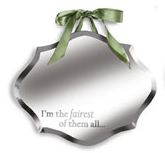
Of course, if you want a self-esteem boost, or already feel really good about yourself, you could buy this one (found with the one above), which says, “I’m the fairest of them all…”:

Anyway, they might provide a (sort of silly) illustration to go with a discussion of how increased access to mirrors or other technologies (is a mirror a technology?) have affected perceptions of the body and our ability to scrutinize every inch of it (which could, of course, be part of a larger discussion about how changes in technology can affect cultural trends).

Thanks, Samantha J.!