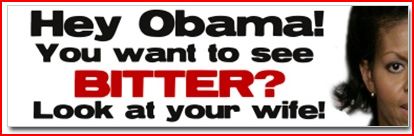
Kirsten Dunst (found here):
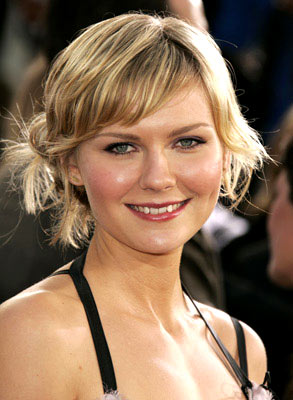
Kirsten Dunst on the cover of Harper’s Bazaar (found here):

Observation made at Jezebel.
There is a lot going on here. Comments after the image (found at MultiCultClassics):
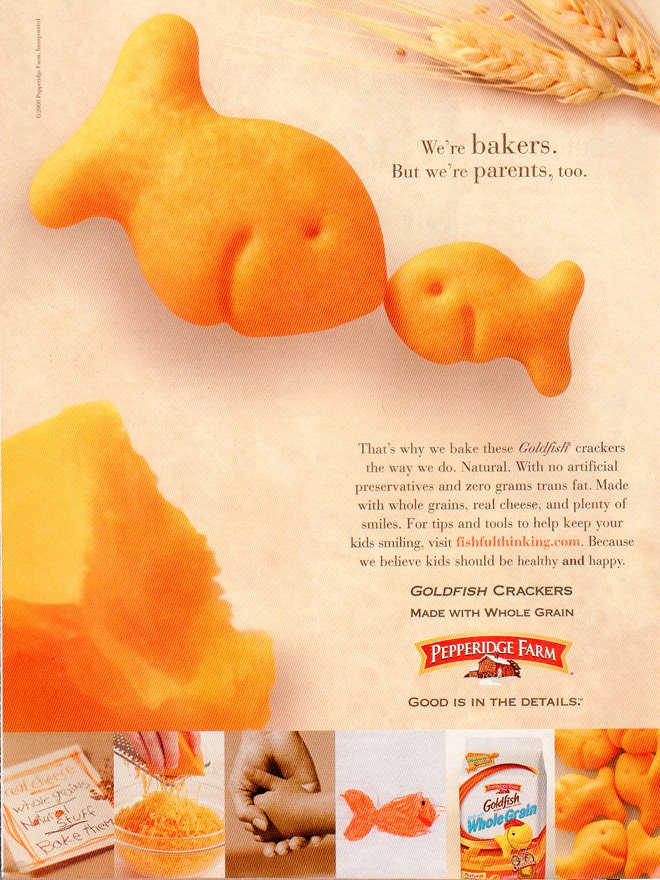
First, notice how this ad mobilizes a nostalgia for a simpler past (“We’re bakers”). Goldfish crackers are likely baked not by bakers (how quaint), but in large automated factories. Second, in line with this nostalgia, Pepperidge Farm, the company, is recast as a parents (“We’re bakers. But we’re parents, too”) instead of a corporation in a capitalistic society likely employing low-wage workers (who are not, by the way, busy caring about consumers kids). Notice that, by re-casting the company as parents, they encourage you to think of the company’s motives not as profit, but nurturing. Third, the Goldfish crackers themselves are anthropomorphized into a happy parent and child. Finally, happiness and family togetherness are commodified. Text:
That’s why we bake Goldfish crackers the way we do. Natural. With no artificual preservatives adn zero grams trans fat. Made with whole grains, real cheese, and plenty of smiles. For tips and tools to help keep your kids smiling, visit fishfulthinking.com. Because we believe kids should be happy and healthy.
This is a famous photograph of Clell Pruett, a farm worker, burning a copy of The Grapes of Wrath while two leaders of Associated Farmers, an organization made up of California agricultural producers, look on. I heard about this incident on NPR this morning; click here for a link to the story.
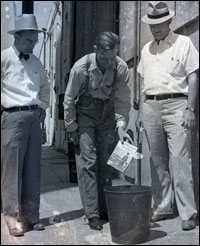
As might be expected, members of Associated Farmers were not too pleased about The Grapes of Wrath, which they thought portrayed them unfairly and also encouraged union organizing, which they very much opposed. In some counties in California, the book was banned from libraries. According to the NPR story,
Camp [leader of a local Associated Farmers branch] wanted to publicize the county’s opposition to The Grapes Of Wrath. Convinced that many migrants were also offended by their depiction in the novel, he recruited one of his workers, Clell Pruett, to burn the book.
Pruett had not read the book at that point, though he had heard about it and did not like what he had heard, and when he got around to reading it a few years ago (after the NPR reporter gave it to him), he said he “had no regrets” about burning it.
I thought this might be useful for a discussion of protests and how dominant groups may orchestrate protests that denounce or invalidate criticisms of their positions of power. We see a somewhat similar phenomenon today with the so-called “Astroturf” organizations, a term coined to refer to what appear to be citizen advocacy groups but that are basically fronts for corporations or industry groups to push their agenda, often with little or no support from anyone not directly connected to the corporations involved–the term makes fun of their attempts to portray these groups as “grassroots.”
It also brings up interesting issues about agency. I suspect many on the left who are generally sympathetic to organized labor would view Pruett as a traitor or a dupe–an ignorant fool who was used by those in power to undermine the very cause that would have improved his life. But there’s a big assumption there–that it would be impossible for a farm worker to simply be offended by the depiction of workers in The Grapes of Wrath (or to be opposed to the labor movement more generally). So this might spark a discussion about the ideas of “interests” (i.e., that workers’ interests are served by organizing) and who gets to decide what they are (or which set of interests should be prioritized). Is Pruett a traitor to organized labor? Did he betray other farmworkers? Is he just a tool of the wealthy landowners who often exploited workers, or was there a legitimate reason some workers might have been offended by The Grapes of Wrath?
This isn’t to discount the fact that those in power often search for an “authentic” voice they can use to delegitimize criticisms. For instance, universities using American Indian mascots have often looked for a group of American Indians willing to state that they either don’t oppose or actively support the mascot. In some cases these supporters were from other states and might have been offered scholarships or other incentives that led many mascot opponents to question whether they were basically being bribed.
I just thought it might make a good addition to a discussion of social movements and protests in general–how do we conceive of counter-movements and the role of the dominant group in them? When and in what way do the powerful use members of the supposedly aggreived group to delegitimate criticism? And who gets to decide when someone is being used and when they are, of free will and presumably sound mind, in agreement with the group that others perceive to be oppressing him or her? Who gets to decide you’re being oppressed, even if you don’t feel like it?
Of course, it would also make a nice image for a discussion of freedom of the press.
In the 1950s, Clearasil started a new marketing campaign called Clearasil Personality of the Month. These were ads disguised as advice columns that ran in magazines. They featured the stories of real girls who wrote in to Clearasil to talk about their own struggles with acne and, of course, how they finally overcame this horrible affliction with the help of Clearasil. Here is an example (found here), a piece on a college student named Linda Waddell:
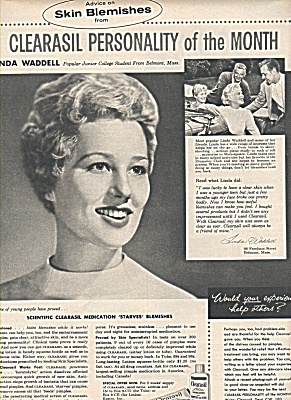
Sorry, the resolution isn’t good enough for me to be able to read all the text, so I don’t know what it says. The general layout was that teens and young women wrote in with little bios about themselves and descriptions of the problems they’ve experienced with pimples.
Notice the connection between clear skin and popularity–we see a picture of Linda surrounded by friends in the upper right corner (and, most importantly, a guy is clearly paying attention to her).
I originally read about this feature in Joan Jacobs Brumberg’s book The Body Project: An Intimate History of American Girls. She discussed it in the context of talking about increasing concern about acne and the rise of a whole host of products to combat it. However, I think it would be great for a discussion about advertising, particular about efforts to disguise advertising as simple information or entertainment (it’s still often difficult to distinguish these categories in women’s magazines). It’s also a good example of a marketing campaign that attempts to appeal to consumers by getting them to think of a product almost as a friend–here, the product is personified by nice, wholesome-looking girls who were just providing friendly advice to other girls just like them.
You still see the strategy of portraying products as friends that help women–for instance, ads for food products or cleaners that depict them as friends that help women get everything done, since apparently no one in their families will. See this post for a humorous take on some of these ads.
In her book The Body Project: An Intimate History of American Girls, Joan Jacobs Brumberg has a chaptered titled “Perfect Skin” in which she looks at the rise of acne as a significant concern among adolescent girls. Because pimples and blackheads were believed by some people to be a sign of immorality–masturbation, lascivious thoughts, or promiscuity–both teenagers and their parents were quite distressed at the appearance of teen acne. Though teens had long been concerned about their appearances, the widespread use of mirrors in bathrooms starting in the Victorian Era gave them many more opportunities to examine their faces and find themselves lacking. And girls tended to be more concerned about their faces than boys, perhaps because girls were judged more harshly for any perceived sexual immorality. A whole industry arose to sell generally useless products to teens, particularly girls, to cure their acne.
Marketers for soap and other products used concerns about morality in their ads. Here is an ad for Hand Sapolio, a popular soap in the early 1900s (found in a 1906 issue of McClure’s Magazine):
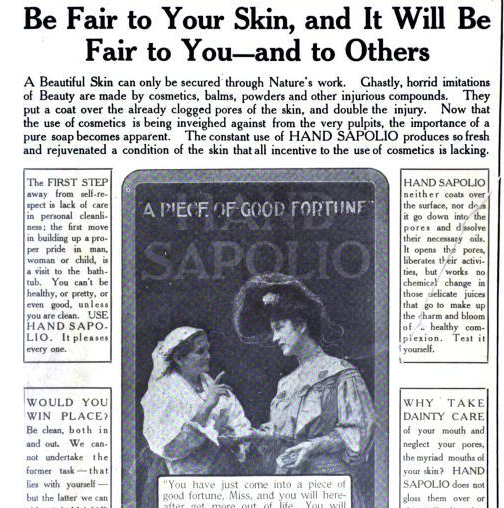
Notice how the text in the top box mentions that cosmetics, which might be used to cover pimples, were being “inveighed against from the very pulpits,” meaning good moral girls couldn’t use cosmetics to hide their acne. Also I like how the title (“Be Fair to Your Skin, and It Will Be Fair to You–and to Others”) implies that if you aren’t fair to your skin, it is going to do something dreadful to the people around you…presumably busting out into a hideous display of pimples that will pain people to look upon.
I zoomed in and did a couple of smaller screen captures of some sections of the text that also stress morality or “goodness”:
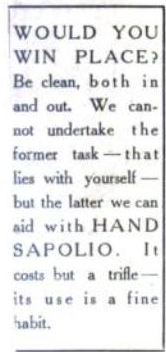
Be clean, both in and out. We cannot undertake the former task–that lies with yourself–but the latter we can aid with HAND SAPOLIO.
This section of text makes it clear that good skin is essential for popularity, at least among the “best” people:
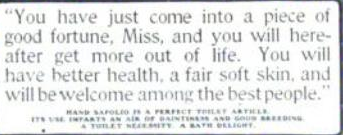
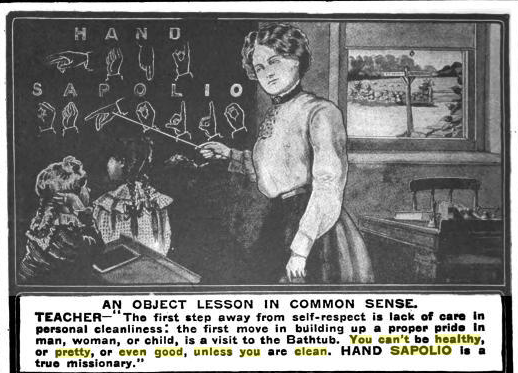
This Hand Sapolio ad (from a 1903 issue of New England Magazine), sums it up:
The first step away from self-respect is lack of care in personal cleanliness: the first move in building up a proper pride in man, woman, or child, is a visit to the Bathtub. You can’t be healthy, or pretty, or even good, unless you are clean. HAND SAPOLIO is a true missionary.
So there we see a connection being made between having good skin and being “good,” which means that, like missionaries who help save heathens, Hand Sapolio is a “missionary” spreading moral goodness and self-respect. Because what could build up self-respect more than being told that if you have less than perfectly clean skin, you can’t be pretty or good?
These could be useful for discussions of how physical appearances were steadily connected to ideas of morality and how biological processes, like getting pimples in adolescence, were turned into diseases that required (often expensive) intervention to “cure.” They could also be good for a discussion of marketing, particularly how ideas of morality were tied to particular products, such that goodness was commodified–by buying the item, you were buying goodness.
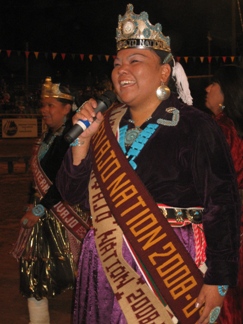
In a comment to a post a while back, Macon D. drew my attention to a post on Womanist Musings about Yolanda Charley, Miss Navajo Nation 2008. The post points out that she (and past winners) show a range of body sizes and shapes that would be unusual in a “mainstream” beauty pageant. The competition emphasizes knowledge of Navajo culture and traditions; contestants must be fluent in Navajo and English and be knowledgeable about Navajo traditions and rituals, according to the Miss Navajo Council website. This is a picture of Miss Charley:
Although I didn’t want to automatically romanticize or fetishize it (as the “good” pageant vs. the “bad” mainstream ones), I’m always happy to see examples of different beauty standards. I rummaged around on the website for a while, and some other things about the pageant also struck me, such as the following rules:
…there is no contact with your parents once you arrive for the pageant.
Contestants must dress themselves individually. (i.e. make your own Navajo hair bun, wrap leggings, etc.) THIS WILL BE STRICTLY ADHERED TO.
I assume the point is to try to make the girls rely on their own skills rather than parents and professional stylists (as well as to reduce the amount of parental hovering and interference that probably occurs at most pageants).
The competition includes traditional skills/talent and traditional techniques competitions. The traditional technique is chosen for them and could include butchering. I tried to imagine Miss America contestants having to get ready entirely on their own, without help doing their hair and makeup, and being forced to butcher an animal in front of a crowd. I also tried to imagine the Miss America audience watching them butcher anything. Despite being a vegetarian, I giggled a lot.
I kept reading and noticed rules about not marrying or living with anyone and not becoming pregnant during their reign; these are pretty standard for beauty pageants. I also saw a document with proposed changes to eligibility rules. Here are some new or revised items (all typos/errors are from the original):
Candidate must be 18-25 years of age, never have co-habituated, never been married (including marriage annulments, common law marriage, same-sex marriage/relationship and/or divorce) and have never been pregnant.
Candidate must have an official birth certificate indicating gender at birth.
Candidate will not have a hetero/or same sex relationship during reign.
The obsession with making sure beauty pageant contestants have never been married or pregnant fascinates me. For one thing, although you can verify that someone has never been married, how do you verify someone has never been pregnant? Critics usually focus on the beauty standards imposed by pageant judges, but the insistence on sexual purity is interesting as well–apparently having ever been pregnant (or married) means you are not worthy to be the paragon of beauty. This isn’t specific to the Miss Navajo pageant–similar standards apply for Miss America and, as far as I can tell, most beauty pageants. And that standard boils down to, “girls who have clearly had sex are not appropriate representatives.” You could be the prettiest (by the pageant’s standards), the most talented, and so on, but the pageant isn’t about just that–you also have to be free of any proof that you are not a virgin. Although you can be sexy, we don’t want to know if you were sexual.
It’s also interesting that future Miss Navajos may have to prove they were female at birth. I looked for a similar requirement for Miss Americas, but couldn’t find a full list of eligibility requirements, so I don’t know if they have it or not. This could be useful for discussions of gender in Native American communities. As is well known, many Native groups had a more fluid, or at least expansive, idea of gender than the current mainstream binary of male/female; many groups had a “third gender,” often referred to as berdache. While this is interesting and makes it clear that our current gender system is just one way of thinking about gender, I find discussions of berdache often devolve into simplified “American culture is oppressive and homophobic, while Native tribes allowed people to just be who they are and didn’t confine or stereotype people based on gender rules.” Anyone who has talked to American Indians who are gay, lesbian, or transgender can tell you there is homophobia within Indian groups. To imply that all Native American tribes are accepting of the GLBT community both greatly simplifies the role of the berdache (which didn’t exist in every tribe) and assumes that tribes have not been affected by homophobic trends in the larger American society of which they are also a part. Whatever traditional Navajo conceptions of gender might be, apparently for the purpose of selecting Miss Navajo Nation, the mainstream binary view of gender (you are born male or female, and that’s what you “really” are for the rest of your life) may be used as an official eligibility requirement.
In any case, it’s very interesting how this Navajo pageant manages to both challenge and conform to elements of the mainstream Miss America-type pageant model.
Thanks for pointing the pageant out, Macon D!
Bryce R. forwarded us an email from Best Buy that included this image (linked from the email to here):

Aside from the typical gendering (targeting laundry appliances to women), this doesn’t even make sense. “…this wild cherry steam thing”? Is this how women supposedly talk about appliances? “I need this shiny pretty cleany-thingy. Woo!” If all she knows is that it’s a steam thing, why would she want it? Is the message that women just want things because they’re pretty (or, in this case, red)? Or that we’re too dumb to be able to talk intelligently about complex appliances? I don’t understand why the copy wouldn’t say “…I need this wild cherry steam washer,” or something that implies she’s smart enough to know what it is she’s talking about.
Also, the vague hint at sex (“a woman has needs”) in relation to a washing machine is kinda weird. See this post for a humorous look at how cleaning supplies are often sold using sexual or romantic imagery.
Thanks for the tip, Bryce!