Search results for The

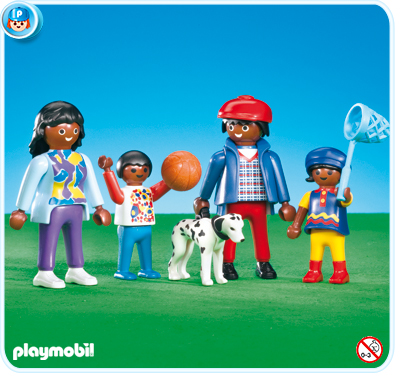
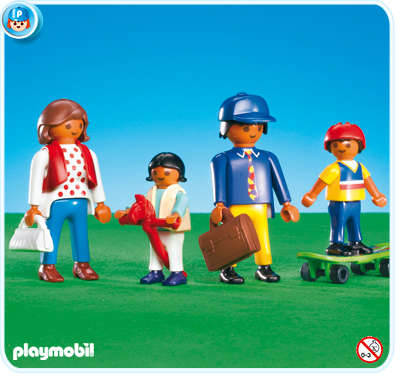
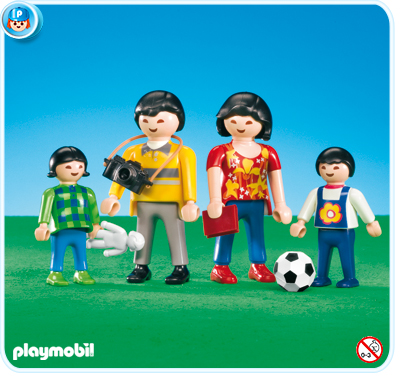
Kirsten D. sent us this link to a series of Playmobil families.  She notes how the families are all racially marked (using racial categories like “Asian” and “African” instead of nationality categories like “Japanese” and “Somalian”).  The “Mediterranean/Hispanic” category also points to the social construction of race and the way in which social construction varies across cultures (Playmobil are made in Germany).

They families are also racially homogeneous.  In the world of Playmobil (at least how it is sold, though not necessarily how it is played with) there are no interracial families and, therefore, no bi- or multi-racial people.  In this way the toys reify racial categories and naturalize racial matching in relationships.

African/African American Family:
Mediterranean/Hispanic Family:
Asian Family:
Native American Family:
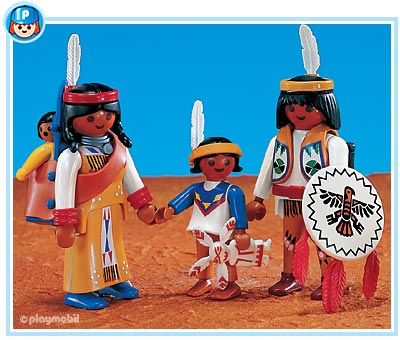
Notice also that all of the families are in contemporary clothes except for the Native American family.  Ethnicized groups are often represented in “native” costume, but this is especially true for American Indians (at least in the U.S.).  It is as if, in the popular imagination, American Indians are extinct; as if there are no American Indians alive today walking around in Nikes (there are).

So, in the world of Playmobil, American Indians are, like Romans, a historical artifact:

Also, because it warrants pointing out, all the female and male children all have gender stereotypical toys.
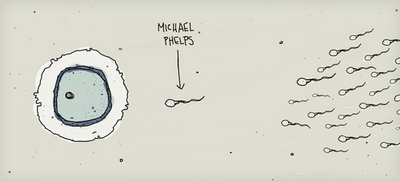
Emily Martin, in her article “The Egg and the Sperm: How Science Has Constructed a Romance Based on Stereotypical Male-Female Roles,” (Signs 16(3), 1991, p. 485-501) critiques the way biological texts generally portray sperm as active, brave adventurers and eggs as passive damsels waiting for a sperm to save her lest she be flushed out as waste during menstruation.

For example, this cartoon was linked in our comments by Noumenon:

As Noumenon notes, the first sperm to arrive is not necessarily the one that “wins” the right to merge with the egg. More often than not, it is not because the necessary chemical reaction that allows fertilization needs many sperm, not just one.

Relatedly, in a comment Ranah pointed out this image (found here), which depicts how the egg plays a much more complex part in guiding some sperm in while limiting access to others than common perceptions of fertilization recognize:

Further, sperm do not swim. They are not making a break for the egg. They do not have brains, desires, or goals. Their “tails” are randomly thrashing around due to the energy provided by the fluid produced by the prostate gland. They go in every direction (not just toward the sperm) and only by random chance do some of them end up at the egg.

Here is a clip from The Family Guy showing Stewie as a sperm or, more accurately, a spermship, competing with other sperm to capture the egg:

Notice also that in both the Phelps and the Stewie examples, the sperm contains all of the future of the identity of the individual.  The contribution of the egg is made invisible.   This is a very old idea.

NEW!  This image is drawing by Dutch physicist and microscopist Nicolas Hartsoekerfrom from 1694.  In the head of the sperm, you can see a tiny, but complete figure sitting with his head down (found here):

1_4_2_hartsoeker

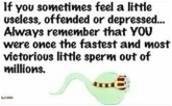
ALSO NEW!  Here’s another contemporary image (found here) affirming this idea:

picture1

Text:

If you sometimes feel a little useless, offended or depressed… Always remember that YOU were once the fastest and most victorious little sperm out of millions.

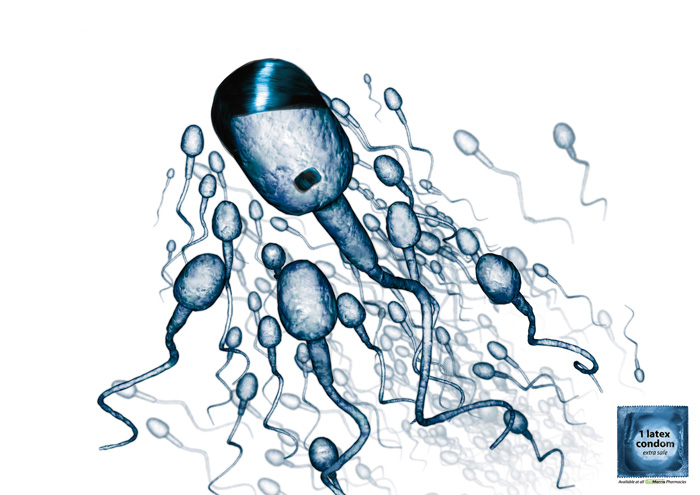
ALSO ALSO NEW! Similarly, this condom ad suggests that Hitler was once a sperm (found here):

1_docmorrishitler

Martin mentions that one of the few (non-scientific) cultural depictions of sperm that doesn’t draw on this imagery is in Woody Allen’s movie “Everything You Always Wanted to Know about Sex* *But Were Afraid to Ask,” where Allen plays the part of a sperm frightened of going out to face contraceptives or the possibility that it’s a false alarm (masturbation, gay sex) that won’t even get him close to an egg.

Here’s a clip from the movie showing that scene:

I’m going to show it the day we discuss Martin’s article in my women’s studies class when we address the way women’s bodies have been historically constructed, both scientifically and non-scientifically.

See also this Viagra ad that shows a sperm exploding an egg open.

Gwen Sharp is an associate professor of sociology at Nevada State College. You can follow her on Twitter at @gwensharpnv.

Amanda B.-P. sent in this Coke ad that illustrates the idea of consumption as activism (that is, you can be an activist simply by buying things). The ad tells you that every time you buy a Coke you’re supporting both the Olympics and Special Olympics.

The Coca-Cola company issued a press release titled “New Advertising Shows that Nothing Brings People Together Like the Olympic Games and Coca-Cola.Olympic-Themed Ads Invite People to ‘Connect with the World Over a Coke’.”

For other examples of consumption as activism, see here, here, here, here, here, and here.

Thanks, Amanda!

On an unrelated note, Lisa’s off doing crazy stuff again, so you’re stuck with lots of posts from me for a week or so. Sorry.

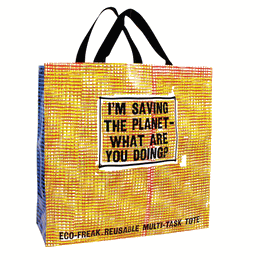
The ever-awesome Elizabeth, of Blog of Stench, sent in this image of a reusable shopping bag (found here):

Elizabeth says this “conspicuous, confrontational environmentalism” annoys her,

…because its point is not just to “save a tree,” but also to “look fashionable while doing it” [quote from organize.com]. I have a problem with pro forma environmentalism where the appearance of environmentalism matters more than actual actions, as is the case with this bag. The text on the bag equates “saving the planet” with using this particular bag or, by extension, making a show of one’s environmentalism. Furthermore and much more problematically, the implied contrast between the owner who is “saving the planet” and the audience who is being interrogated suggests that the audience is not doing anything to save the planet. The audience may be doing environmentally conscious activities in other areas of life; or the audience may have mitigating factors that prevent them from spending extra money in order to flaunt their environmentalism like white urban bourgeois hipsters.

For another example of environmentalism as fashion statement, see this post.

Thanks, Elizabeth!

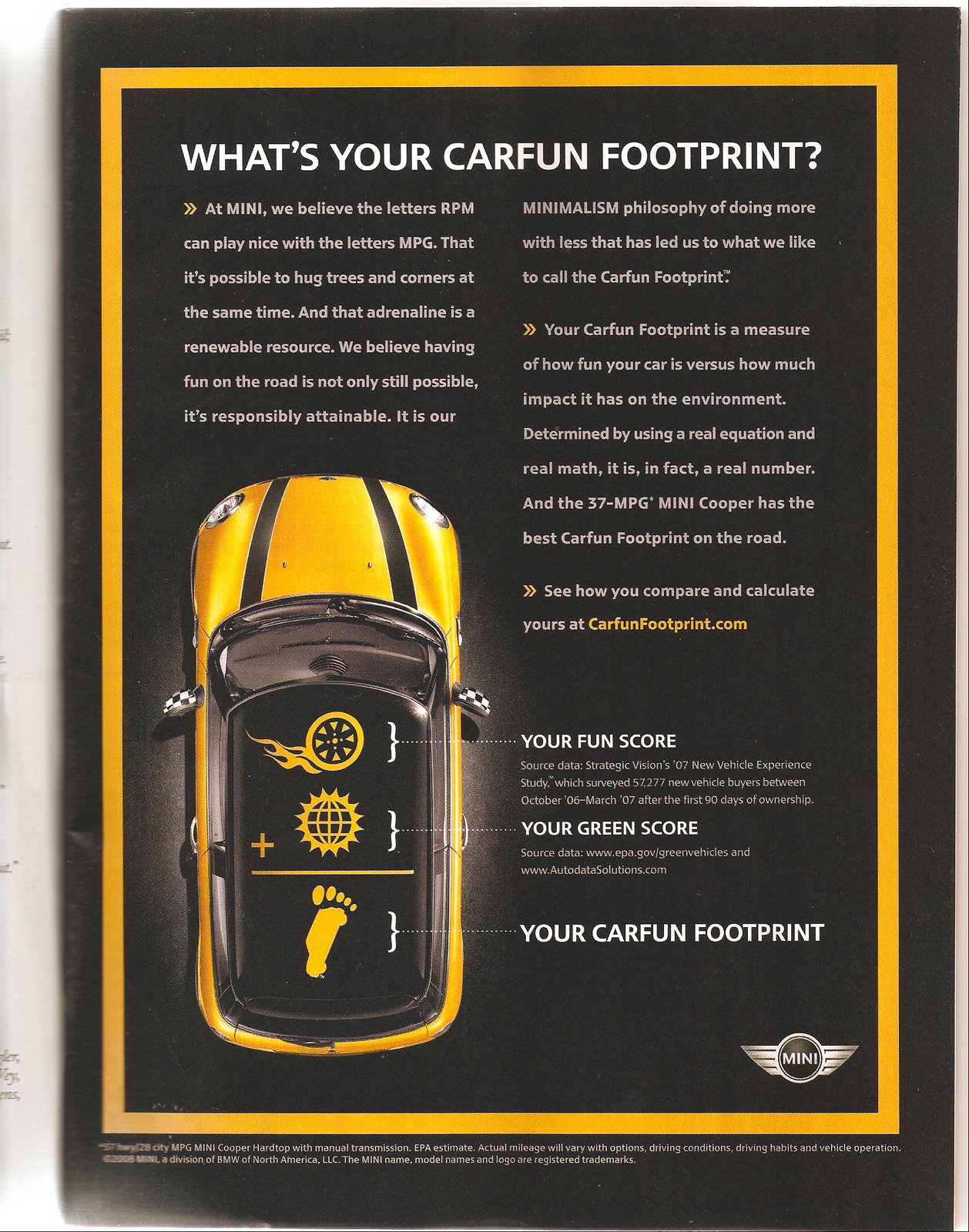
Zach W. sent in this Mini Cooper ad (found here) that talks about the car’s “carfun footprint,” which is “a measure of how fun your car is versus how much impact it has on the environment”:

Clearly it’s awesome if car manufacturers are realizing they actually have to address the environmental aspects of their cars, but what grabbed my attention is that in the main text it says the Mini gets 37 mpg, but when you read the fine print at the bottom, you find out that in town it’s 28 mpg, and that’s the hard-top manual transmission Mini. According to this article, the convertible gets 30-32 mpg on the highway, and Yahoo’s autos page shows them getting in the low-20s per gallon in-town. As a Honda Civic driver, that doesn’t strike me as much to brag about, really. I mean, ok, yes, better than the Mercury my grandma bought last year, but still. (Note: I think my grandma is the last person on earth to buy a Mercury.)

Thanks, Zach!

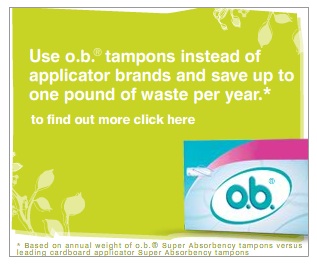
NEW: Claire T. sent in this ad for o.b. tampons (found at Science Daily):

I think when even tampons are being advertised as environmentally-friendly, we can safely say that the idea of being eco-conscious is becoming fairly mainstream (though that, of course, means little about how people actually act).

Thanks, Claire!

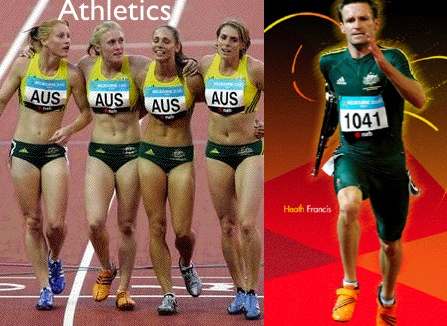
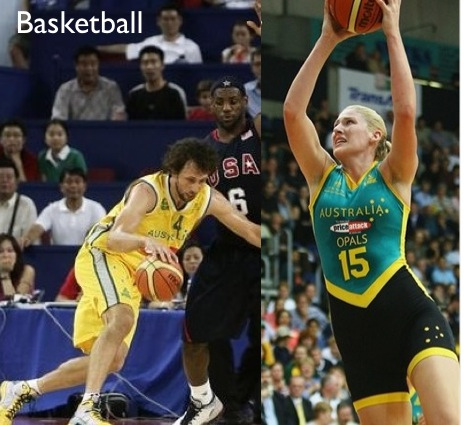
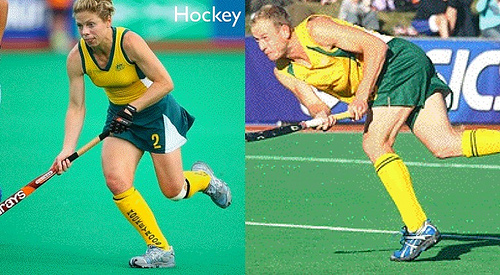
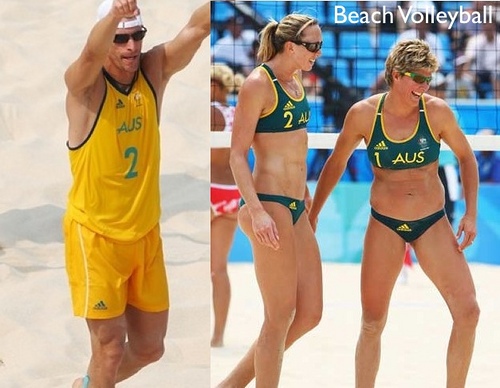
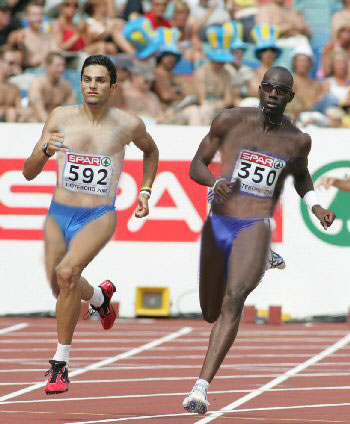
Lauredhel at Hoyden About Town put up these nice images comparing Australian women’s and men’s athletic uniforms:


As tigtog mentions in another post, if these skimpy uniforms were really about performance, men would be wearing them too.  But that, of course, would look ridiculous:


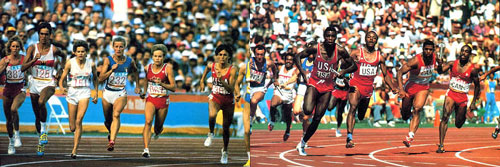
Tigtog also points out that this degree of sexualization is new.  Here are pictures comparing the men’s and women’s runners uniforms at the 1984 Olympics:

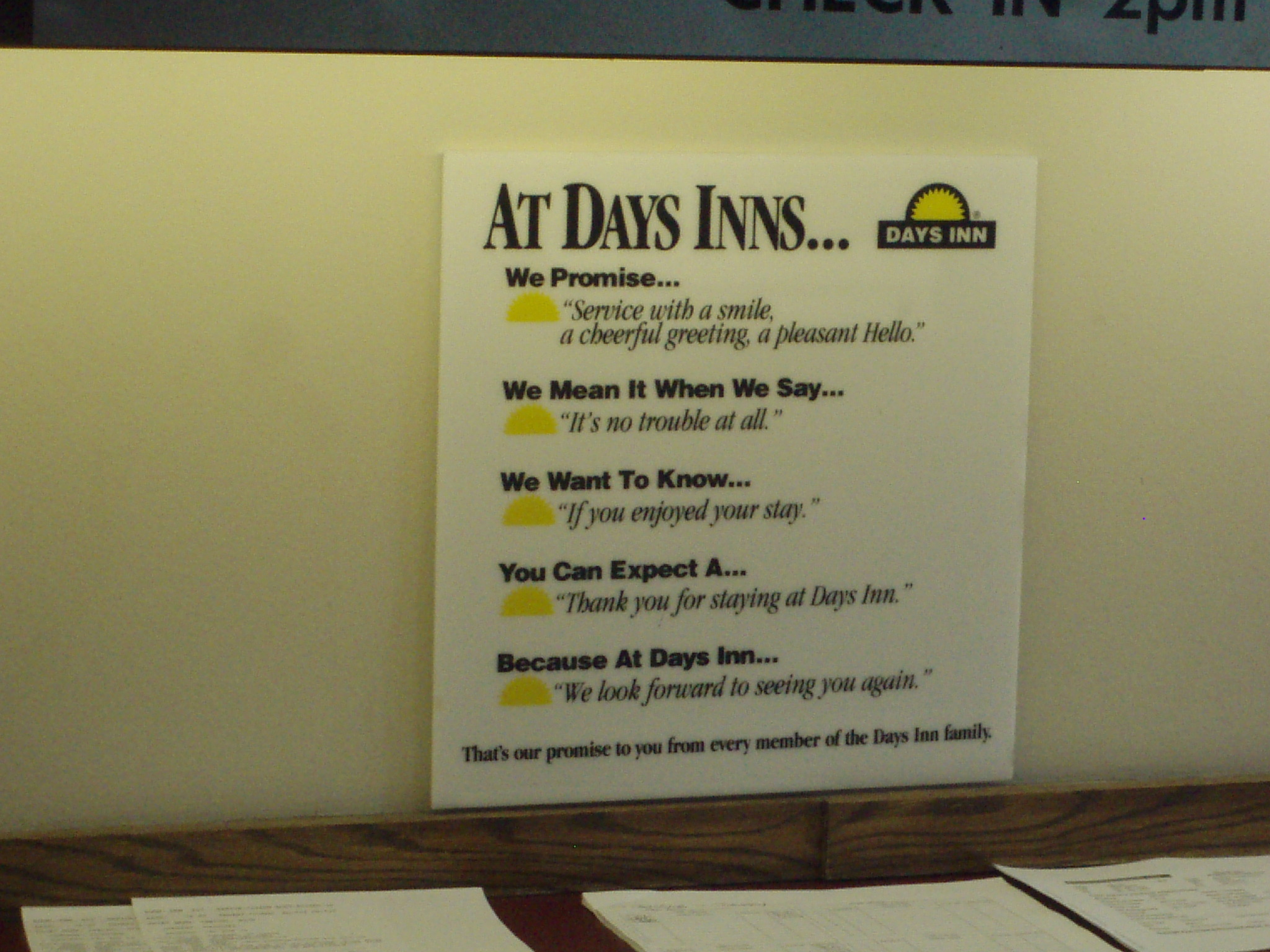
This sign was posted in sight of the customer at the Days Inn (where I stayed when I failed to get out of Logan airport after the American Sociological Association meetings in August of 2008).  I have incuded three observations after the image and text.

Text:

At Days Inns…

We Promise…
“Service with a smile, a cheerful greeting, a pleasant Hello.”

We Mean It When We Say…
“It’s no trouble at all.”

We Want To Know…
“If you enjoyed your stay.”

Because At Days Inn…
“We look forward to seeing you again.”

That’s our promise to you from every member of the Days Inn family.

(1) It is a nice example of the kind of emotional work that employees are required to do.  It’s not just about getting customers into rooms efficiently and politely, it’s about a putting on a shit-eating grin and kissing their asses.  Or else you’re fired.

(2)  It’s also an example of a for-profit company calling itself a “family.”  You are supposed to do things selflessly for your family, but you work at a job for money.  Comparing a company to a family, I suspect, is one way to get employees to give to the company out of kinship-like duty instead of on contractual terms for money.  This, of course, and ironically, lines the pockets of executives quite nicely.

(3) The logic behind their use of quotation marks eludes me.

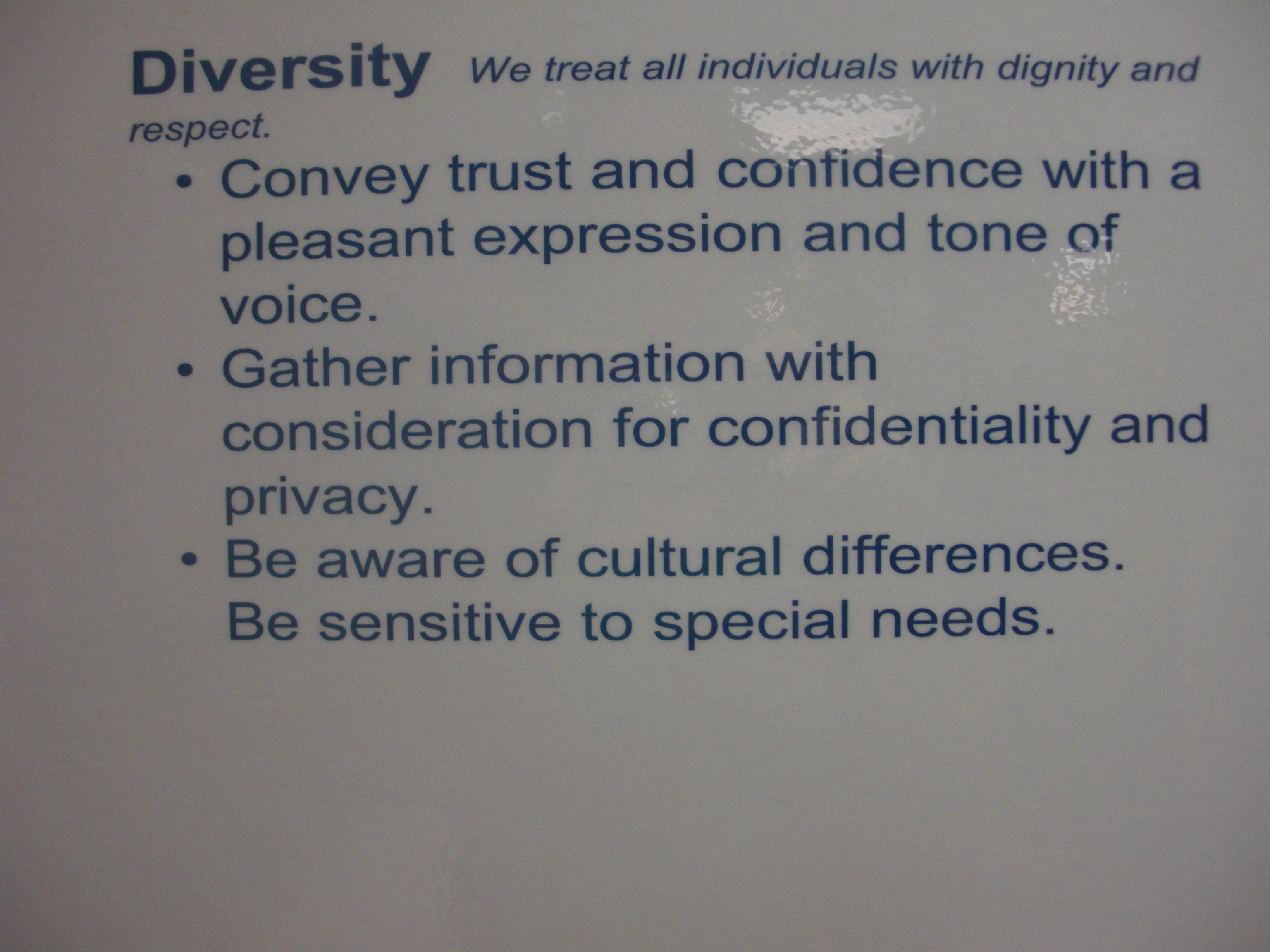
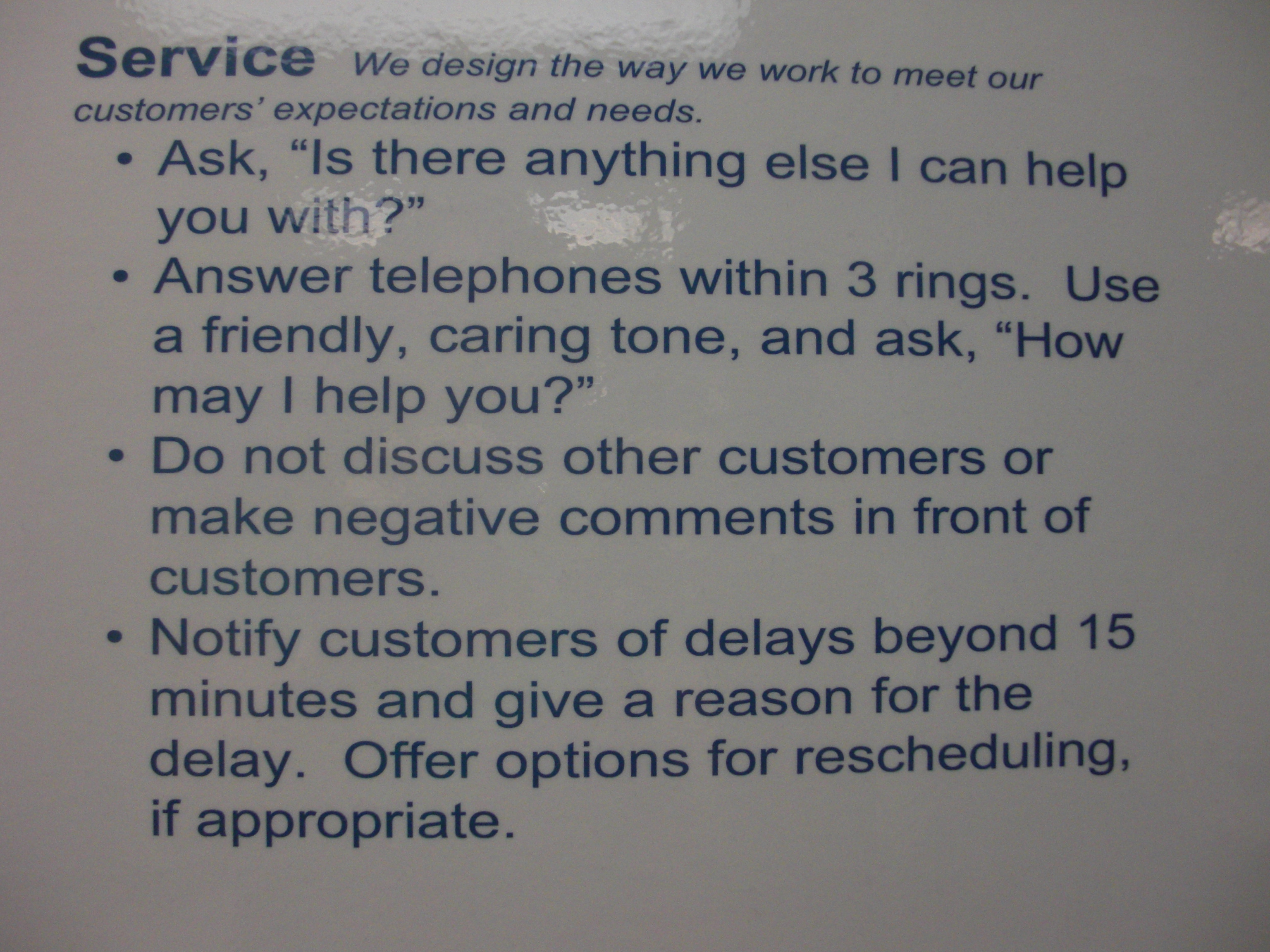
NEW: I took these picture in a Kaiser Permanente hospital in Hollywood in October 2008.  Close-ups and remarks below.


Like in the Days Inn example, employees at Kaiser are to do more than simply do their job effectively, they must do it “pleasant[ly]” and with “care.”  It is one thing to be instructed to “gather information with consideration for confidentiality,” and quite another to be asked to “convey trust and confidence.”  Scholars of emotion work note that the emotional part of jobs is (1) rarely seen as a skill or (2) a toll that makes your job trying and is, therefore, (3) undercompensated.  Yet, the ability to “convey trust and confidence” in strangers is certainly a special one and the health insurance employee that can do that is certainly valuable.  Unfortunately, like with other type of care work (i.e., nursing, teaching), that “value” is mostly lipservice and rarely translates into anything with exchange value (i.e., CASH).

For another example of emotion work, this one a sneak look behind the counter, click here.

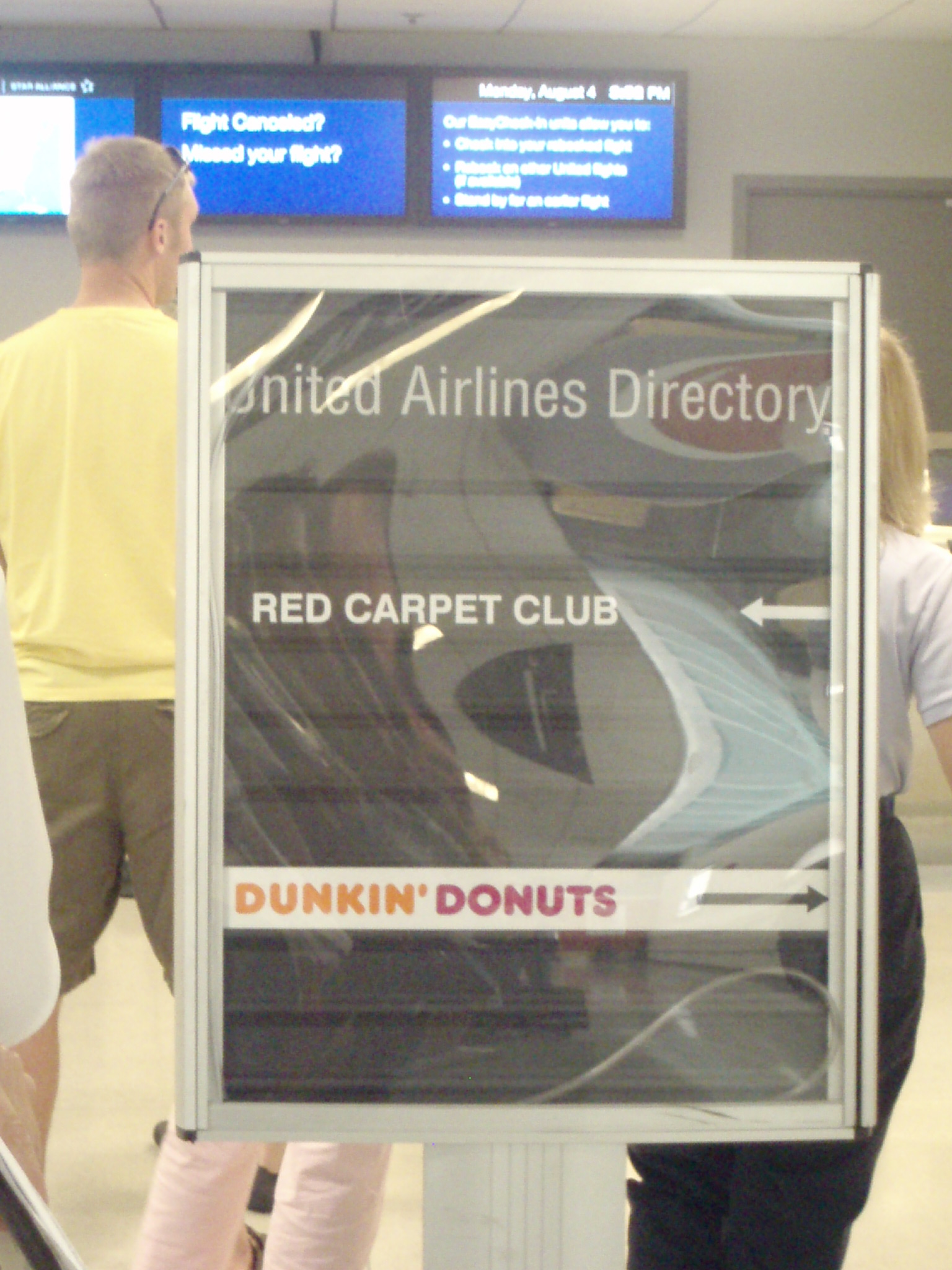
You’re either having a scotch at the Red Carpet Club or you’re downin’ cheap coffee at Dunkin’ Donuts:

This picture, which I happen to find hilarious, was taken by me during an unsuccessful attempt to get out of Logan Airport after the American Sociological Association meetings in Boston.  I ended up being treated very nicely at the Days Inn.

Parents, feminists, and cultural critics often express dismay at Barbie, Bratz, and similar fashion-type dolls for girls that are often sexualized and have extremely unrealistic body proportions, leading many to argue that they provide bad models for children and may promote negative body image among girls.

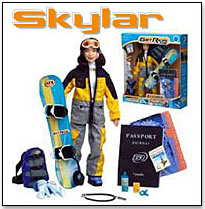
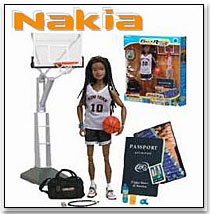
As a result, every so often “anti-Barbie”-type dolls come out. They often have more realistic body proportions and aim to provide a wider range of images of women and girls in terms of activities, dress, and/or careers. One example of this was the Get Real Girl line that came out around 2001 in the U.S. (images found here):

Here’s a description from this website:

While other dolls teeter on feet formed for high-heels, Get Real Girls stand on their own two feet, have posable, fully-articulated bodies and display physical tone and definition for full-action play. The Girls’ faces have soft natural features and are dressed in authentic sports clothing.

And yet, as with so many of these types of dolls, as far as I can tell, these were short-lived. The website is basically defunct–you can go to it, but there are no working links to the supposedly interactive features. I couldn’t find any websites currently selling the dolls.

This brings up some interesting issues, particularly the fact that what parents want their kids to want and what kids actually want often do not coincide. As I’ve discussed before, kids often have their own ideas about toys and how to play with them and may reject the non-traditional toys their parents think they ought to be crazy about. They may shy away from these toys because they aren’t like the ones their friends are playing with or that they see on TV. Or they may come up against one major problem with creating new types of dolls for girls: if they have more realistic body proportions, they don’t fit into the wide array of clothing and shoes designed for dolls with Barbie’s proportions. There’s an inertia in the toy industry because of this–new, differently-shaped dolls don’t fit the clothes and accessories kids may already own and the range of outfits available to put on them is limited because the market for them is so new and small. However, this problem can apparently be overcome, since according to this website Barbie is bigger than the Bratz dolls and so can’t really wear clothing designed for them (the site also helpfully warns against over-brushing Bratz dolls’ hair), and yet they became wildly popular (to the dismay of many parents).

I just thought these might be interesting for a discussion of the toy industry generally, efforts to provide alternatives to Barbie-type dolls, and the difficulties of doing so due to the fact that kids just might not like them.