Search results for The

This website contains links to a lot of Census Bureau maps showing where different racial and ethnic groups (including White ethnics) are concentrated in the U.S. They also have “absence of” maps showing counties with less than 25 people from different racial grops, which are fascinating. They’re all available from the Census, but it’s nice to have them all collected here for easy access and comparison.

Thanks to Kelly V. for pointing it out!

Angela B. brought our attention to an animated map showing, over the space of some seconds, the growth of Walmart across the United States from 1962 to 2007.  Below is the final image.  It’s worth a click to watch the growth yourself.

Many believe that all women involved in prostitution are desperate for rescue and that being rescued always and inevitably leads to a better life for women and their families.  Myra M. F. sent us a link to this poster, made by brothel workers in Thailand, begs for an end to attempts to rescue them. Laura Agustin, who took this picture (and blogged about it here), writes:

This poster comes from the EMPOWER centre in Chiang Mai, Thailand, where brothel workers gathered to discuss recent raids and rescue operations. On the left they have written a list of reasons why they do not wish to be rescued by police, ngo or charity workers.

The text (as transcribed by Agustin):

• We lose our savings and our belongings.
• We are locked up.
• We are interrogated by many people.
• They force us to be witnesses.
• We are held until the court case.
• We are held till deportation.
• We are forced re-training.
• We are not given compensation by anybody.
• Our family must borrow money to survive while we wait.
• Our family is in a panic.
• We are anxious for our family.
• Strangers visit our village telling people about us.
• The village and the soldiers cause our family problems.
• Our family has to pay ‘fines’ or bribes to the soldiers.
• We are sent home.
• Military abuses and no work continues at home.
• My family has a debt.
• We must find a way back to Thailand to start again.

Many activists in the U.S. similarly argue that the policing of prostitution, ostensibly to “protect” women,” serves to criminalize them (and not so much their johns) and ultimately makes their lives more difficult and dangerous than they would be otherwise. (See, for example, Call Off Your Old Tired Ethics or COYOTE.)

See also posters against the criminalization of prostitution.

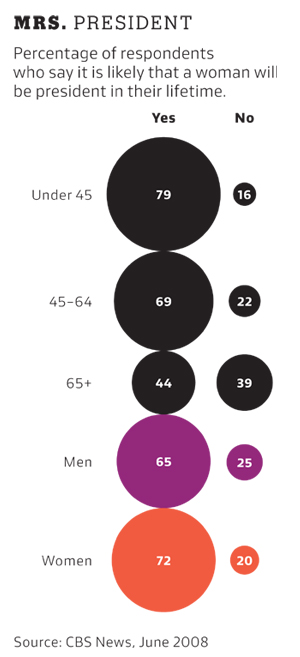
This figure, part of this New York Times story, illustrates the percentage of people (grouped by age and sex) who think that it is likely a woman will be president in their lifetime:

I’ll admit, it makes me feel like a crotchety old cynic.

American Girl Place, one of the company stores in New York City, offers fun at a price.

Pleasant Company started off with three American Girl dolls in 1986. Kirsten was from 1854, Samantha from 1904 and Mollie from 1944. The dolls came with scads of historically accurate and really expensive accessories, as well as mediocrely written stories in which they demonstrated how caring, assertive and morally sound they were. The Pleasant Company line soon exploded in popularity, resulting in its inevitable buyout by Mattel and the current proliferation of American Girls in all colors from all time periods.

Now a “premier lifestyle brand” containing books, magazines, movies [including the recent Kitt Kittredge: An American Girl], toys and clothing, American Girl the media machine markets not only products, but a host of problematic assumptions about race, class and gender. [See screencap above for expensive fun available at the New York City location of American Girl Place.] Not only were the first wave of American Girl dolls all Caucasian characters, but the entire American Girl enterprise promotes conspicuous consumption and an aspiration to upper bourgeois “gentility” composed of salon care for your doll and $33-a-head tea parties.

In an informal discussion on Slate about American Girls, commenter Nina made the following astute observation:

I like the idea of teaching kids that quality and craftsmanship matter and that investing in special items can be OK. But it doesn’t just stop at the dolls—there’s the outfits, and the furniture, and the tea parties. And that makes me a little uncomfortable. It feels too much like a patina of morality masks conspicuous consumption. It’s the kind of rationalization that makes it seem OK to spend thousands of dollars on, say, a mint-condition Eames chair.

If you have the time for an extended radio episode, you may be interested in the segment that This American Life did about the American Girl Places. [If you follow the link, you can stream this episode through your Internet connection for free.]

In the U.S. today, when infants are born with ambiguous genitalia, surgeons often operate in order to bring the child’s body into accordance with our expectations for “correct” male or female genitalia, even when the actual morphology of their bodies causes no dysfunction or harm.

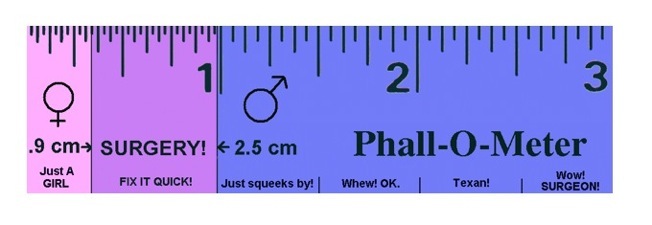
Some activists, such as those involved with the Intersex Society of North America, are trying to stop these surgeries.  The Phallo-O-Meter (found here) is a satirical ruler designed to draw attention to the way in which the surgeries force bodies existing in nature into social categories of our own invention (it is attributed to Kiira Triea here).  Here it is:

The ruler is satirical (as you can tell by the tongue-in-cheek “just squeeks by” etc.), but the measurements are based on the kind of decisions doctors actually make.  Indeed, if doctors decide that a penis is “too small” or a clitoris is “too big,” an infant is in danger of having corrective cosmetic surgery.  The point here is: When bodies don’t fit into our pre-existing notions of male and female, we will force them to, even if it involves a knife.  Clitorises that are longer than .9 cm and penises that are shorter than 2.5 must be fixed.  As Martha Coventry says in Making the Cut:

The strict division between female and male bodies and behavior is our most cherished and comforting truth.  Mess with that bedrock belief, and the ground beneath our feet starts to tremble.

In Creating Good-Looking Genitals in the Service of Gender, Suzanne Kessler found that clitorises that were seen as “too big” were often described by doctors in moral terms.  They were “defective,” “anatomic derangements,” “obtrusive,” “embarrassing,” “offensive,” and “troublesome.”

Surgery on intersex infants reflects a taboo on gender similarity; a moral objection to gender sameness.  We must be separated… by at least .6 cm.

Coal Black and de Sebben Dwarfs (found here):

In the contemporary U.S., the feminist movement has been so thoroughly intertwined with the pro-choice movement that the rhetoric of choice has become a common way to talk, more generally, about women’s liberation.  And women’s liberation, as we have demonstrated (see here, here, here, here, here, here, and here), is frequently co-opted for the purposes of selling women all sorts of products (including those in decided conflict with mainstream feminism, like this one and this one).

A reader, Tracy in Canada, saw these ads at Sears.  In them, the phrase “the right to choose” is used to invoke feminist ideals and applied to the right to select a “gift adapted to your beauty concerns.”

NEW! (Nov. ’09): Kristyn G. sent in this commercial for a cable company in India that also co-opts the right to choose…in this case, the right to choose her own husband:


Lisa Wade, PhD is an Associate Professor at Tulane University. She is the author of American Hookup, a book about college sexual culture; a textbook about gender; and a forthcoming introductory text: Terrible Magnificent Sociology. You can follow her on Twitter and Instagram.