Search results for The

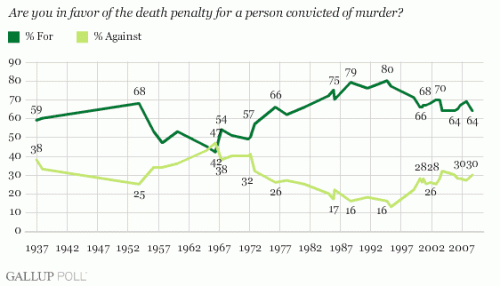
I found this graph of public support for the death penalty over time at the Gallup Poll website:
death penalty

I’m not sure what the “2828” and “3030” are at the right-hand side of the “% Against” line–perhaps they didn’t round off the %s? I looked at the specific %s given in a table and that seems to fit–that they were supposed to be 28% and 30% and somehow weren’t entered correctly.

Some other questions that were asked:

Generally speaking, do you believe the death penalty is applied fairly or unfairly in this country today?


Fairly

Unfairly

No opinion


%

%

%

2008 Oct 3-5

54

38

8

2007 Oct 4-7

57

38

5

2006 May 8-11

60

35

4

2005 May 2-5

61

35

4

2004 May 2-4

55

39

6

2003 May 5-7

60

37

3

2002 May 6-9

53

40

7

2000 Jun 23-25

51

41

8

Asked about if the person believes an innocent person has been executed in the past 5 years:


Yes, in past
five years

No, not

No
opinion

2006 May 8-11

63%

27

10

2005 May 2-5

59%

33

8

2003 May 5-7

73%

22

5

Do you feel that the death penalty acts as a deterrent to the commitment of murder, that it lowers the murder rate, or not?


Yes, does

No, does not

No opinion


%

%

%

2006 May 8-11

34

64

2

2004 May 2-4

35

62

3

1991 Jun 13-16

51

41

8

1986 Jan 10-13

61

32

7

1985 Jan 11-14

62

31

7

The answer to that last question is interesting in that it indicates people do not, in general, support the death penalty because they believe it reduces the likelihood of more murders. The most common response to why people support it is based on a retaliation/”eye for an eye” principle, not deterrance:


May
19-21,
2003

Feb
19-21,
2001

Feb
14-15,
2000

Jun.
13-16,
1991


%

%

%

%

An eye for an eye/They took a life/Fits the crime

37

48

40

40

I am in Munich for the month and last week I visited the Dachau Concentration Camp Memorial. I was struck by the difference between the tour I took here and the tour I took of the Lara Plantation just outside of New Orleans in May. Visiting Dachau put the two modes of remembrance into stark contrast. Without trying to argue that the holocaust and U.S. slavery are the same in every way, I would like to suggest that both are tragic histories that included unimaginable human suffering. Yet, the tours were very different.

I’ll start with Dachau.

The first thing that our tour guide did was impress upon us, in no uncertain terms, that Hitler was a terrible man, that the things that happened under his rule were indescribably inhumane, and that the concentration camps were death camps, pure and simple, with or without a gas chamber. In case his words were not clear enough, we took in a 22-minute video featuring photographs and narratives, all camp specific. No details, no horror, no gore was spared.

The entry gates lead to the main square in the camp where prisoners were required to congregate each morning and evening. What dominates the square today isn’t the guard towers, though they are present and meticulously reconstructed, it is the memorial by Yugoslav sculptor Glid Nandor. I had seen this sculpture in pictures before and have always found it to be one of the most impactful pieces of art I have ever seen.

The artist, who had been a prisoner in one of Hitler’s concentration camps himself, meant for the sculpture to commemorate the prisoners who had committed suicide by throwing themselves against the electrified gates of the camp. I appreciate that the sculptor makes no attempt to ease our acknowledgment of the horror and hopelessness of life in the camps.

This main memorial sculpture was one of many. There were four memorial buildings, about six monuments, the museum, and a convent that had been located on the site. And memorials are still being added. The gift shop sold books and documentaries.

My impression was that the Germans took this deadly seriously and I was impressed by the way that the Germans are handling their national tragedy. They seem fully committed to owning this tragedy so as to never ever allow anything like it to happen anywhere again. Never did the guide try to sugarcoat the holocaust, minimize the tragedy, or put anything into a measured perspective.

All of this may seem unremarkable. We’ve all heard that Hitler and his concentration camps were bad before. Hitler is, no less, synonymous with evil. Accordingly, it may seem to you that it could not be otherwise; it may seem that this tour of the Dachau concentration camp was the only possible tour that could exist.

Let’s turn to the Lara Plantation tour. The main story in this tour was about the glamorous lives of Lara (the strong-willed female head of the plantation) and her family members. Plantation life was romanticized: strong women, dueling men, wine collections, expensive furniture, distinguished visitors, breeze basking and mint julep drinking, and an ever-expanding fortune.

The plantation was done up to look gorgeous:

CIMG0260

I would guess that about 15-20 percent of the tour was spent on slave life. They showed us some documents listing the slave “inventory” at its peak, they talked about laws regarding slaves and how they differed from laws elsewhere in the U.S., they revealed that the Br’er Rabbit stories were originally collected from slaves there, they discussed the extent of the sugarcane fields, and they allowed us to walk through this reconstructed two-family cabin (mentioning that slaves were allowed to have gardens):

CIMG0274

In contrast to the almost obscene documentation of the abuse and murder of concentration camp prisoners, this was the only image of a slave that I saw during the entire tour:

CIMG0272

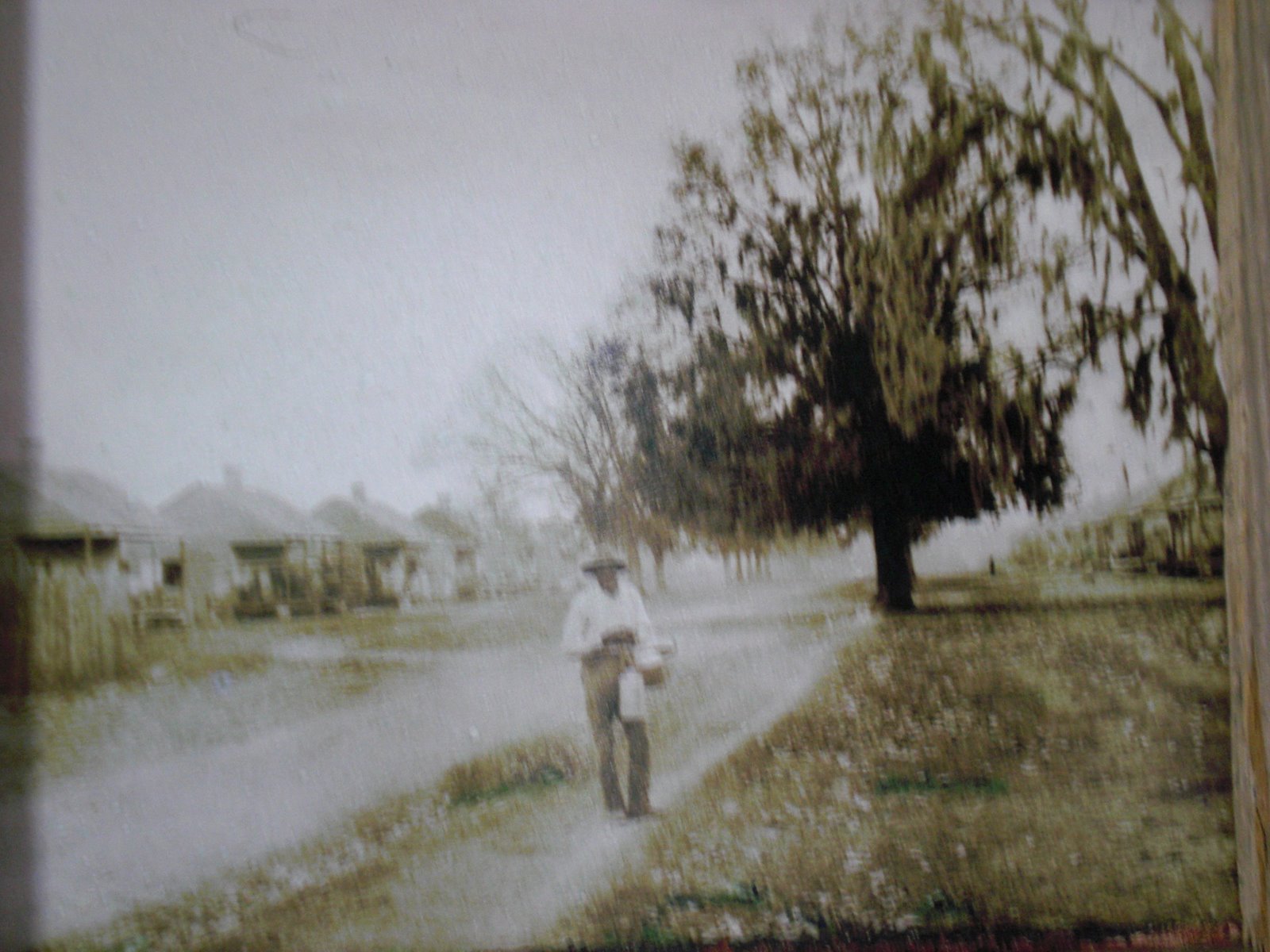
The image shows one slave and the two rows of slave cabins reaching back into the sugar cane from the year behind the main house. You can compare the reconstructed cabin with those in the image. It’s hard to say, but I’m not sure I see cute picket fences and gardens.

Here are some things that were not included in the tour: extended discussions of the health of slaves, their physical and emotional abuse, the breeding programs, rape, their punishing labor, the destruction of their families, the age at which slaves began to work, and all of the other indescribably inhumane things about human slavery.

The gift shop sold jam and honey, CDs, yummy smelling candles, candy bars, New Orleans hot sauces, dried alligator heads, little angels made out of picked cotton… and Lara’s memoirs.

The contrast with the Dachau tour was nothing short of stunning.

Could the Lara Plantation do a tour that mirrored that of Dachau? Absolutely.
Should they do that tour? Absolutely.

Plantations were many other things, but they were also the engine of slavery.  It is this that should stand out as the most important thing about them. Concentration camps were many other things as well (e.g., a military training site, a daily job site for German soldiers, a factory producing goods, and a strategic part of the war effort), but we have absorbed the important lessons from them so thoroughly that it is difficult to even imagine what an alternative tour might look like. In contrast, one can visit the Lara Plantation and come away not really thinking about slavery at all, in favor of how pretty the china was and oooh did you smell that candle as we walked by? Delicious. I need a coke, you?

A lot of Americans, when Germany is mentioned, express disbelief that a people could live with a history like the holocaust. But Americans do live with a history like the holocaust, we just like to pretend it never happened. While Germany is processing its participation in a human rights tragedy, the U.S. is denying its own; while Germany is confronting its own ugly history for the betterment of the world, we are busy preserving the myth of U.S. moral superiority.

The plantation pictures are mine and the Dachau pictures are borrowed from here and here.

—————————

Lisa Wade is a professor of sociology at Occidental College. You can follow her on Twitter and Facebook.

Lisa Wade, PhD is an Associate Professor at Tulane University. She is the author of American Hookup, a book about college sexual culture; a textbook about gender; and a forthcoming introductory text: Terrible Magnificent Sociology. You can follow her on Twitter and Instagram.


The Texas Board of Education is currently holding hearings about textbook standards and changes they want publishers to make for their texts to be adopted. Texas and California have great influence over what textbooks contain since they are such enormous markets; while the standards are only specific to each of them, very similar (or identical) versions of the texts are then sold to other states as well.

Here is a clip of standards advisor Don McLeroy explaining that textbooks should recognize the fact that women and racial minorities got more liberties because the majority gave it to them (from TPM):

Technically, he is exactly right: it did take a majority of votes in Congress to pass the Civil Rights Act, and the majority then (and now) was White (men). But to say that the majority did it “for the minority” erases an awful lot of struggle and organizing on the part of disadvantaged groups, as well as the foot-dragging and opposition so many members of the majority engaged in to try to prevent such changes. Before men “passed it for the women,” both women and men worked for decades to get women the vote, often being harassed and even jailed as a result. But to hear him describe it, you’d think the majority just happily passed these types of bills, with maybe just a tiny bit of prodding from minorities.

Here’s a clip of Barbara Cargill explaining that we need to take “negative” elements of American history out of textbooks and focus more on “American exceptionalism”:

Her opposition to the idea that the U.S. ever used “propaganda” is somewhat undermined by her blatant effort to rewrite history texts to be what, if it happened in another nation, we’d call propaganda.

Amber W. let us know about the “Consuming Kids” video, which looks at how marketers target kids, both for their own spending power and for their influence over parents’ spending.

See also hyper-consumerism and parenting, girl culture, girls’ shirts encourage materialism, “born to shop” pacifier, kids and their stuff, good parenting through consumption, and more commodification of kids and parenting.

Gwen Sharp is an associate professor of sociology at Nevada State College. You can follow her on Twitter at @gwensharpnv.

Brian Safi offers a fun tripartite typology of (mostly) gay men in advertising: (1) homoeroticism as simultaneously hilarious and disgusting in ads aimed at straight men, (2) coded gay cues in ads aimed at a general market, and (3) parallel ads, differing only slightly from each other, playing in straight and gay media. The second set of ads = especially hilarious. Enjoy.

—————————

Lisa Wade is a professor of sociology at Occidental College. You can follow her on Twitter and Facebook.

Lisa Wade, PhD is an Associate Professor at Tulane University. She is the author of American Hookup, a book about college sexual culture; a textbook about gender; and a forthcoming introductory text: Terrible Magnificent Sociology. You can follow her on Twitter and Instagram.

tarte-naturally-gorgeous

Tarte is a products sold by Sephora, which has a whole line of “naturally gorgeous” brands:

Picture1

Naturally gorgeous could mean two things, I suppose:

1.  You are gorgeous without make-up.

LOL… moving on:

2.  Our make-up is natural.

This is what Sephora means.  But if you use their “naturally gorgeous” products, will your gorgeous be natural?  Not necessarily.  As Audrey at Triple Pundit points out, the USDA does not regulate cosmetics, and neither does any other governmental agency.  They can apply the word “natural” to any product because no entity ensures that the word actually means anything.

Audrey continues:

According to their website, their natural products are “formulated with high concentrations of plant-based and naturally-derived ingredients, and fewer to no parabens, sodium lauryl sulfate, phthalates, petrochemicals, and synthetic fragrances or dyes.” And the products in their organic section contain over 70% organic ingredients.

So Sephora says they’re natural.  The Environmental Working Group however, an organization with a wholly different agenda, says that products that Sephora labels natural–such as Tarte, Caudalie, Decleor, and Korres Natural Products–present a moderate to high toxin hazard.

I think this is a really nice example of how difficult it can be to figure out what’s true.  First, language is tricky and it’s used to trick us.  Second, we can’t trust corporations (we just can’t).  They say that they have our best interests in mind, but they do not.  Third, other entities also have agendas.  The Environmental Working Group is a non-profit organization, but it too has an agenda.  Audrey points out that if there is a make-up that doesn’t get labeled as toxic by the Environmental Working Group, she has yet to figure out what it is.

So how do we know?  More problematically, how do we know when there is a question like this to be asked of every single product and service we could buy?  Because even if we had time to do the real research to figure out the answer to the cosmetics question, no one has time to do the research to figure out the answers to all the questions.  And while there are website designed to tell you the answers (like the Environmental Working Group or this one on eco-labels), we still have to look more closely at them in order to know whether their answers are good.  So the work in finding the truth isn’t alleviated, it’s just one step removed.

See also this post on the framing of genetically-modified food by activists and this post on what “organic” looks like.

(Image via.)

—————————

Lisa Wade is a professor of sociology at Occidental College. You can follow her on Twitter and Facebook.

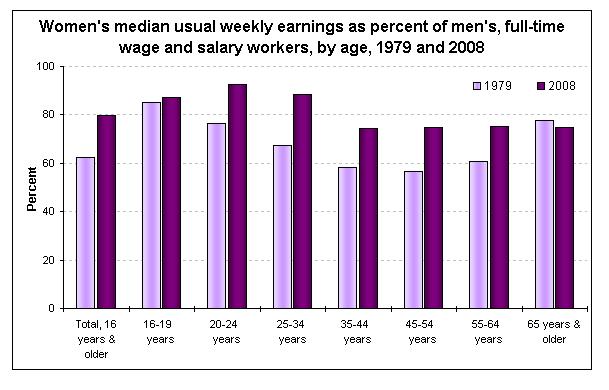
The figure below, borrowed from U.S. News and World Report, shows that the wage gap between women and men, for nearly all age groups, has narrowed significantly between 1979 and 2008.  It also shows that the wage gap is smallest for men and women aged 20-24, grows for men and women aged 25-34, grows even further for men and women aged 35-44, and remains steady after that.

wagegap

These data are for men and women in the same jobs working full time.  So what would explain this change?  Sociologists have found that much of the growth in the wage gap over the life course is due to the fact that women are held disproportionately responsible for childcare and housework (see some data here).  As men and women start to have children, women (whether by choice or necessity) find themselves sacrificing their careers more so than men.  On the flip side, mothers are discriminated against by employers more often than fathers and women without children. (See, for example, this clip of Gov. Rendell commenting that Janet Napolitano is a good candidate for secretary of Homeland Security because she has no family.) That’s why you see the wage gap increasing during prime childbearing years (25-44), but not afterward.

For more on the wage gap, see our posts on the wage gap for college grads, comparing different kinds of wage gaps, the role of job segregation, gender and the wage gap in different professions.

—————————

Lisa Wade is a professor of sociology at Occidental College. You can follow her on Twitter and Facebook.

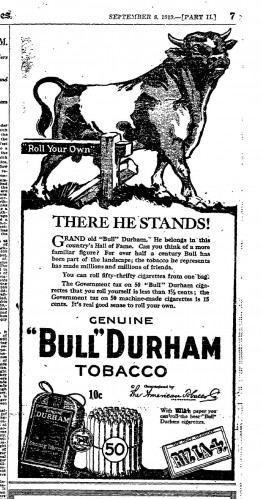
My friend Larry, of The Daily Mirror, found some awesome old ads for Bull Durham tobacco. Here’s the original, with both a map of North America on his side and a scrotum that is partially obscured by still clearly present:

steer durham

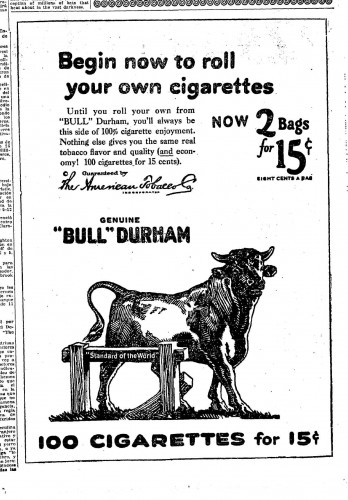
Here’s the version that ran from 1919-1924. Notice the difference?

1924_0323_bull_durham

No more shocking reproductive organs! Also, he doesn’t have a map of North America on his side any more. As Larry says, clearly a subversive plot to try to symbolically emasculate the U.S., probably so the socialists could take over.

I do wonder what was going on during that particular time period that would make marketers at Bull Durham believe that a less anatomically correct version was necessary. Any thoughts (other than it being a subversive plot)?

More recently we saw men’s nipples airbrushed out of a Wrestle Mania billboard. On the other hand, testicles were added to a statue of Civil War General John H. Morgan sitting in his favorite horse, Bess…who, as you might have surmised, wasn’t a male horse and did not have testicles. But, you know, testicles made her look more appropriate for a military figure to ride.