Search results for The

Filibustering in the U.S. Senate (preventing a vote on a bill with continuous speech–or at least the threat of it, since often now a Senator just has to state that s/he intends to filibuster; if there aren’t 60 Senators to vote for cloture, they often just pretend the filibuster happened without making a person actually do it)–has been increasing over time:
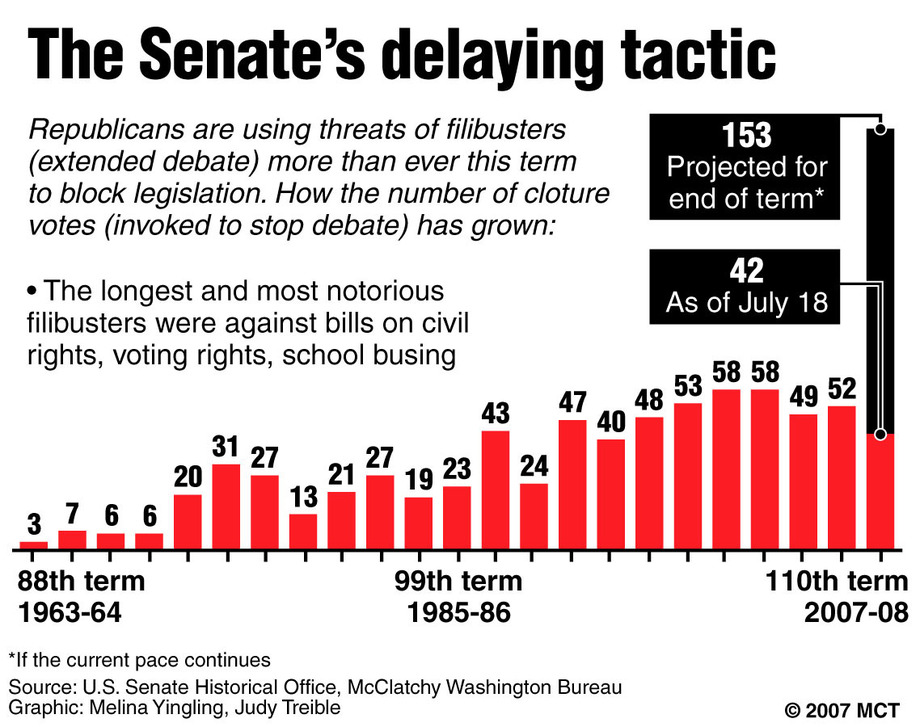
654-20070720-FILIBUSTERS_large_prod_affiliate_91

Why? Greg Koger at the Monkey Cage has a fascinating explanation (via Matthew Yglesias):

So why did the Senate change? The stock answer is that the chamber’s responsibilities grew with the size and scope of the federal government, so it became more costly to sit around watching obstructionists kill time. There is some truth in that explanation. Also, however, senators’ work habits changed. The introduction of railroads, cars, and (especially) air travel made sitting around in the Senate chamber so…boring. Tedious. Totally lame. During the mid-20th century, the Senate increasingly became a Tuesday-Thursday club, and individual senators began insisting that major legislation be kept from the floor to accomodate their travel schedules. A serious attrition effort would mean cancelled speeches in Manhattan and Chicago, no trips to the Delaware coast, and waiting longer to return to the ranch back in Texas.

—————————

Lisa Wade is a professor of sociology at Occidental College. You can follow her on Twitter and Facebook.
Miz Belle sent us a set of photos from the September issue (#106) of Numéro, a fashion magazine. The fashion spread, titled “Best Friends” (I found at least one post online saying the two models are, in fact, good friends) features a White woman in at least enough clothing to cover her lady bits posed next to a Black woman whose breasts are on display as she is either entirely or partially naked.

These aren’t even vaguely safe for work.

more...

Ever since it occurred to me a few years ago, I’ve been deeply disturbed the two meanings that the word “fuck” has in U.S. culture.  We use the word when we want to hurt someone really, really bad; and we use it to describe what may be the most physically intimate thing two people can do together.  The fact that the word has that double meaning, I think, speaks volumes about our fucked up relationship with sex.

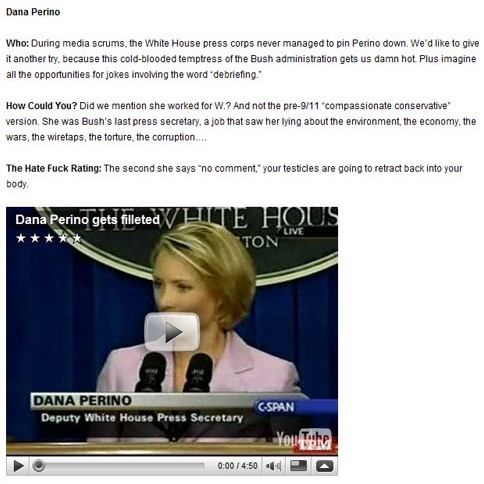
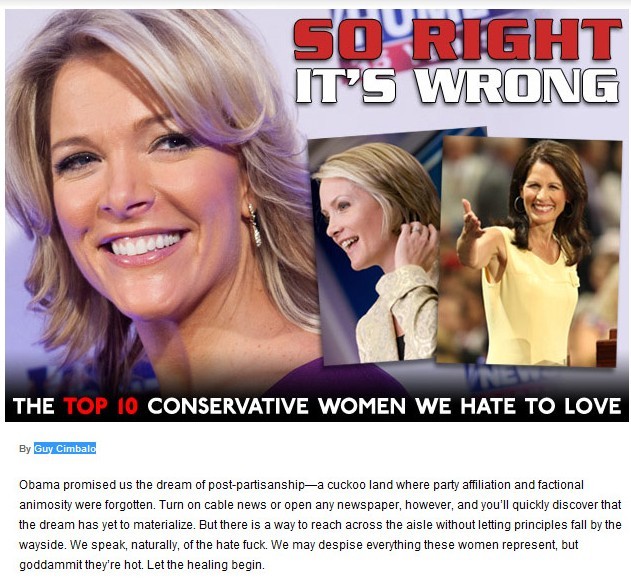
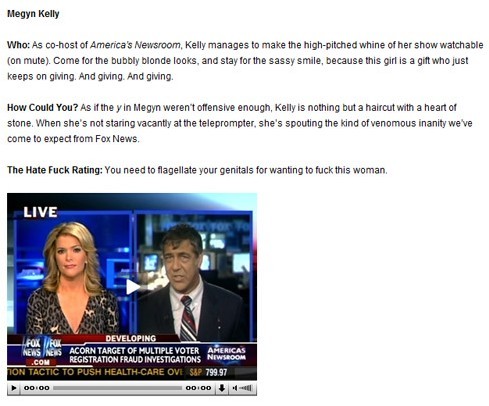
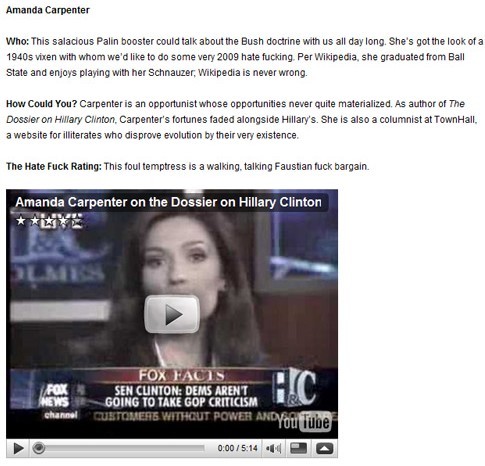
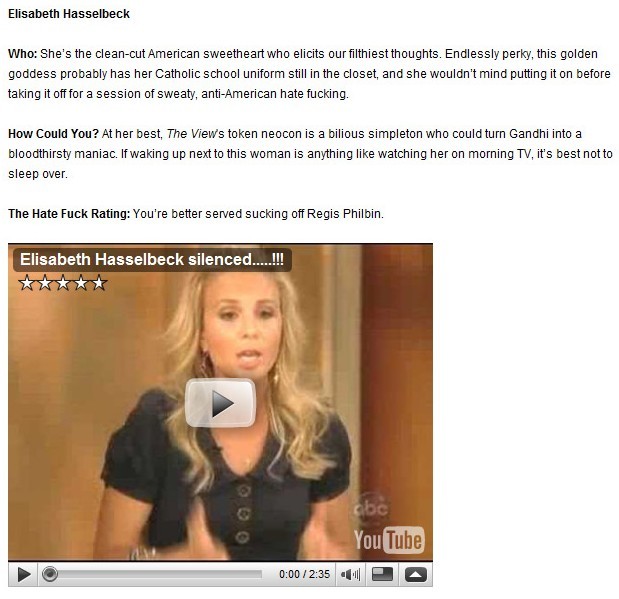
Illustrating this, Caroline H. pointed me to a June 2009 Playboy slideshow of politically conservative women that readers want to “hate fuck.”  After protests, Playboy took the slideshow down, but RedState captured screen shots. You can see them all here. I post a selection below.

The first slide:

playboy-1


Megyn Kelly:

playboy-3-500

Amanda Carpenter:

playboy-5-500

Elisabeth Hasselbeck:

playboy-6

Dana Perino:

playboy-7-500

—————————

Lisa Wade is a professor of sociology at Occidental College. You can follow her on Twitter and Facebook.
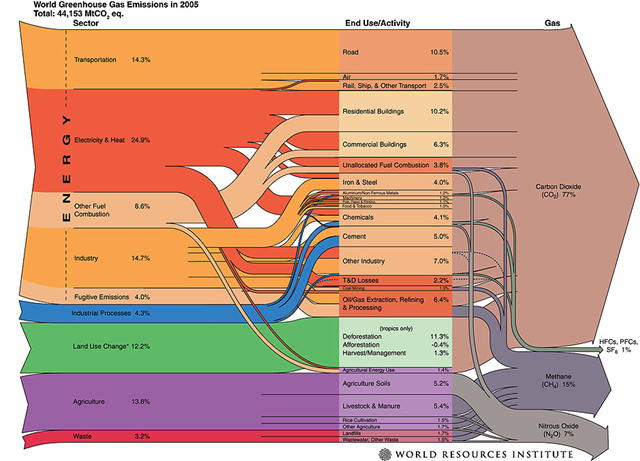
The graphic below is interesting to me in light of the discourse about greenhouse gas emissions.  We often hear about emissions from cars and sometimes about emissions from industry.  I was surprised, then, to see that electricity and heat was such a large contributor to carbon dioxide emissions.  And I feel like land use change and agriculture hardly get discussed at all.

Picture2

Graphic borrowed from ChartPorn, which also has an interactive graphic that breaks down emissions by country (via Simoleon Sense).

—————————

Lisa Wade is a professor of sociology at Occidental College. You can follow her on Twitter and Facebook.
Time magazine offers readers a history of the bikini in which they offer these two interesting tidbits:

First, the two piece bathing suit was, in part, justified/necessitated by war rationing during World War II. There simply wasn’t enough money to buy all that fabric.

Second, the bikini got it’s name from the oooh and awe resulting from a nuclear test at Bikini Atoll. Louis Réard, to whom the invention of the bikini is credited, followed the nuclear-loving fashion of the day.  He named it after the location, hoping that “his invention would be as explosive as that test…”

Lisa Wade, PhD is an Associate Professor at Tulane University. She is the author of American Hookup, a book about college sexual culture; a textbook about gender; and a forthcoming introductory text: Terrible Magnificent Sociology. You can follow her on Twitter and Instagram.

Critics of multiculturalism argue that, far too often, multiculturalism ignores addressing head on the tension caused by racial and ethnic inequality, in favor of cute, simple tokens of diversity.

Jessica G. sent us this screen shot of the Juicy Juice website. It is suggesting that we can teach our children about “diversity… by preparing ethnic meals.”

Capture

In the bottom left corner, it reads:

Tacos can take you to the Mayan pyramids of Mexico! Baked Ziti to the Tower of Pisa in Italy! Help your child discover the world through a meal you make together.

Don’t get me wrong: I don’t think there is anything wrong with teaching a child about Mayan pyramids and the Tower of Pisa. It is, however, going too far to suggest that you can teach children about the promise and perils of “diversity” by instituting “dinner without borders.”

—————————

Lisa Wade is a professor of sociology at Occidental College. You can follow her on Twitter and Facebook.
As you may know, Disney has a movie coming out later this year called “The Princess and the Frog,” a retelling of the story of the princess who kisses a frog that then helpfully turns into a handsome prince for her to marry. The noteworthy aspect of this film, aimed at a mainstream audience, is that the female protagonist is African American. We’ve seen Disney films with non-White protagonists before–“Mulan” and “Pocahontas,” for instance–but to my knowledge there haven’t been any with a Black main character, unless I guess you count the Uncle Remus stuff, and that’s just a whole lot of ick.

While many people have eagerly awaited “The Princess and the Frog,” Disney’s long history of negative or stereotypical portrayals of non-White characters (i.e., “Fantasia“) meant many were concerned about what the final product might be, expressing concerns based on the trailer and other promotional materials that have emerged so far. Margaret Lyons at EW.com says,

Disney’s track record with racism and racist caricature makes me a little nervous when I see stuff like that toothless firefly.

According to Jezebel, “…Tiana was originally a maid named Maddy (to0 close to mammy?)…” And Leontine says,

…based on this trailer, the other things that Black people get to do are voodoo shit, playing jazz and dancing, and making jokes about their butts.  Charming.

For the record, the protagonist is only African American for part of the movie; for a good chunk of it she’s a green frog. But then, doesn’t the princess turn into an ogre in at least some of the “Shrek” movies? I can’t quite recall.

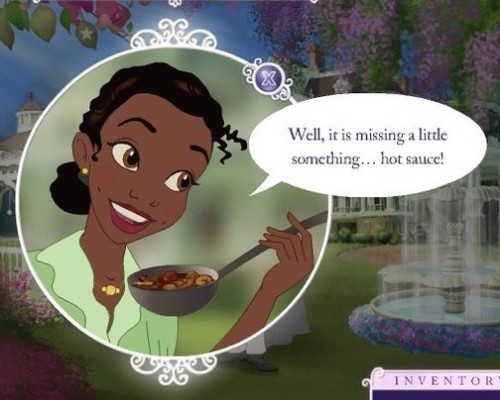
The movie website has a video game. In the game (from io9),

…Tiana, is sent on a mission to retrieve the rich white girl’s tiara, so she can borrow it, but along the way she’s asked to fetch some hot sauce for the gumbo before she has permission to get to the rich girl’s bedroom.

A screenshot of the hot sauce part:

504x_hotsauce

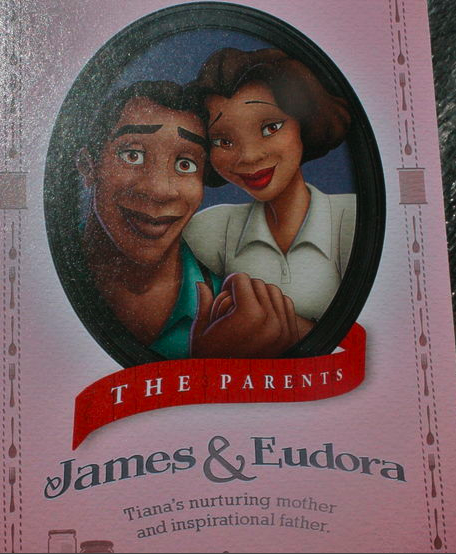
Rebekah R. pointed out a deck of promotional cards handed out at Comic-Con (also at io9). There are some interesting gender and racial elements. Here are Tiana’s parents; note that her mother is “nurturing” while her father is “inspirational”:

Picture 1

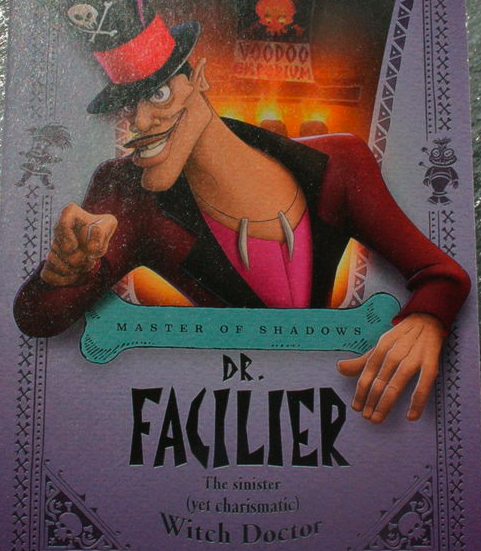
Dr. Facilier is a “witch doctor,” practices voodoo, and looks a bit like cartoonish images of pimps I’ve seen now and then:

Picture 2

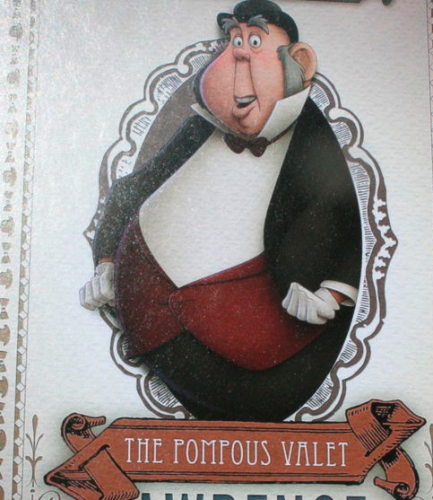
I did notice that the valet (is that the same as a butler?) for the prince is White rather than Black:

Picture 3

The text for one of the cards says “It’s not in yo’ cards”:

Picture 4

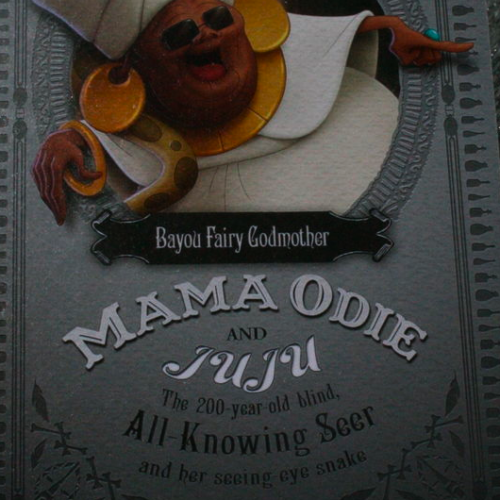
Here’s Mama Odie, the godmother figure, is a “seer” with a snake:

Picture 5

These images and objections are interesting by themselves, but they also bring up some of the difficulties in portraying groups that have historically been stereotyped negatively and occupied a subordinate social status. For instance, the fact that Tiana was originally going to be a maid wouldn’t, on the surface, necessarily be that different from “Cinderella,” in which the (White) protagonist is basically a maid. And there’s nothing wrong with playing jazz or, for that matter, practicing voodoo (which could be seen as very similar to the magic that is so common in kids’ films).

But of course, an image of a Black woman as a maid carries different connotations than that of a White woman doing the same job. There have certainly been large numbers of White maids  in the U.S. as well as other countries; in the late 1800s many female Irish immigrants to the U.S. took jobs as domestic servants. But they fairly quickly transitioned, as a group, into other types of work. African American women were stuck with jobs as maids a lot longer because of job discrimination. The “Mammy” figure, a happy-go-lucky servant pleased to take care of the White family she worked for, was applied exclusively to Black women.

Depicting Cinderella as a maid doesn’t play into pre-existing stereotypes of White women; it’s just an individual portrayal. A Black character cast as a maid, to many people, reproduces an image of Black women that goes beyond the individual–whether the creators intend to or not, such images bring with them associations to the Mammy character and real oppression of African American women in a culture that saw them primarily as servants for more privileged groups.

Disney may have intentionally tapped into those cultural images when Tiana was originally imagined as a maid for a White character (as well as including other stereotypical elements). Or the creators may have unthinkingly reproduced stereotypes because, when thinking about characters to use in a movie set in New Orleans with a Black protagonist, they drew on existing cultural imagery. In the absence of a concerted, thoughtful effort to avoid reproducing them, it’s not surprising that problematic elements show up in TV shows, movies, and so on.

Anyway, this should be an interesting situation to watch unfold when the movie is finally released.

UPDATE: Commenter John Lewis says,

This movie’s worth analyzing, but Gwen’s commentary here is not among the most insightful I’ve read on this blog. From my viewing of the trailer, without knowing much else about the film, I think she’s really reaching.

I don’t know that I’m “reaching,” exactly–we know quite a bit of other stuff about the film, such as the fact that Disney originally had Tiana cast as a maid, and that many people who want this to be a good film are very frightened about how it might turn out, which I think is fascinating in and of itself–but he’s right about it not being the best commentary ever. Meh. It’s free content, people, and this is the first week of classes. My brain works better at putting together a coherent argument some days than others. Taking the post down b/c it’s not my best, or b/c people say I’m off-base, seems sort of intellectually dishonest, like I’m trying to hide anything that gets criticized, so I guess I’ll just leave it up and people can read the critical comments.

And in my defense, it also turns out Disney has recut the trailer and some of the scenes that were in it when I first started writing up some commentary aren’t in it any more. I didn’t realize when I found a link to the trailer after the original link disappeared that it had been changed to leave out some things I found odd in the first one.

See also this post that includes a discussion of concerns that the movie “Up” wouldn’t be popular because it had an Asian lead character as well as our post on gender in Pixar films, gender roles in “Bee Movie,”

Gwen Sharp is an associate professor of sociology at Nevada State College. You can follow her on Twitter at @gwensharpnv.

Reading Resist Racism, I found a link to an article in this Sunday’s Washington Post by a journalist by the name of Amit Paley who chronicled her exploration of “tribes” in Thailand.  The article is a study in class privilege, with a global twist.  It begins with the sentence: “You can see almost anything in the world if you pay enough.”

She wanted to see women of the Padaung (or Kayan), who are from Burma but now live in Thailand as refugees.  The Kayan women are famous for wearing brass rings around their necks, leading to the illusion of an elongated neck created by the depression of their collarbone. Paley writes:

Ever since I glimpsed the Padaung as a child in my grandfather’s National Geographics, I had wanted to see these curious women, who suffer painful disfigurement to emerge as graceful beauties.

Her description of human beings, indirectly, as curiosities, combined with the comment that you can see “anything… if you pay enough” (my emphasis) is an excellent example of the objectification of ethnic others.

Paley’s desire to see these women is almost thwarted by the majority of tourist companies in Thailand who describe her effort as exploitative and immoral.  They even suggest that the women are “prisoners held captive in the villages by businessmen” making money off of tourism.  This is confirmed by Wikipedia, for what it’s worth.

This doesn’t stop Paley, who keeps asking until she finds a company that will take her to one of the remote villages in which Kayan women live.

The women she meets confirm that they wear traditional garb, continue traditional practices (such as the brass rings), and are even forced to remain in the villages, in order to attract tourists.  Men, largely, appear to be exempted from earning their keep in this way.

Paley says that one powerful male village member said that the women “must wear the dress because of tradition” and “spoke excitedly about its appeal to tourists and noted that half of the village’s income of $30,000 a year comes from tourism.”

A woman in brass rings told her “We do it to put on a show for the foreigners and tourists!”

Paley finishes with this lackluster reflection:

So is it unethical to visit the long-necked women? It is clearly true that money spent to visit them supports an artificial village from which they essentially cannot leave. On the other hand, many of them appeared to prefer living in virtual confinement as long as they are paid and safe. According to what they told me, their situation beats the alternative of living in a repressive country plagued by abject poverty and hunger.

I don’t feel guilty about visiting the Padaung, but my feelings might be different if I had traveled solely as a tourist rather than as a journalist. And I certainly don’t like their lot in life:  Shouldn’t everyone have the freedom to live and travel wherever they want?

Well, Paley has shown that she certainly does have that freedom.  And she is apparently willing to use her “journalist” identity to justify just about any advantage that her privilege affords her.


Lisa Wade, PhD is an Associate Professor at Tulane University. She is the author of American Hookup, a book about college sexual culture; a textbook about gender; and a forthcoming introductory text: Terrible Magnificent Sociology. You can follow her on Twitter and Instagram.