
Flashback Friday.
This is a picture of a statue in Lexington, KY, in honor of Civil War general John H. Morgan. It depicts him on his favorite horse, Black Bess. The inscription is “Gen. John H. Morgan and His Bess.”
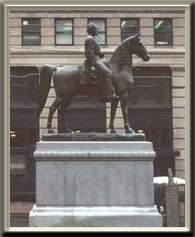
Here’s what’s interesting about this: Bess, as you might guess, was a mare — a female horse. The statue, however, has testicles. You can see them in the picture below. The sculptor gave Bess testicles because he considered a mare an unworthy mount for a general — despite the fact that Morgan himself seemed to think she was just fine.
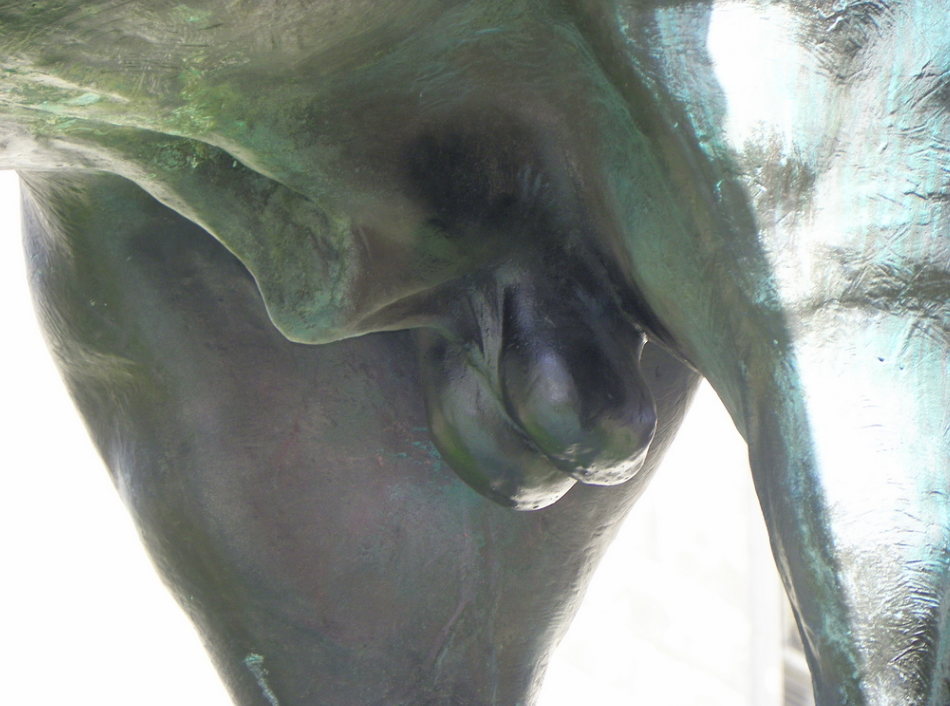
Flickr Creative Commons License, J Stephen Conn
I found out about this in Lies Across America: What Our Historical Sites Get Wrong by James W. Loewen. Top image borrowed from here. This post originally appeared in 2007.
Gwen Sharp is an associate professor of sociology at Nevada State College. You can follow her on Twitter at @gwensharpnv.
Comments 24
Jess — January 26, 2009
That is hilarious. How ridiculous are we as a society when our rigid, distorted gender identities come to define animals? Or rather - likenesses of historical animals...
A — August 8, 2009
Horses are portrayed "rearing up" only when the rider has died in battle; I'm assuming General Morgan did not, and that's why Bess is on all fours.
But the testicle thing is pretty ridiculous.
Sarah — December 13, 2009
I think this can go into the category of "silly", when you get down to it.
Mike — March 2, 2010
Maybe the sculpter is gay?
Mike — March 2, 2010
Or he just felt like playing with balls and sculpting them?
Mike — March 2, 2010
Maybe the horse was a maphradite?
MXvi — April 25, 2014
"The sculptor gave Bess testicles because he considered a mare an unworthy mount for a general"
How do you know that? Maybe it was a plain old mistake.
Corey Lee Wrenn — April 25, 2014
Another interesting fact...this piece was commissioned by the Daughters of the Confederacy, which speaks to the fact that gender and male supremacy is something that is enacted and upheld by men and women alike.
Andrew — April 25, 2014
I would guess that the artist put the testicles on the horse because it would have been considered too provocative to put them directly onto General Morgan. But the message is loud and clear.
It's not unheard of for celebrated and mythical figures to be depicted nude in sculpture in other countries, and not just in the antiquities. I spotted a modern nude sculpture of Simon Bolivar riding a horse (not sure if the horse was male) in Colombia, and wondered if we'll ever be treated to a nude George Washington in the US.
By the way, does the horse have a penis too, or would that be too literal?
Bill R — April 25, 2014
I think you're starting to run out of material...
NancyP — April 25, 2014
Too funny. I can attest to the PITA-ness of intact stallions as ordinary riding horses when in the presence of other horses (as would be the case on a battlefield). One has to keep them in check, otherwise they spend a fair amount of time trying to sniff other horses' butts (pheromones) looking for mares in heat. This tendency would be annoying if one was just trying to sit on the horse and use a pocket telescope to view distant troop action, keep one's mind on the battle, make decisions. Mares are only intermittently annoying as ordinary riding horses, when they go into heat. Out of heat, they can be perfectly non-distractable and thus suitable for an easy riding horse in a chaotic environment with lots of other horses around. The other reliable no-fuss horse for the situation would be a gelding.
echomrg — April 28, 2014
there's something weird with the comments here: the post reads it's from 3 days ago (25/04/2014) and most of the comments were made on the same date but a few report 4/5 years ago as publishing date...
TexaCali — May 4, 2014
If it weren't for those ball, generations of UK undergraduates would have nothing else to paint red.
Bill A. Penn — March 31, 2023
A fact seldom mentioned is that Morgan lost Black Bess at the Battle of Stones River in December 1862, according to his biographer, James A. Ramage: "There was no time to save her, and Morgan would never see her again." So he rode other horses in 1864 up to his death that September. Could they have been stallions?