Search results for The

U.S. tobacco companies–through political donations, lobbying efforts, and networks–are able to exert some control over the degree to which, and how, the U.S. government controls its industry.  One area of resistance involves warning labels.  The tobacco company has been resisting the very idea that cigarettes cause cancer, and the advertising of this fact, for decades.

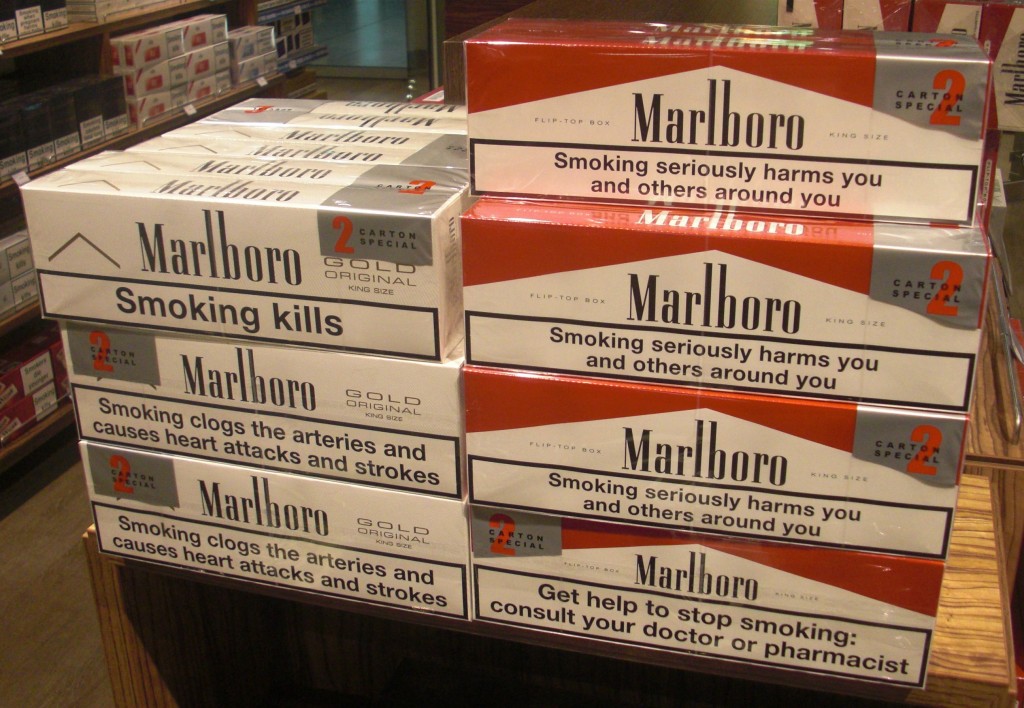
This photo of cigarettes on sale at a duty free shop in Düsseldorf, Germany, sent in by Steve W., gives us some perspective on just how successful they’ve been:
CIMG4252

Here, for comparison, is a photo of cartons of Marlboro’s on sale in Texas:
doc49fd157246239836939343

In case you can’t read it, the large text above the “Marlboro” logo reads: “Flip Top Box.”

—————————

Lisa Wade is a professor of sociology at Occidental College. You can follow her on Twitter and Facebook.


I love how this ad from the 1950s acknowledges how exhausting and mind-numbing housekeeping and childcare can be!

The ad also illustrates the post-WWII efforts to cultivate a market for new food technologies (easy and instant foods that were developed for the war).  This ad for Campbell’s soup describes the phenomenon in more detail.

For another vintage Jell-O ad that takes an entirely different approach, see here.

—————————

Lisa Wade is a professor of sociology at Occidental College. You can follow her on Twitter and Facebook.
According to this slide show at Slate (linked from The Color Line), the Frito Bandito was introduced as a mascot for Fritos in 1967.

10_Frito

A “cunning, clever-and sneaky” thief who loved the “cronchy” corn chips, he was targeted by the Mexican American Anti-Defamation Committee (MAADC).

Here’s the Frito Bandito in action:

[youtube]http://www.youtube.com/watch?v=FbYj7ZyqjYY[/youtube]

The Slate notes read:

So, Frito Lay ordered a makeover. An ad firm was told to tidy up the Bandito, fix his teeth, and change his expression from sinister sneer to rascally grin. His guns were holstered, too, a response to the assassination of Robert Kennedy… But the MAADC was unmoved and prompted several television affiliates to ban the Bandito. In 1971, a House subcommittee made him the star of hearings about ethnic defamation on the airwaves. It wasn’t long before Frito Lay pulled the campaign.

The campaign against Frito Bandito is a nice example of how collective action can make a difference. I imagine, also, that the time period (the late ’60s/early ’70s) had something to do with MADDC’s quick success also.

See more racial and ethnic stereotypes in marketing and in these posts: the Chinese (here, here, and here), American Indians (here and here), Black Americans (here and here), and the Irish.

—————————

Lisa Wade is a professor of sociology at Occidental College. You can follow her on Twitter and Facebook.
Lisa Wade, PhD is an Associate Professor at Tulane University. She is the author of American Hookup, a book about college sexual culture; a textbook about gender; and a forthcoming introductory text: Terrible Magnificent Sociology. You can follow her on Twitter and Instagram.

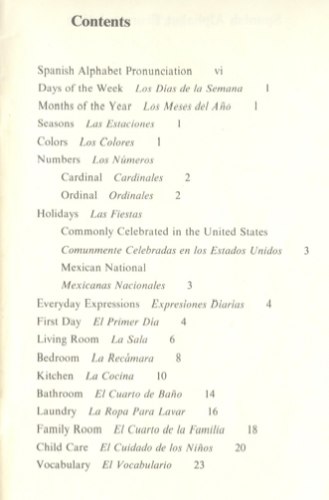
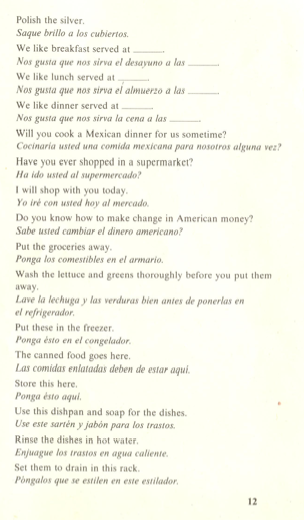
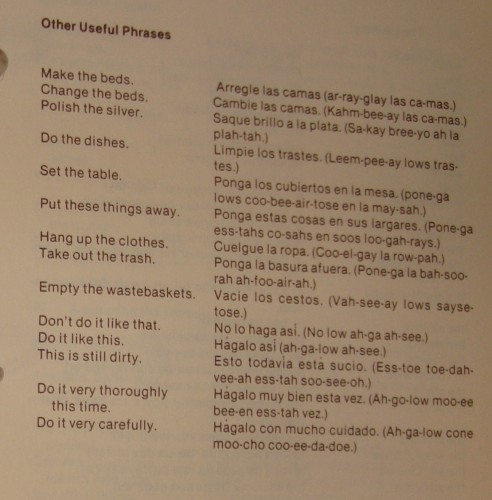
Mary M., of Cooking with the Junior League (go read it now! It’s awesome!) sent in photos she took of several pages from House Dressing, a cookbook published by the Windsor Square-Hancock Park Historical Society in 1978 (Hancock Park is a wealthy section of L.A.). The cookbook contains a section called “Kitchen Spanish,” which, as Mary says, “pretty much amounts to phrases you can use to boss around your help.” They are quite thorough, providing terms not just for cooking but for many other household tasks, and specific terms for wool vs. silk clothing. Here are images of a couple of the pages:

household spanish4

household spanish2

And here we have my favorites, “This is still dirty” and “Do it very thoroughly this time”:

household spanish3

And to think, when I first read the phrase “Kitchen Spanish” I assumed it was a geographically confused title for the Tex-Mex recipe section. Also, given that the pronunciation guides don’t include instructions on which syllable to emphasize, I can only imagine what kind of directions the employees actually received.

It made me think of the book Domestica: Immigrant Workers Cleaning and Caring in the Shadows of Affluence, by Pierrette Hondagneu-Sotelo. She discusses the tensions and conflicts that often arise between immigrant (largely Latina) housekeepers/nannies and their (mostly White and female) wealthy employers over how tasks should be done. Domestic workers generally expressed a wish to be told what to do, but not how to do it (and not watched while they worked), while employers felt they had to provide a lot of micromanagement if they wanted tasks done to their standards. Many instances where employees quit or employers fired them resulted from the conflict over this issue.

My guess would also be that many of the individuals contributing to and buying this cookbook would not be cooking anything from it themselves. The cookbook probably served as a form of symbolic domesticity for wealthy women to share recipes, while the women doing much of the actual cooking and cleaning in their households were present only implicitly as the recipients of the instructions on these pages. As Mary pointed out, something similar was probably true of all the “signature recipes” of First Ladies are often shown serving in photo ops–it seems likely that many of them had nothing to do with the preparation and may not have even supplied the recipe. Didn’t John McCain’s wife (I know, not a First Lady, but she was a hopeful) post a recipe on the campaign website that turned out to be taken from another cooking website?

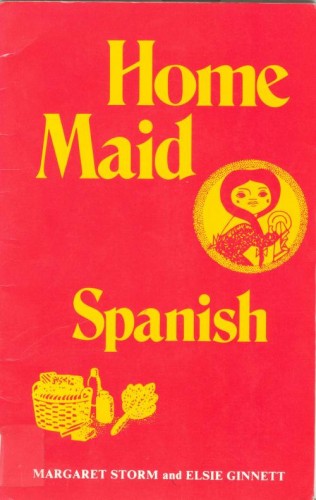
NEW! (July ’10): Jason K. sent in another example, this one published in 1976:

—————————

Lisa Wade is a professor of sociology at Occidental College. You can follow her on Twitter and Facebook.
Lisa Wade, PhD is an Associate Professor at Tulane University. She is the author of American Hookup, a book about college sexual culture; a textbook about gender; and a forthcoming introductory text: Terrible Magnificent Sociology. You can follow her on Twitter and Instagram.

As I understand it, the leisure gap between men and women has largely to do with the fact that women spend more time taking care of children and (especially) the home. I don’t know if this applies internationally or not. In any case, here’s a graphic illustrating the leisure gap across 18 different countries (via Jezebel):

leisuretime1

UPDATE: In the comments, Elena linked to the original OECD report, if you’d like to explore the methodology etc.

A big thanks to Cycles who went and looked it up.  A summary:


Chapter 2, “Special Focus: Measuring Leisure in OECD Countries,” answers most of the questions posed here about what is considered “leisure” and what is not.

Brief overview:

“The approach taken here is to divide time during the day into five main categories. These five-time categories are 1) Leisure, narrowly defined, 2) Paid work, 3) Unpaid work, 4) Personal care, and 5) Other time (uses of time which are either unaccounted for or undefined).”

and

“‘Paid work’ includes full-time and part-time jobs, breaks in the workplace, commuting to the workplace, time spent looking for work, time spent in school, commuting to and from school, and time spent in paid work at home. “Unpaid work” includes all household work (chores, cooking, cleaning, caring for children and other family and non-family members, volunteering, shopping, etc.). “Personal care” includes sleep, eating and drinking, and other household, medical, and personal services (hygiene, grooming, visits to the doctor, hairdresser etc.). “Leisure” includes hobbies, games, television viewing, computer use, recreational gardening, sports, socialising with friends and family, attending events, and so on. “Other time” includes all activities not elsewhere mentioned.”

… and then it goes into even MORE detail about specific activities within each of those five categories.

I highly recommend reading at least Chapter 2 if you have questions. It includes a fascinating backgrounder on past studies and how they categorized of time-use.

—————————

Lisa Wade is a professor of sociology at Occidental College. You can follow her on Twitter and Facebook.

This cartoon satirizes the common sitcom family that includes an average-looking, bumbling husband and a gorgeous, put-together wife. It reverses the roles to illustrate (1) how offensive these sitcoms are to men (men are useless oafs who can’t be expected to act like adult human beings) and (2) how we take for granted that hot chicks should marry useless oafs (via):

I know, it’s satire, and, if you’re a regular reader, you know how I worry about satire.  To me, this points out how stupid (and gendered) family sitcoms are.  But, for others, it might just reinforce the hateful stereotype that fat women are disgusting and useless.  The problem is that the impact of the cartoon depends on who is watching it.

—————————

Lisa Wade is a professor of sociology at Occidental College. You can follow her on Twitter and Facebook.
The Women’s Media Center has compiled a series of clips exposing the racist and sexist discourse surrounding Sotomayor’s nomination to the Supreme Court:

Via Racialicious.

—————————

Lisa Wade is a professor of sociology at Occidental College. You can follow her on Twitter and Facebook.