Cross-posted from Family Inequality.

The Congressional Budget Office has a new report on trends in the income distribution. The big news is the 1%’s blitzkrieg assault on equality.*

The headline image will be this one, which shows the changing share of after-tax-and-transfer household income. Every group except the top 1% had a smaller share of income in 2007 than they did in 1979, or just an equal share in the case of the 81st-99th percentile group. That means the gains in the top quintile are all concentrated in the top 1%.

That is very important and a source of outrage for the hundreds of thousands of Facebook users posting, commenting, or “liking” Occupy Wall St. and its related pages.

But it would be misleading to view the chart as showing that incomes fell for the other groups, since it shows shares of the total income. Income growth has been very skewed toward the top, but it is by no means confined to the top 1%. Here is my graph showing the income cutoffs for each quintile, and for the top slices separately. These are the cutoffs in 1979 and 2007 (in inflation-adjusted dollars), with the percentage change in the backgrounded bars.
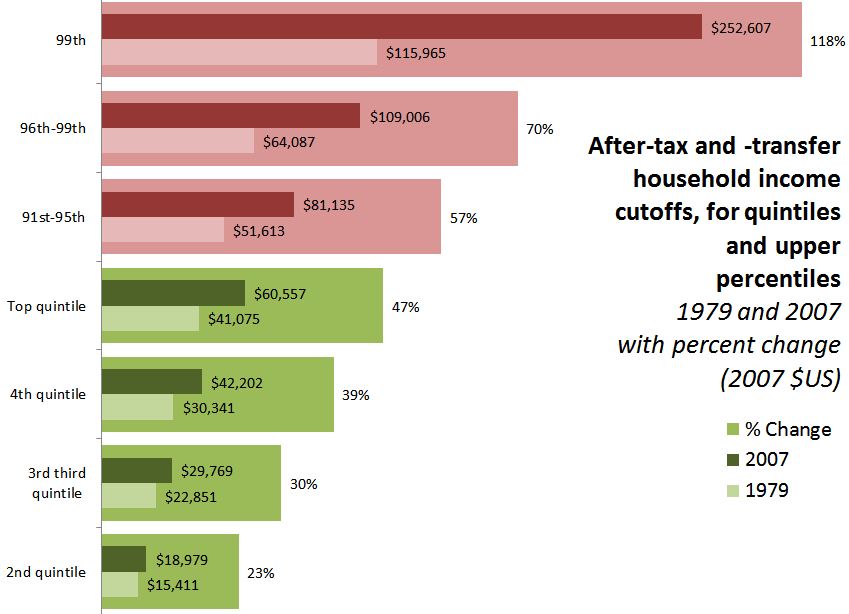
(Note there is no lower cutoff for the bottom quintile — the price of entry for that group is always $0).

Two thoughts about this.

  • Even if there were no 1%, if the graph only included the green bars, there would be plenty of increasing inequality for what might then be called “the 80%” to protest. The 81st-99th folks may be lucky to have the popular anger directed at the grotesque opulence of the sliver above them. (I’m not diminishing the extremity of the gains for the top 1%, but, as Matt Taibbi describes, the object of opposition is not just their income, but their influence.
  • If you look at the families and networks of the top 1%, how many of them have relatives, friends, and even co-“workers” who are only in the top 10%? Would a self-respecting 1% family be appalled if their son married someone from a stable 5%-er family?

What I’m wondering is whether the 1% folks are merely a statistical convenience rather than a socially cohesive group (dare I say, class?). That’s an empirical question that national income distributions can’t necessarily answer.

*I should mention that the report is not just another rehash of Census numbers, though. Two adjustments they made seem especially good. First, they used a tricky matching method to combine Current Population Survey numbers (which do better at benefits and low-income households) combined with Internal Revenue Service data (which is better for high-end data). Second, they adjusted for household size and composition, and calculated distributions before and after taxes and transfers, and among different kinds of income. The report is here, a summary is here, and the blog post version is here.
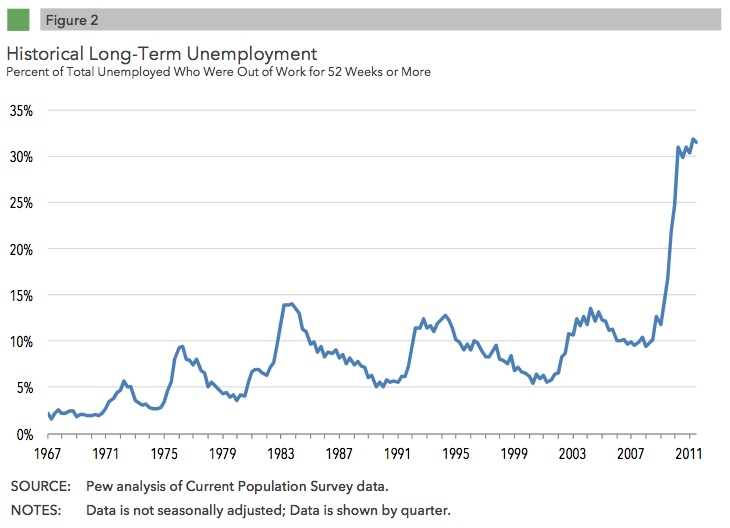
The Pew Charitable Trusts just released an update on the effects of long-term unemployment. One aspect of this economic crisis that sets it apart from others over the past several decades is how long unemployment is lasting. At this point, about a third of the unemployed have been out of a job for a full year or more:

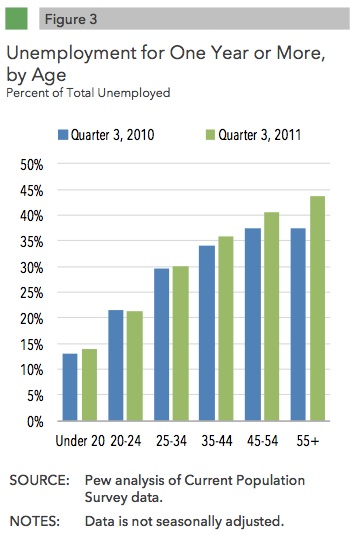
Though the likelihood of being unemployed went down with age, among those who have lost their jobs, long periods of unemployment are more common among older than younger workers:

Read the full mini-report here. Via Talking Points Memo.

Also check out Lisa’s post on the long-term consequences of unemployment.


Today cheerleading can be an incredibly athletic and risky sport. Because it is associated with women, though, and serves a sideline function for football and other male-dominated sports, cheerleading is often not considered a sport at all. Less than half of U.S. high school athletic associations define high school cheerleading as a sport and neither the U.S. Education Department or the National Collegiate Athletic Association categorize it as one.

Instead, cheerleading is frequently labeled an “activity,” akin to the chess club.  Accordingly, cheerleading remains unregulated by organizations responsible for ensuring the safety of athletes, leading to rates of injury among cheerleaders higher than even those among American football players.

A similar logic appears to be at play regarding the Lingerie Football League, 12 teams of women that play live tackle football in underwear.  Here are some highlights from a game:

So, here’s the thing.    Last month 16 of the 26 players on the Triumph, a team in Toronto, resigned over safety concerns. From a story at the Toronto Star sent in by Emily M.:

…four players described the ill-fitting hockey helmets and one-size-fits-all shoulder pads designed for young males that they had to wear.

“We would have headaches during practice… They made a hockey helmet a football helmet, and that’s not what it’s for.”

…

Sprained ankles, concussions and pulled hamstrings were among the injuries sustained by Triumph players in their first game… their team had no medical staff.

One of the players reported that, when they brought their concerns to the coach, he shrugged and said: “You know, it is what it is.”

“You know, it is what it is.”  In other words, “You’re women in underwear. It doesn’t matter what you do, you’re not really playing football.”  Ideology triumphing over reality.

Lisa Wade, PhD is an Associate Professor at Tulane University. She is the author of American Hookup, a book about college sexual culture; a textbook about gender; and a forthcoming introductory text: Terrible Magnificent Sociology. You can follow her on Twitter and Instagram.

With all the emphasis on Halloween, you may or may not have heard that this year, October 31st was noteworthy for another reason: according to the United Nations, that’s the day the global population hit 7 billion. The UN has set up a website to provide information about population trends and estimates for the future. Here’s the current world population, by region:

The map is interactive, so you can click on a region to find out its population, as well as its percentage of the total world population.

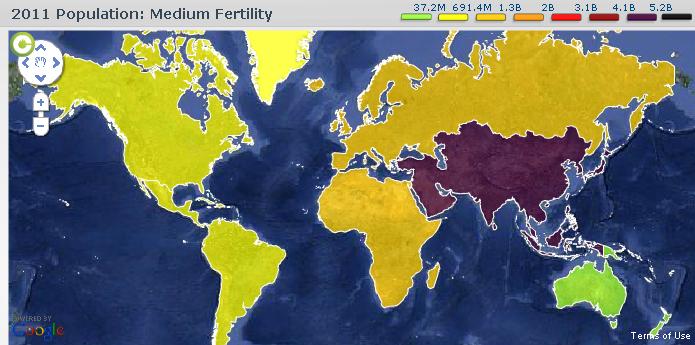
You can also estimate the population through 2100 based on various fertility scenarios. In the default medium scenario, fertility is expected to follow past trends, leveling out at a little over 10 billion by 2100:

On the other hand, if we saw no further reductions in global fertility, the 2100 population would be over 26.8 billion:

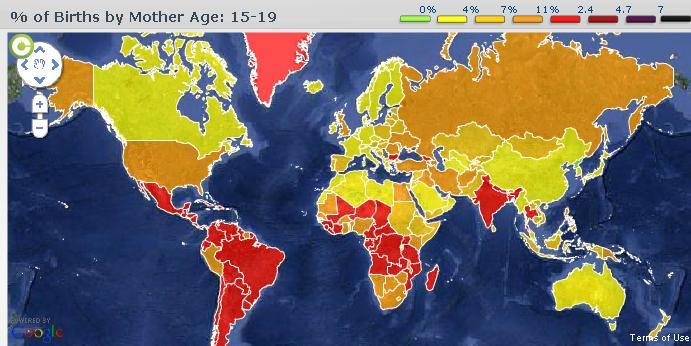
There’s an enormous amount of data available at the site. For instance, if you select the Births tab, you can click on either a region or a specific country and find out what percent of births are to women in different age groups. Here’s the % of all births to women aged 15-19, by country:

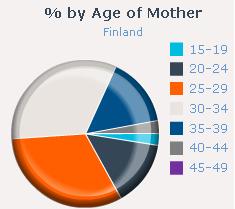
And the chart showing the total age breakdown for Finland (at the site you can hover over the graph to get the actual %):

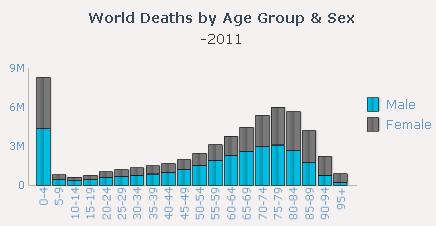
A chart of deaths by age and sex, illustrating the continued high mortality in infancy and early childhood:

There’s also a section of the site where you can enter information about your own date and place of birth and then get a snapshot of what the global population was when you were born. Since I entered the world:

Overall, it’s a pretty great resource, and another one of those websites that can easily eat up a significant amount of your time without you realizing it.

Our financial system is dominated by banks considered too big to fail.  And that is a problem for the rest of us.  As Time magazine explains:

“Too big to fail is opposed by the right and the left, though not apparently by the people drafting legislation,” says Simon Johnson, an MIT professor and the author of a recently published book on the subject, 13 Bankers: The Wall Street Takeover and the Next Financial Meltdown. “The current financial-reform bills are effectively a wash on the issue.”

The question is how large banks ought to be allowed to become. When large banks run into trouble, regulators are often unwilling to let them fail, as bank failures can wipe out individual depositors. What’s more, banks often fund their operations by borrowing from other banks. The bigger the bank, the more likely it is to put other banks at risk if it fails. Mass bank failures, especially of big banks, means people can’t get loans. And no loans, no economy.

That’s why the government decided to bail out most of the nation’s largest banks at the height of the financial crisis. And here’s where the problem potentially gets worse. Once bankers understand that the government will bail out their firms when their loans or other financial bets go bad, they are likely to take riskier and riskier bets. That, of course, leads to more potential bank failures — and more taxpayer-funded bailouts.

Not only have attempts at reform largely failed, government regulators have often tried to paper over financial problems by encouraging our dominant banks to swallow smaller, less stable ones, thereby worsening the problem.

So, who are our ”too big to fail” banks and how did they get so big?  Here is a time line that charts the process and highlights the winners.

328240_139434879491415_100002747126914_140493_2014881848_o.jpg

Of course there are answers to this “too big to fail” problem.  One is turning our banks into public utilities.  Here is Yves Smith talking about this solution:


HAPPY November! Here are some highlights from last month…


Advertising Fails, Sociology Wins:

A guest post by Larkin Callaghan about a Skinny Water advertisement telling women to lose weight was re-posted on Jezebel.  Jezebel reports that the ad was pulled by the company thanks to complaints.

Apparently the moronic anti-woman, man-mocking Dr. Pepper campaign was a bust. The Wall Street Journal reports that favorability fell by one-fourth among men and one-half among women after the ad campaign was released.  Hello advertisers! Treat your customers as if they have half a brain!

Miss Representation Documentary:

A documentary featuring SocImages Contributor Caroline Heldman, Miss Representation, premiered this month to great acclaim.  It’s about the relationship between representations of women in the media and political participation.  Watch the trailer or catch this interview on Ellen with Rachel Maddow, who was also in the documentary, along with Lisa Ling, Jane Fonda, Condoleezza Rice, Margaret Cho, Rosario Dawson, Katie Couric, and more.

New Course Guide:

We just added a new Course Guide organizing SocImages material in a way that is helpful to instructors.  This one is on Research Methods. That makes three!

We’d like to offer as many Course Guides as we can, even different takes on the same course.  So, if you’re interested in writing one, please see our Instructors Page. There’s other good stuff for instructors there too.

Best of October:

Our hard-working intern, Norma Morella, collected the stuff ya’ll liked best from last month. Here’s what she found:

Talks:

I had a fantastic time last week visiting Pacific Lutheran University. Tacoma was gorgeous, the students were brilliant, and the faculty were engaging and fun. Tomorrow I’ll be giving a quick talk about Occupy Wall Street on my own campus, Occidental College.  And I’m looking forward to visiting Harvard and the University of Massachusetts, Amherst in the last week of March. I’ll try to have a meet up if anyone would like to get together for drinks in Cambridge!

Links:

Our posts on consumer spending, racist college parties, gender and toilets, and homosexuality in our collective consciousness were linked from or featured at BoingBoing,Bitch, the San Francisco Chronicle, and Andrew Sullivan’s Daily Beast, respectively.  Always great fun when our ideas get out there!

Social Media ‘n’ Stuff:

Finally, this is your monthly reminder that SocImages is on Twitter and Facebook.  Gwen and I and most of the team are also on twitter:

To add to our coverage of sketchy Halloween costumes and the social significance of costume themes Ann K., Dolores R., Tessa S., Zeynep A., and occasional guest blogger Brady Potts all sent in an opinion column that ran in the New York Times on Friday about a costume party at Steven J. Baum, a law firm near Buffalo, NY. Steven J. Baum specializes in representing banks and mortgage companies as they attempt to foreclose on homes and evict the residents; according to the NYT piece, it is the largest such firm in New York, representing clients such as Bank of America and JP Morgan Chase.

Apparently the company has a big annual Halloween party, with employees encouraged to dress up and the office elaborately decorated. In 2010, the theme in one department was…mocking people who are losing their homes. Part of the office was decorated as “Baum Estates,” a set of foreclosed-upon homes, and some employees dressed up as residents of homes in foreclosure, whom they depict as dirty, pathetic, booze-loving liars. Part of the room was decorated as foreclosed homes; the sign says “Foreclosure Sale.”

Recently I posted about Philip Zimbardo’s research on conformity and the ways that seemingly normal people become involved in horrible acts, and I think his research has some relevance here. It’s possible these employees are all openly mean-spirited, callous people who lack compassion, and that they were like that before they got to Steven J. Baum. But more likely, they are reacting to a corporate culture that gives clear signals that this type of attitude and behavior is acceptable. Indeed, according to the NYT article,

When we spoke later, [the former employee who sent the photos] added that the snapshots are an accurate representation of the firm’s mind-set. “There is this really cavalier attitude,” she said. “It doesn’t matter that people are going to lose their homes.” Nor does the firm try to help people get mortgage modifications; the pressure, always, is to foreclose.

For these employees, there’s going to be a powerful motivation to view people being foreclosed upon as lying, stupid cheats. Day after day, your job is to help kick people out of their homes. Your workplace has made it clear that the preferred outcome is always to foreclose, not to help people get loan modifications that might allow them to stay in their homes. Your job, by definition, requires you to not try to help people, even when they have legally-guaranteed options available.

Given that situation, belittling the homeowners, dehumanizing them, thinking of them as just stumbling blocks who cause you headaches with their complaints that you haven’t followed proper procedure, their efforts to legally block the foreclosure proceedings, their various attempts to avoid becoming homeless…those seem like unsurprising outcomes encouraged as part of the corporate culture, and job requirements, described at Steven J. Baum.

—————————

UPDATE: It appears that Steven J. Baum PC has folded in the aftermath of this scandal.  Reports Globe St.:

New York’s largest foreclosure firm, Steven J. Baum PC, has announced “mass layoffs,” signaling that the firm is closing its doors. The move followed recent decisions by Fannie Mae and Freddie Mac to stop referring new cases to the embattled firm.

Gwen Sharp is an associate professor of sociology at Nevada State College. You can follow her on Twitter at @gwensharpnv.

Enjoy our collection of Halloween posts from years past:

Race and Ethnicity

Gender

The intersection of Race, Class, and Gender

Halloween and Politics

And, for no conceivable reason…

Lisa Wade, PhD is an Associate Professor at Tulane University. She is the author of American Hookup, a book about college sexual culture; a textbook about gender; and a forthcoming introductory text: Terrible Magnificent Sociology. You can follow her on Twitter and Instagram.