Another theme re-emerged among the safer sex ads that Julie C. pointed us to: the use of insects arachnids and reptiles to symbolize sexually transmitted infectiousness (you might have already seen a preview here).
After the jump, partly because of the creepiness factor:
Way back in April Taylor sent in a link to a post at Media Assassin about some interesting depictions of Black women in a couple of ads. This one is for Lord and Taylor:
Apparently the Black woman just can’t control her naughty self.
The rest of the post is not safe for work–the first image mildly so, the second one definitely not safe.
This new commercial for Kentucky Fried Chicken’s grilled option features an assortment of people and, then, two Asian guys in Asian-looking garb with fake Asian accents acting like fools (found at Racialicious):
I’m sort of speechless here. (1) I can’t imagine how KFC could have thought that this made any sense at all. (2) I don’t understand how they could fail to notice that this is racist.
In a post on Racialicious, Arturo Garcia made a point about Sasha Baron Cohen’s work that resonated with me deeply and, I think, captures how I feel about this new brand of satirical humor/hipster racism:
Maybe we’ve had it wrong all along – Borat and the upcoming [film] Bruno aren’t comedies at all – they’re horror movies, holding up the mirror to our new idea of funny.
thewhatifgirl let us know about a really interesting interactive website that shows job gains and losses for the 100 largest metropolitan areas in the U.S. from the beginning of 2004 until March 2009, based on Bureau of Labor Statistics data. I took a few screenshots.
Right after Hurricane Katrina:
From April 2006 to March 2007, the economy’s looking good for everybody but beleaguered Detroit:
We start seeing a few more problem areas and a lot less job growth from April 2007 to March 2008:
And then things go really badly. Notice the job loss circle in L.A. is so big that it got cut off on the website, and there’s not a single job growth circle [Note: eagle-eyed commenter Ali points out there are a few teensy job-gain circles, one in Louisiana, one around Austin, TX, and one way down at the tip of Texas along the border, and it’s possible there are some other small ones covered by the red]:
UPDATE: Commenter Miss Prism cautions,
The maps could be straight out of “How to Lie with Statistics”, though. The diameter (rather than the area) of the circles increases linearly with jobs lost, so a ten times bigger job loss gives the visual impression of being 100 times worse.
So just be aware that it’s how wide the circles are that indicates job loss.
Tracy J. sent in this ad aimed at encouraging women to get pap smears to check for cervical cancer (originally found here, but the page was taken down, so Ashley in the comments thread found us this cached page):
And along with the ad she offered this great commentary:
The message is essentially that pap tests have the potential to save the lives of women, but rather than pointing out that, you know, this is good cause… women deserve the opportunity to live a long and meaningful life in whatever way they may wish, or whatever… [But this isn’t the message, instead] they use the ad to scare us into thinking, “if all our women were to die, well then who would we objectify? men? gasp! wouldnt that be horrible”…
…it also sends a very clear message that one of the requirements of women in our North American society is to stand as objects for our admiration. Of course this is only certain kinds of women as this ad could easily be used for some sort of diet pill with an ‘overweight’ woman replacing this man with the statement “the world needs skinny women.”
This is very much like the breast cancer awareness efforts that revolve around how hot boobs are (see here, here, here, and the bottom of this post).
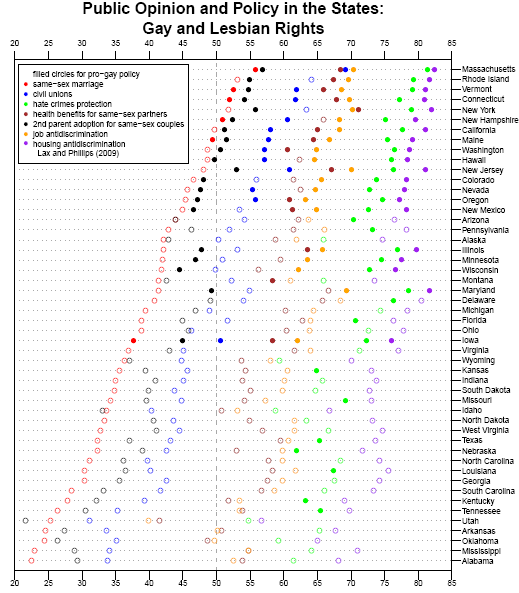
Andrew Gelman, over at FiveThirtyEight, presents a graph from data put together by Jeff Lax and Justin Phillips regarding opinions about various policies affecting gays and lesbians:
In another post, Nate Silver asks how public opinion about same-sex marriage might change if polls worded the question somewhat differently. Instead of asking “should the government allow same-sex couples to marry?”, we could just as well ask “should the government prevent same-sex couples from marrying?” He suggests that pro-gay-marriage groups might also frame the issue in this way–of keeping the government from taking away rights that people presumably already have rather than as the government giving new rights. It’s an interesting thought, and illustrates the role that question wording can play in affecting how survey respondents think about an issue.
UPDATE: Well, I was taken to task for not providing a better explanation of the graph. However, commenter Christopher explains it pretty well:
For each state, the status of seven public policies is listed as either pro- or anti-gay with seven colored circles which are either filled or empty with respect to the status. In addition, the position of the circle reflects the status of public opinion for each policy.
That is, each color represents one of the policies listed in the legend in the upper-left corner, so, for instance, red = public support for same-sex marriage. If the dot is filled in, it means gay-friendly legislation about the issue was actually passed in the state. If the dot is an empty circle, it means no gay-friendly legislation exists in the state. And the position of the circle tells you what percent of people in each state support each policy.
This image, found at International Networks, depicts the globe at night. The areas bathed in electricity reveal “the global spread of industrialization, as evidenced by the lights of human civilization”:
I think it’s interesting to compare this image with a world population map (link):
At first the two maps seem to overlap pretty nicely, but if you look closely there are plenty of interesting discrepancies, especially in Africa.
Thanks to Toban B. for the link that got me to the graphic that inspired this post.
NEW (Apr. ’10)! In the comments, Brendon linked to this great image of the Korean peninsula at night that reveals an amazing difference between North and South Korea:
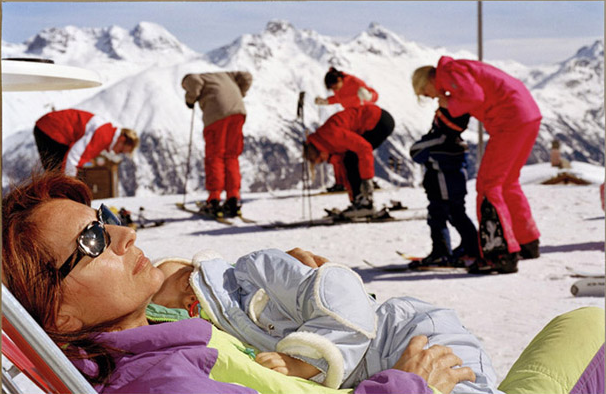
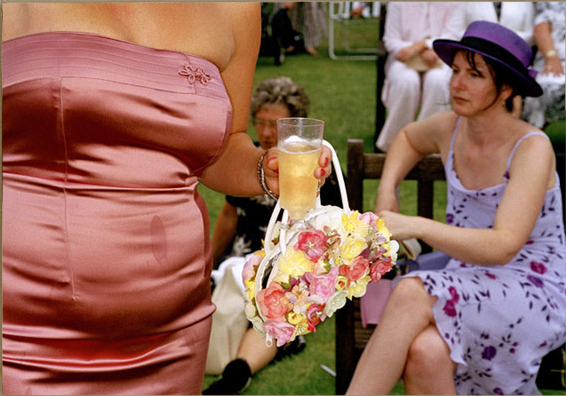
Photographer Martin Parr has decided to photograph the rich in their habitat, exposing an elite world for the rest of us. He writes:
Shot in various locations, from art fairs to horse racing, and in many countries, I have selected situations where people are comfortable showing off their wealth. Designer clothes, champagne and parties are all part of this repertoire.
…
Traditionally the portrayal of poverty has been the domain of the “concerned photographer” [see, for example, here], but I photograph wealth in the same spirit.
What I like about his photographs is the realistic portrayal of the rich. Unlike the way in which wealth is glamorized in popular culture (see, for example, here, here, here, here, and here), these are real people, with all of their imperfections, showing off all of their money.
The pictures are (as far as I’ve been able to determine) from the U.S., Moscow, and Dubai:
Sociological Images encourages people to exercise and develop their sociological imaginations with discussions of compelling visuals that span the breadth of sociological inquiry. Read more…