Archive: Jun 2009

In the opening essay to the book Shared Visions: Native American Painters and Sculptors in the Twentieth Century, Rennard Strickland and Margaret Archuleta write,

J.J. Brody in his classic study, Indian Painters & White Patrons, identified the colonial nature of a patronage system that narrowly defined and dictated what was “Indian art”…It seems almost as if definitionally…that paintings by Indians can be considered only in a primitive, aboriginal context. (p. 9)

They discuss Oscar Howe:

…[he was] thwarted in developing new directions in painting and striving to break away from the old stereotypes limiting Indian art…one of Howe’s Cubist style paintings was rejected from the 1959 Indian Artists Annual because it was “non-Indian” and embodied a “non-traditional Indian style.” (p. 9)

Strickland and Archuleta quote a letter from Howe to a friend:

“There is much more to Indian Art, than pretty, stylized pictures…Are we to be held back forever with one phase of Indian painting…?” (p. 10)

What Strickland, Archuleta, and Howe (as well as other contributors to Shared Visions) are discussing is the pressure American Indian artists have often faced to create a certain type of art. This pressure may come from other Indians or from non-Indians. Non-Indians have often had significant power over Indian artists because of their role as benefactors (providing money for artists to attend The Studio at the Santa Fe Indian School, for instance) and because non-Indians are the majority of buyers of art created by American Indian artists. And benefactors and art collectors often have a certain idea of what “Indian art” is, which includes assumptions about both themes and styles. Specifically, they want “traditional” images that depict Native Americans in a pre-modern world, often including images of animals.

I couldn’t help but think of that book when I recently picked up a tourist-oriented guide to Taos, New Mexico. Now, don’t get me wrong: I’m not saying there is anything necessarily wrong with any of the particular art pieces (or with “traditional” type Indian art more broadly). I’m also not claiming these particular artists feel their artistic expression is limited by preconceived notions of what counts as “Indian art.”

What struck me was just the homogeneity of the images found in the guide, which seemed to more or less fit the mold of the stereotypical idea of “Indian art.” It brings up the question: what is Indian art? Is it any art made by an American Indian? Or does it only count if it fits in with non-Indians’ preferences for what Indian art should look like? What if a White person, say, masters the “traditional” style–is it Indian art then? Over the years a number of American Indian artists have created art to intentionally challenge the idea of the romanticized 19th-century Indian as well as what Indian art can be. For instance, Fritz Scholder painted “Indian Wrapped in Flag” in 1976, in an attempt to deconstruct images of Native Americans (p. 16 of Shared Visions).

Both Indians and non-Indians picketed some of Scholder’s shows in protest.

Similarly, T.C. Cannon painted “Osage with Van Gogh” (I’ve also seen it titled “Collector #5“; from around 1980), which reverses our idea of who collects or appreciates which type of art by showing a Native American collecting a European artist’s work. Another great piece is “When Coyote Leaves the Reservation (a portrait of the artist as a young Coyote)” by Harry Fonseca (1980). See images here.

So are those pieces Indian art? Does it count as “Indian art” only if it contains specific styles and themes?  In which case, does it remain a sub-genre of art–part of “ethnic” art, as opposed to the neutral, non-marked mainstream art world?  Are Indians who paint or sculpt or play music in ways that don’t fit the existing idea of Indian art not “authentic” Indian artists?  If we accept that premise, “Indian art” is, as Howe said, “held back forever,” with themes and styles frozen in time and artists discouraged from experimenting or innovating in their work, as Howe learned so clearly. This tendency is apparent in other elements of U.S. culture, of course: movies like “Dances with Wolves,” books about “noble savages,” and conflicts over what types of technologies American Indians can use when spear fishing (with non-Indians arguing Indians should only be able to use the methods that their tribes used in the 1800s) all indicate a wider perception that “authentic” Indians should inhabit a time-warp universe in which their cultures and lifestyles have remained basically unchanged since the late 1800s or early 1900s, a requirement we don’t ask of other groups.

For more evidence that Indians are represented, and expected to represent themselves, anachronistically, see this post.

UPDATE: Commenter Camilla points out a documentary that asks similar questions about “African” art:

Christopher B. Steiner produced a fantastic anthropological documentary about the market for “African” art that addressed many of these same issues. It’s called “In and Out of Africa”…It explores the issue of how ideas such as “authenticity” and “tradition” are socially constructed phenomena. It also questions why particular types of “ethnic” art are successful in Western markets, while others are not.

Gwen Sharp is an associate professor of sociology at Nevada State College. You can follow her on Twitter at @gwensharpnv.

3615989327_e3474289ca

“Pregnant? Scared?”  They don’t mean hemorrhoids and contractions; they mean social opprobrium and economic ruin due to stingy social services.

Jill at I Blame the Patriarchy writes:

There is only one reason that pregnancy should “scare” you: your culture hates women and kids. It especially hates teenage women. It especially hates pregnant teenage women. It especially hates teenage pregnant women who get knocked up under unapproved circumstances.

It had never occurred to me before that a generalized fear of getting pregnant is a culturally and historically contingent state of mind.  But, of course, it is.

—————————

Lisa Wade is a professor of sociology at Occidental College. You can follow her on Twitter and Facebook.

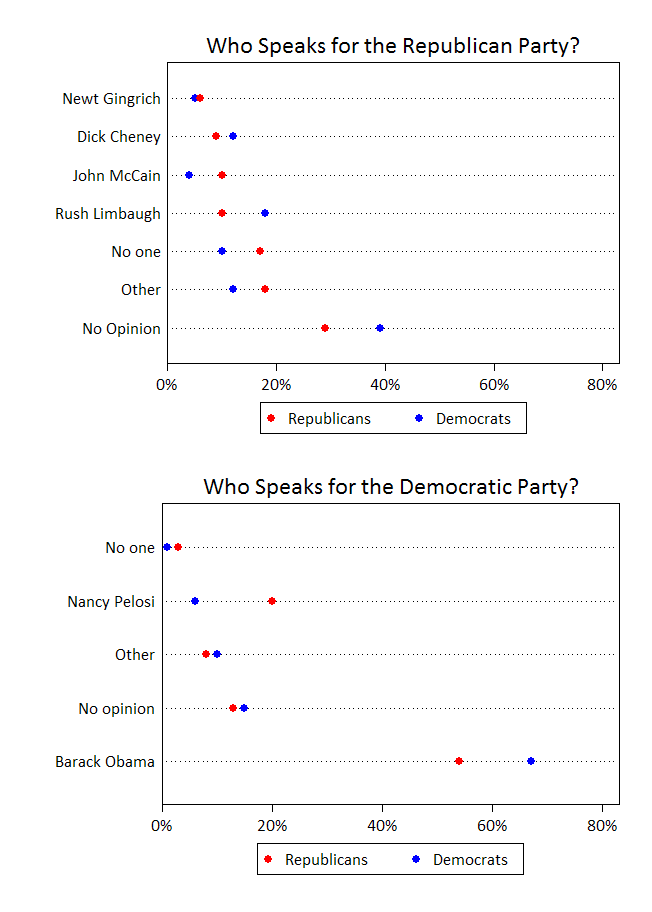
Some interesting data on who Republicans and Democrats feel represents them and the opposing party:

speaksforparties

Gallup data borrowed from The Monkey Cage (via Matthew Yglesias).

—————————

Lisa Wade is a professor of sociology at Occidental College. You can follow her on Twitter and Facebook.

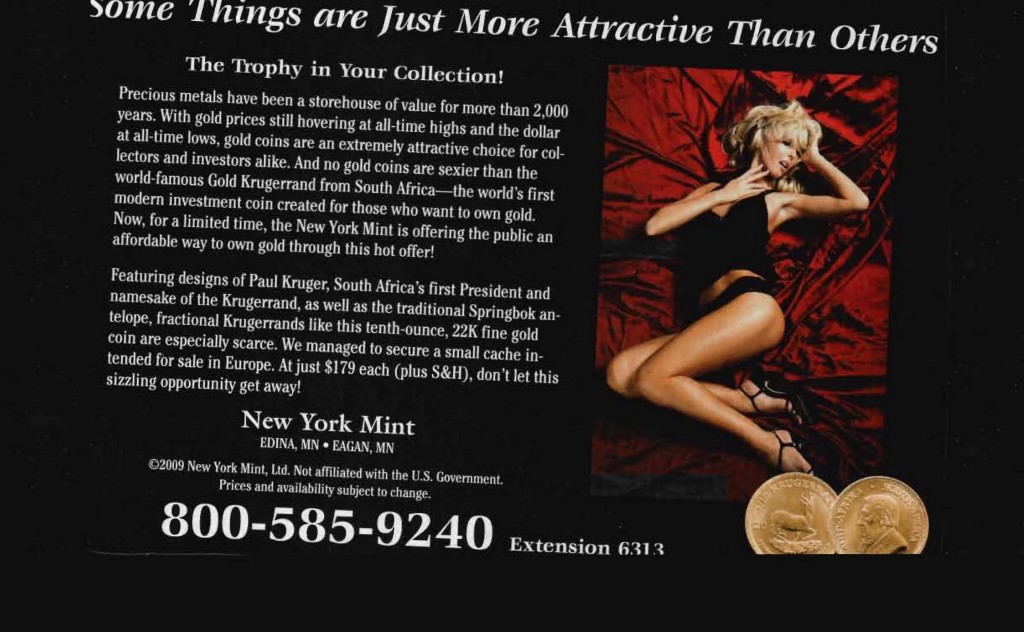
Given how common they are, ads that use a woman in a sexy pose for no good reason don’t really surprise me anymore. But every once in a while I come across one that makes me do a double-take, such as this advertisement for gold coins:

attractive2

Really? A woman in what appears to be a sexually aroused state? Who can apparently be the “trophy in your collection,” a statement which is all kinds of creepy? I also like the naturalization of current female beauty standards–thin, long-legged blond women who will lie around in lingerie and heels are “just more attractive”! It’s, like, a universal law, just the way it is.

Ugh. That is all.

Toban B. sent us a link to an infographic that included data that put U.S. spending on the military into perspective:

capture7

See also this post looking at where our tax dollars go.

—————————

Lisa Wade is a professor of sociology at Occidental College. You can follow her on Twitter and Facebook.

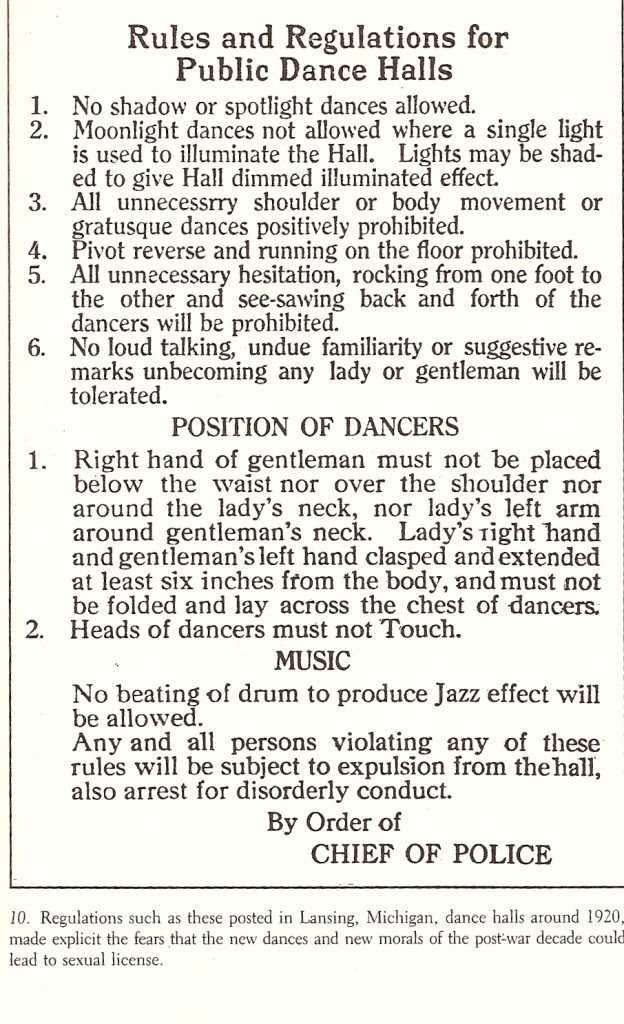
I found this list of rules posted by the Lansing, Michigan, Chief of Police in dance halls during the 1920s in Allan Brandt’s book No Magic Bullet: A Social History of Venereal Disease in the United States Since 1880:

sc00801976

I don’t know what a “gratusque” dance, from point 3, is–maybe “grotesque” spelled incorrectly?

Notice the association of jazz with sexual impropriety. And although I think most readers, like me, will read the list and laugh at the fact that people thought dancing was so problematic, keep in mind that there are still many people who do. In college a friend told me he had never been allowed to go to a dance of any sort because his parents were from an evangelical Christian group that thought dancing was evil and led to sexual promiscuity. He’d also never eaten a single piece of Halloween candy, which horrified me way more than never going to a dance. I apparently am a tool of evil because I insisted that he enjoy the pleasures of Halloween candy for the first time. Next thing you know, he was drinking and smoking pot, proving that candy is a gateway drug.

True story.

Gwen Sharp is an associate professor of sociology at Nevada State College. You can follow her on Twitter at @gwensharpnv.
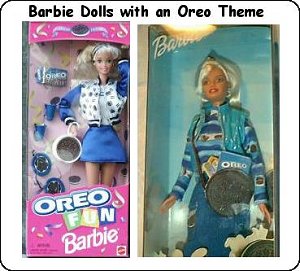
Michaela N. alerted us to the Oreo Barbie. According to Monica Roberts at Transgriot, Mattel once marketed an Oreo-themed Barbie (image here):

oreobarbie

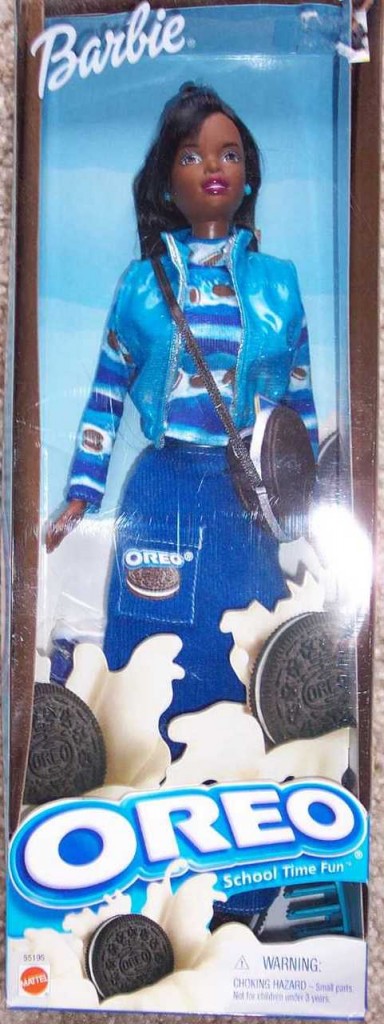
The doll sold so well that Mattel decided to make a Black version (image here):

2001_oreo_barbie

The Black version of the doll triggered protests.  Monica explains it nicely:

…Oreo has another connotation in the Black community beyond just being a slammin’ cookie.

Calling someone an ‘Oreo’ is fighting words. It means that you are calling them Black on the outside and white on the inside. Translation, you call a Black person an Oreo, you are accusing them of being a sellout or an Uncle Tom to the race.

The doll was eventually recalled. (This was all about four years ago.)

Did Mattel intentionally produce a doll that embodied a well-known insult in the Black community?  If they didn’t (and let’s just go with that theory), it means that no one at Mattel involved in the production of this doll had the cultural competence to notice the problem.  This points to both (1) white privilege and the ease with which white people can be ignorant of non-white cultures and (2) a lack of diversity on the Mattel team.  Less employee homogeneity might have saved Mattel both face and money in this instance.  Diversity, then, is often good business.

For more on Barbie and racial politics, see this post inspired by Ann DuCille.

—————————

Lisa Wade is a professor of sociology at Occidental College. You can follow her on Twitter and Facebook.

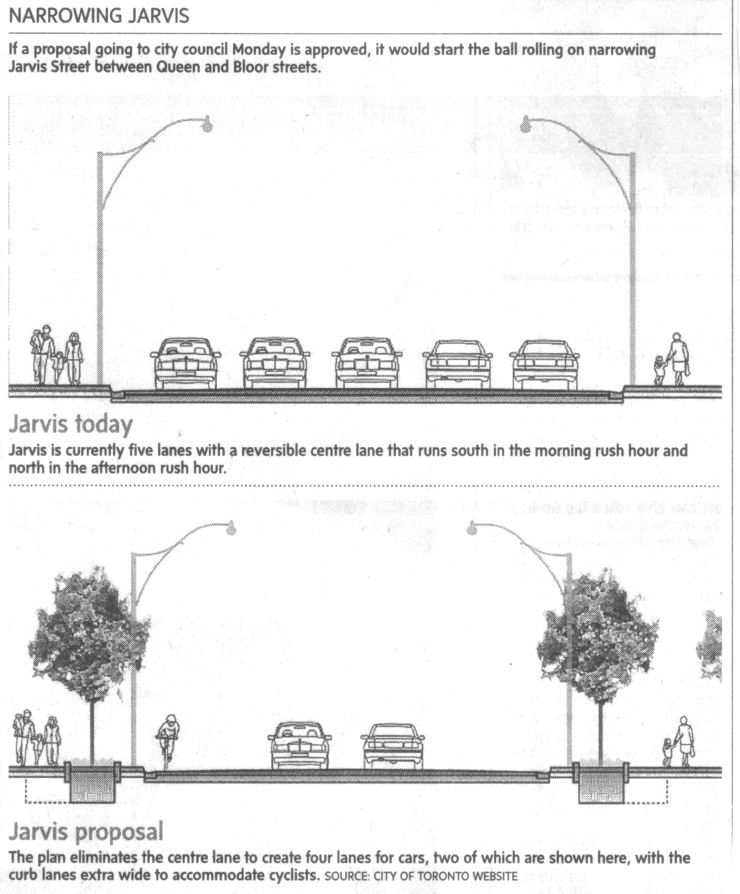
Jim C. sent us this graphic designed to illustrate a proposal to reduce the lanes on Jarvis Street in Toronto from five to four (Globe and Mail, May 22, 2009, p. A12).   As Jim points out, the text of the graphic describes the proposal accurately, and even points out that the graphic misrepresents the change, but the graphic itself still gives the impression that the reduction will be to two, not four lanes.

jarvisbikelanes2

It is a good example of how much graphics matter. Even with the text, it is potentially misleading.  Such misrepresentation can also be purposeful and political.  Jim speculates that this is the case here:

As is often the case whenever there are modest efforts to make space on city streets for pedestrians and cyclists, right-wing councillors (and affluent commuters) raised the spectre of traffic chaos and a ‘war on the car’.

If you’re interested in comparing the representation of this proposal by the Globe with its representation in the proposal itself, check out the final page of the proposal.  Thanks to Nick J. B. in the comments for the link.

—————————

Lisa Wade is a professor of sociology at Occidental College. You can follow her on Twitter and Facebook.