Archive: Jun 2009

Nicole D. pointed out an interesting post on boingboing about plagiarism and status. Somehow or another someone noticed that large parts of the dissertation written by William Meehan, president of Jacksonville State University, were lifted word-for-word from an earlier dissertation by Carl Boehning; both men got their Ph.D.s from the University of Alabama. Here is an image indicating the extent of the copying–all the highlighted sections are exact replications of Boehning’s words (this does not include passages that were paraphrased without citation from his dissertation):
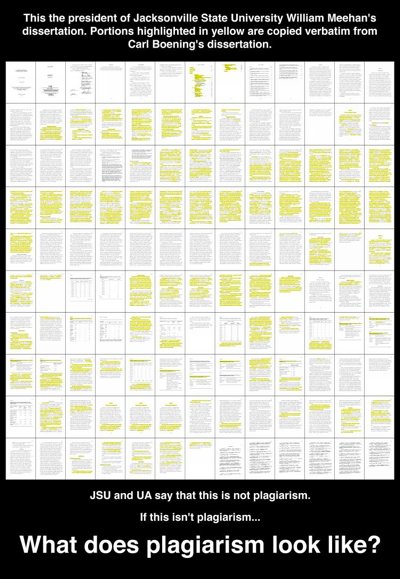
200906011029

You can get a look at the actual documents if you’d like: Boening’s work, Meehan’s dissertation, and an index of the plagiarized sections.

Michael Leddy of Orange Crate Art says,

Neither the University of Alabama (which granted Boening and Meehan their doctorates) nor Jacksonville State University, where Meehan is president, has chosen to take up the obvious questions about plagiarism that Meehan’s dissertation presents. As another recent story suggests, plagiarism seems to be governed by a sliding scale, with consequences lessening as the wrongdoer’s status rises.

The “recent story” he mentions is about how a paragraph from Talking Points Memo ended up in a Maureen Dowd column, uncited and without quotation marks.

I find this beyond infuriating. I am, admittedly, hardcore about plagiarizing. I check every paper for it and I immediately give a 0 on any assignment where I find plagiarizing for a first offense; if it’s a second offense, I fail them in the course (I’d really prefer to fail them for the first offense, but we aren’t allowed to do that). I also turn in every instance to the college student ethics committee so the record will be on file. But, as Leddy says, apparently if you can rise high enough, then later discovery of your plagiarism–of the document on which a person’s entire Ph.D. is based, no less–won’t be held against you (though it did dim Joe Biden’s career for a while when he, or his writers, plagiarized part of a speech years ago).

Given that universities increasingly make statements about the importance of academic honesty, it’s an interesting position for JSU to be in–how do you tell your students they can’t plagiarize but admit that the president’s dissertation was largely copied? Perhaps they are using it as an illustration to students of how status, power, and privilege combine to protect some people more than others.
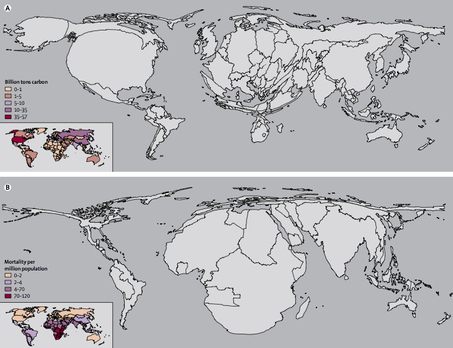

The two maps below are part of a series of maps that warp the size and shape of countries according to various international disproportions (see lots more here).

These two warp countries according to how much they are contributing to global warming and how much they are likely to suffer from global warming respectively.

globeadjustedclimate-thumb-453x348

Ezra Klein interprets:

The first shows the world in terms of carbon emissions. America, for instance, is huge. So is China. And Europe. Africa is hardly visible. The second map shows the world in terms of increased mortality — that is to say, deaths — from climate change. Suddenly, America virtually disappears. So does Europe. Africa, however, is grotesquely distended. South Asia inflates.

Kevin Drum summarizes:

Long story short, we spit out the carbon, but it’s people in Africa and South Asia who are mostly going to die because of it.

Thanks to Toban B. who linked to these maps in a comments thread.

—————————

Lisa Wade is a professor of sociology at Occidental College. You can follow her on Twitter and Facebook.


I mean, it’s Ellen DeGeneres. She’s a comedian. Everyone knows she’s just being funny.

Besides, she’s totally gay. Gay ladies don’t really care about beauty, am I right or am I right?

What do you think?

I’ll tell you what I think. Satire or no, Cover Girl’s done a lot of market research and they think it’s going to make people buy make up just like any old advertisement.  And I think they’re right.

In fact, I think satire is disarming.  When we see this commercial, our “don’t fuck with us” response doesn’t kick in because it’s just funny ol’ Ellen bein’ wacky.  Advertising counts on us thinking it doesn’t affect us.  Otherwise we’d be pissed.  I think satire is a useful tool with which advertisers trick us into letting down our guard.

We’ve been hitting satire hard lately.  I think it’s because it’s really pretty tricky to figure out.  See our previous posts on or featuring satire here, here, here, here, here, and here.  Here’s one that actually refers to data (as opposed to just involves us mouthing off.)

(Via Moody Springs.)

—————————

Lisa Wade is a professor of sociology at Occidental College. You can follow her on Twitter and Facebook.

Lisa Wade, PhD is an Associate Professor at Tulane University. She is the author of American Hookup, a book about college sexual culture; a textbook about gender; and a forthcoming introductory text: Terrible Magnificent Sociology. You can follow her on Twitter and Instagram.

I know I’ve been negligent in my posting for a few days. I was grading and busy watching old Michael Jackson videos and performances on YouTube and feeling unexpectedly sad about everything his life represented, and also the realization that people I idolized as a kid are now in their 50s.

Anyway, Sarah N. sent in a link to a story at the Mail Online about how women’s perceived attractiveness plays a part in deciding which matches will be played on the main court at Wimbledon. The organizers of Wimbledon don’t try to hide the fact that the appearance of the competitors is taken into account when scheduling matches:

…the All England Club admitted that physical attractiveness is taken into consideration. Spokesman Johnny Perkins said: ‘Good looks are a factor.’

Some women who were scheduled to play on Center Court, the main area, and their world rankings:

World No. 45 (unseeded) Gisela Dulko

87977985MT050_The_Champions

World No. 59 (unseeded) Maria Kirilenko

TENNIS Wimbledon 136

No. 28 seed Sorana Cirstea

All England Lawn Tennis Championships Day 5

Women who played on the other courts, with their rankings:

No. 5 seed Svetlana Kuznetsova

Britain Wimbledon Tennis

No. 2 seed Serena Williams:

w6

Attractiveness doesn’t seem to play such a factor in scheduling the men’s matches:

In the men’s tournament, five-times winner Roger Federer and British hope Andy Murray invariably play on Centre.

The scheduling of women by perceived attractiveness may have something to do with attracting television viewers. A comment from a BBC television employee:

But obviously it’s advantageous to us if there are good-looking women players on Centre Court…Our preference would always be a Brit or a babe as this always delivers high viewing figures.

Of course, it’s nothing new that female athletes are judged on their appearances as well as their athletic abilities. Female athletes have often felt pressure to meet conventional standards of beauty. This isn’t just about looks; it’s also about doing heterosexual femininity. Female athletes have long been suspected of being lesbians, particularly if they did not seem to actively seek male sexual approval. In fact, WNBA players have been encouraged to wear make-up and jewelry, have their hair long, and bring up their boyfriends, husbands, and/or children to prove their heterosexuality. Thus, in the end women’s appearances, and willingness to play up their gender in an approved way, often trumps their athletic accomplishments in a way that male athletes don’t usually face.

Other posts about female athletes and attractiveness are here, here, here, here (watch the second video), here, and here.

These Virginia Slims ads from 1969, sent in by Fred H., show how the idea of “progress” was as useful then as it is now (see also this post on the subject). The commercials suggests that the right to smoke is part and parcel of women’s liberation.

Fred also notes the suggestion that “petite things are meant for women.” Notice that the last commercial, on a different theme, uses not only the “slim” analogy, but also calls the cigarette “beautiful.”

[youtube]https://www.youtube.com/watch?v=vXUbkIkwn2Y[/youtube]

For other examples of co-optation, see these posts using feminism to sell guns (here and here), beauty products (here and here), botox, diamond rings, cars and credit cards, cars and bras, pornography, cleaning products, panties, and eyeglasses, washing machines, and, of course, cigarettes (here and here).

—————————

Lisa Wade is a professor of sociology at Occidental College. You can follow her on Twitter and Facebook.

Lisa Wade, PhD is an Associate Professor at Tulane University. She is the author of American Hookup, a book about college sexual culture; a textbook about gender; and a forthcoming introductory text: Terrible Magnificent Sociology. You can follow her on Twitter and Instagram.

Sociologist Yen Le Espiritu popularized the idea of a pan-ethnic identity.  “Asian American” is a pan-ethnic identity. It is an invented label applied to dozens of different groups with wildly different cultural traditions and languages. Most Americans (Asian and not), over time, came to accept the term as meaningful. American Indian is also a pan-ethnic term, as is African American and most other such labels.

On the one hand, pan-ethnic labels can be empowering. There is power in numbers. A large community identified across ethnic and national identities by race (however fake that racial designation is) can, for example, become a powerful voting bloc to which politicians must attend, or be mobilized to work together to fight for a common cause.

On the other hand, pan-ethnic labels can be disempowering. They tend to ignore the distinctions that make ethnic and national identities meaningful, and the rough categories erase differences among groups, thus making it more difficult to see and, thus, problematize disadvantage.

This latter problem motivated the Asian Pacific American Coalition (APAC) of the University of California campuses to run its “Count Me In” campaign. They notice that, though “Asian Americans” were well represented on University of California campuses (they make up 43% of incoming frosh in 2006), certain groups deemed “Asian” remain underrepresented. These include students of Cambodian, Hmong, and Laotian descent, among others.

The campaign asked the University of California system to disaggregate their “Asian” category.

In response the University of California added 23 new categories to their application.

For a much more extensive discussion of this issue, see Fatemeh Fakhraie’s post at Racialicious(where I stole this video clip).

—————————

Lisa Wade is a professor of sociology at Occidental College. You can follow her on Twitter and Facebook.

Feminist scholars argue that patriarchy relies not just on a hierarchy that places men above women, but a hierarchy of men that punishes men who don’t obey rules of masculinity.

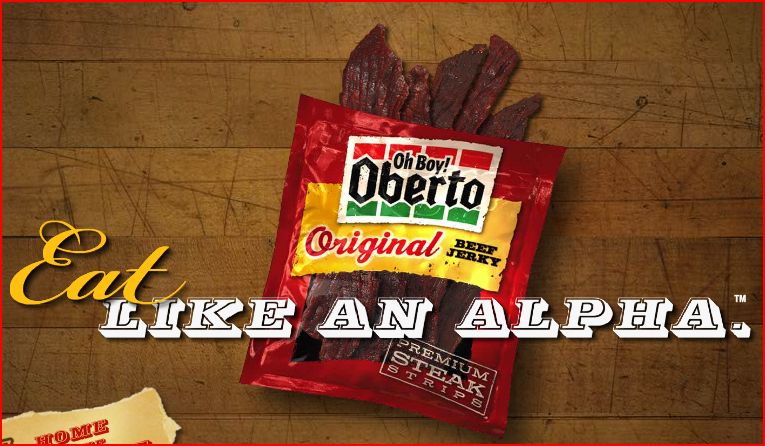
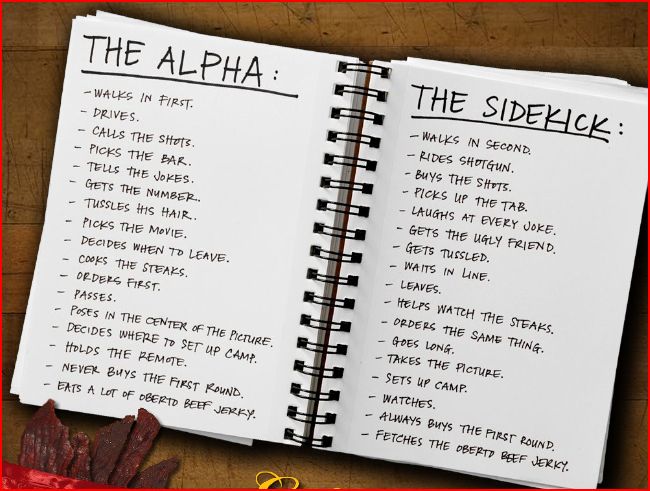
An advertising campaign for Oberto Beef Jerky, sent in by Kate S., nicely illustrates the threat to men if they don’t comply with patriarchy.

capturett

The threat is: If you’re not an “Alpha,” then you’re a “Sidekick.”

capturetv

The Alpha is first; the Sidekick is second. The Alpha gets served; the Sidekick serves. The Alpha gets the hot chick; the Sidekick gets the “ugly friend.” The Alpha makes the decisions; the Sidekick takes them.

In one part of the website, it actually encourages you to “establish your dominance.”   It features taunting emails and cards that you can send to your friends to trick them into looking like idiots/being your sidekick.

UPDATE: In the comments thread, Toban B. (T B) had a really nice observation:

As Murray Bookchin has written, language about ‘alpha males’ naturalizes hierarchy.

Bookchin highlights how people have conflated animal and insect interactions (e.g. ‘queen’ bees) with societal structures created by humans — as opposed to the far more instinctual of relations of non-human creatures.  (For Bookchin, there is a continuum between humans and other life forms, so these distinctions aren’t binaries.)  Basically, the point here is that if human hierarchies are the same as instinctual hierarchies (e.g. interactions with a lion ‘king’), then the human hierarchies must be just as natural and inevitable — which just isn’t the case.

Joanne suggests, further, that humans, invested in patriarchy and hierarchy, actually project it onto the natural world:

Using the terms “alpha” and “dominance” just reinforces the belief that nature exists within a patriarchal, hierarchical model.  It actually doesn’t.  I do a lot of work with horses, researching and observing the horse-human relationship, and this whole idea of “dominance” is one that has started with and is kept alive by the patriarchal worldview of Western culture.  Many observers of animal behavior are brought up in and continue to live in that worldview, so they impose it on animals and the natural world.  If you step outside of that worldview, what you find in the natural world is something entirely different.

—————————

Lisa Wade is a professor of sociology at Occidental College. You can follow her on Twitter and Facebook.

Lisa Wade, PhD is an Associate Professor at Tulane University. She is the author of American Hookup, a book about college sexual culture; a textbook about gender; and a forthcoming introductory text: Terrible Magnificent Sociology. You can follow her on Twitter and Instagram.

From ABC News, “Transformers: Revenge of the Fallen … is taking fire for its comic relief: a pair of slang-spewing, illiterate Chevy hatchbacks named Skids and Mudflap… the robot duo is being labeled a racist caricature.” According to Yahoo News, “They’re forced to acknowledge that they can’t read. One has a gold tooth.”

ADDITION Film Transformers-Jar Jar AgainI haven’t seen the movie, so it’s difficult to comment directly, but I wonder if this another example of the dehumanizing racial stereotypes. Michael Bay, the director, largely dismisses the concerns. “Listen, you’re going to have your naysayers on anything,” he said. “It’s like is everything going to be melba toast? It takes all forms and shapes and sizes.”