race/ethnicity/nationality

Savage Race participants struggle through an obstacle named “Sawtooth.” (Photo by Mac Stone / Daily Burn)

The racist and historically problematic myth of the “savage” lives on within contemporary North American discourse. A prominent example of this is found in the rising popularity of adventure races, such as Savage Race, Tough Mudder and Warrior Dash, in which sporting companies reproduce traditional notions of masculinity and comradery through environmental and obstacle conquest. In at least one of the events, a historically racist term like “savage” is frequently employed to sell customers an opportunity to push themselves to their physical, mental, and emotional limits by running a purposefully rural, physically-taxing course filled with predesigned obstacles and stressful natural environments (running through mud and near dangerous elements like fire and barbed wire, for example). It is symptomatic of the enduring ubiquity of racial ideals within American society that, through a company like Savage Race, customers pay for a chance to be physically active, have fun and “get savage.”

Click here to read the full article...

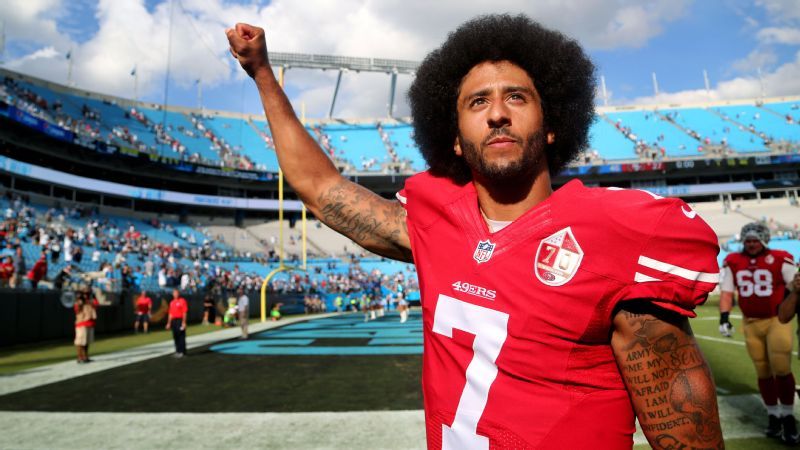
Following a season of protest and activism, Colin Kaepernick has been frequently passed over by teams in need of a quarterback.
Following a season of protest and activism, Colin Kaepernick has been frequently passed over by teams looking to sign a quarterback. (Photo by Gerry Melendez/ESPN)

With NFL training camps well underway, teams looking to sign a quarterback have passed over Colin Kaepernick time and time again. It appears he may be serving his ultimate punishment following a year of protest and activism. Amid those who defend NFL decision-makers as simply making choices for “football reasons,” there has also been a chorus of critics who see (black) players as responsible for his remaining on the sidelines.

Click here to read the full article...

“We are on the map and we’re staying on the map, not just in sports, but in everything”. This quote from American-Jewish basketball player Tal Brody is not only one of the most well-known quotes in Israel’s sports history, but also one of the most famous in Israeli culture overall.

Click here to read the full article...

Muhammad Ali’s stand against the Vietnam War transcended not only the ring, which he dominated as the undisputed heavyweight champion of the world, but also the realms of faith and politics. —Krishnadev Calamur, The Atlantic. (AFP | Getty Images)

April 28, 2017 marks the 50th anniversary of the day that boxing champion Muhammad Ali (1942-2016), citing religious reasons, was stripped of his heavyweight title for refusing to be inducted into the United States Army. That memorable event is somehow all the more amazing when considered as part of an evolution whereby “The Greatest” went from being reviled as a “draft-dodger” to being respected as a spokesperson against Islamophobia and a political activist for persons living with Parkinson’s disease.

Click here to read the full article...

University of Arizona freshman Lauri Markkanen, a native of Finland, was named to the top-20 list for the Wooden Award, which recognizes the best player in men’s college basketball. (Photo from Sports Illustrated)

The NCAA Division I Men’s and Women’s National Basketball Tournaments tip off this week, bringing together players and spectators from around the world. Commonly known as “March Madness”, these annual tournaments have come to be seen as one of the biggest performance platforms for young basketball players from both the United States and, increasingly, across the planet. Generating more than $1 billion in advertising revenue alone, the NCAA basketball tournament has drawn more attention globally thanks to international broadcasting, digital technology, and the rise of international (non-U.S.) “student-athletes” at U.S. colleges and universities. In this article, I’ll discuss some noteworthy international players in this year’s tournament in light of the debate set off on college campuses nationwide by President Donald Trump’s policies surrounding immigration.

Click here to read the full article...

Team USA’s starting 11 before a friendly match against Romania, November 2016
Team USA’s starting 11 before a friendly match against Romania, November 2016. Photo from YouTube.

The United States Women’s National Soccer Team will take the field on March 1 for the SheBelieves Cup. With no upcoming major international tournaments, these matches will be the team’s most publicized events of 2017. Though the team’s success has been rightly celebrated as an achievement for women in sports, there has been far less analysis about the racial and ethnic diversity of the players. Prior to the 2015 World Cup, several journalists noted the team’s overwhelming whiteness, but this discussion largely took a back seat to female empowerment narratives and Title IX salutes that followed their victory, celebratory parade, and subsequent time in the spotlight.

Click here to read the full article...

Donald Trump signing the Executive Order which has once again raised questions about the impact of migration in sport. Photo from Politifact.com

The migration of professional athletes has entered the news once more in recent weeks. In Chinese association football (soccer), quotas on the number of foreign athletes permitted on the pitch have been implemented to curb the boom in spending which has attracted players such as Carlos Tevez, Oscar, Hulk, Asamoah Gyan and Graziano Pellè to the Chinese Super League. In further high profile news, freshly inaugurated President Donald Trump’s use of executive orders to restrict the movement of people from predominantly Muslim countries could affect the movement of athletes into the North American territory.

Click here to read the full article...

High school senior Jamire Calvin announces his commitment to Oregon State University during the U.S. Army All-American Bowl on Jan. 7, 2017.
High school senior Jamire Calvin announces a commitment to Oregon State University during the U.S. Army All-American Bowl on Jan. 7, 2017. (Photo from USA TODAY Sports)

Each year, universities in the United States spend millions of dollars and college football coaches invest countless hours in an effort to lure top players to their schools. The recruiting process culminates with “National Signing Day,” on which high school seniors are officially able to sign National Letters of Intent that bind them to attend a particular university. As National Signing Day 2017 approaches this Wednesday (Feb. 1), millions of people will visit recruiting websites, such as rivals.com and scout.com, to follow who signs with which school. College football fans will alternately experience joy when a top prospect commits to their favorite team and devastation when a recruit goes elsewhere (this is often how I’ve felt as a fan, at least).

Click here to read the full article...

gettyimages-507739764-0
Photo from Deadspin. Taken by Cameron Spencer/Getty Images.

The recently knighted Scotsman and new world-number-one-ranked tennis player, Andy Murray, will be entering the Australian Open with his confidence sky-high, looking to start this year just as he ended the last. After defeating Novak Djokovic in the end-of-season ATP Tour final in November and, perhaps most crucially, in the process, finishing above him in the world rankings, this might represent Murray’s best chance of winning “down under” after eleven previous attempts. In the event’s history, Murray is one of the best players ever to have not won here, despite reaching five finals (2010, 2011, 2013, 2015, 2016). All except for 2010 when he lost to Roger Federer, Murray has been defeated by Djokovic. This year, for a change, Murray will enter the event as top-seed and favourite, which is a position he has tended to relish.

Click here to read the full article...

punjabihockey2-jpeg-size-custom-crop-1086x724
Parminder Singh (left) and Harnarayan Singh (right). Photo from The Toronto Star.

My PhD research explores South Asian experiences in ice hockey. Why, you ask?

  1. Because the South Asian community in Canada has become some of the most devout and enthusiastic hockey fans you will find on this planet.
  2. We don’t talk about race in Canada; therefore, there is very little literature about what it is like to be a “visible minority” playing in Canada’s game (a game that remains pretty white-dominated).
  3. Lastly, because the Punjabi broadcast of Hockey Night in Canada has become a significant development for hockey culture and Canadian media more broadly.

Two years ago, I conducted a study via Twitter to try and see how people made sense of Hockey Night in Punjabi. It was a term paper that eventually made it’s way into the Sociology of Sport Journal. This was well before the “Bonino Bonino Bonino” call went viral during the 2016 NHL playoffs and before the broadcast moved from CBC online to OMNI television. This post is compiled from excerpts from the article in an attempt to translate some of the material for a popular audience. Please keep in mind that a lot has changed with the broadcast and it’s online presence since the study was first conducted.

Click here to read the full article...