Search results for embed

I love this episode on Supreme and streetwear from Patriot Act with Hasan Minhaj, especially for the explainer on conspicuous consumption with a nod to “O.G. Hypebeast” Thorstein Veblen.

Veblen’s The Theory of the Leisure Class is a classic on how people use wealth and taste to make status, and conspicuous consumption is a good way to explain how hype happens. It got me thinking about other classic sociological explanations for how luxury brands blow up.

Marx’s idea of commodity fetishism is also important for understanding luxury brands and other Veblen goods. While conspicuous consumption focuses on why people buy, this idea gets to the core of how these goods get associated with status. We often venerate all the labor that supposedly goes into a luxury product, like a fancy watch, or we venerate the creative processes in branding or appropriating ideas. For Marx, the important part is that we transfer the value of that labor into the product and treat the product like it just has that value on its own.

This is the reason why the products of labour become commodities, social things whose qualities are at the same time perceptible and imperceptible by the senses. In the same way the light from an object is perceived by us not as the subjective excitation of our optic nerve, but as the objective form of something outside the eye itself…There it is a definite social relation between men, that assumes, in their eyes, the fantastic form of a relation between things.

Karl Marx. 1887. Capital: A Critique of Political Economy. Volume 1

Marx goes on to compare this process to the development of religious beliefs, and here we could also look at Émile Durkheim and collective effervescence. Part of the reason these products get hype is that they create big social events around shopping. The long lines and limited edition “drops” force people to get together in large crowds at special times to get the product. This makes shopping less of an individual experience and more of a collective one, where just being in the crowd contributes to the excitement.

All these theories make an important point about the social dynamics of popular products. As Matt Powell says in an interview earlier in the episode, you can’t take hype to the bank. But maybe you can; the generation of hype isn’t just an ephemeral, “fake” thing, but an example of a core truth in sociology—if people define hype as real it is real in its consequences.

Evan Stewart is an assistant professor of sociology at University of Massachusetts Boston. You can follow his work at his website, or on BlueSky.
SocImages authors and readers love pointing out pointlessly gendered products, especially children’s toys in blue and pink. Since gender is about what we do in the world, all the things we use for work and play can give weight to assumptions about gender differences that aren’t true. Critics of pointlessly gendered products emphasize that small differences in design—from color to function—can ultimately add up to big differences in how people learn to act in the world.

Gendering toys isn’t just about the color, it is also about what we teach kids to do with them. That’s why I got a huge kick out of this video: a compilation of old commercial shots of “white boys winning board games.” Of course, I haven’t done a systemic sampling of old commercials to see if girls win too, but this compilation makes an important point about how we can miss tropes that only show one outcome of social interaction over and over, especially competition.

I remember being a competitive kid when it came to board games. I didn’t like losing at all, and it took quite a few years until I learned to just enjoy playing on its own. After this compilation I look back and wonder whether I just felt bad about losing—as most of us do from time to time—or whether a part of that feeling was also a sense that something was wrong because I was “supposed” to be winning like the other boys. That’s the power of gendered socialization.

Evan Stewart is an assistant professor of sociology at University of Massachusetts Boston. You can follow his work at his website, or on BlueSky.

Those Fyre Festival documentaries were wild, weren’t they? Both movies highlighted fans’ collective glee watching the fakery play out from afar, as people with astounding amounts of disposable income fell prey to the festival’s poor execution. Who would buy all that hype, right?

The demand for exclusivity that fueled the festival is anything but fake. From Becker’s Art Worlds to Bourdieu’s Distinction, sociologists have long studied how culture industries and social capital create the tastes of the upper class. “Influencers” aren’t new, but social media makes it easier than ever to see them operate, and viral stories of high class hoaxes show this process in action.

Two great examples are these recent pranks parodying fine dining and fashion. Using a savvy social media presence, both teams were able to get a (fake) restaurant and a (fake) model a ton of buzz.

The interesting thing about these vides is how some of the humor rings hollow. It can be funny to see people chasing the next big trend get duped, but the fields they are mocking thrive on this exact kind of creativity and salesmanship. Taking the perspective of researchers like Bourdieu and others reminds us that taste is not objective, and it isn’t naturally tied to any basic level of effort or craft. At the end of the day, these pranksters still put together a “creative” look and restaurant experience, and so it is hard to tell whether they are making an effective parody, or just exploring and studying the basic rules of the game in the culture industry. Still, these videos are a fun excuse to think about how what it takes to cultivate “cool.”Evan Stewart is an assistant professor of sociology at University of Massachusetts Boston. You can follow his work at his website, or on BlueSky.

As a feminist sociologist, I couldn’t help but notice how reality competition shows like Dwayne “The Rock” Johnson’s  The Titan Games and American Ninja Warrior can teach us a lot about how society understands physical strength in relation to gender. 

Each of these shows takes a different approach to including women in strength competitions. On The Titan Games, women compete against women, while men compete against men. For each round, there is a man and woman winner. Given this format, men and women get equal screen time throughout the show. We see pairs of women and men compete in the same competitions like the Herculean Pull—the most intense one-on-one game of tug-of-war you have ever seen. This same-gender competition can actually minimize gender differences to the audience. Even if the pairs of women are slower than the pairs of men on some events, competition times are not shown to the television audience, so this difference is not highlighted.

In contrast, in the original rules of Ninja Warrior, everyone competed and the highest ranked individuals moved on to the next round. This quickly resulted in few women being represented beyond the first round (although some women were advanced as “wildcards” at the producers’ discretion). On Ninja Warrior, the audience sees the ranks of all the competitors, so it is very clear how the women do in comparison to the men (not so well, for the most part).

Source: “Numbers of Ninja Warrior: Ladies Night in Philadelphia”

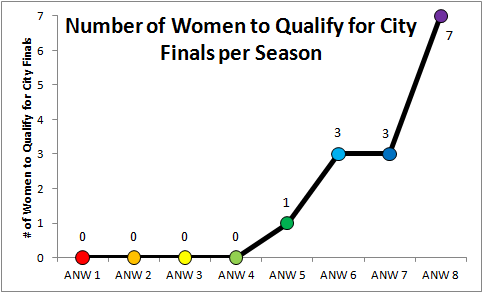
In 2017 (Season 9), the rules were modified to secure slots for women in later rounds. Interestingly, the rule change was in response to fan interest in seeing more women compete. Under the new rules, the top five women in qualifying rounds would advance and the top two women in the city finals would move on to national finals. This format results in some women moving forward based on performance in relation to all competitors and other women moving on based on their performance in relation to other women. For example, in Philadelphia qualifiers in Season 10, three women earned a spot in the city finals based on their overall rank in the competition and the next two highest-ranking women (although lower ranking than some men) also advanced to the City finals to attain the minimum of five women advancing.

From a feminist perspective, which approach is best for showing women’s strength in competition? Do you prioritize representation and visibility for women, giving equal time to men and women throughout the competition as in The Titan Games? Or do you prioritize eliminating gender as an organizing category, providing the opportunity for (some) women to be ranked higher than (some) men, and including the potential for participation of folks outside the gender binary as in the original Ninja Warrior rules? Or do you try to do both?

Five women moving on from American Ninja Warrior Philadelphia qualifiers to city finals in Season 10. (Click for Source)

This question matters because there are real stakes to the way we see strength in pop culture. The way we consider gender and physical strength affects many women, even those who are not elite athletes. For example, in my own research on the construction trades, many tradeswomen face assumptions and stereotypes about women’s physical ability that disadvantage them throughout their careers. It’s important to disrupt discourses about strength when they are leveraged to unnecessarily disadvantage women. Not all women (or men) have the physical ability to do construction work. But many do. 

Strength competitions like these might seem to support stereotypes, but our scientific understanding of strength raises some troubling ideas about perceived “natural” differences of the body. Biological differences between men and women are not a clear as some would like to believe, this had led to problems with determining athletes’ genders for competition. In the US, large and muscular bodies are seen as desirable for men and problematic for women; this shapes who trains to complete in these types of competitions. If more women trained for strength-based competitions, we can assume the gap between men and women in these competitions would shrink, but not fully disappear. Similar trends have occurred in long distance running.

It’s difficult to imagine that anyone who has seen the women competitors on these shows could believe that women are not strong enough to do construction. Especially if you watched the first episode of The Titan Games and saw Tina Rivas, a sheet metal installer. And as she said about her work, “I am the only woman. So obviously that’s a little bit hard. But I can handle it.” Indeed.

Maura Kelly is an Associate Professor of Sociology at Portland State University. Her research and teaching interests include gender, sexualities, social inequality, work and occupations, and popular culture. Her current research is primarily focused on the experiences of women and people of color in the construction trades as well as policy and programs intended to increase the diversity of the construction trades workforce. She is the co-editor of the forthcoming book Feminist Research in Practice (Rowman & Littlefield 2019).

When I teach social statistics, I often show students how small changes in measurement or analysis can make a big difference in the way we understand the world. Recently, I have been surprised by some anger and cynicism that comes up when we talk about this. Often at least one student will ask, “does it even matter if you can just rig the results to say whatever you want them to say?”

I can’t blame them. Controversy about manufactured disagreement on climate change, hoax studies, or the rise of fake news and “both side-ism” in our politics can make it seem like everyone is cooking the books to get results that make them happy. The social world is complicated, but it is our job to work through that complexity and map it out clearly, not to throw up our hands and say we can’t do anything about it. It’s like this optical illusion:

The shape isn’t just a circle or a square. We can’t even really say that it is both, because the real shape itself is complicated. But we can describe the way it is built to explain why it looks like a circle and a square from different angles. The same thing can happen when we talk about debates in social science.

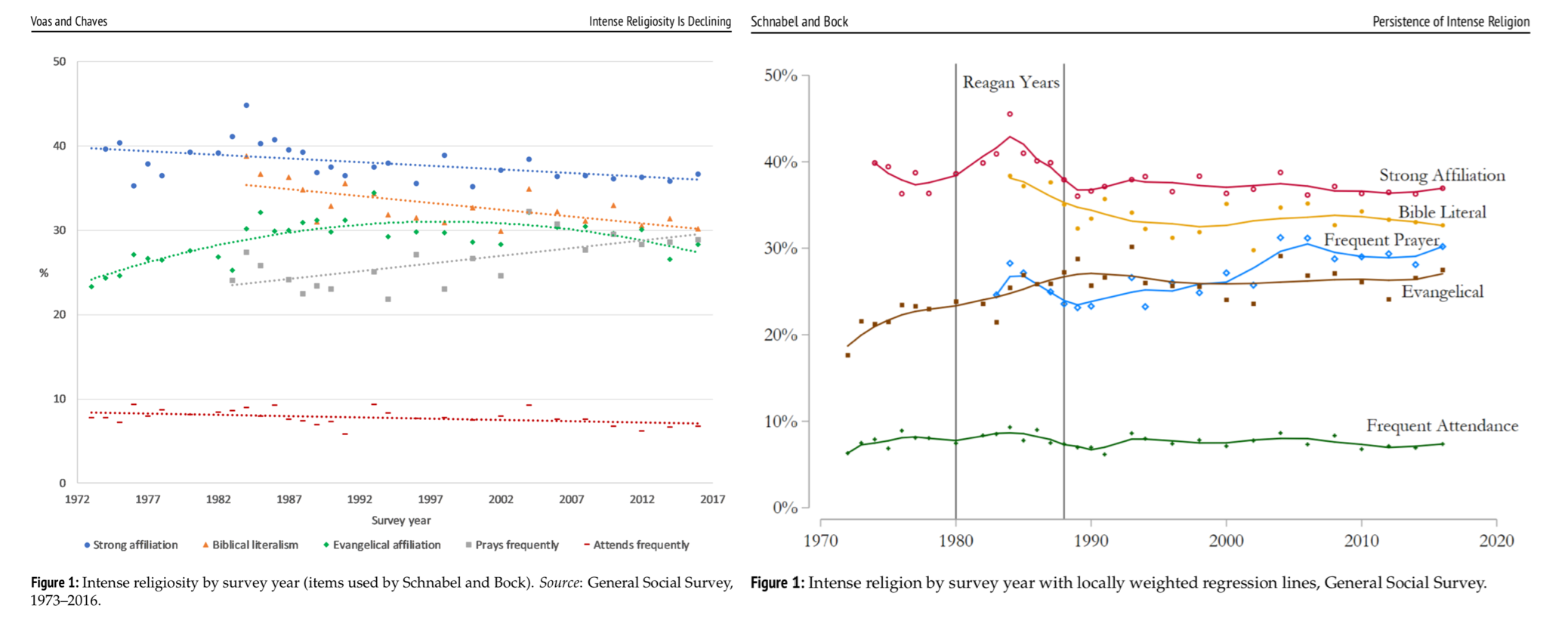
A fun example of this popped up recently in the sociology of religion. In 2016, David Voas and Mark Chaves published an article in the American Journal of Sociology about how rates of religious commitment in the United States are slowly declining. In 2017, Landon Schnabel and Sean Bock published an article in Sociological Science responding to this conclusion, arguing that most of the religious decline was among moderate religious respondents—people with very strong religious commitments seemed to be holding steady. Just recently, both teams of authors have published additional comments about this debate (here and here), analyzing the same data from the General Social Survey.

So, who is right?

Unlike some recent headlines about this debate, the answer about religious decline isn’t just “maybe, maybe not.” Just like the circle/square illusion, we can show why these teams get different results with the same data.

Parallel Figures from Voas & Chaves (2018) and Schnabel & Bock (2018) (Click to Enlarge)

When we put the charts together, you can see how Voas and Chaves fit straight and smoothly curved lines to trends across waves in the GSS. This creates the downward-sloping pattern that fits their conclusions about slow religious decline over time. Schnabel and Bock don’t think a single straight line can accurately capture these trends, because the U.S. saw a unique peak in religious commitment that happened during the Regan years and may have receded more quickly. Their smoothing technique (LOESS smoothing) captures this peak and a quick decline afterwards, and doing so flattens out the rest of the trends after that period.

The most important lesson from these charts is that they don’t totally get rid of the ambiguity about religious change. Rather than just ending the debate or rehashing it endlessly, this work helps us see how it might be more helpful to ask different questions about the historical background of the case. I like this example because it shows us how disagreement among experts can be an invitation to dig into the details, rather than a sign we should just agree to disagree. Research methods matter, and sometimes they can help us more clearly explain why we see the world so differently.Evan Stewart is an assistant professor of sociology at University of Massachusetts Boston. You can follow his work at his website, or on BlueSky.

For years now, expecting parents have been popping balloons and cutting colorful cakes to announce the sex of their babies. These “gender reveal parties” can be a fun new take on the baby shower, but they also show just how much we invest in the gender identities of children. In a world where gender inequality persists and gender identities can be in flux, cultural traditions like this can lock people into rigid thinking that separates boys and girls.

Photo Credit: Peter Mai, Flickr CC

Of course, point this out at the wrong time and you’ll usually get accused of raining on the parade. It’s just a cake after all, right? The tricky part is that social scientists often show how identities can turn into ideologies that have real stakes for human behavior.

For a dramatic example, last week the world got footage of the gender reveal party that sparked a massive 2017 wildfire in Arizona. These parents wanted to go big to announce their new baby boy—so big that it warranted explosions in the middle of dry grasslands.

It’s not that gender stereotyping directly caused this fire—even if we didn’t have a rigid gender binary, people would still start disasters with a stray campfire or sparkler. This case is still useful for thinking about gender, though, because what we celebrate and how we celebrate it shows a lot about where people learn to place their interest and effort. We don’t have massive parties for baby’s first steps or first conversation, and I can’t think of a time when a First Communion needed 800 fire fighters to come clean up afterwards.

 Evan Stewart is an assistant professor of sociology at University of Massachusetts Boston. You can follow his work at his website, or on BlueSky.

Recent news on climate change is deeply troubling, and people around the world are mobilizing to call for immediate action. This unique global problem means we all have to get better at understanding global inequality, but the first step to this might just be getting a more accurate view of the globe itself.

I love this classic clip from The West Wing about the problems with the Mercator Projection—the way we typically draw maps of the world.

About a month ago, data scientist Neil Kaye made a popular animation correcting the Mercator Projection to countries’ true sizes. Watch how dramatically the northern hemisphere shrinks, and the points from Cartographers for Social Equality seem even more serious.

One of the most striking parts of this animation for me is that many of the regions that are most vulnerable to extreme early changes don’t shrink much. If it is true that people attribute importance to size, these maps are an important reminder that we may not have the best mental pictures for thinking about both old trends in economic and political inequality and new trends in climate risk.Evan Stewart is an assistant professor of sociology at University of Massachusetts Boston. You can follow his work at his website, or on BlueSky.

One of the most important ideas in social psychology is that there are different ways to think. Sometimes we consciously process information by reasoning through it. Other times we rely on snap judgements, emotional reactions, habit and instinct. These two ways of thinking (sometimes called “cold” and “hot”, “discursive” and “practical”, or System 1 and System 2) are important for studying society and culture. Is an advertisement trying to persuade you with an argument, or just trying to get you to feel a certain way when you pick up a product? We all think that System 1 is thinking, but once you start noticing System 2 at work, plain old thinking can seem a bit more magical.

Photo Credit: Robbi Baba, Flickr CC

Psychics are a fun way to see these ideas at work. Check out this short clip of actor Orson Welles talking about his experience with “cold reading”—learning and practicing the techniques that psychics use to draw conclusions and make predictions about people. Notice how the story he tells moves across the different kinds of thinking.

At first, cold readers consciously rely on a set of observations and rules, but as they get better this process becomes instinctual. They start relying on snap judgements, and they sometimes start believing that their instincts reflect actual psychic abilities. What’s actually happening is a practical insight from their training, it is just packaged and sold like it came from carefully considering a mystical knowledge or power.

But if a psychic doesn’t believe in what they are doing, is selling readings unethical? If the insights they get are based on real observations and instincts, are they just helping people think about their lives in a different way? If you have a little more time to ponder this, check out this cool documentary about Tarot reader Enrique Enriquez. He makes no claims to a mystical power or secret knowledge here; he just lays out cards and talks to people about what they bring to mind. The commentators say this is closer to poetry or performance art than psychic work. What kinds of thinking are going on here?Evan Stewart is an assistant professor of sociology at University of Massachusetts Boston. You can follow his work at his website, or on BlueSky.