
Search results for embed

On the Data is Beautiful subreddit, a user going by the name fencelizard recently took a look at gender differences in full-time staff salaries in the last four U.S. Presidential administrations. This is only a quick descriptive picture (notes on the methodology below), but it highlights an important point about organizations: inequality doesn’t always neatly align with ideology.
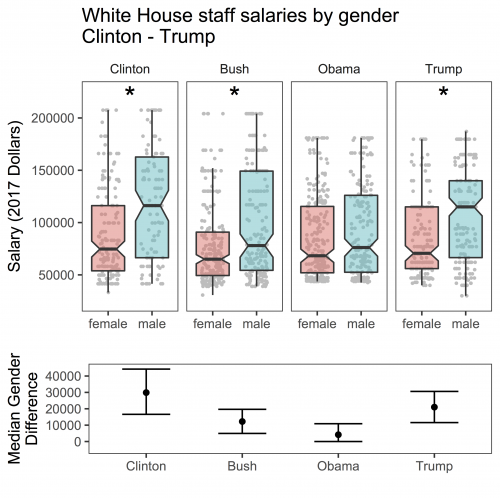
Both the wide and the narrow median pay gaps are bipartisan. While the Clinton and the early Trump administrations have the widest gaps in median earnings, the George W. Bush and Obama administrations were the closest to gender parity (the gap was not statistically significant in the Obama years).

Of course, these gaps mean different things in different administrations. The parity among Bush staffers looks like it came from pay cuts on both sides, with more men remaining in a higher salary range, while the Obama administration had a much more even distribution across men and women. Part of the pattern for the Trump administration could be due to understaffing in general.

Nevertheless, it is interesting to see how the salary distribution for women staffers has remained relatively consistent and lower than fluctuating salaries for men. Sociologists know that inequality can be embedded in the day-to-day operations of institutions like schools, prisons, and government offices. Bias certainly can and does play a role in this process, but the ideological support that we often associate with such biases—like political preferences—doesn’t always have to be the deciding factor for whether inequality happens.

Some background on the analysis from fencelizard:

Salary data was sourced from white house press releases for Trump (PDF tables; FML) and Obama (UTF-8 csv’s; thanks Obama), and from the Washington Post for Bush (http://www.washingtonpost.com/wp-srv/politics/administration/whbriefing/2004stafflistb.html) and Clinton (https://www.washingtonpost.com/archive/politics/1993/11/01/salaries-at-clintons-white-house/9c96f5b6-02c5-4888-87ee-dc547d8d93f0/?utm_term=.aa70a4af1649). Supposedly full salary data for Bush I exists too, but I couldn’t find it anywhere online.
I cleaned up the data in R, used the ‘gender’ package to guess staffers’ gender from their first names, and made the plots with ggplot2 and gridExtra. I used a Wilcox test to compare the distribution of salaries across genders for each president. Asterisks in the figure above indicate significantly different distributions.

Evan Stewart is an assistant professor of sociology at University of Massachusetts Boston. You can follow his work at his website, or on BlueSky.
Originally posted at Discoveries

Punk rock has a long history of anti-racism, and now a new wave of punk bands are turning it up to eleven to combat Islamophobia. For a recent research article, sociologist Amy D. McDowell  immersed herself into the “Taqwacore” scene — a genre of punk rock that derives its name from the Arabic word “Taqwa.” While inspired by the Muslim faith, this genre of punk is not strictly religious — Taqwacore captures the experience of the “brown kids,” Muslims and non-Muslims alike who experience racism and prejudice in the post-9/11 era. This music calls out racism and challenges stereotypes.

Through a combination of interviews and many hours of participant observation at Taqwacore events, McDowell brings together testimony from musicians and fans, describes the scene, and analyzes materials from Taqwacore forums and websites. Many participants, Muslim and non-Muslim alike, describe processes of discrimination where anti-Muslim sentiments and stereotypes have affected them. Her research shows how Taqwacore is a multicultural musical form for a collective, panethnic “brown” identity that spans multiple nationalities and backgrounds. Pushing back against the idea that Islam and punk music are incompatible, Taqwacore artists draw on the essence of punk to create music to that empowers marginalized youth.

Neeraj Rajasekar is a Ph.D. student in sociology at the University of Minnesota.

In February, CBS Sunday Morning aired a short news segment on the bro hug phenomenon: a supposedly new way heterosexual (white) men (i.e., bros) greet each other. According to this news piece, the advent of the bro hug can be attributed to decreased homophobia and is a sign of social progress.

I’m not so sure.

To begin, bro-ness isn’t really about any given individuals, but invokes a set of cultural norms, statuses, and meanings. A stereotypical bro is a white middle-class, heterosexual male, especially one who frequents strongly masculinized places like fraternities, business schools, and sport events. (The first part of the video, in fact, focused on fraternities and professional sports.) The bro, then, is a particular kind of guy, one that frequents traditionally male spaces with a history of homophobia and misogyny and is invested in maleness and masculinity.

The bro hug reflects this investment in masculinity and, in particular, the masculine performance in heterosexuality. To successfully complete a bro hug, the two men clasp their right hands and firmly pull their bodies towards each other until they are or appear to be touching whilst their left hands swing around to forcefully pat each other on the back. Men’s hips and chests never make full contact. Instead, the clasped hands pull in, but also act as a buffer between the men’s upper bodies, while the legs remain firmly rooted in place, maintaining the hips at a safe distance. A bro hug, in effect, isn’t about physical closeness between men, but about limiting bodily contact.

Bro hugging, moreover, is specifically a way of performing solidarity with heterosexual men. In the CBS program, the bros explain that a man would not bro hug a woman since a bro hug is, by its forcefulness, designed to be masculinity affirming. Similarly, a bro hug is not intended for gay men, lesbians, or queer people. The bro hug performs and reinforce bro identity within an exclusively bro domain. For bros, by bros. As such, the bro hug does little to signal a decrease in homophobia. Instead, it affirms men’s identities as “real” men and their difference from both women and non-heterosexual men.

In this way, the bro-hug functions similarly to the co-masturbation and same-sex sexual practices of heterosexually identified white men, documented by the sociologist Jane Ward in her book, Not Gay. Ward argues that when straight white men have sex with other straight white men they are not necessarily blurring the boundaries between homo- and heterosexuality. Instead, they are shifting the line separating what is considered normal from what is considered queer.  Touching another man’s anus during a fraternity hazing ritual is normal (i.e., straight) while touching another man’s anus in a gay porn is queer.  In other words, the white straight men can have sex with each other because it is not “real” gay sex. 

Similarly, within the context of a bro hug, straight white men can now bro hug each other because they are heterosexual. Bro hugging will not diminish either man’s heterosexual capital. In fact, it might increase it. When two bros hug, they signal to others their unshakable strength of and comfort in their heterosexuality. Even though they are touching other men in public, albeit minimally, the act itself reinforces their heterosexuality and places it beyond reproach.

Hubert Izienicki, PhD, is a professor of sociology at Purdue University Northwest. 

This week FOX commentator Melissa Francis was brought to tears while trying to defend Trump’s assertion that “many sides” were to blame for the fatal violence in Charlottesville, VA during a white supremacist, anti-Semitic, pro-Confederacy demonstration and counter-demonstration. She was challenged by two of her fellow panelists who argued that Trump was drawing a false equivalence to suggest that each side was responsible. Oddly, Francis took their comments on Trump personally, began to cry, and said this:

I am so uncomfortable having this conversation… because I know what’s in my heart and I know that I don’t think that anyone is different, better, or worse based on the color of their skin. But  I feel like there is nothing any of us can say right without without being judged!

At this point, a fellow FOX commentator, Harris Faulkner, who is African American, interrupted to console her:

You know Melissa, there have been a lot of tears… It’s a difficult place where we are… [but] we can do this. We can have this conversation. Oh yes, we can. And it’s okay if we cry having it.

But is it okay for white people to cry in the midst of conversations about racism?

Education scholar Frances V. Rains has argued that it is not okay. In her essay, Is the Benign Really Harmless?, Rains discusses several types of reactions white people frequently have to difficult conversations about race, ones that undermine meaningful progress. In one, she talks about white people’s tears.

When a white person cries in response to frank discussions of racism, Rains explains, it derails the conversation, refocuses the attention on the white person, and holds anti-racist speakers accountable for attending to his or her feelings. The most important thing in the room, in other words, becomes a privileged person’s hurt feelings, not generations of systematic racial oppression, exploitation, and violence.

This is exactly what happened in the clip above.

  1. The panelists were debating whether Trump’s comments amounted to a false equivalence that was supportive of racism and anti-Semitism.
  2. A white woman rejects the notion that Trump’s comments endorsed bigotry.
  3. When some disagree, she cries and begins discussing what it feels like for her personally to be having this conversation.
  4. The conversation turns away from racism, anti-Semitism, and the possibility that the President of the United States is a Nazi sympathizer, and toward the white woman and her feelings.
  5. Her discomfort become the problem to be resolved.
  6. A member of the disadvantaged group steps in to comfort her.

This is just as Rains would have predicted.

Amazingly, an earnest conversation about oppression turns into an opportunity to give solace to the oppressor… and it’s a member of the oppressed who must do the comforting.

Lisa Wade, PhD is an Associate Professor at Tulane University. She is the author of American Hookup, a book about college sexual culture; a textbook about gender; and a forthcoming introductory text: Terrible Magnificent Sociology. You can follow her on Twitter and Instagram.

In the 1950s and ’60s, a set of social psychological experiments seemed to show that human beings were easily manipulated by low and moderate amounts of peer pressure, even to the point of violence. It was a stunning research program designed in response to the horrors of the Holocaust, which required the active participation of so many people, and the findings seemed to suggest that what happened there was part of human nature.

What we know now, though, is that this research was undertaken at an unusually conformist time. Mothers were teaching their children to be obedient, loyal, and to have good manners. Conformity was a virtue and people generally sought to blend in with their peers. It wouldn’t last.

At the same time as the conformity experiments were happening, something that would contribute to changing how Americans thought about conformity was being cooked up: the psychedelic drug, LSD.

Lysergic acid diethylamide was first synthesized in 1938 in the routine process of discovering new drugs for medical conditions. The first person to discover it psychedelic properties — its tendency to alter how we see and think — was the scientist who invented it, Albert Hoffmann. He ingested it accidentally, only to discover that it induces a “dreamlike state” in which he “perceived an uninterrupted stream of fantastic pictures, extraordinary shapes with intense, kaleidoscopic play of colors.”

By the 1950s , LSD was being administered to unwitting American in a secret, experimental mind control program conducted by the United States Central Intelligence Agency, one that would last 14 years and occur in over 80 locations. Eventually the fact of the secret program would leak out to the public, and so would LSD.

It was the 1960s and America was going through a countercultural revolution. The Civil Rights movement was challenging persistent racial inequality, the women’s and gay liberation movements were staking claims on equality for women and sexual minorities, the sexual revolution said no to social rules surrounding sexuality and, in the second decade of an intractable war with Vietnam, Americans were losing patience with the government. Obedience had gone out of style.

LSD was the perfect drug for the era. For its proponents, there was something about the experience of being on the drug that made the whole concept of conformity seem absurd. A new breed of thinker, the “psychedelic philosopher,” argued that LSD opened one’s mind and immediately revealed the world as it was, not the world as human beings invented it. It revealed, in other words, the social constructedness of culture.

In this sense, wrote the science studies scholar Ido Hartogsohn, LSD was truly “countercultural,” not only “in the sense of being peripheral or opposed to mainstream culture [but in] rejecting the whole concept of culture.” Culture, the philosophers claimed, shut down our imagination and psychedelics were the cure. “Our normal word-conditioned consciousness,” wrote one proponent, “creates a universe of sharp distinctions, black and white, this and that, me and you and it.” But on acid, he explained, all of these rules fell away. We didn’t have to be trapped in a conformist bubble. We could be free.

The cultural influence of the psychedelic experience, in the context of radical social movements, is hard to overstate. It shaped the era’s music, art, and fashion. It gave us tie-dye, The Grateful Dead, and stuff like this:


via GIPHY

The idea that we shouldn’t be held down by cultural constrictions — that we should be able to live life as an individual as we choose — changed America.

By the 1980s, mothers were no longer teaching their children to be obedient, loyal, and to have good manners. Instead, they taught them independence and the importance of finding one’s own way. For decades now, children have been raised with slogans of individuality: “do what makes you happy,” “it doesn’t matter what other people think,” “believe in yourself,” “follow your dreams,” or the more up-to-date “you do you.”

Today, companies choose slogans that celebrate the individual, encouraging us to stand out from the crowd. In 2014, for example, Burger King abandoned its 40-year-old slogan, “Have it your way,” for a plainly individualistic one: “Be your way.” Across the consumer landscape, company slogans promise that buying their products will mark the consumer as special or unique. “Stay extraordinary,” says Coke; “Think different,” says Apple. Brands encourage people to buy their products in order to be themselves: Ray-Ban says “Never hide”; Express says “Express yourself,” and Reebok says “Let U.B.U.”

In surveys, Americans increasingly defend individuality. Millennials are twice as likely as Baby Boomers to agree with statements like “there is no right way to live.” They are half as likely to think that it’s important to teach children to obey, instead arguing that the most important thing a child can do is “think for him or herself.” Millennials are also more likely than any other living generation to consider themselves political independents and be unaffiliated with an organized religion, even if they believe in God. We say we value uniqueness and are critical of those who demand obedience to others’ visions or social norms.

Paradoxically, it’s now conformist to be an individualist and deviant to be conformist. So much so that a subculture emerged to promote blending in. “Normcore,” it makes opting into conformity a virtue. As one commentator described it, “Normcore finds liberation in being nothing special…”

Obviously LSD didn’t do this all by itself, but it was certainly in the right place at the right time. And as a symbol of the radical transition that began in the 1960s, there’s hardly one better.

Lisa Wade, PhD is an Associate Professor at Tulane University. She is the author of American Hookup, a book about college sexual culture; a textbook about gender; and a forthcoming introductory text: Terrible Magnificent Sociology. You can follow her on Twitter and Instagram.

Flashback Friday.

In Race, Ethnicity, and Sexuality, Joane Nagel looks at how these characteristics are used to create new national identities and frame colonial expansion. In particular, White female sexuality, presented as modest and appropriate, was often contrasted with the sexuality of colonized women, who were often depicted as promiscuous or immodest.

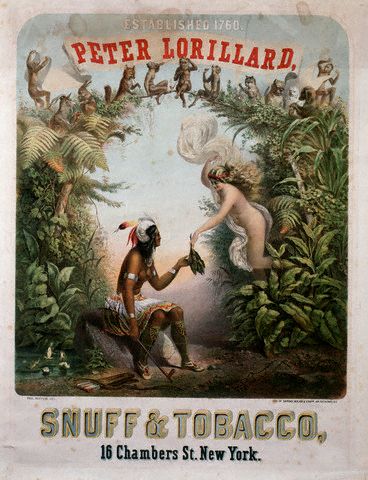
This 1860s advertisement for Peter Lorillard Snuff & Tobacco illustrates these differences. According to Toby and Will Musgrave, writing in An Empire of Plants, the ad drew on a purported Huron legend of a beautiful white spirit bringing them tobacco.

There are a few interesting things going on here. We have the association of femininity with a benign nature: the women are surrounded by various animals (monkeys, a fox and a rabbit, among others) who appear to pose no threat to the women or to one another. The background is lush and productive.

Racialized hierarchies are embedded in the personification of the “white spirit” as a White woman, descending from above to provide a precious gift to Native Americans, similar to imagery drawing on the idea of the “white man’s burden.”

And as often occurred (particularly as we entered the Victorian Era), there was a willingness to put non-White women’s bodies more obviously on display than the bodies of White women. The White woman above is actually less clothed than the American Indian woman, yet her arm and the white cloth are strategically placed to hide her breasts and crotch. On the other hand, the Native American woman’s breasts are fully displayed.

So, the ad provides a nice illustration of the personification of nations with women’s bodies, essentialized as close to nature, but arranged hierarchically according to race and perceived purity.

Originally posted in 2010.

Gwen Sharp is an associate professor of sociology at Nevada State College. You can follow her on Twitter at @gwensharpnv.

Originally posted at Montclair SocioBlog.

Did Donald Trump’s campaign and election cry havoc and unleash the dogs of racism?

Last June, hauling out Sykes and Matza’s concept of “neutralization,” I argued that Trump’s constant denigration of “political correctness” allowed his supporters to neutralize norms against racism. If the denigration of political correctness means that the people who condemn racism are wrong or bad, then what they are condemning must be OK. The logic might not be impeccable, but it works. I argued that I wasn’t sure that Trump had caused an increase in racist attitudes, but he gave people a license to express those attitudes.

Aziz Ansari made a similar point on Saturday Night Live  the day after the inauguration. (Apologies if you have to wait through an ad.)

.

Ansari’s version is much better than mine, and it reached a slightly larger audience. But there’s another important difference. I was talking about the message Trump supporters took from Trump himself before the election. Ansari is talking about the message they got from the electorate. The election changed their perceptions of the norms about expressing anti-immigrant views.

It’s as though minds of half the country had been clouded by “pluralistic ignorance.” That’s the scenario where each person thinks X but assumes that everyone else thinks Y, so everyone keeps their true ideas to themselves. Then something happens that reveals those previously hidden preferences, and suddenly everyone feels liberated. From the Trump supporters’ perspective, Trump was Dorothy throwing a bucket of water to dissolve the Wicked Witch of Political Correctness, and now all the Munchkins were free to express their feelings about Mexicans and Muslims (and perhaps others).

The 20% increase in hate crimes after the election certainly suggests that racists felt liberated by the election. Unfortunately, because of the uncontrolled variables and the small sample size of just one candidate winning one election, this bit of evidence is hardly conclusive.

But we now have some experimental evidence on the topic. In the two weeks before the election, three economists surveyed Mechanical Turkers in eight very Red states. The MTurkers were asked, in addition to other on-topic questions, if they would authorize the economists to make a donation on their behalf to a strongly anti-immigrant group, FAIR.  Mturkers were told, “The founder of FAIR is John Tanton, author of `The Immigration Invasion’ who wrote ‘I’ve come to the point of view that for European-American society and culture to persist requires a European-American majority, and a clear one at that.’”

For half the MTurkers, the donation question included this:

Note: just like any other answer to this survey, also your donation decision will be completely anonymous. No one, not even the researchers, will be able to match your decision to your name. [emphasis in original]

The other half were told:

Important: in order to ensure the quality of the data collected, a member of the research team might personally contact you to verify your answers to the next question and the following ones. [emphasis in original]

In addition, some of the people were told that Trump was certain to win their state. Others were given no information.

The results strongly support the idea that norms – or at least people’s perceptions of the norms – make a big difference. People who thought their choice would be public were much less likely to make the anti-immigrant donation – 34% vs. 54%. But that difference held true only for people who were not told how popular Trump was in their state. Among the people who were told basically, “Trump is a sure thing to win your state,” knowing that their donation would be public (i.e., known to the surveyors) made no difference in their willingness to donate.

If the researchers had stopped there, they would have been able to say

  • there seems to be a norm against giving money to anti-immigrant groups
  • the knowledge of that norm makes people less willing to make a donation to blatantly racist anti-immigrant group if even one stranger can know about that donation
  • if people think that many others in their state support an anti-immigrant candidate, they no longer feel that they need to keep their anti-immigrant views to themselves

Thanks the results of the election, though, they didn’t have to stop there. The gave the researchers a natural experiment to find out if the norms – or at least perceptions of the norms – had changed. Had Trump’s victory caused the scales of pluralistic ignorance to fall from the eyes of these Red-state Turkers?

The answer was yes. The election had the same effect as did the information about Trump support in the person’s state. It obliterated the difference between the public and private conditions.

To people who were reluctant to let their agreement with FAIR be known, Trump’s victory said, “It’s OK. You can come out of the closet. You’re among friends, and there are more of us than you thought.”

Jay Livingston is the chair of the Sociology Department at Montclair State University. You can follow him at Montclair SocioBlog or on Twitter.

How observant are you? Here’s a test! Pay careful attention, then scroll down:

.

.

.

.

.

.

.

Perception is not neutral, it’s curated. If we paid attention to everything in our environments all the time, we’d be overwhelming with information. So, we learn to direct our attention to what seems important at the moment. As a result, we miss a lot. See this example, too.

The directing of our attention is situationally specific, so we learn to adapt our seeing to differing circumstances. When driving, we see different things than we do when we’re walking down the sidewalk or sitting on our front porch. When engaged in a conversation with friends at a bar, we hear different things than when we momentarily turn our focus to the band across the room. When meditating, we feel different things than when we’re daydreaming or waiting to fall asleep. In all these cases, we miss seeing, hearing, and feeling different things, too.

We can imagine that sensation is culturally specific, too, such that people familiar with different cultures literally sense the world differently. Studies comparing the cognition of people from East Asia and America — communal and individualistic societies, respectively — find that Americans looking at a picture tend to focus on a central object, whereas East Asians pay attention to the relationships between objects.

In one study, Japanese and American citizens were shown an underwater scene, like this:

Photo by mycatkins, flickr creative commons.

Asked to describe the scene afterward, Americans started with and focused on the biggest fish, while the Japanese started with the whole picture — for example, “It was a fish tank” — and recalled more details about the rocks, plants, bubbles, and smaller denizens of the pond. “Americans immediately zoomed in on the objects,” the lead scientist Richard Nisbett said. “The Japanese paid more attention to context.”

Our experience of the world isn’t neutral. It’s shaped by our cultural backgrounds, situations, and choices about how to direct our attention. So, the question is, what are you missing? And what are you seeing that others do not?

Lisa Wade, PhD is an Associate Professor at Tulane University. She is the author of American Hookup, a book about college sexual culture; a textbook about gender; and a forthcoming introductory text: Terrible Magnificent Sociology. You can follow her on Twitter and Instagram.