
Search results for embed

Flashback Friday.

During the colonial era, class-privileged citizens of colonizing nations would travel to colonized lands to, as I wrote in a previous post, “enjoy reveling in the seemingly bizarre and unfamiliar people and customs of these Other places…” Human beings, in other words, were among the objects of this tourism, along with gorgeous vistas and unfamiliar plants and animals.

Today many citizens of wealthy nations still yearn for “authentic” and “unique” travel experiences. It is somehow more prestigious to go where others do not. And human beings are still, often, the object of such tourism. This kind of travel, always ethically problematic, has become increasingly disruptive as fewer and fewer places are inaccessible and more and more people are able to afford to get there. For those humans identified as worthy of the tourist gaze, this may sometimes mean constant and overwhelming objectification.

A new documentary, Camera, Camera, documents the crushing weight of tourism in Luang Prabang, Laos, where monks make a traditional sacred procession each morning. Seth Mydans, reviewing the film, writes:

…this sacred ritual is now swarmed by scores of bustling tourists, some of whom lean in with cameras and flashes for closeups as the monks pad silently past.

Screenshot from Camera, Camera.

Frustrated, artist Nithakhong Somsanith says:

They come in buses. They look at the monks the same as a monkey, a buffalo. It is theater… Now the monks have no space to meditate, no space for quiet.

This clip from the documentary captures Somsanith’s concerns beautifully and hauntingly:

Originally posted in 2010.

Lisa Wade, PhD is an Associate Professor at Tulane University. She is the author of American Hookup, a book about college sexual culture; a textbook about gender; and a forthcoming introductory text: Terrible Magnificent Sociology. You can follow her on Twitter and Instagram.
This month sociologist Matthew Desmond won the Pulitzer Prize for his book, Evicted: Poverty and Profit in the American City. Desmond’s book documents, in rich and depressing detail, what it’s like to try to pay rent as a low income earner and how easy it is to end up on the street. Eviction is not caused by personal “irresponsibility,” Desmond insists, it’s essentially “inevitable.”

Eviction is psychologically scarring, but it also throws families further into poverty, destabilizing their work and family lives, often stripping them of their few possessions, and costing money — all while enriching landlords.

Here’s 7 minutes from Desmond about his experience living among low income families and the lessons he learned:

Lisa Wade, PhD is an Associate Professor at Tulane University. She is the author of American Hookup, a book about college sexual culture; a textbook about gender; and a forthcoming introductory text: Terrible Magnificent Sociology. You can follow her on Twitter and Instagram.

Sometimes you have to take the long view.

This week Bill O’Reilly — arguably the most powerful political commentator in America — was let go from his position at Fox News. The dismissal came grudgingly. News broke that he and Fox had paid out $13 million dollars to women claiming O’Reilly sexually harassed them; Fox didn’t budge. They renewed his contract. There was outcry and protests. The company yawned. But when advertisers started dropping The O’Reilly Factor, they caved. O’Reilly is gone.

Fox clearly didn’t care about women — not “women” in the abstract, nor the women who worked at their company — but they did care about their bottom line. And so did the companies buying advertising space, who decided that it was bad PR to prop up a known sexual harasser. Perhaps the decision-makers at those companies also thought it was the right thing to do. Who knows.

Is this progress?

Donald Trump is on record gleefully explaining that being a celebrity gives him the ability to get away with sexual battery. That’s a crime, defined as unwanted contact with an “intimate part of the body” that is done to sexually arouse, gratify, or abuse. He’s president anyway.

And O’Reilly? He walked away with $25 million in severance, twice what all of his victims together have received in hush money. Fox gaves Roger Ailes much more to go away: $40 million. Also ousted after multiple allegations of sexual harassment, his going away present was also twice what the women he had harassed received.

Man, sexism really does pay.

But they’re gone. Ailes and O’Reilly are gone. Trump is President but Billy Bush, the Today host who cackled when Trump said “grab ’em by the pussy,” was fired, too.  Bill Cosby finally had some comeuppance after decades of sexual abuse and rape. At the very least, his reputation is destroyed. Maybe these “victories” — for women, for feminists, for equality, for human decency — were driven purely by greed. And arguably, for all intents and purposes, the men are getting away with it. Trump, Ailes, O’Reilly, Bush, and Cosby are all doing fine. Nobody’s in jail; everybody’s rich beyond belief.

But we know what they did.

Until at least the 1960s, sexual harassment — along with domestic violence, stalking, sexual assault, and rape — went largely unregulated, unnoticed, and unnamed. There was no language to even talk about what women experienced in the workplace. Certainly no outrage, no ruined reputations, no dismissals, and no severance packages. The phrase “sexual harassment” didn’t exist.

In 1964, with the passage of the Civil Rights Act, it became illegal to discriminate against women at work, but only because the politicians who opposed the bill thought adding sex to race, ethnicity, national origin, and religion would certainly tank it. That’s how ridiculous the idea of women’s rights was at the time. But that was then. Today almost no one thinks women shouldn’t have equal rights at work.

What has happened at Fox News, in Bill Cosby’s hotel rooms, in the Access Hollywood bus, and on election day is proof that sexism is alive and well. But it’s not as healthy as it once was. Thanks to hard work by activists, politicians, and citizens, things are getting better. Progress is usually incremental. It requires endurance. Change is slow. Excruciatingly so. And this is what it looks like.

Lisa Wade, PhD is an Associate Professor at Tulane University. She is the author of American Hookup, a book about college sexual culture; a textbook about gender; and a forthcoming introductory text: Terrible Magnificent Sociology. You can follow her on Twitter and Instagram.

“Manspreading” is a relatively new term.  According to Google Trends (below), the concept wasn’t really used before the end of 2014.  But the idea it’s describing is not new at all.  The notion that men occupy more space than women is one small piece of what Raewyn Connell refers to as the patriarchal dividend–the collection of accumulated advantages men collectively receive in androcentric patriarchal societies (e.g., wages, respect, authority, safety).  Our bodies are differently disciplined to the systems of inequality in our societies depending upon our status within social hierarchies.  And one seemingly small form of privilege from which many men benefit is the idea that men require (and are allowed) more space.


It’s not uncommon to see advertisements on all manner of public transportation today condemning the practice of occupying “too much” space while other around you “keep to themselves.”  PSA’s like these are aimed at a very specific offender: some guy who’s sitting in a seat with his legs spread wide enough in a kind of V-shaped slump such that he is effectively occupying the seats around him as well.

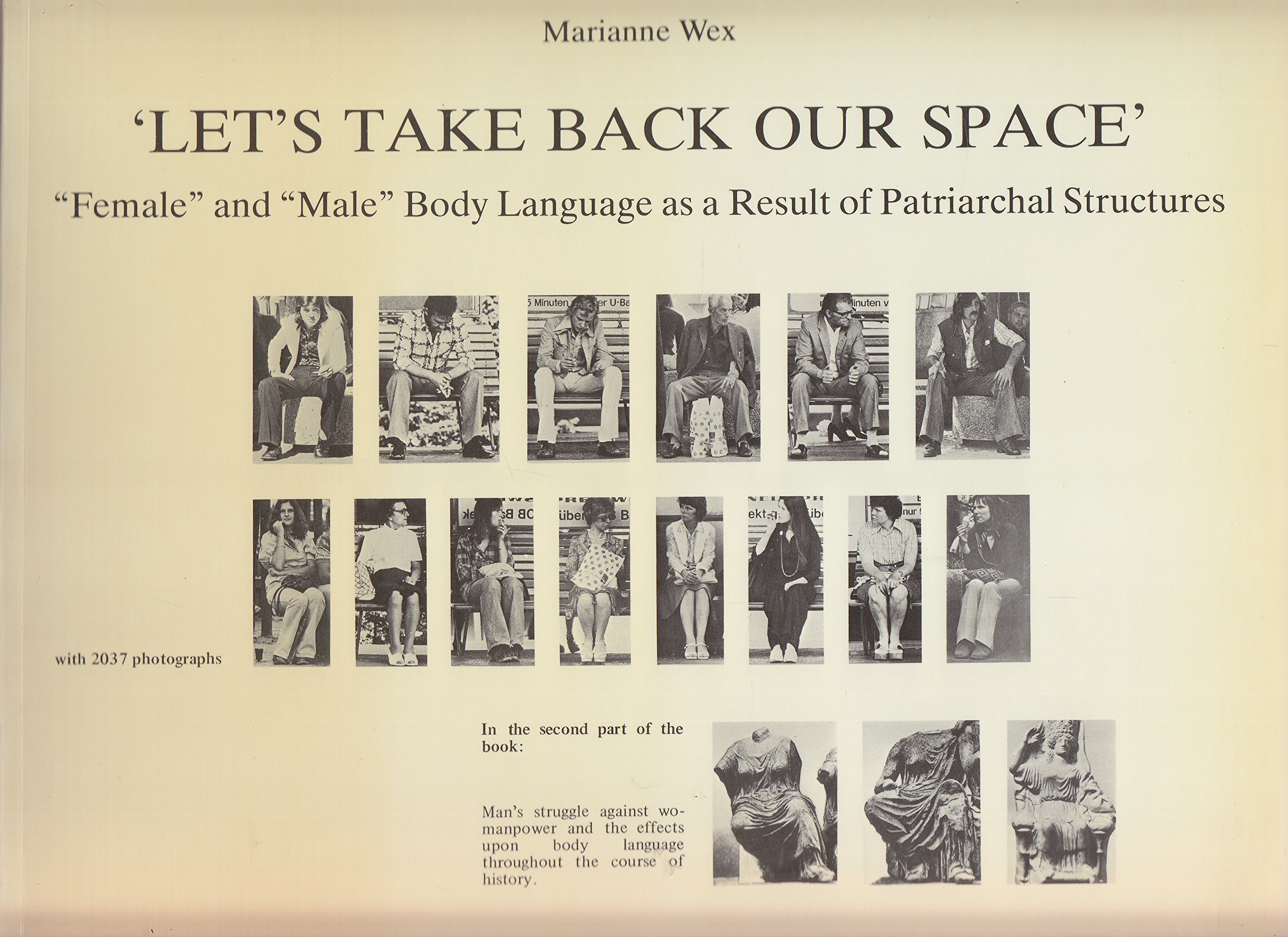
I recently discovered what has got to be one of the most exhaustive treatments of the practice ever produced.  It’s not the work of a sociologist; it’s the work of a German feminist photographer, Marianne Wex.  In Wex’s treatment of the topic, Let’s Take Back Our Space: Female and Male Body Language as a Result of Patriarchal Structures (1984, translated from the German edition, published in 1979), she examines just shy of 5,000 photographs of men and women exhibiting body language that results from and plays a role in reproducing unequal gender relations.

The collection is organized by an laudable number of features of the various bodily positions.  Interestingly, it was published in precisely the same year that Erving Goffman undertook a similar sociological study of what he referred to as “gender display” in his book, Gender Advertisements–though Goffman’s analysis utilized advertisements as the data under consideration.

Like Goffman, Wex examined the various details that made up bodily postures that seem to exude gender, addressing the ways our bodies are disciplined by society.  Wex paired images according to the position of feet and legs, whether the body was situated to put weight on one or two legs, hand and arm positions, and much much more.  And through this project, Wex also developed an astonishing vocabulary for body positions that she situates as the embodied manifestations of patriarchal social structures.  The whole book organizes this incredible collection of (primarily) photographs she took between 1972 and 1977 by theme.  On every page, men are depicted  above women (as the above image illustrates)–a fact Wex saw as symbolizing the patriarchal structure of the society she sought to catalog so scrupulously.  She even went so far as to examine bodily depiction throughout history as depicted in art to address the ways the patterns she discovered can be understood over time.

If you’re interested, you can watch the Youtube video of the entire book.

https://www.youtube.com/watch?v=ScoOF2GDFrM

Tristan Bridges, PhD is a professor at the University of California, Santa Barbara. He is the co-editor of Exploring Masculinities: Identity, Inequality, Inequality, and Change with C.J. Pascoe and studies gender and sexual identity and inequality. You can follow him on Twitter here. Tristan also blogs regularly at Inequality by (Interior) Design.

The Women’s March in Washington had three times more people in attendance than did President Trump’s inauguration. Many have argued about the reasons for these numbers (see here, here, and here), and used them both individually and together to make claims about activism and political support. But something is missing from these conversations. In order to fully understand the differences in attendance at these events in D.C., and to avoid taking these numbers to mean something they do not, we must account for class and race.

Gender, education and race may have been the biggest rifts in voters this past presidential election, but class is part of this political shift. At least part of why people didn’t show up for President Trump’s inauguration in droves but did show up to the Women’s Marches is a story of class privilege and the cultural capital that comes with it. Upper middle class white women and urban dwellers from all classes had easy access to Women’s Marches, both in D.C. and around the country. Many of Trump’s voters would have had to fly to D.C. Because research shows that only about 50% of the population in the US flies each year, and because that tracks with income and education, Women’s March supporters may have been more likely to fly than Trump voters were. If we look at data from just the five counties with the largest vote share for Trump, we see that, except for Buchanan, Virginia, these locations present great travel distance. Further, President Trump received 4.1% of the vote in Washington, D.C., and lost in surrounding states by large percentages. As CNN points out, a trip to inauguration would be a long one for a critical mass of Trump supporters.

White voters from rural areas and those without a college education represent the largest demographics to turn out for Trump. Many of Trump’s supporters reside in more rural areas that are struggling economically. Cost and familiarity with travel, ease and options in taking time off of work, and geographic proximity to D.C. may have affected participation in Inauguration events. Sociologists talk about cultural capital—or the non-financial goods that help with social mobility beyond economic means. Such capital can include knowledge, skills, and education—things that are both material and symbolic. When Emily lived in rural Arkansas, many people she met had never left the state or in some cases even the county. Indeed, when she told a friend there that she flew home for Christmas and it cost $70, he was surprised that a plane ticket cost less than it did to fill up his truck, because he’d never flown before. Emily’s knowledge of air travel is a form of cultural capital, and one that could put her at an advantage in planning a trip to fly to Washington, D.C. for the March. There is an intimidation that comes from not having done that or been there before—your cultural capital can determine how well versed you are in navigating AirBnB and the slew of cheap flight websites that exist.

Why was the Women’s March so highly attended? Many have analyzed the mass turn-out in D.C., nationally, and internationally. For the first time, the Women’s March brought out highly educated, more affluent white women who have the forms of capital to plan and attend a weekend in D.C. Of course, there were many—millions, in fact—who did not go to D.C., but who showed support in sister marches around the country and globe. For many, their lack of attendance in D.C. could be due to the same barriers that perhaps inhibited many from attending the Inauguration. For others, their participation was possible because demographics likely to participate in Women’s Marches – LGBTQA+ folks and people of color – are more likely to reside in urban communities. But to compare these attendance rates without talking about class, and without talking about the mobilization of white women, muddies the realities of who is ready and willing to act at more local levels.

While the Women’s March may have kicked off a movement that has the tools in place for success, we need to remember that Trump’s path to success was unpredicted. To take his inauguration attendance numbers to mean that his initial supporters have changed their minds or that Trump has lost political support would be a potentially grave mistake. To take what is now the largest protest in U.S. history as evidence of mass, continued mobilization, that may also be inaccurate. White women are just starting to show up—will they continue to do so? In talking about the intersections of class and race, we remember who is able to mobilize and show support when, and we must bring these intersections to the fore in future conversations about mobilization and activism.

Sarah Diefendorf is a PhD candidate in Sociology at the University of Washington. Her research centers on sexuality, gender, and evangelical religious groups. You can follow her on Twitter here.

Emily Kalah Gade is a PhD candidate in Political Science at the University of Washington. Her research centers on political violence, civil resistance and militancy.

The 2017 Women’s March was a historic event.  Social media alone gave many of us the notion that something happened on an incredibly grand scale.  But measuring just how “grand” is an inexact science.  Women’s Marches were held around the world in protest of Trump on the day following his inauguration.  Subsequently, lots of folks have tried to find good ways of counting the crowds.  Photos and videos of the crowds at some of the largest marches are truly awe-inspiring.  And the media have gotten stirred up attempting to quantify just how big this march really was.

Think about it.  The image below is taken of some of the crowds in Los Angeles.  The caption Getty Images associates with the image includes the estimate “Hundreds of thousands of protesters…”  But, was it 200,000?  Or was it more like 900,000?  Do you think you could eyeball it and make an educated guess?  We’d bet you’d be off by more than you think.  Previous research has found, for instance, that march participants and organizers are not always the best source of information for how large a protest was.  If you’re there and you’re asked how many people were there, you’re much more likely to exaggerate the number of people who were actually there with you.  And that fact has spawned wildly variable estimates for marches around the U.S. and beyond.

More than one set of estimates exist attempting to figure this out.  The estimates that have garnered the most media attention (deservedly) are those produced by Jeremy Pressman and Erica Chenoweth.  They collected as many estimates as they could for marches all around the world to try to figure out just how large the protest was on a global scale.  Pressman & Chenoweth collected a range of estimates, and in their data set they classify them by source as well as providing the lowest and highest estimates for each of the marches for which they were able to collect data. You can see and interact with those estimates visually below in a map produced by Eric Compas (though some updates were made in the data set after Compas produced the map).

By Pressman & Chenoweth’s estimates, the total number of marchers in the U.S. was between 3,266,829 and 5,246,321 participants.  When they include marches outside the U.S. as well they found that we can add between 266,532 and 357,071 marchers to that number to understand the scale of the protest on an international scale.  That is truly extraordinary.  But, the range is still gigantic.  The difference between their lowest and highest estimate is around 2.1 million people!  Might it be possible to figure out which of these estimates are better estimates of crowd size than others?

Nate Silver at FiveThirtyEight.com tried to figure this out in an interesting way.  They only attempted to answer this question for U.S. marches alone.  And Silver and a collection of his statistical team produced their own data set of U.S. marches.  They collected as many crowd estimates as they could for all of the marches held in the U.S.  And there are lots of holes in their data that Pressman and Chenoweth filled.  March organizers collect information about crowd size and are eager to claim every individual who can be claimed to have been present.  But, local officials estimate crowd sizes as well because it helps to give them a sense of what they will need to prepare for and respond to such crowds.  As a part of this, some marches had estimates from march organizers, news sources, official estimates, as well as estimates from non-partisan experts (so-called crowd scientists)–this is especially true of the larger marches.  Examining their data, they discovered that for every march in which they had both organizer and official estimates, the organizers’ estimate was 50-70% higher than the officials’ estimates.  As Silver wrote: “Or put another way, the estimates produced by organizers probably exaggerated crowd sizes by 40 percent to 100 percent, depending on the city” (here).  The estimates Silver produced at FiveThirtyEight are mapped below.

You can interact with the map to see Nate Silver’s team estimate, but also the various estimates on which that estimate is based.  And you may note that the low and high estimates are often the same for Silver and for Pressman & Chenoweth (though not always).  Additionally, there were a good number of marches in FiveThirtyEight’s data set that lacked any estimates at all. And those marches are not visible on the map above.  Just to consider some of what is missing, you might note that there are no marches on the map immediately above in Puerto Rico, though Silver’s data set includes four marches there–all with no estimates.

Interestingly, Silver took a further step of offering a “best guess” based on patterned differences between types of estimates they found for marches for which they had more than a single source of data (more than one estimate).  For instance, where there were only organizers’ estimates, they discounted that estimate by 40%, assuming that it was exaggerated.  They discounted news estimates by 20% for similar reasons.  Sometimes, non-partisan experts relying on photographs and videos provide estimates were available, which were not discounted (similar to official estimates).

It might be possible then, as Pressman & Chenoweth collected many more estimates, to fine-tune Silver’s formula and possibly come up with an even more accurate estimate of crowd sizes at marches around the world based on the source of the estimate. It’s a fascinating puzzle and a really interesting and simple way of considering how to resolve it with a (likely) conservative measure.

By these (likely conservative) estimates, marches in the U.S. alone drew more than 3,000,000 people across hundreds of separate locations across the nation.  In the U.S. alone, FiveThirtyEight estimated that 3,234,343 people participated (though, as we said, some marches simply lacked any source of data in the data set they produced).  And that number, you might note, is strikingly close to Pressman & Chenoweth’s low estimate for the U.S. (3,266,829).  Even by this conservative estimate, this would qualify the 2017 Women’s March as certainly among the largest mass protests in U.S. history.  It may very well have been the largest mass protest in American history.  And in our book, that’s worth counting.

Tara Leigh Tober, PhD is a Lecturer in the Sociology Department at the University of California, Santa Barbara.  She studies the sociology of memory, is writing a book on how the Irish have remembered being neutral during WWII, and is presently engaged in a study on mass shootings in the U.S.  You can follow her on Twitter here.

Tristan Bridges, PhD is a professor at the University of California, Santa Barbara. He is the co-editor of Exploring Masculinities: Identity, Inequality, Inequality, and Change with C.J. Pascoe and studies gender and sexual identity and inequality. You can follow him on Twitter here. Tristan also blogs regularly at Inequality by (Interior) Design.

The 2020 Summer Olympics will be held in Japan.  And when the prime minister of Japan, Shinzo Abe, made this public at the 2016 Olympics in Rio de Janeiro, Brazil, he did so in an interesting way.   He was standing atop a giant “warp pipe” dressed as Super Mario.  I’m trying to imagine the U.S. equivalent.  Can you imagine the president of the United States standing atop the golden arches, dressed as Ronald McDonald, telling the world that we’d be hosting some international event?

Prime minister Abe was able to do this because Mario is a cultural icon recognized around the world.  That Italian-American plumber from Brooklyn created in Japan is truly a global citizen. The Economist recently published an essay on how Mario became known around the world.

Mario is a great example of a process sociologists call cultural globalization.  This is a more general social process whereby ideas, meanings, and values are shared on a global level in a way that intensifies social relations.  And Japan’s prime minister knew this.  Shinzo Abe didn’t dress as Mario to simply sell more Nintendo games.  I’m sure it didn’t hurt sales.  In fact, in the past decade alone, Super Mario may account for up to one third of the software sales by Nintendo.  More than 500 million copies of games in which Mario is featured circulate worldwide.  But, Japan selected Mario because he’s an illustration of technological and artistic innovations for which the Japanese economy is internationally known.  And beyond this, Mario is also an identity known around the world because of his simple association with the same human sentiment—joy.  He intensifies our connections to one another.  You can imagine people at the ceremony in Rio de Janeiro laughing along with audience members from different countries who might not speak the same language, but were able to point, smile, and share a moment together during the prime minister’s performance.  A short, pudgy, mustached, working-class, Italian-American character is a small representation of that shared sentiment and pursuit.  This intensification of human connection, however, comes at a cost.

We may be more connected through Mario, but that connection takes place within a global capitalist economy.  In fact, Wisecrack produced a great short animation using Mario to explain Marxism and the inequalities Marx saw as inherent within capitalist economies.  Cultural globalization has more sinister sides as well, as it also has to do with global cultural hegemony.  Local culture is increasingly swallowed up.  We may very well be more internationally connected.  But the objects and ideas that get disseminated are not disseminated on an equal playing field.  And while the smiles we all share when we connect with Mario and his antics are similar, the political and economic benefits associated with those shared smirks are not equally distributed around the world.  Indeed, the character of Mario is partially so well-known because he happened to be created in a nation with a dominant capitalist economy.  Add to that that the character himself hails from another globally dominant nation–the U.S.  The culture in which he emerged made his a story we’d all be much more likely to hear.

Tristan Bridges, PhD is a professor at the University of California, Santa Barbara. He is the co-editor of Exploring Masculinities: Identity, Inequality, Inequality, and Change with C.J. Pascoe and studies gender and sexual identity and inequality. You can follow him on Twitter here. Tristan also blogs regularly at Inequality by (Interior) Design.

Late last year Covergirl announced a new spokesmodel, a 17-year-old named James Charles. Their Instagram announcement currently boasts over 53,000 likes, though the comments on the post were decidedly mixed. They ranged from “I will never buy another (coverGIRL) because of this” to  “love love love” and “the world is coming to equality and acceptingness.”

In my circles, the overwhelming response was enthusiasm. Charles’ ascendance to Covergirl status was evidence that gender flexibility was going mainstream. And, I suppose it is.

I am always suspicious, though, of corporate motives. Covergirl’s decision to feature Charles does serve to break down the gender binary, but it does other things, too. Most notably, if makeup companies could convince boys and men that their product is as essential for them as it is for girls and women, it would literally double the size of their market.

That this hasn’t happened yet, in fact, is evidence of the triumph of gender ideology over capitalism. Either companies have decided that there’s (almost) no market in men or men have resisted what marketing has been applied. It’s an impressive resistance to what seems like an obvious expansion. There’s just no money in men thinking their faces look just fine as they are; the fact that we’ve allowed them to do so thus far is actually pretty surprising when you think about it.

If Covergirl had its way, though, I have no doubt that it would make every 17-year-old boy in America into a James Charles. Such a change would contribute to breaking down the gender binary, at least as we know it (though no doubt there are more and less feminist ways of doing this). Of course, if it was advantageous to do so, Covergirl would claim that it had something to do with feminism. But, I wouldn’t buy it.

Lisa Wade, PhD is an Associate Professor at Tulane University. She is the author of American Hookup, a book about college sexual culture; a textbook about gender; and a forthcoming introductory text: Terrible Magnificent Sociology. You can follow her on Twitter and Instagram.