Search results for embed

Many tennis clubs today uphold an all-white dress code. But does this homage to tradition come with the racism and sexism of the past? Wimbledon’s achromatic clothing policy hearkens back to the Victorian era, when donning colorless attire was regarded as a necessary measure to combat the indecency of sweat stains, particularly for women. Of course, back then, women customarily played tennis in full-length skirts and men in long cotton pants — also for propriety’s sake.  
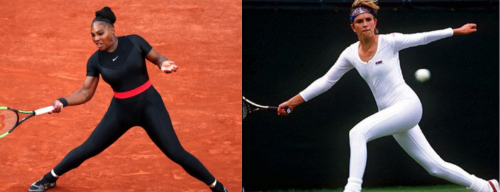
Serena Williams at the French Open, 2018 Anne White at Wimbledon, 1985

But today, not all tennis clubs insist on all-white.While Wimbledon is known for having the strictest dress standards (even Anne White’s catsuit pictured above got banned there in 1985), the other grand slams, including the French Open (along with the U.S. Open and the Australian Open), have recently become venues for athletes to showcase custom fashions in dramatic colors and patterns. Since the advent of color TV, athletes have used their clothing to express their personality and distinguish themselves from their competitors.

For instance, Serena Williams wore a black Nike catsuit to this year’s French Open. Her catsuit, a full-body compression garment, not only made her feel like a “superhero,” but also functioned to prevent blood clots, a health issue she’s dealt with frequently and which contributed to complications with the birth of her daughter. On Instagram, she dedicated it to “all the moms out there who had a tough recovery from pregnancy.”

Despite this supposed freedom, Williams’ catsuit drew the ire of the French Tennis Federation. Its president, Bernard Giudicelli, said in an interview with Tennis Magazine that “[Catsuits] will no longer be accepted.” The FTF will be asking designers to give them an advance look at designs for players and will “impose certain limits.” His rationale?I think that sometimes we’ve gone too far,” and “One must respect the game and the place.”

The new policy and the coded language Giudicelli used to justify it have been called out as both racist and sexist. By characterizing Williams’s catsuit as a failure to “respect the game,” the FTF echoes other professional sporting associations who have criticized Black football players kneeling during the anthem and Black or Latino baseball players’ celebrating home runs. Moreover, the criticism of Williams’ form-fitting clothing and the reactionary new dress code it spawned are merely the latest in a series of critiques of Williams’ physique.

Sociologist Pierre Bourdieu explains in his “Program for a Sociology of Sport” that practices like the policing of athletes’ apparel are a way for the tennis elite to separate themselves from other players and preserve a hierarchy of social status. This became necessary as the sport, derived from royal tennis and known as the “Sport of Kings,” experienced a huge increase in popularity since the 1960s. Bourdieu describes how this expansion resulted in a variety of ways to play tennis, some more distinctive than others:

…under the same name, one finds ways of playing that are as different as cross-country skiing, mountain touring, and downhill skiing are in their own domain. For example, the tennis of small municipal clubs, played in jeans and Adidas on hard surfaces, has very little in common with the tennis in white outfits and pleated skirts which was the rule some 20 years ago and still endures in select clubs. (One would also find a world of differences at the level of the style of the players, in their relation to competition and to training, etc.)

In reanimating the dress code, FTF officials are engaging in boundary work to preserve the status of a certain kind of tennis — and, by extension, a certain kind of tennis player — at the top of the hierarchy. In so doing, it is limiting the expression of a sports icon who redefines beauty and femininity and perhaps elite tennis itself.

Amy August is a doctoral candidate in Sociology at the University of Minnesota. Her research focuses on education, family, culture, and sport. Her dissertation work uses qualitative methods to compare the forms of social capital recognized and rewarded by teachers and coaches in school and sports. Amy holds a BA in English Literature from the University of Illinois at Chicago, a MA in Teaching from Dominican University, and a MA in Comparative Human Development from the University of Chicago.
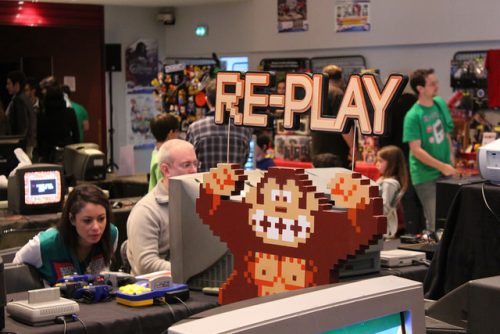
Our lives are a team effort, often influenced by larger social forces outside of our control. At the same time, we love stories about singular heroes rising to the occasion. Sociologists often argue that focusing too much on individual merit teaches us not to see the rest of the social world at play.

Photo Credit: Vadu Amka, Flickr CC

One of my favorite recent examples of this is a case from Christopher A. Paul’s book, The Toxic Meritocracy of Video Games, about the popular team-based competitive shooter Overwatch. After the match is over and a winning team declared, one player is awarded “play of the game,” and everyone watches an automatically-generated replay. Paul writes that the replay…

… takes one moment out of context and then chooses to only celebrate one of twelve players when the efforts of the other members of the team often make the moment possible…a more dynamic, holistic system would likely be harder to judge and code, which is a problem at the heart of meritocracy. Actually judging skill or effort is ridiculously difficult to do…the algorithm built into selecting what is the play of the game and which statistics will be highlighted rewards only what it can count and judge, stripping out situation and context. (2018, Pp. 34-35)

It isn’t just the computer doing this; there is a whole genre of youtube videos devoted to top plays and personalized highlight reels from games like Overwatch, Paladins, and Counter Strike: Global Offensive.


Paul’s point got me thinking about the structure and culture of replays in general. They aren’t always about a star player. Sometimes we see the execution of a brilliant team play. Other times, it’s all about the star’s slam dunk. But replays do highlight one of the weird structural features about modern competition. Many of the most popular video games in the massive esports industry are team based, but because these are often played in a first-person or limited third person view, replays and highlight reels from these games are often cast from the perspective of a single “star” player.

This is a great exercise for thinking sociologically in everyday life and in the classroom. Watch some replays from your favorite team sport. Are the highlights emphasizing teamwork or are they focusing on a single player’s achievements? Do you think different replays would have been possible without the efforts of the rest of the team? How does the structure of the shot—the composition and perspective—shape the viewer’s interpretation of what happened on the field?

Evan Stewart is an assistant professor of sociology at University of Massachusetts Boston. You can follow his work at his website, or on BlueSky.

People talk. Their interactions become habits, habits become routines, and routines become rules. Sociologists call this emergent behavior, and sometimes it happens so slowly we don’t even notice it until we look back and think “where did that come from?”  Emergent behavior can be quirky and fun (think of Taco Friday at the office or “on Wednesdays we wear pink“), but sometimes it can also be far more serious or more troubling.

The challenge is that new technology makes these interactions happen much faster, on a much larger scale, and with less editing—often with odd results. Check out this TED talk—The Nightmare Videos of Children’s YouTube— for a good illustration of the dark side of emergent behavior when algorithms accelerate and exploit social interactions online.


Evan Stewart is an assistant professor of sociology at University of Massachusetts Boston. You can follow his work at his website, or on BlueSky.

One major part of introducing students to sociology is getting to the “this is water” lesson: the idea that our default experiences of social life are often strange and worthy of examining. This can be challenging, because the default is often boring or difficult to grasp, but asking the right questions is a good start (with some potentially hilarious results).

Take this one: what does English sound like to a non-native speaker? For students who grew up speaking it, this is almost like one of those Zen koans that you can’t quite wrap your head around. If you intuitively know what the language means, it is difficult to separate that meaning from the raw sounds.

That’s why I love this video from Italian pop singer Adriano Celentano. The whole thing is gibberish written to imitate how English slang sounds to people who don’t speak it.


Another example to get class going with a laugh is the 1990s video game Fighting Baseball for the SNES. Released in Japan, the game didn’t have the licensing to use real players’ names, so they used names that sounded close enough. A list of some of the names still bounces around the internet:

The popular idea of the Uncanny Valley in horror and science fiction works really well for languages, too. The funny (and sometimes unsettling) feelings we get when we watch imitations of our default assumptions fall short is a great way to get students thinking about how much work goes into our social world in the first place.

Evan Stewart is an assistant professor of sociology at University of Massachusetts Boston. You can follow his work at his website, or on BlueSky.

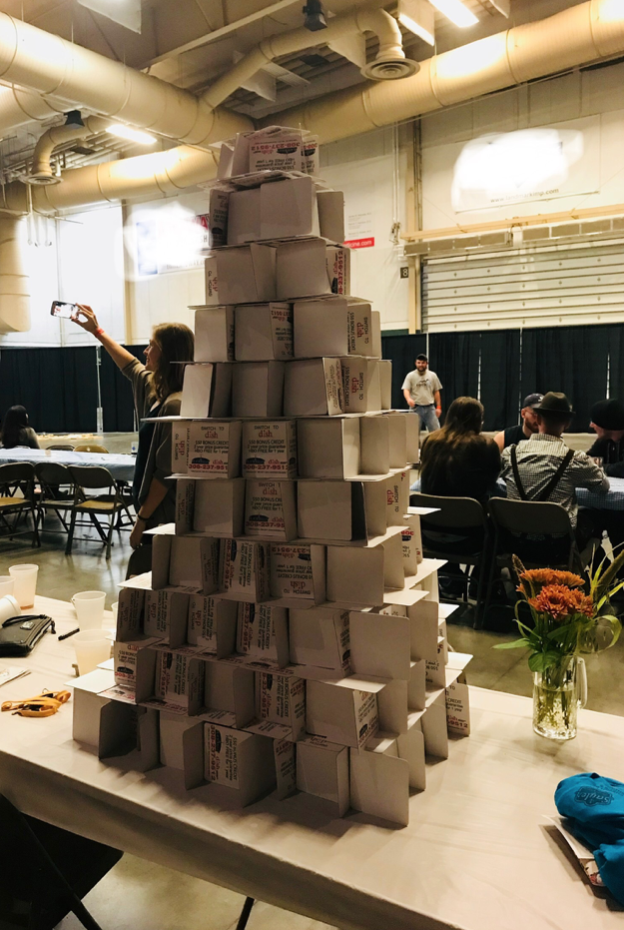
When I was eight, my brother and I built a card house. He was obsessed with collecting baseball cards and had amassed thousands, taking up nearly every available corner of his childhood bedroom. After watching a particularly gripping episode of The Brady Bunch, in which Marsha and Greg settled a dispute by building a card house, we decided to stack the cards in our favor and build. Forty-eight hours later a seven-foot monstrosity emerged…and it was glorious.

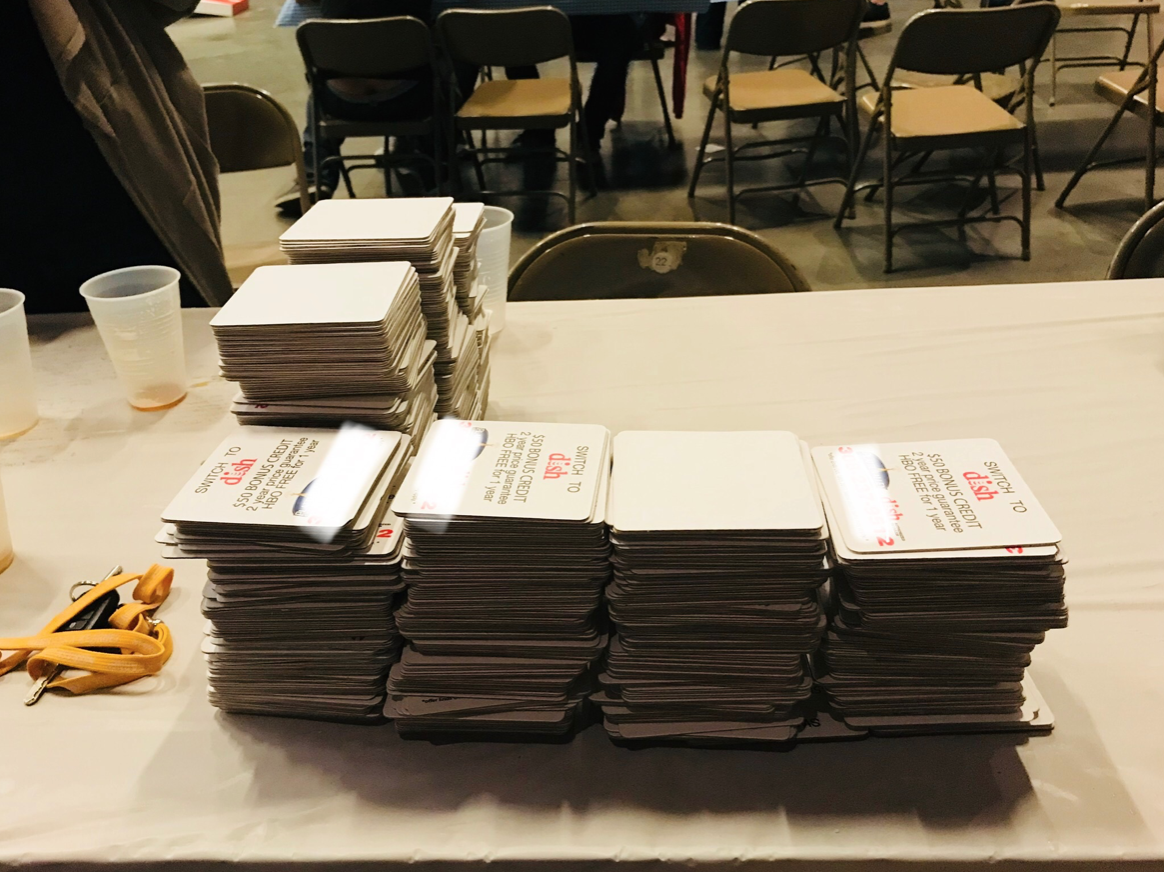
I told this story to a group of friends as I ran a stack of paper coasters through my fingers. We were attending Oktoberfest 2017 in a rural university town in the Midwest. They collectively decided I should flex my childhood skills and construct a coaster card house. Supplies were in abundance and time was no constraint. 

I began to construct. Four levels in, people around us began to take notice; a few snapped pictures. Six levels in, people began to stop, actively take pictures, and inquire as to my progress and motivation. Eight stories in, a small crowd emerged. Everyone remained cordial and polite. At this point it became clear that I was too short to continue building. In solidarity, one of my friends stood on a chair to encourage the build. We built the last three levels together, atop chairs, in the middle of the convention center. 

Where inquires had been friendly in the early stages of building, the mood soon turned. The moment chairs were used to facilitate the building process was the moment nearly everyone in attendance began to take notice. As the final tier went up, objects began flying at my head. Although women remained cordial throughout, a fraction of the men in the crowd began to become more and more aggressive. Whispers of  “I bet you $50 that you can’t knock it down” or “I’ll give you $20 if you go knock it down” were heard throughout.  A man chatted with my husband, criticizing the structural integrity of the house and offering insight as to how his house would be better…if he were the one building. Finally, a group of very aggressive men began circling like vultures. One man chucked empty plastic cups from a few tables away. The card house was complete for a total of 2-minutes before it fell. The life of the tower ended as such: 

Man: “Would you be mad if someone knocked it down?”

Me: “I’m the one who built it so I’m the one who gets to knock it down.”

Man: “What? You’re going to knock it down?”

The man proceeded to punch the right side of the structure; a quarter of the house fell. Before he could strike again, I stretched out my arms knocking down the remainder. A small curtsey followed, as if to say thank you for watching my performance. There was a mixture of cheers and boos. Cheers, I imagine from those who sat in nearby tables watching my progress throughout the night. Boos, I imagine, from those who were denied the pleasure of knocking down the structure themselves.

As an academic it is difficult to remove my everyday experiences from research analysis.  Likewise, as a gender scholar the aggression displayed by these men was particularly alarming. In an era of #metoo, we often speak of toxic masculinity as enacting masculine expectations through dominance, and even violence. We see men in power, typically white men, abuse this very power to justify sexual advances and sexual assault. We even see men justify mass shootings and attacks based on their perceived subordination and the denial of their patriarchal rights.

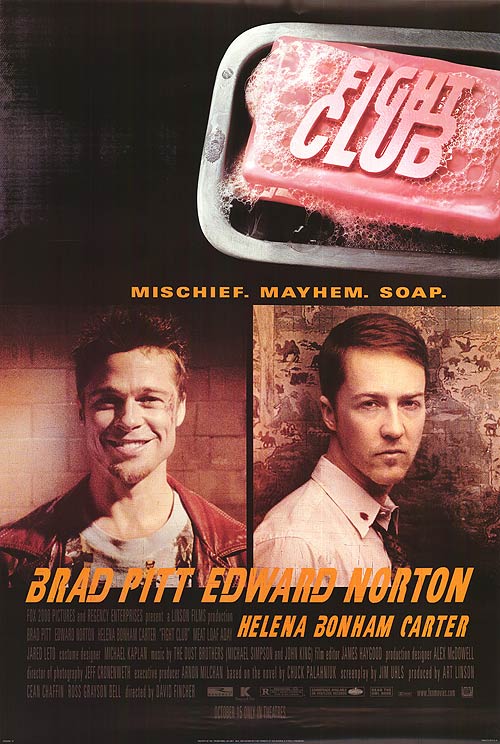
Yet toxic masculinity also exits on a smaller scale, in their everyday social worlds. Hegemonic masculinity is a more apt description for this destructive behavior, rather than outright violent behavior, as hegemonic masculinity describes a system of cultural meanings that gives men power — it is embedded in everything from religious doctrines, to wage structures, to mass media. As men learn hegemonic expectations by way of popular culture—from Humphrey Bogart to John Wayne—one cannot help but think of the famous line from the hyper-masculine Fight Club (1999), “I just wanted to destroy something beautiful.”

Power over women through hegemonic masculinity may best explain the actions of the men at Ocktoberfest. Alcohol consumption at the event allowed men greater freedom to justify their destructive behavior. Daring one another to physically remove a product of female labor, and their surprise at a woman’s choice to knock the tower down herself, are both in line with this type of power over women through the destruction of something “beautiful”.

Physical violence is not always a key feature of hegemonic masculinity (Connell 1987: 184). When we view toxic masculinity on a smaller scale, away from mass shootings and other high-profile tragedies, we find a form of masculinity that embraces aggression and destruction in our everyday social worlds, but is often excused as being innocent or unworthy of discussion.

Sandra Loughrin is an Assistant Professor at the University of Nebraska at Kearney. Her research areas include gender, sexuality, race, and age.

On November 1st, 2017, Muslim YouTube phenomenon Dina Tokio premiered her documentary project “#YourAverageMuslim,” a four-part Creators for Change series produced by YouTube. This documentary is a prime example of the meaningful feminist digital activism being undertaken by contemporary Muslim women. Such activism seeks to reframe the discourse around Muslim women by showing that successful, independent and bold Muslim women are not the exception, but the norm.

For centuries, Muslim women have been subject to the Orientalist gaze, which paints Muslim female bodies as exotic, veiled, and oppressed victims in various visual and written depictions. These depictions have largely shaped the experiences of average Muslim women, who must deal with constantly being stereotyped by the public as victims of their culture and religion. These Muslim women have now taken to the online world to fight against these stereotypes. By using online platforms to make documentaries such as #YourAverageMuslim and music videos like “Somewhere in America #Mipsterz” (both of which received millions of views online) these women have been quite successful in extending their perspectives to wider audiences.

“Somewhere In America” – dir. Habib Yazdi from XY CONTENT on Vimeo.

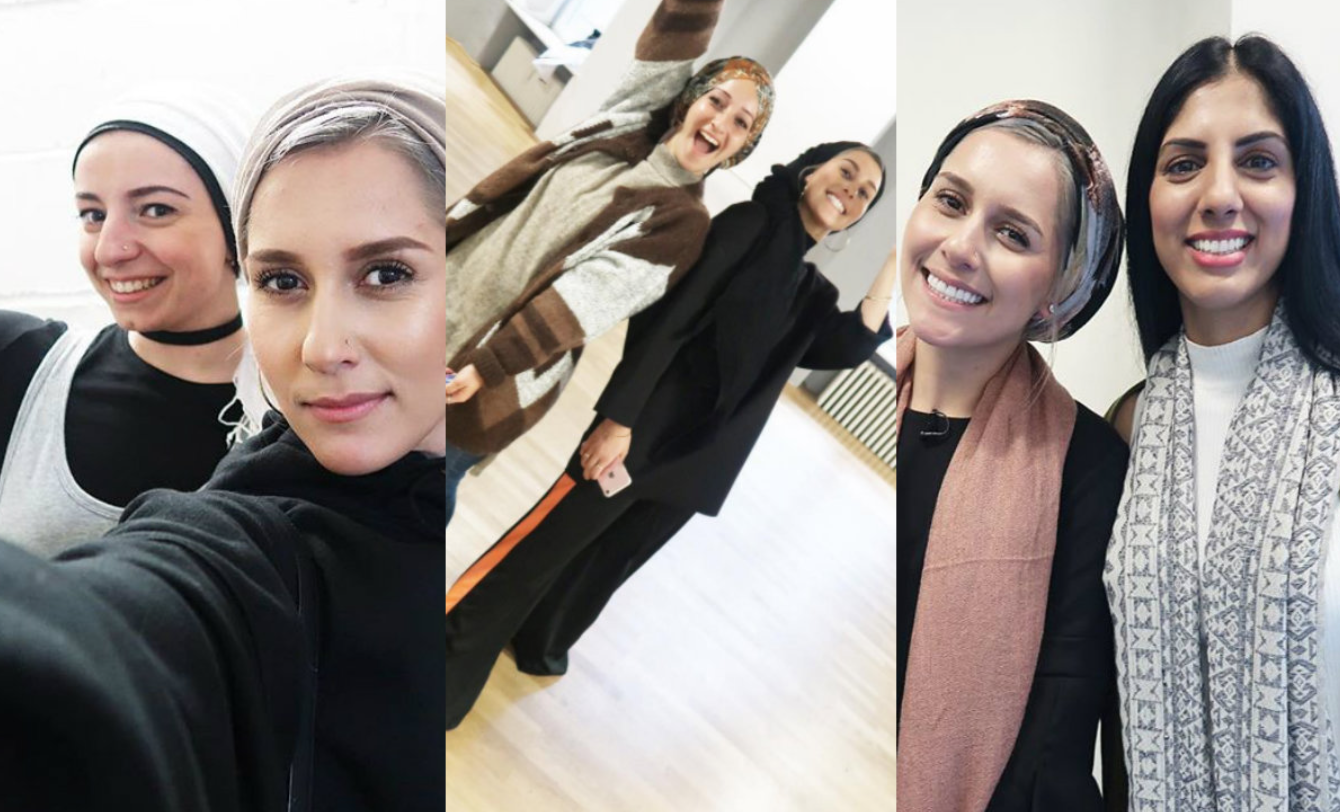
#YourAverageMuslim highlights the lives of three Muslim women in Europe – Dalya Mlouk, Emine, and Sofia Buncy. Dalya Mlouk is the world’s first female hijabi power-lifter, who has broken the world record for deadlifting in her age and weight category. German hip-hop dancer Emine dominates Berlin’s underground hip-hop dance world, and is the first hijabi dance teacher in Europe who also owns her own dance school. Sofia Buncy stands out from the other women, in that she doesn’t wear the hijab, but works primarily in an overlooked area of social work, catering to the needs of Muslim women in prisons. 

Dina Tokio with Dalya Mlouk, Emine, and Sofia Buncy

While all these women are doing exceptional work, whether it be individual or community based, the aim of this documentary is not to showcase how exceptional these women are. Rather, its priority is to normalize the idea that your average Muslim woman may come from diverse backgrounds and is successful, multi-talented, and determined to live her life the way she chooses. Western media representations of minority groups play a large role in shaping how the public conceptualizes its notions of such groups. When these conceptualizations are depicted repeatedly, they become normalized and shape the experiences of minority group members. #YourAverageMuslim seeks to disrupt those representations by normalizing an alternate conceptualization that refrains from reducing the complex nature of the Muslim female experience in the West. This project is unique as it is dedicated specifically to showing amazing women who are not breaking any stereotype, but are instead leading #YourAverageMuslim life.

Inaash Islam is a PhD student in Sociology at Virginia Tech. She specializes in the areas of race, culture and identity, and focuses specifically on the Muslim experience in the West. 

Source Photo: Ted Eytan, Flickr CC

It’s that time of year again! Fans across the nation are coming together to cheer on their colleges and universities in cutthroat competition. The drama is high and full of surprises as underdogs take on the established greats—some could even call it madness.

I’m talking, of course, about The International Championship of Collegiate A Cappella.

In case you missed the Pitch Perfect phenomenon, college a cappella has come a long way from the dulcet tones of Whiffenpoofs in the West Wing. Today, bands of eager singers are turning pop hits on their heads. Here’s a sampler, best enjoyed with headphones:

And competitive a cappella has gotten serious. Since its founding in 1996, the ICCA has turned into a massive national competition spawning a separate high school league and an open-entry, international competition for any signing group.

As a sociologist, watching niche hobbies turn into subcultures and subcultures turn into established institutions is fascinating. We even have data! Varsity Vocals publishes the results of each ICCA competition, including the scores and university affiliations of each group placing in the top-three of every quarterfinal, regional semifinal, and national final going back to 2006. I scraped the results from over 1300 placements to see what we can learn when a cappella meets analytics.

Watching a Conference Emerge

Organizational sociologists study how groups develop into functioning formal organizations by turning habits into routines and copying other established institutions. Over time, they watch how behaviors  become more bureaucratic and standardized.

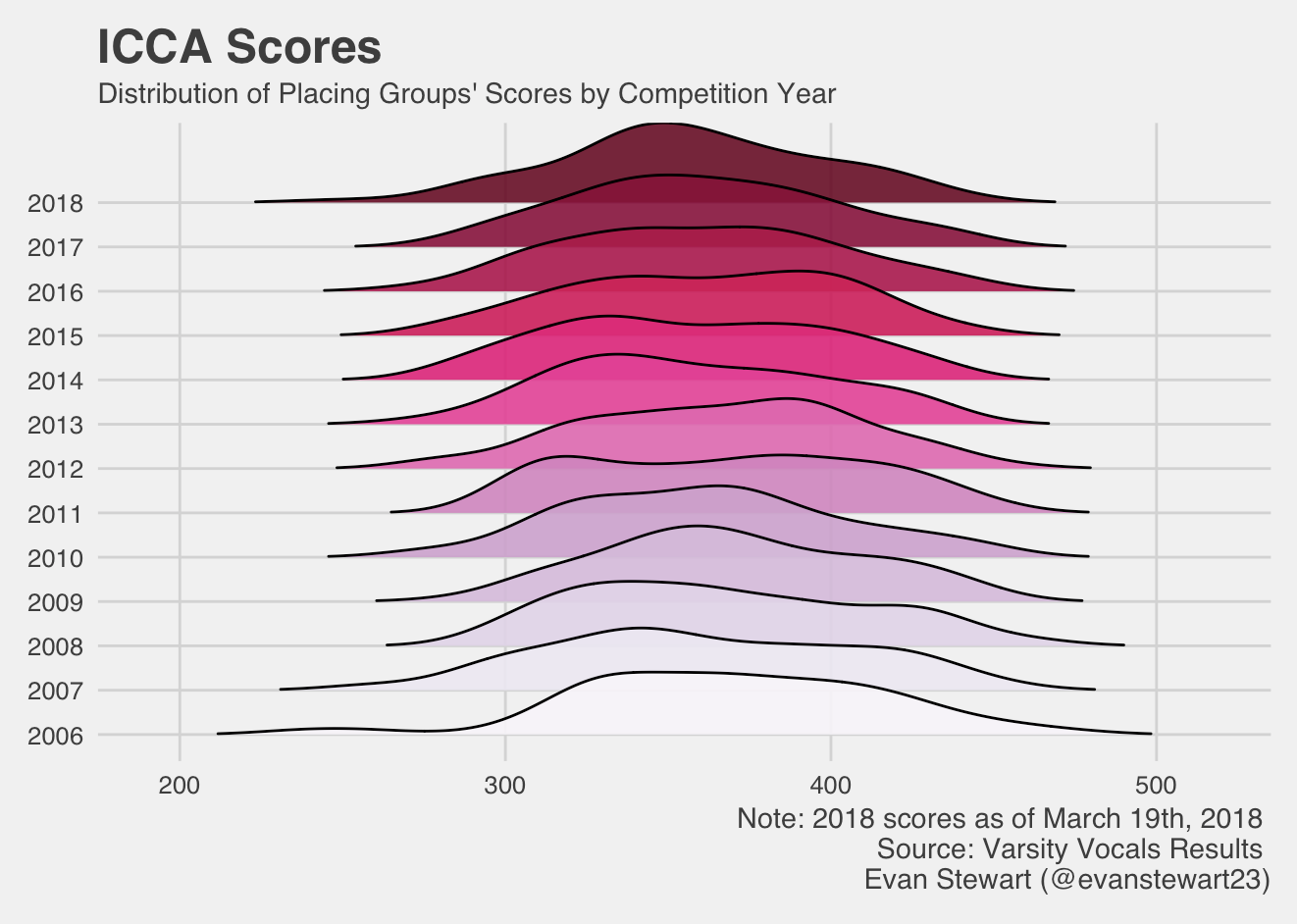
We can watch this happen with the ICCAs. Over the years, Varsity Vocals has established formal scoring guidelines, judging sheets, and practices for standardizing extreme scores. By graphing out the distribution of groups’ scores over the years, you can see the competition get more consistent in its scoring over time. The distributions narrow in range, and they take a more normal shape around about 350 points rather than skewing high or low.

(Click to Enlarge)

Gender in the A Cappella World

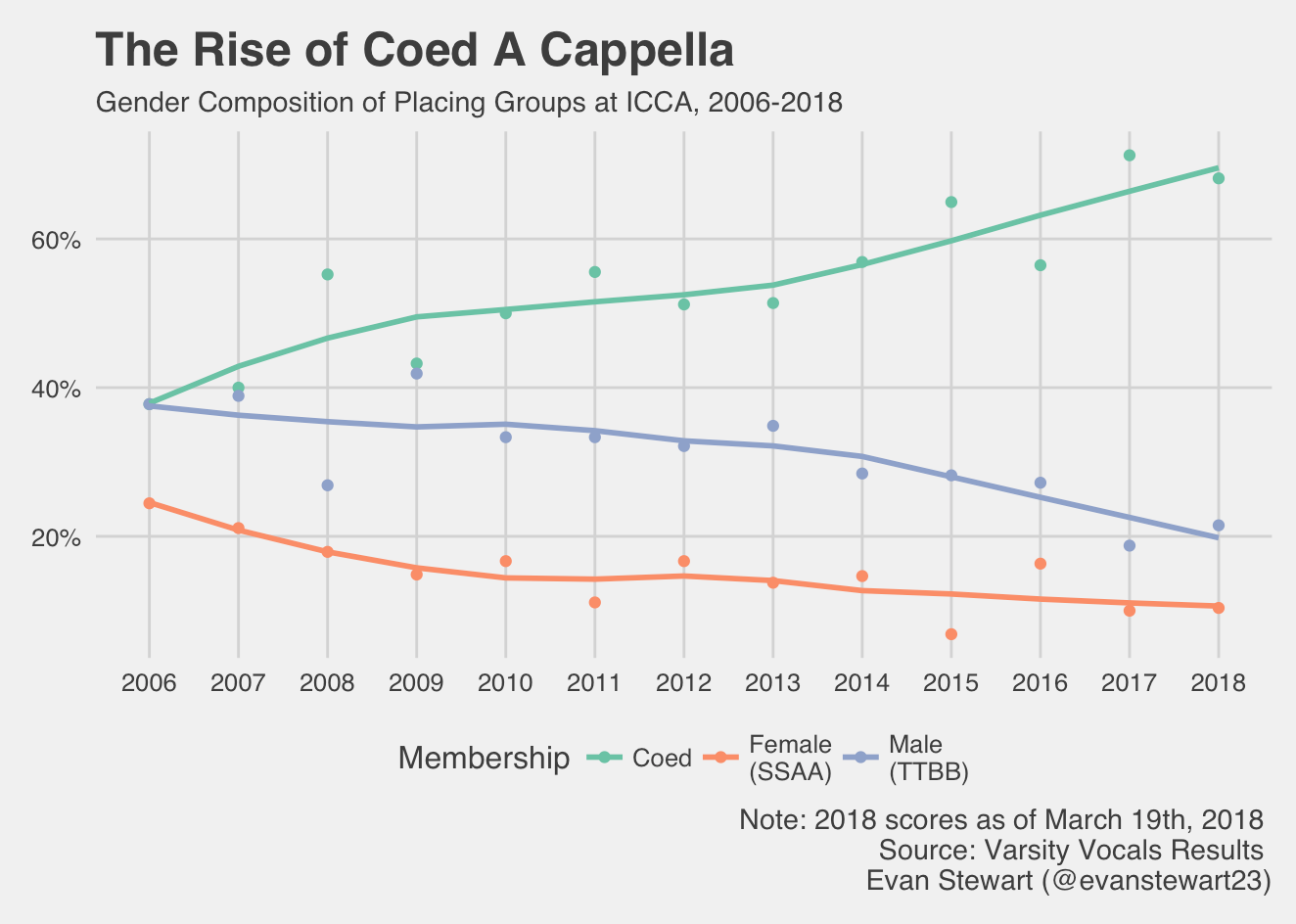
Gender is a big deal in a cappella, because many groups define their membership by gender as a proxy for vocal range. Coed groups get a wider variety of voice parts, making their sound more versatile, but gender-exclusive groups can have an easier time getting a blended, uniform sound. This raises questions about gender and inequality, and there is a pretty big gender gap in who places at competition.

In light of this gap, one interesting trend is the explosion of coed a cappella groups over the past twelve years. These groups now make up a much larger proportion of placements, while all male and all female groups have been on the decline.

(Click to Enlarge)

Who Are the Powerhouse Schools?

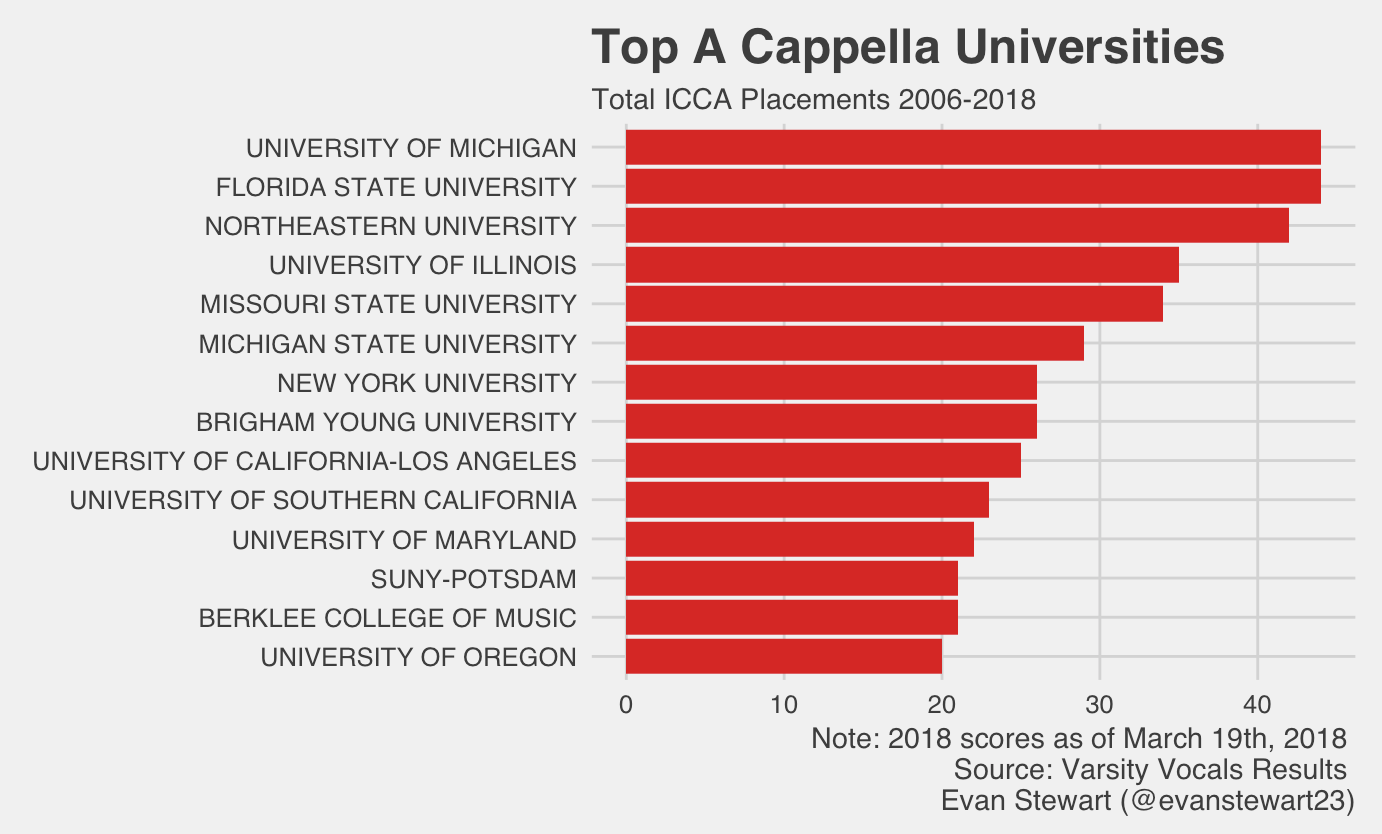
Just like March Madness, one of my favorite parts about the ICCA is the way it brings together all kinds of students and schools. You’d be surprised by some of the schools that lead on the national scene. Check out some of the top performances on YouTube, and stay tuned to see who takes the championship next month!

(Click to Enlarge)


Evan Stewart is an assistant professor of sociology at University of Massachusetts Boston. You can follow his work at his website, or on BlueSky.

National Ugly Christmas Sweater Day is this Friday, December 15th. Perhaps you’ve noticed the recent ascent of the Ugly Christmas Sweater or even been invited to an Ugly Christmas Sweater Party. How do we account for this trend and its call to “don we now our tacky apparel”?

Total search of term “ugly Christmas sweater” relative to other searches over time (c/o Google Trends):

Ugly Christmas Sweater parties purportedly originated in Vancouver, Canada, in 2001. Their appeal might seem to stem from their role as a vehicle for ironic nostalgia, an opportunity to revel in all that is festively cheesy. It also might provide an opportunity to express the collective effervescence of the well-intentioned (but hopelessly tacky) holiday apparel from moms and grandmas.

However, The Atlantic points to a more complex reason why we might enjoy the cheesy simplicity offered by Ugly Christmas Sweaters: “If there is a war on Christmas, then the Ugly Christmas Sweater, awesome in its terribleness, is a blissfully demilitarized zone.” This observation pokes fun at the Fox News-style hysterics regarding the “War on Christmas”; despite being commonly called Ugly Christmas Sweaters, the notion seems to persist that their celebration is an inclusive and “safe” one.

Photo Credit: TheUglySweaterShop, Flickr CC

We might also consider the generally fraught nature of the holidays (which are financially and emotionally taxing for many), suggesting that the Ugly Sweater could offer an escape from individual holiday stress. There is no shortage of sociologists who can speak to the strain of family, consumerism, and mental health issues that plague the holidays, to say nothing of the particular gendered burdens they produce. Perhaps these parties represent an opportunity to shelve those tensions.

But how do we explain the fervent communal desire for simultaneous festive celebration and escape? Fred Davis notes that nostalgia is invoked during periods of discontinuity. This can occur at the individual level when we use nostalgia to “reassure ourselves of past happiness.” It may also function as a collective response – a “nostalgia orgy”- whereby we collaboratively reassure ourselves of shared past happiness through cultural symbols. The Ugly Christmas Sweater becomes a freighted symbol of past misguided, but genuine, familial affection and unselfconscious enthusiasm for the holidays – it doesn’t matter that we have not all really had the actual experience of receiving such a garment.

Jean Baudrillard might call the process of mythologizing the Ugly Christmas Sweater a simulation, a collapsing between reality and representation. And, as George Ritzer points out, simulation can become a ripe target for corporatization as it can be made more spectacular than its authentic counterparts. We need only look at the shift from the “authentic” prerogative to root through one’s closet for an ugly sweater bestowed by grandma (or even to retrieve from the thrift store a sweater imparted by someone else’s grandma) to the cottage-industry that has sprung up to provide ugly sweaters to the masses. There appears to be a need for collective nostalgia that is outstripped by the supply of “actual” Ugly Christmas Sweaters that we have at our disposal.

Colin Campbell states that consumption involves not just purchasing or using a good or service, but also selecting and enhancing it. Accordingly, our consumptive obligation to the Ugly Christmas Sweater becomes more demanding, individualized and, as Ritzer predicts, spectacular. For examples, we can view this intensive guide for DIY ugly sweaters. If DIY isn’t your style, you can indulge your individual (but mass-produced) tastes in NBA-inspired or cultural mash-up Ugly Christmas Sweaters, or these Ugly Christmas Sweaters that aren’t even sweaters at all.

The ironic appeal of the Ugly Christmas Sweater Party is that one can be deemed festive for partaking, while simultaneously ensuring that one is participating in a “safe” celebration – or even a gentle mockery – of holiday saturation and demands. The ascent of the Ugly Christmas Sweater has involved a transition from ironic nostalgia vehicle to a corporatized form of escapism, one that we are induced to participate in as a “safe” form of  festive simulation that becomes increasingly individualized and demanding in expression.

Re-posted at Pacific Standard.

Kerri Scheer is a PhD Student working in law and regulation in the Department of Sociology at the University of Toronto. She thanks her colleague Allison Meads for insights and edits on this post. You can follow Kerri on Twitter.