Search results for embed

For a long time, political talk at the “moderate middle” has focused on a common theme that goes something like this: 

There is too much political polarization and conflict. It’s tearing us apart. People aren’t treating each other with compassion. We need to come together, set aside our differences, and really listen to each other.

I have heard countless versions of this argument in my personal life and in public forums. It is hard to disagree with them at first. Who can be against seeking common ground?

But as a political sociologist, I am also skeptical of this argument because we have good research showing how it keeps people and organizations from working through important disagreements. When we try to avoid conflict above all, we often end up avoiding politics altogether. It is easy to confuse common ground with occupied territory — social spaces where legitimate problems and grievances are ignored in the name of some kind of pleasant consensus. 

A really powerful sociological image popped up in my Twitter feed that makes the point beautifully. We actually did find some common ground this week through a trend that united the country across red states and blue states:

It is tempting to focus on protests as a story about conflict alone, and conflict certainly is there. But it is also important to realize that this week’s protests represent a historic level of social consensus. The science of cooperation and social movements reminds us that getting collective action started is hard. And yet, across the country, we see people not only stepping up, but self-organizing groups to handle everything from communication to community safety and cleanup. In this way, the protests also represent a remarkable amount of agreement that the current state of policing in this country is simply neither just nor tenable. 

I was struck by this image because I don’t think nationwide protests are the kind of thing people have in mind when they call for everyone to come together, but right now protesting itself seems like one of the most unifying trends we’ve got. That’s the funny thing about social cohesion and cultural consensus. It is very easy to call for setting aside our differences and working together when you assume everyone will be rallying around your particular way of life. But social cohesion is a group process, one that emerges out of many different interactions, and so none of us ever have that much control over when and where it actually happens.

Evan Stewart is an assistant professor of sociology at University of Massachusetts Boston. You can follow his work at his website, or on BlueSky.

Can political leaders put partisanship aside to govern in a crisis? The COVID-19 pandemic has proved to be a crucial test of politicians’ willingness to put state before party. Acting swiftly to slow the spread of a novel virus and cooperating with cross-partisans could mean the difference between life and death for many state residents.

The first confirmed case of the novel coronavirus in the United States was reported in Washington state in January 2020. New cases, including incidents of community spread, continued to be recorded across the country in February. However, federal-level efforts to “flatten the curve” did not begin in force until March. Michigan’s Democratic Governor Gretchen Whitmer was among the first governors to openly criticize the Trump administration’s slow response. Her criticism led to an open partisan feud on Twitter between the two leaders.

In the absence of a national
order to limit the virus’ spread within the country, state governors took
action. Leaders in states with some of the earliest-recorded cases – such as
Washington, Illinois, and California – put stay-at-home or shelter-in-place
orders into effect shortly after the US closed its northern and southern borders to non-essential travel. In a matter of weeks,
most states’ residents were under similar orders.

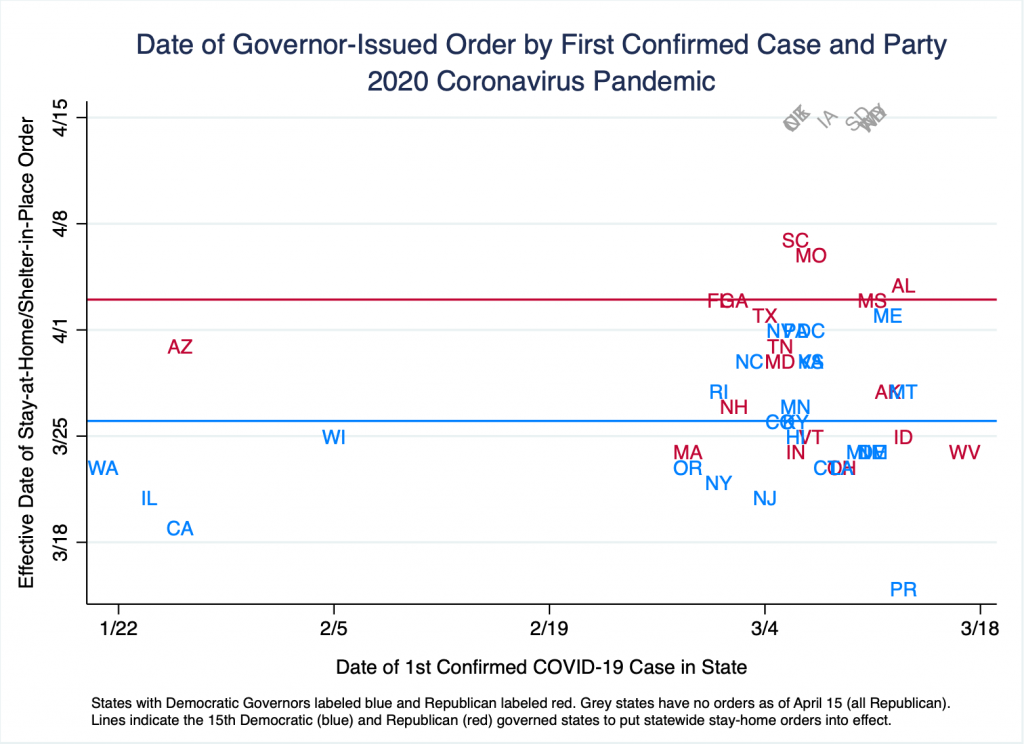
Did governors’ decisions to order their states’ residents to hunker down vary by party? In the figure below, I have plotted the date stay-at-home or shelter-in-place orders went into effect (as of April 15, according to the New York Times) by the date of the state’s first reported confirmed case of COVID-19 (according to US News & World Report). States with Democratic governors are labeled in blue and Republican governors are labeled in red. As of April 15, no statewide stay-home orders had been issued in the Republican-governed states labeled in grey on the plot.

Of the 50 states plus
Washington DC and Puerto Rico, a total of 44 governors have issued stay-at-home
or shelter-in-place orders. All Democratic-governed states were under similar
orders after Governor Janet Mills called for Maine’s residents to stay home
beginning April 2. By contrast, just over two-thirds of states led by
Republican executives have mandated residents stay home. Eight states – all led
by Republicans – had not issued such statewide orders as of April 15, 2020.
States without stay-at-home orders have had substantial outbreaks of COVID-19,
including in South Dakota where nearly 450 Smithfield Foods workers were infected in April
causing the plant to close indefinitely.

Republican governors have generally been slower to issue restrictions on residents’ non-essential movement. Democrats and Republicans govern an equal number of states and territories on the above plot (26 each). Fifteen Democratic governors had issued statewide stay-home orders by March 26. The fifteenth Republican governor to mandate state residents stay home did not put this order into effect until April 3. This move came after all states with Democratic governors had announced similar orders and over two weeks after COVID-19 cases had been confirmed in all states.

The median number of days Democratic governors took to mandate their residents to stay home after their state’s first confirmed case was 21 days. By contrast, the median Republican governor took four additional days (25) to restrict residents’ non-essential movement, not accounting for states without stay-home orders as of April 15.

In short, the timing of
governors’ decisions to mandate #stayhomesavelives appears to be partisan.
However, there are select cases of governors putting public health before party.
Ohio’s Republican Governor Mike DeWine has been heralded as one example. He was
the first governor to order all schools to close, an action for which CNN
described DeWine as the “anti-Trump on coronavirus.” These deviations from the norm suggest that
divisive partisanship is not inevitable when governing a crisis.

Morgan C. Matthews is a PhD candidate in sociology at the University of Wisconsin-Madison. She studies gender, partisanship, and U.S. political institutions.

Because everything is currently terrible, I binge-watched Love is Blind. In case you are planning to do the same, this is a spoiler-free post.

You probably know the premise: contestants in this romantic reality romp go on speed dates in little pods. They can’t see their conversation partners, and at the end of the dates they decide whether to get engaged before seeing each other. The question is whether love can flourish when we cast aside our assumptions about appearances, including race, wealth, and sexuality.1 It is a mess. I couldn’t look away.

What struck me most about the show isn’t actually what unfolded, but instead how it is based on an interesting assumption about the way biases work: if you can’t see anything to make a snap judgment, you have to be genuine and objective, right? This reminded me of how people use the term “colorblind” to signal that they don’t feel racial bias. Scholars are critical of this colorblindness because it suggests that ignoring social differences is the same as reducing biases against those differences.

Does limited information actually make us less likely to make snap judgements? Social science findings are a pretty mixed bag. 

On the one hand, taking information away in some cases has been shown to give people a fair shot. One big example is the “ban the box” movement. This policy reform effort works to remove the initial reporting of felony convictions on applications, based on the fact that people with criminal records often face high rates of discrimination when they try to get jobs or go to school

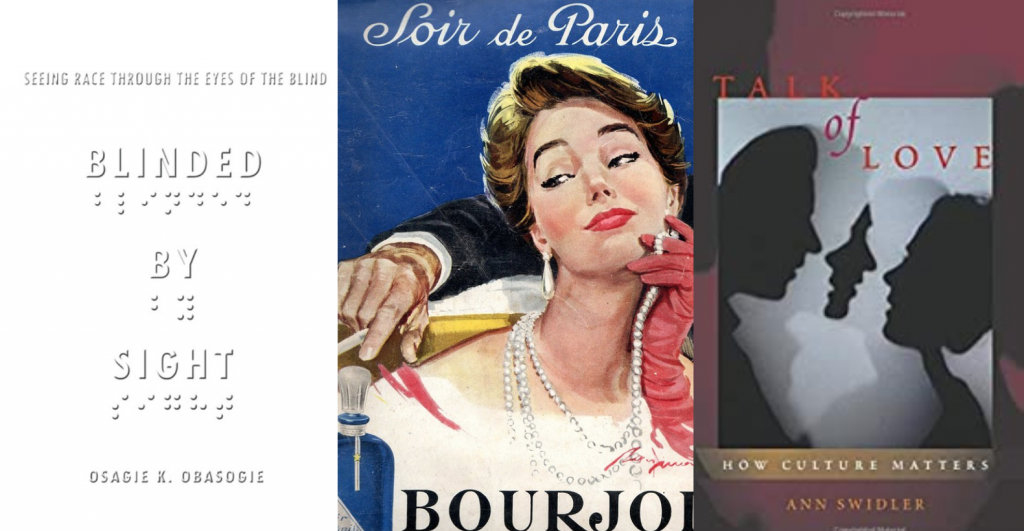
On the other hand, “blindness” doesn’t necessarily reduce bias. Our brains are pattern-making machines ready to fill in any gaps with our own best guesses. One of the most interesting findings on this is that people who are blind still understand race in visual terms. Experimental studies show that people can “smell” social class, matching perfume scents alone to our assumptions about taste and wealth. Jumping to conclusions is exactly what the mind does when you give it an incomplete picture, and you can see this lead to some particularly cringe-worthy moments early in the show.

Love may be blind, but all our senses give us social signals.

Implicit biases are implicit for a reason: they happen whether or not you are trying to stop them. The important part is to recognize them and consciously work to set them aside, rather than thinking they can be cast out by cutting off your information or attention. Again, avoiding spoilers, I think the most successful couples on the show were self-aware enough to know how much work they would have to put in after leaving the pods. For the couples who thought the experiment made this “meant to be”—that their relationship was somehow special, pre-ordained, or protected by the process—well, we got our fair share of drama.


1 They kept calling the show an “experiment.” The scientist talked about “testing hypotheses.” This irked me, because you know IRB would absolutely freak out if one of us tried to propose this as a study.

Evan Stewart is an assistant professor of sociology at University of Massachusetts Boston. You can follow his work at his website, or on BlueSky.
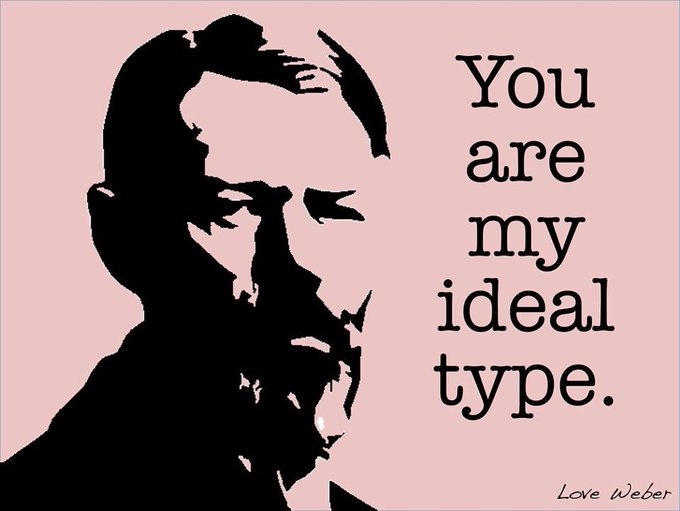
It’s Valentine’s Day, and my social media feed is more snarky than smarmy. The Hallmark holiday gets us thinking about love, but it also highlights our unquestioned assumptions about romantic relationships. The culture of love is tied up in all kinds of expectations: what we buy, how we date, even who does the dishes. A lot of sociological thought works to make these assumptions explicit, breaking them down to reveal the (sometimes sad) truth that many of us haven’t really thought that much about how we really want to love and be loved. 

But social science isn’t always depressing! Some recent work actually has pretty good news about the state of our romantic relationships. One example is Philip Cohen’s article published in Socius last year on “The Coming Divorce Decline.” Where many of us have gotten used to a story about rising divorce rates over the past few decades, Cohen finds that the probability of divorce for women has been declining from 2008 to 2017. Especially encouraging, he also finds that the probability of divorce for newly married women has been declining over same time period. 

Cohen, Philip N. 2019. “The Coming Divorce Decline.” Socius: Sociological Research for a Dynamic World 5:237802311987349.

In the article, Cohen writes:

…because the risk profile for newly married couples has shifted toward more protective characteristics, it appears certain that—barring unforeseen changes—divorce rates will further decline in the coming years.

And he even highlights how new data supported this prediction from an earlier draft of the paper!

Another example is a recent op-ed from Stephanie Coontz in The New York Times: “How to Make Your Marriage Gayer.” This piece is packed with current social science on relationships, from how couples split the housework to how they handle stress. One big takeaway from the research is better reported relationship outcomes for same-sex couples, and Coontz explains this in terms of our unquestioned assumptions about our love lives. Heterosexual couples tend to revert to more traditional assumptions about gender and relationship roles. But with fewer assumptions about gender and family roles at play, same-sex couples often have to (gasp!) openly talk about their needs, negotiate expectations, and generally do the things that make a relationship really strong.

So, if you’re grumpy this Valentine’s Day, remember that there’s some good news as well. As we learn more about what makes relationships work, we make it easier to navigate romance in a more open and honest way.

Hat tip to Erin McDonnell for tweeting this amazing SocValentine

Evan Stewart is an assistant professor of sociology at University of Massachusetts Boston. You can follow his work at his website, or on BlueSky.

Mattel, creator of the Barbie doll, has launched “a doll line designed to keep labels out and invite everyone in—giving kids the freedom to create their own customizable characters again and again.”  This doll has minimal makeup, a short hairstyle with an attachable long-hair wig, a flat chest, flat feet (for wearing sneakers, hiking boots, or platform sandals), and clothing that includes femme and butch options.  The clothes and accessories can, of course, be interchanged into dozens of different combinations. 

Creatable World Doll – Let Toys Be Toys Blog

For those old enough to remember the 1960s dolls, I have one word for you:  Skipper.  For those too young to know, Skipper was Barbie’s little sister and had a pre-pubescent body: flat chest and flat feet, since she was too young to wear heels. Imagine Skipper only with hair that could go off and on, and a more expansive wardrobe (which, in the 60s, we would have called “tomboy”).

https://www.flickr.com/photos/51764518@N02/16366423021
Vintage Skipper Doll, Joe Haupt, Flicker CC

In fact, Mattel sidestepped controversy by diplomatically calling the new doll “customizable” rather than gender-inclusive.  This doll does not include adult body types at all.  It is more of a genderless kid than a gender inclusive adult.  For gender inclusion recognizes that policies, programs, and language need to be broader to encompass the fluidity of gender expression and orientation.  According to Gender Spectrum, the organization whose mission is to create a gender-inclusive world for all children and youth, gender inclusivity means being open to everyone regardless of their gender identity and/or expression.  Gender inclusion would thus include people with large breasts who identify as men and people with penises who identify as women.    

Of course, Mattel’s 12-inch plastic dolls were never particularly realistic, and never had genitalia.  In addition, anyone with even an ounce of creativity could, and did, dress their Barbie doll in the clothing that came with a Ken or G.I. Joe doll, cut off Barbie’s hair, pierce Ken’s ears, draw on tattoos, create their own accessories, and so on.   

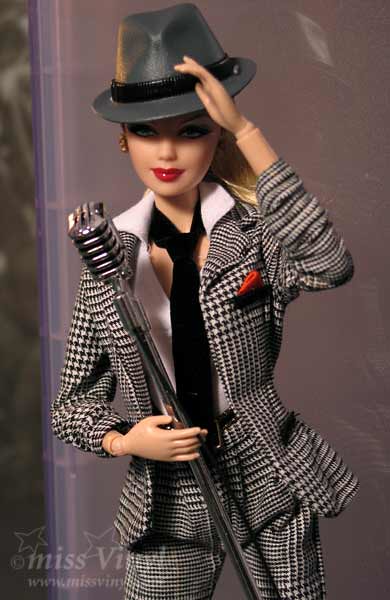
Interestingly, Mattel has already made Barbie dolls dressed as men.  Between 2011 and 2019, Mattel released an Elvis Barbie, a David Bowie Barbie, a Frank Sinatra Barbie, and an Andy Warhol Barbie.  These are standard buxom Barbie dolls dressed as the iconic male figures.  Some might consider these dolls at least as gender-bending as the Creatable WorldTM dolls.  But they are also less threatening because they are marketed to adult collectors, not to kids who will play with them.  And Mattel has yet to create Marilyn Monroe Ken or Barbra Streisand Ken. (If you’re listening, Mattel, I’ll accept royalties.)

Frank Sinatra Barbie
Frank Sinatra Barbie, Miss Vinyl, Flickr CC

Changing your Barbie’s skin color was a little more challenging, but by 2009, Barbie’s 50th anniversary, Mattel had released far more ethnically diverse Barbies, although they were still primarily princesses, graceful goddesses, and buxom movie stars.  Over its nearly 60-year history, Barbie’s body shape remained a lingering complaint of feminist critics, well after Barbie got more racially diverse and Teen Talk Barbie no longer said “Math class is tough.”  For even the pilot and presidential candidate Barbies had big chests and really tiny waists, making one wonder if she would hit that glass ceiling pointy boobs first.  Sure, it could be seen as a sign of strength that Barbie does everything Ken does, only in downward pointing feet that only fit in heels.  But as millennials began to become moms who buy (or refuse to buy) Barbies (see, e.g., this feminist mom’s explanation), and Mattel’s sales started to plummet, Mattel began to rebrand itself in 2016 with the launch of new Barbie body types—petite, tall, and curvy. 

Perhaps Lena Dunham, whose nudity in Girls was considered transgressive, deserves thanks.  We should also thank the artists and activists who had a dream for Barbie and used social media to share it, going much farther than Mattel to re-imagine Barbie, gender, and pop culture.  Indeed, they make Creative WorldTM dolls look pretty conventional.  The changes Mattel has been making can be seen as a direct result of the willingness of artists, activists, and fans to playfully engage with—rather than simply criticize—their dolls.  Creatable WorldTM dolls may be another step Mattel is taking to embrace diversity and include more consumers.  How far it will go might once again depend on what fans of the dolls demand and how creative people get in making their own visions known.

Martha McCaughey is Professor of Sociology at Appalachian State. She blogs on sexual assault prevention at See Jane Fight Back (www.seejanefightback.com)

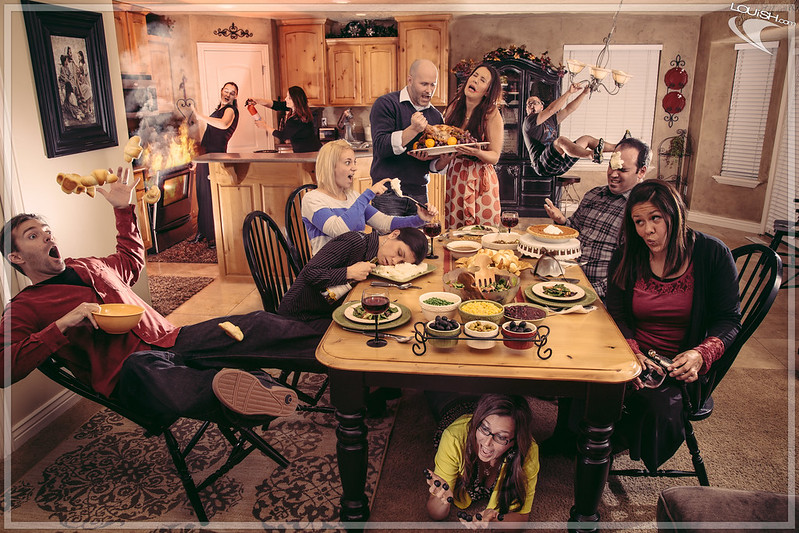
Tis’ the season for throwing down at dinner. Every year the humor and the horror stories about Thanksgiving hit our social media feeds. This isn’t just about politics, either. Family dinners have a strong symbolic significance. When the stakes are high for a once-a-year gathering, other kinds of social conflicts are primed to play out as well.

Photo Credit: Louish Pixel, Flickr CC

But for all this talk about fighting, one thing I find really interesting as a political sociologist is just how much work people do to avoid conflict. We know from embedded studies of parent organizations and neighborhood groups that people will tie themselves up in knots to avoid talking about political issues. In some cases, people are more likely to confide in near-strangers or acquaintances than close family members. In an increasingly fraught political climate, the answer for many people might be cutting their visits short. According to research published last year Science, there is some evidence for this happening.

In the article, political scientists matched anonymous smartphone location data from over 10 million Americans to precinct-level voting data from 2016. By doing this, they could see who traveled for Thanksgiving that year and how long they stayed at dinner. People who ate in an opposing political district spent less time at dinner, about 30-50 minutes less on average. The pattern was stronger for people coming from Republican districts to dine among Democrats—they split about 50 to 70 minutes sooner. The authors also find that increased local political advertising was also associated with cut-down dinner time.

Sure, these people could be storming out before that second helping. But I think one of the less-appreciated trends in political life is that many of us are just clamming up and cutting out early to spend time elsewhere. There are many perfectly valid reasons to do this, especially if people are made to feel unwelcome or unsafe. These results suggest we could all do a little more to think about keeping people at the table.

Evan Stewart is an assistant professor of sociology at University of Massachusetts Boston. You can follow his work at his website, or on BlueSky.
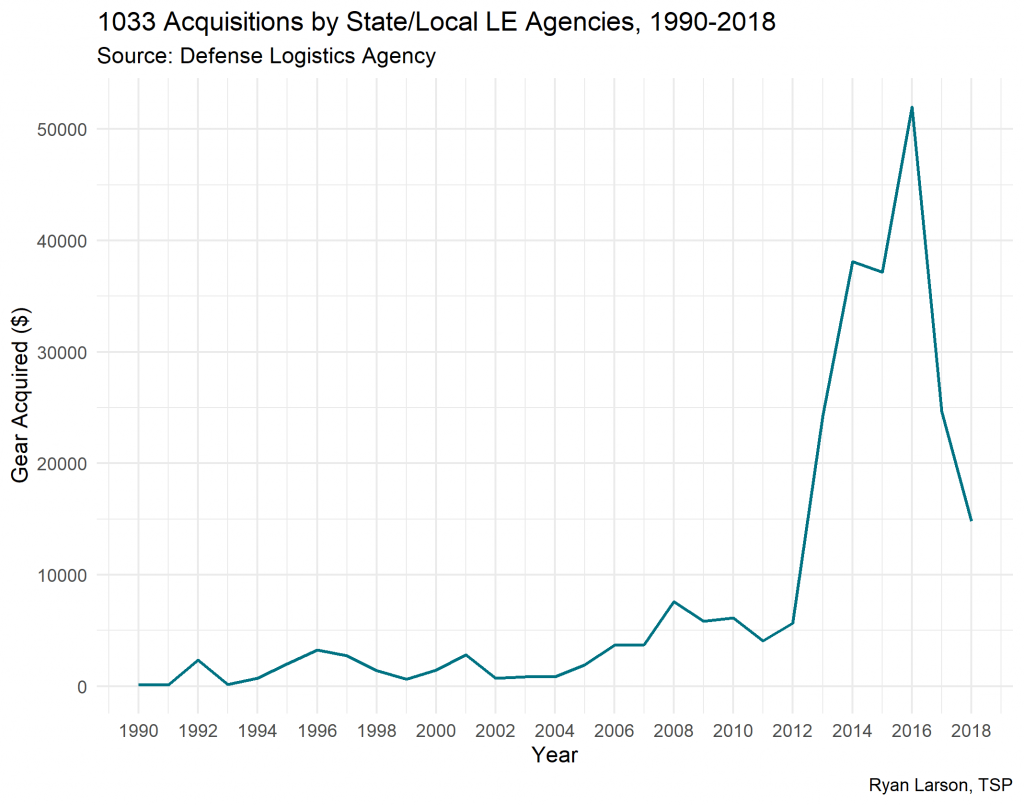
Modern policing is often characterized by quasi-militaristic tendencies, from “wars” on drugs and crime to its use armored vehicles and automatic weapons. The Department of Defense 1033 Program, which provides military equipment slated for storage to law enforcement agencies, is a popular way that police and sheriff’s departments acquire military gear. According to data from the Defense Logistics Agency, acquisitions of military equipment by state and local law enforcement sharply rose to a peak in 2016, and then have declined in recent years. But what explains participation in the DOD’s program? Which police departments acquire the most military equipment?

In a recent study published in Criminology, David Ramey and Trent Steidley investigate whether law enforcement agencies participated in the program and how much gear they acquired using 1033 program participation and U.S. Census and American Community Survey data. They find that participation in the 1033 — but not the value of gear acquired — is greater in areas of higher violent arrests. They also find that, after controlling for crime rates and other factors, higher local Black and Hispanic populations correlate with higher levels of participation and greater value acquired.

Las Vegas Metropolitan Police SWAT
Las Vegas Metropolitan Police SWAT, Photo by Tomás Del Coro, Flickr CC

However, these racial patterns are not linear. Agencies operating in areas with very small and very large minority populations have low probabilities of program participation, but agencies that serve a more diverse community are most likely to obtain military equipment through the 1033 program. For those that do participate, increases in minority populations correlated with higher dollar values of equipment acquired, with each subsequent increase garnering even more gear than the last (an exponential increase). In other words, program participation increases in response to racial demographics up to an extent, but once an agency decides to participate, the value of military equipment requested dramatically increases as minority populations increase.

Trends in police militarization highlight two patterns. Law enforcement agencies respond to increasing crime rates with police militarization, possibly in an attempt to deter further crime. In contrast, the racial effects found in this study follow  a “minority threat” model, as military acquisitions correspond to the presence of racial minority groups. This research illustrates how race, net of the crime rates in an area, can pattern not only where police operate, but how they operate.

Ryan Larson is a graduate student from the Department of Sociology, University of Minnesota – Twin Cities. He studies crime, punishment, and quantitative methodology. He is a member of the Graduate Editorial Board of The Society Pages.

For feminists, liking Barbie is tough.  This top selling American toy has long been criticized for fueling sexist stereotypes, because women are not actually focused on dream houses, dream dates, beauty, and unbridled consumption. 

And yet Mattel has made attempts to refashion the doll as women’s positions in society have changed.  By the 1990s Barbie had careers as a firefighter, police officer, and in the military.  She had also been a racecar driver, a pilot, and a presidential candidate.  However, the 90s also gave us the infamous Teen Talk Barbie whose voice box had been programmed to say, “Math class is tough.”

The Barbie Liberation Organization (B.L.O.) switched Teen Talk Barbie’s voice box with that of talking G.I. Joe, and put the altered dolls back into their original packages and back onto store shelves.  They released videotapes to major television news outlets explaining their action and calling attention to Mattel’s outdated gender ideology.  With G.I. Joe saying, “Let’s sing with the band tonight” or “Wanna go shopping?” and Barbie saying, “Dead men tell no tales” the B.L.O.’s media-savvy culture jam threw our gendered expectations into sharp relief.   

In addition to the B.L.O., women’s groups expressed concern that Barbie’s math-anxious statement would discourage girls from pursuing math and math-related fields, and so Mattel removed the offending remark from Barbie’s voice box.

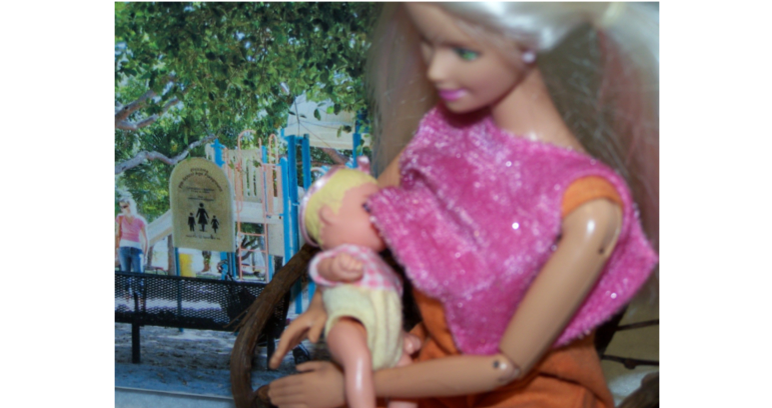
Inspired by the B.L.O. and other culture jammers, for Barbie’s 50th anniversary in 2009 I initiated a “Barbies We Would Like to See” exhibition on my campus.  The exhibition included Muslim Girl Barbie (made from a 1960s Skipper doll), Stay-At-Home-Dad Ken, Public Breastfeeding Barbie, and Lesbian Wedding Barbie—to name a few.

Public Breastfeeding Barbie and Lesbian Wedding Barbie (Photos by Martha McCaughey)

And now, as Barbie turns 60, we can see how participatory social media has made it possible for anyone with a dream for Barbie to share it instantaneously and widely.  For example, Black Moses Barbie videos on YouTube use Barbie dolls to depict imagined moments in history with Harriet Tubman, and photographer Mariel Clayton creates elaborate scenes with Barbies—sometimes violent, sometimes sexual, sometimes both—which she photographs and shares on her public Facebook page.  There are entire Instagram accounts devoted to depictions of Barbie and social critiques made through Barbie, for instance Sociality Barbie, the anonymous Instagram feed with over 800,000 followers that depicts Barbie as a Portland, Oregon hipster.  In our documentary video on Barbie in the age of digital reproduction (produced by Martha McCaughey and Beth Davison, linked above), we see how these artists and Barbie hackers go much farther than Mattel to re-imagine gender and pop culture.  Indeed, they make curvy Barbie, released in 2016, and the gender-neutral Creative WorldTM dolls, released this year, look pretty conventional.

In line with Rentschler and Thrift’s (2015) argument that feminist meme propagators do feminist cultural production, Barbie artists and activists sharing their altered dolls on social media are doing feminist cultural production and creating “feminist community-building media” (Rentschler 2019).  In this age of digital reproduction Mattel can neither thwart nor ignore what people want to do with their dolls.  Indeed, the changes Mattel has been making to their dolls can be seen as a direct result of the willingness of artists, activists, and fans to playfully engage with—rather than simply criticize—their dolls. 

Barbie has always been malleable.  Thanks to feminist media, perhaps Mattel can now acknowledge what Barbie hackers have long known: that gender, like the doll itself, is plastic.  

Martha McCaughey is Professor of Sociology at Appalachian State.  She is the author of The Caveman Mystique: Pop-Darwinism and the Debates Over Sex, Violence, and Science, and Real Knockouts: The Physical Feminism of Women’s Self-Defense.She blogs on sexual assault prevention at See Jane Fight Back.

Works Cited

Rentschler, Carrie, 2019.  “Making Culture and Doing Feminism.” Pp. 127-147 in Routledge International
Handbook on Contemporary Feminism
Ed. by Tasha Oren and Andrea Press.

Rentschler,
Carrie and Samantha Thrift, 2015. “Doing Feminism in the Network: Networked
Laughter and the Binders Full of Women Meme” Feminist Theory 16:3:329–359.