Search results for embed

Flashback Friday.

Electric clothes dryers are among the most energy-greedy appliances in the home, accounting for between 6% and 15% percent of home energy use. In contrast, drying clothes outside is both environmentally friendly and free. Yet, according to the New York Times, many homeowners associations insist that they are “…an eyesore, not unlike storing junk cars in driveways, and a marker of poverty that lowers property values.” In the documentary Drying for Freedom, laundry activists claim that bans on clotheslines affect 50 million households, requiring people to buy electric clothes dryers or hang their clothes inside their home.

Homeowners associations require many things intended to increase the “curb appeal” and property value of homes.  Many of these things specifically function to make the home and yard appear decorative instead of functional. Rules prohibit visible vegetable gardens, parking cars in the driveway overnight, allowing your cat outside (lest they poop), and failing to clean oil stains left by leaky vehicles.  They turn driveways, curbs, front yards, and porches into communal space designed to advertise the luxury of having non-functional spaces.  They say, in effect, “This is a lovely neighborhood where we can afford to curate flowers instead of vegetables and preserve pristine concrete by taking our cars to Jiffy Lube.”

All of this supposedly protects home values by preserving the notion that the neighborhood includes only middle- and upper-class people who can afford to avoid (dirty) work by consuming services.  Not being able to afford to dry your clothes electrically apparently appears, well, trashy.

Drying for Freedom is trying to interrupt this narrative, but instead of fighting the classist reasoning behind the clothesline bans, they are trying a different social movement strategy: re-framing. They are suggesting that using clotheslines isn’t a sign of poverty, but one of good global citizenship and, thus, a sign of responsible living. It seems to be working, too. As of 2016, 19 states ban clothesline bans, which is a start. Laundry activists hope the trend will go nation-wide, and then global, and that someday drying one’s clothes in a dryer will be the “trashy” thing to do.

Trailer :

Originally posted in 2010.

Lisa Wade, PhD is an Associate Professor at Tulane University. She is the author of American Hookup, a book about college sexual culture; a textbook about gender; and a forthcoming introductory text: Terrible Magnificent Sociology. You can follow her on Twitter and Instagram.

Flashback Friday.

I was waiting for my connecting flight at Chicago O’Hare, and spotted this advertisement on the opposite side of our gate. It reads:

“Chicago is the Potawatomi word for onion field. Apparently, the Potawatomis didn’t have a word for global business center.”

This is an example of the use of Indigenous language and imagery that many people wouldn’t think twice about, or find any inherent issues with. But let’s look at this a little deeper:

  • The use of past tense. It’s not “The Potawatomis don’t have a word for…” it’s “The Potawatomis didn’t…” Implying that the Potawatomi no longer exist or are using their language.
  • The implication that “Indians” and “Global Business Center” aren’t in congruence. Which is assuming that Natives are static, unchanging, and unable to be modern and contemporary. “Potawatomi” and “Onion Field” are fine together, because American society associates Indians with the natural world, plants, animals, etc. But there is definitely not an association between “Potawatomi” and “Global Business”.

But, in reality, of course Potawotomis still exist today, are still speaking their language, and do have a word for Global Business Center (or multiple words…).

Language is constantly evolving, adapting to new technology (remember when google wasn’t a verb?) and community changes.  I remember reading a long time ago in one of my Native studies classes about the Navajo Nation convening a committee to discuss how one would say things like “computer” or “ipod” in Navajo language, in an effort to preserve language and culture and promote the use of Navajo language among the younger generation.

In fact, here’s an awesome video of a guy describing his ipod in Navajo, complete with concepts like “downloading” (there are subtitles/translations):

Native peoples have been trading and communicating “globally” for centuries, long before the arrival of Europeans. To imply that they wouldn’t have the ability to describe a “Global Business Center” reeks of a colonialist perspective (we must “civilize” the savage! show him the ways of capitalism and personal property, for they know not of society!).

Thanks, Chicago, for giving me one more reason to strongly dislike your airport.

Originally posted in 2010.

Adrienne Keene, EdD is a graduate of the Harvard Graduate School of Education and is now a postdoctoral fellow in Native American studies at Brown University. She blogs at Native Appropriations, where this post originally appeared. You can follow her on Twitter.

Originally posted at Scatterplot.

Olympic fever has hit! As we all marvel at the power, precision, and grace of the athletes, a more disturbing commentary has also emerged, one that diminishes women athletes’ accomplishments, defines them by the men around them, places them in tired tropes of sex objects, or infantilizes them as “girls.” Some journalists, in combination with a robust social media discussion, are calling this bad behavior out. But should we be so surprised?

According to past research, no. In our work, we see this as a more pervasive issue, and women’s collegiate coaching is a prime example. When Title IX was enacted in 1972 approximately 90% of women’s teams were coached by women; in 2014 that number dropped to 43%. Women comprise only 23% of head coaching positions. Why are women coaches – especially of women’s teams – being left out? We talked to 9 female and 12 male coaches of women’s and men’s teams and many of their own explanations suggest a view of fundamental and “natural” differences between men and women.

.

Talking to Coaches… Gender Matters

In general, the qualities of sport – competition, confidence, physical strength, aggression – are seen as masculine, while characteristics of cooperation, passivity, and dependency are coded feminine, raising suspicions about women’s capacity to excel. Masculine dominance has helped to define the parameters of what it means to be a coach.

Interestingly, coaching may be seen as an example of conflicting masculine roles. Given the low pay and high time commitment, coaching undermines the traditional male family role as breadwinner. As this male head women’s tennis coach explains,

I’ve been kind of lucky… I didn’t feel like I had to make a certain amount of money, X amount of dollars to be happy. So I was ok with where I was at salary wise… I think that the key to that is having a wife that also works, and that we can still make it happen, and sort of live the way we want to live and be happy.

Many of the men echoed the idea that without a spouse’s support, a coaching career would be difficult. Although respondents all felt women opt out of coaching due to family pressures, none felt that men needed to opt out to support their families. Arguably, the relationship between masculinity and athletics provides men with the social compensation necessary to remain in coaching in a way that does not operate for women.

Especially when asked why women don’t coach men, many of the respondents did not think women would have the strength, athleticism, authority, and leadership abilities to be effective men’s coaches. As a male head men’s soccer coach expresses:

I think the game is slightly different. The understanding of the nuances of the men’s game versus the women’s game… for a female to go into a men’s athletic team and command respect from those guys, it’s difficult. A female wouldn’t be able to step in and play seven versus seven and be able to play at the same level. Not technically, not tactically, I mean simply physically…just the strength factor.

Other arguments highlight the assumed biological connection between men and leadership. A female assistant women’s soccer coach argued that “the leadership gene is much more apparent in guys, it’s much more inherent in them.” Additionally challenging is the perception that taking orders and guidance from a female threatens masculinity and calls into question male superiority in a male dominated field. A former male head golf coach notes,

A woman coach is going to have to work harder to gain respect from a guy player than a male coach will have to work from a female player. … [Individuals are] raised to say if a guy’s leading, you give them a little benefit of the doubt. A woman has to prove herself, and until she does there’s going to be doubt.

By internalizing and enforcing stereotypes a gender pecking-order can be preserved. As this woman, an assistant women’s soccer coach, suggests, socialization improves men’s leadership ability:

When girls are socialized… it’s share, everyone in groups, be nice to everyone; guys are taught much more of competitiveness… a guy leader comes out in a group much easier… because in a girl’s environment it’s no one should be above anyone else… guys and girls are just different. They’re socialized different.

Stereotypes about men’s competitiveness and women’s need for emotional bonding were prevalent, and if these are carried into hiring decisions it is easy to see why male coaches are favored. Yet, if gender differences are so stark, we would expect to see same-sex coaching across the board, instead of the current disparity. Instead, this difference only legitimated women’s absence and was not used to question men’s presence as coaches of women’s teams. None of the women said they wanted to coach men’s teams and nor were they upset at being denied access to these positions. Respondents were more in favor of increasing women coaching women, but did not question or challenge any of the main gender stereotypes. This man, a former head men’s golf coach said,

I’m a fan of a woman coaching women’s sports, if skill levels are equal, because there are certain intangibles – I don’t understand the woman animal as well on certain things.

Shattering the “Glass Wall”?

Coaches we interviewed recognized the role that resources and opportunities played in incentivizing men into coaching women, but none challenged any aspect of the system. Respondents automatically buy into the “glass wall” such that 50 percent of jobs (those coaching men) are off-limits, thus if women coach approximately 50 percent of women’s teams, it’s “fair.” We see that unquestioned assumptions of gender difference supported perceptions that masculinity and men were superior to femininity and women. Twenty years ago scholars on this topic said it is beliefs in male athletic superiority that justify gender disparities in coaching, and according to these interviews little has changed. So, yes, observers should continue to call out the failures of Olympic commentators to treat women athletes equally, but as we say goodbye to Rio, let’s not forget how these issues are shaping coaches’ and athletes’ experiences every day.

Catherine Bolzendahl is a professor of sociology and the co-author of Counted Out: Same Sex Relations and Americans’ Definitions of Family. Vanessa Kauffman is a PhD student.  Both are at the University of California, Irvine. Jessica Broadfoot-(Lee) is an alum and was a member of the women’s tennis team and a two-time Big West Scholar-Athlete..

Flashback Friday.

I heard stories this week about dung beetles and cuttlefish.  Both made me think about the typical stories we hear in the media about evolved human mating strategies.  First, the stories:

—————————-

Story #1 :The Dung Beetle

Photo from flickr by Camilo Hdo.
Photo by Camilo Hdo, retrieved from flickr.

A story on Quirks and Quarks discussed the mating strategies of the dung beetle.  The picture above is of a male beetle; only the males have those giant horns.  He uses it to defend the entrance to a tiny burrow in which he keeps a female.  He’ll violently fight off other dung beetles who try to get access to the burrow.

So far this sounds like the typical story of competitive mating that we hear all the time about all kinds of animals, right?

There’s a twist: while only male dung beetles have horns, not all males have horns.  Some are completely hornless.  But if horns help you win the fight, how is hornlessness being passed down genetically?

Well, it turns out that when a big ol’ horned male is fighting with some other big ol’ horned male, little hornless males sneak into burrows and mate with the females.  They get discovered and booted out, of course, and the horned male will re-mate with the female with the hopes of displacing his sperm.

But.

Those little hornless males have giant testicles, way gianter than the horned males.  While the horned males are putting all of their energy into growing horns, the hornless males are making sperm.  So, even though they have limited access to females, they get as much mileage out of their access as they can.

The result: two distinct types of male dung beetles with two distinct mating strategies.

———————————

Story #2: The Giant Australian Cuttlefish

846693304_2d180b3fff_z
Photo by Paul Oughton, retrieved from Flickr.

The Naked Scientists podcast featured a story about Giant Australian Cuttlefish.  During mating season the male cuttlefish, much larger than the females, collect “harems” and spend their time mating and defending access.  Other males try to “muscle in,” but the bigger cuttlefish “throws his weight around” to scare him off. The biggest cuttlefish wins.

So far this sounds like the typical story of competitive mating that we hear all the time about all kinds of animals, right?

Well, according The Naked Scientists story, researchers have discovered an alternative mating strategy.  Small males, who are far too small to compete with large males, will pretend to be female, sneak into the defended territory, mate, and leave.

How do they do this?  They change their color pattern and rearrange their tentacles in a more typical female arrangement (they didn’t specify what this was) and, well, pass.  The large male thinks he’s another female. In the video below, the cuttlefish uses his ability to change the pattern on his body. He simultaneously displays a male pattern to the female and a female pattern to the large male on the other side.

———————————

So, can the crossdressing cuttlefish and dodge-y dung beetle tell us anything about evolved human mating strategies?

Probably not.

But I do think it tells us something about how we should think about evolution and the reproduction of genes. If you listen to the media cover evolutionary psychological explanations of human mating, you only hear one story about the strategies that males use to try to get sex. That story sounds a lot like the one told about the horned beetle and the large male cuttlefish.

But these species have demonstrated that there need not be only one mating strategy. In these cases, there are at least two. So, why in Darwin’s name would we assume that human beings, in all of their beautiful and incredible complexity, would only have one? Perhaps we see a diversity in types of human males (different body shapes and sizes, different intellectual gifts, etc) because there are many different ways to attract females. Maybe females see something valuable in many different kinds of males! Maybe not all females are the same!

Let’s set aside the stereotypes about men and women that media reporting on evolutionary psychology tends to reproduce and, instead, consider the possibility that human mating is at least as complex as that of dung beetles and cuttlefish.

Originally posted in 2010.

Lisa Wade, PhD is an Associate Professor at Tulane University. She is the author of American Hookup, a book about college sexual culture; a textbook about gender; and a forthcoming introductory text: Terrible Magnificent Sociology. You can follow her on Twitter and Instagram.

Ever since Hillary Clinton became the Democratic nominee for president, commentators have been speculating as to how much being a woman will hurt her chances for election. The data suggest it won’t. In fact, if anything, what we know about American voting patterns suggests that being a woman is a slight advantage over being a man.

It’s not that there’s no sexism at all. Parents are more likely to encourage their sons to aspire to political office than their daughters. Women are more likely to be overburdened by childcare and housework when they’re married to men. Women are less likely than men to be tapped by powerful political party gatekeepers. And the media continues to produce biased news coverage.

But when women actually get on the ballot they are as likely to win an election as men. In fact, men in the United States seem rather indifferent towards a candidate’s sex, whereas women tend to prefer females.

Gender stereotypes still apply: voters tend to think that men are better at handling masculine areas of governance like foreign affairs and the economy, but they tend to think that women are better at feminized areas like health care and education. This means that being female can help or hurt a candidate, depending on which issues dominate the election. But, when looked at as an aggregate, gender stereotypes don’t hurt women more than men.

So, there’s one thing we can be reasonably sure of this November: If Clinton loses and Trump wins, it is unlikely to be because the American electorate is too sexist to elect a woman.

.

Lisa Wade, PhD is an Associate Professor at Tulane University. She is the author of American Hookup, a book about college sexual culture; a textbook about gender; and a forthcoming introductory text: Terrible Magnificent Sociology. You can follow her on Twitter and Instagram.

It’s all harmless political shenanigans until a racist mob murders Vincent Chin.

It’s amazing how the new figureheads of both major parties are now pretending to oppose globalization, outsourcing, and the corporate “free trade” agenda that they both have spent their professional lives furthering. It wasn’t long ago that I taught in my stratification class that this agenda was the one thing we could be sure both parties and the big money behind them wouldn’t give up. Never say never, but I’m still pretty sure that’s still true.

There are humans that are hurt by this agenda, but most of them aren’t Americans. If politicians want to talk about slave labor, exploitation, and environmental degradation in the new manufacturing centers of the world, then I would be happy to listen to them talk about the harmful effects of those practices “here at home” too. But if they just want to bash China, then that’s racist, and no thank you.

Case in point, Pennsylvania Senator Bob Casey at the Democratic National Convention the other day. Here’s his speech, followed by some of the text and my comments:

Casey quoted his father, the former governor:

The sweat and blood of working men and women who built Pennsylvania forged the industrial revolution in our country, and outproduced the world.

How touching, attributing the industrial revolution the efforts of the working class and not the capitalists. It reminds me of when another Pennsylvania governor, Democrat Robert Pattison, reached across the aisle, helping out Republican industrialists by lending them the National Guard to attack striking steelworkers.

I assume today’s Democratic politician will now go on to recognize the working class of today’s manufacturing centers, who, through their sweat and blood, are outproducing the world and building the middle class in their countries. Oh right, Senator Casey is an American.

What about Donald Trump? Donald trump says he stands for workers, and that he’ll put American first, but that’s not how he’s conducted himself in business. Where are his, quote, tremendous products made? Dress shirts: Bangladesh. Furniture: Turkey. Picture frames: India. Wine glasses: Slovenia. Neckties: China. China! Why would Donald Trump make products in every corner of the world, but not in Altoona, Erie, or here in Philadelphia? Well, this is what he said, quote, outsourcing is not always a terrible thing. Wages in America quote, are too high. And then he complained about companies moving jobs overseas because, quote, we don’t make things anymore. Really? … [examples of stuff made in America]. Donald Trump hasn’t made a thing in his life, except a buck on the backs of working people. If he is a champion of working people, I’m the starting center for the 76ers! The man who wants to make America great, doesn’t make anything in America! If you believe that outsourcing has been good for working people, and has raised incomes for the middle class, then you should vote for Donald Trump. … We need to making good paying jobs for everyone here at home, so that everyone who works hard can get ahead and stay there.

The great conflict of our time is between “China” and “working people”? Maybe we should all link arms and together put down striking Chinese workers to keep the price down on our iPhones and Wal-Mart junk.

The Democratic National Convention was very on-message. In Hillary Clinton’s acceptance speech the next day, she said:

If you believe that we should say “no” to unfair trade deals, that we should stand up to China, that we should support our steelworkers and autoworkers and homegrown manufacturers — join us.

She gave no definition of what it means to “Stand up to China,” though her website says she will insist on trade deals that raise wages and create good-paying jobs (presumably in the US). That’s not important — the important thing communicated to her audience is she’s against China and for American workers. Then she went through the same list of Trump production locations that Casey did, before concluding, “Donald Trump says he wants to make America great again – well, he could start by actually making things in America again.” The current U.S. trade deficit in goods (as opposed to services) is about $62 billion — per month. Virtually all Americans are dependent on imported goods (including, apparently, Clinton, whose Nina McLemore suits are made from European and Asian fabrics). No major politician is seriously against this. Trump hiring U.S. workers to make his ties would make about as much difference as Clinton buying clothes with U.S. fabrics, which is basically none. It’s just symbolism, and the symbolism here is “China is bad.” Unless you join this kind of talk with explicit concern for the suffering and exploitation of Chinese workers, this just feeds American racism.

Decades later, Vincent Chin’s murder still resonates with me. There is debate about whether racism was the real motivation behind his murder, and it wasn’t as simple as a random lynch mob. Despite the legend, it is not the case that the auto workers just killed him because they falsely believed he was Japanese. But a witness at the bar said they blamed him for them being out of work before they fought. She said:

I turned around and I heard Mr. Ebens say something about the “little motherfuckers.” And Vincent said, “I’m not a little motherfucker,” and he said, “Well, I don’t know if you’re a big one or a little one.” Then he said something about, “Well, because of y’all motherfuckers we’re out of work.”

After losing the first round, Ronald Ebins and his stepson, Michael Nitz, hunted Chin down and killed him with a baseball bat, a crime for which they ultimately served no jail time.

My 8-year-old Chinese immigrant daughter, who learns all about how racism and bullying are bad and MLK is great in her neoliberal public American elementary school, is routinely offended and hurt by the China-bashing she hears from Democrats as well as Trump (she supported Bernie but is willing to back Hillary to stop Trump).

Hillary says we should protect our children from having to listen to Trump’s nastiness — she even has ad on that, which I’ve personally witness liberals tearing up over:

So, what about the people making speeches at the Democratic convention, spitting out the word China! like it’s a disease? “What example will we set for them?”

If the new normal of politics is both parties bashing foreigners  while they pretend to oppose globalization — and then pursuing the same policies anyway (which, face it, you know they will), then what have we gained? It seems to me there is a small chance Clinton will negotiate better trade deals to the benefit of workers (U.S. or Chinese), alongside a much greater chance that her rhetoric will stoke nativism and racism. Trump’s megaphone may have drawn the White supremacists out from under their rocks, but the new anti-TPP Hillary is bellowing the same obnoxious chauvinism.

Philip N. Cohen is a professor of sociology at the University of Maryland, College Park, and writes the blog Family Inequality, where this post originally appeared. He is the author of The Family: Diversity, Inequality, and Social Change. You can follow him on Twitter or Facebook.

FBI director, James Comey, didn’t call it the “Ferguson Effect.” Instead, he called the recent rise in homicide rates a “viral video effect” – a more accurately descriptive term for the same idea: that murder rates increased because the police were withdrawing from proactive policing. The full sequence goes something like this:  Police kill unarmed Black person. Video goes viral. Groups like Black Lives Matter organize protests. Politicians fail to defend the police. Police decrease their presence in high-crime areas. More people in those areas commit murder.

Baltimore is a good example, as Peter Moskos has strongly argued on his blog Cop in the Hood. But many cities, even those with all the Ferguson elements, have not seen large increases in homicide. New York, for example, the city where I live, had all of the Ferguson-effect elements. Yet the number of murders in New York did not rise, nor did rates of other crimes. Other factors – gang conflict, drugs, and the availability of guns – make a big difference, and these vary among cities. Chicago is not New York. Las Vegas is not Houston. All homicide is local.

There is another flaw with the viral-video theory: It assumes that the crime is a game of cops and robbers (or cops and murderers), where the only important players are the bad guys and the cops. If the cops ease up, the bad guys start pulling the trigger more often. Or as Director Comey put it,

There’s a perception that police are less likely to do the marginal additional policing that suppresses crime — the getting out of your car at 2 in the morning and saying to a group of guys, “Hey, what are you doing here?”

This model of crime leaves out the other people in those high-crime neighborhoods. It sees them as spectators or bystanders or occasionally victims. But those people, the ones who are neither cops nor shooters, can play a crucial role in crime control. In some places, it is the residents of the neighborhood who can get the troublesome kids to move off the corner. But even when residents cannot exert any direct force on the bad guys, they can provide information or in other ways help the police. Or not.

This suggests a different kind of Ferguson Effect. In the standard version, the community vents its anger at the cops, the cops then withdraw, and crime goes up. But the arrows of cause and effect can point in both directions. Those viral videos of police killing unarmed Black people reduce the general level of trust. More important, those killings are often the unusually lethal tip of an iceberg of daily unpleasant interactions between police and civilians. That was certainly the case with the Ferguson police department with its massive use of traffic citations and other fines as a major source of revenue. Little wonder that a possibly justifiable shooting by a cop elicited a huge protest.

It’s not clear exactly how the Full Ferguson works. Criminologist Rich Rosenfeld speculates that where people don’t trust the police, they are more likely to settle scores themselves. That may be true, but I wonder if it accounts for increases in killings between gang members or drug dealers. They weren’t going to call the cops anyway. Nor were people who have been drinking and get into an argument, and someone has a gun.

But maybe where that trust is absent, people don’t do what most of us would do when there’s trouble we cannot handle ourselves  –  dial 911. As in Director Comey’s version, the police are less a presence in those neighborhoods but not because they are afraid of being prosecuted for being too aggressive and not because they are being petulant about what some politician said, but because people there are not calling the cops.

Originally posted at Montclair SocioBlog.

Jay Livingston is the chair of the Sociology Department at Montclair State University. You can follow him at Montclair SocioBlog or on Twitter.

We often think that religion helps to build a strong society, in part because it gives people a shared set of beliefs that fosters trust. When you know what your neighbors think about right and wrong, it is easier to assume they are trustworthy people. The problem is that this logic focuses on trustworthy individuals, while social scientists often think about the relationship between religion and trust in terms of social structure and context.

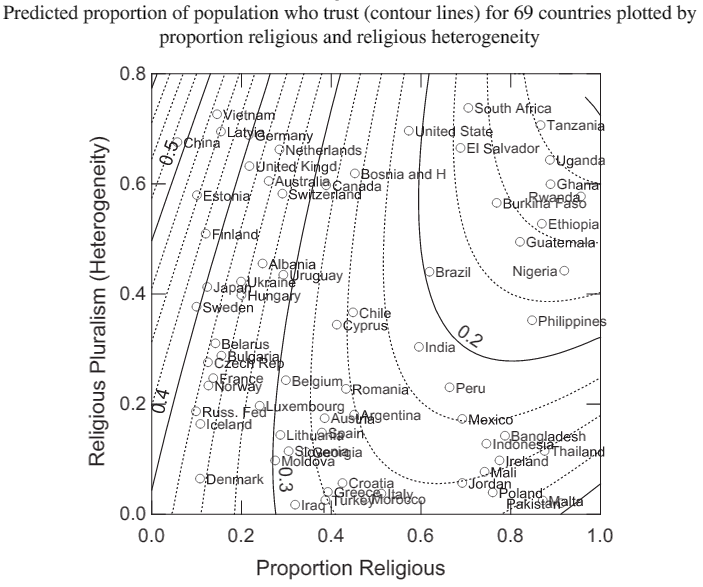
New research from David Olson and Miao Li (using data from the World Values survey) examines the trust levels of 77,405 individuals from 69 countries collected between 1999 and 2010. The authors’ analysis focuses on a simple survey question about whether respondents felt they could, in general, trust other people. The authors were especially interested in how religiosity at the national level affected this trust, measuring it in two ways: the percentage of the population that regularly attended religious services and the level of religious diversity in the nation.

These two measures of religious strength and diversity in the social context brought out a surprising pattern. Nations with high religious diversity and high religious attendance had respondents who were significantly less likely to say they could generally trust other people. Conversely, nations with high religious diversity, but relatively low levels of participation, had respondents who were more likely to say they could generally trust other people.

5

One possible explanation for these two findings is that it is harder to navigate competing claims about truth and moral authority in a society when the stakes are high and everyone cares a lot about the answers, but also much easier to learn to trust others when living in a diverse society where the stakes for that difference are low. The most important lesson from this work, however, may be that the positive effects we usually attribute to cultural systems like religion are not guaranteed; things can turn out quite differently depending on the way religion is embedded in social context.

Evan Stewart is a PhD candidate at the University of Minnesota studying political culture. He is also a member of The Society Pages’ graduate student board. There, he writes for the blog Discoveries, where this post originally appeared. You can follow him on Twitter