Search results for embed

For centuries, nations have expanded geographically and economically by taking land and labor from indigenous people. One of the narratives used to justify this colonialist expansion portrays indigenous land and space as empty, simply there for others to occupy. This narrative is known as indigenous absence.

Kleinman and Kleinman write that this kind of erasure is also applied to indigenous communities and families through the lens of health and suffering. For example, as in this Pulitzer prize-winning photo taken by Kevin Carter for The New York Times, the media often portrays indigenous communities as if they are in a state of constant helpless suffering, leaving any local action, support or voices out of the narrative. This implies that indigenous communities and families cannot adequately help themselves and require outside intervention from a supposedly more qualified source. Colonizers then use this logic to pursue their goals under the guise of providing help.

Chris Sanders’ Lilo & Stitch illustrates the narrative of indigenous absence through its portrayals of Lilo’s family, while using the presence of aliens (and a social worker) to advance this narrative and represent a justified state intervention.

Check out an extended video version of this post by Lena Denbroeder here!

When we first meet Lilo, she is swimming alone in the ocean, without any supervision. We then learn that Lilo and her older sister Nani’s parents have recently died in a car crash, leaving Nani to care for Lilo. While the film shows their local community in the beginning, this community is absent when it comes to caring for Lilo or Nani.  Nani is also repeatedly portrayed as an incredibly incompetent guardian. Because of this, the family’s biggest threat and the most major plot device is the presence of an evil social worker, who could take Lilo away. Thus, the very premise of the plot depends on the absence of a competent guardian for Lilo, and the fact that her household and community are inadequate and have failed her, creating a supposedly dire need for state intervention– so dire that the social worker identifies himself as “a special classification” that they bring in when “something has gone wrong.”

When Stitch joins the family, he creates chaos and jeopardizes Nani’s job search, all of which make the household appear even more unsuitable for Lilo. Stitch is thus used as a plot point that furthers the narrative of indigenous absence by exacerbating Nani’s caretaking challenges. At the same time, however, we see that Stitch fits in well with the family and is a valuable friend for Lilo when she has no one else. Both Lilo and Stitch are portrayed as unruly and badly behaved. In fact, Lilo fits in so poorly with the white community around her, that the only creature she can befriend is an alien. By choosing not to give Lilo anyone from her own community that she can relate to, the film furthers the notion that the indigenous community is absent and is a space for others to fill. Furthermore, the fact that she is portrayed as so deranged that she can only be expected to befriend an alien emphasizes Lilo’s otherness and implies that Lilo requires correction by an external force.

The most iconic phrase from the film is “Ohana means family,” and it’s marketed as a wholesome Hawaiian phrase. However, for Lilo, “Ohana” is policed and threatened by outsiders throughout the movie—both by a social worker and an invading alien military force; in fact, Lilo can only keep Stitch at the end by invoking state law.

This mirrors a history of state violence against indigenous children in the form of residential schools and forced adoptions, which were justified by the same narratives of safety and health that are used to question Nani’s competence as a guardian. Social workers and child welfare professionals participated in and often facilitated these colonial efforts. Frantz Fanon, referring to health and medicine, explains, “colonization sought a justification for its existence and the legitimization of its persistence….” Thus, the plot of Lilo and Stitch can be viewed as a microcosm of colonialism.

Lena Denbroeder is a recent graduate of Barnard College where she studied economics. Her professional interests include working towards health and housing equity, and approaching healthcare and health policy through a social justice lens.


For More:

Fanon, Frantz. 1982. A Dying Colonialism. New York: Grove Press..

Kleinman, Arthur, and Joan Kleinman.
1996. “The Appeal of Experience; The Dismay of Images: Cultural Appropriations
of Suffering in Our Times.” Daedalus
125 (1): 1–23.

Sanders, Chris. 2002. Lilo & Stitch. Walt Disney Pictures.

Talks about product design are a great tool for thinking about sociology because they show us just how much work goes into understanding our basic assumptions about the things we use everyday. Design shows us which parts of a product are absolutely essential for function, and just how much is only there for show. Small choices in color, curvature, or casting can do a lot to shape how we use products and what we assume about people who use them.

Karin Ehrnberger recently sent in her TEDx talk on a product re-design to swap a hand blender with a hand drill. The talk highlights gendered expectations for household labor and shows us what happens when we shake up those assumptions in the design. Fans of pointlessly gendered products will love this talk, and I also think it has a lot to teach us about labor itself, especially in how Ehrnberger highlights the difference between what gets to be a “tool” and what is just an “appliance.” Check it out!

Evan Stewart is an assistant professor of sociology at University of Massachusetts Boston. You can follow his work at his website, or on BlueSky.

From music to movies and restaurants, genres are a core part of popular culture. The rules we use to classify different scenes and styles help to shape our tastes and our social identities, and so we often see people sticking to clear boundaries between what they like and what they don’t like (for example: “I’ll listen to anything but metal.”). 

But bending the rules of genre can be the quickest way to shake up expectations. Mashups were huge a few years ago. This past summer we saw “Old Town Road” push boundaries in the country music world on its way to becoming a mega-hit. Zeal & Ardor’s mix of black metal and gospel, country blues, and funk is breaking new ground in heavier music.

Blending genres can also backfire. A new fusion concept could be a hit, or it could just be confusing. Sociological research on Netflix ratings and Yelp reviews finds that people with a high preference for variety, who like to consume many different things, are not necessarily interested in atypical work that blends genres in a new or strange way.

One of the more interesting recent examples is this new gameshow concept from Hillsong—a media channel tied to the charismatic megachurch organization:

What is this show? Is it preaching? Is it a game show? Do millennials even watch prime time game shows? Don’t get me wrong, I’ll hate-watch The Masked Singer every once in a while, but the mix seems a little out of place here. Gerardo Martí makes a good point in the tweet above. This show may be a way to repackage religious messaging in a new style. Given what we know about cultural consumption, however, I wonder if this is just too risky to pull anyone in.

It is easy to chase atypicality today, both for media organizations and religious groups trying to retain a younger viewership and find the next big thing. For all the pressure to innovate, this trailer for SOUTHPAW shows us just how much we still rely on genre rules to figure out what to consume.

Evan Stewart is an assistant professor of sociology at University of Massachusetts Boston. You can follow his work at his website, or on BlueSky.

Social scientists rely on the normal distribution all the time. This classic “bell curve” shape is so important because it fits all kinds of patterns in human behavior, from measures of public opinion to scores on standardized tests.

But it can be difficult to teach the normal distribution in social statistics, because at the core it is a theory about patterns we see in the data. If you’re interested in studying people in their social worlds, it can be more helpful to see how the bell curve emerges from real world examples.

One of the best ways to illustrate this is the “Galton Board,” a desk toy that lets you watch the normal distribution emerge from a random drop of ball-bearings. Check out the video below or a slow motion gif here.

The Galton Board is cool, but I’m also always on the lookout for normal distributions “in the wild.” There are places where you can see the distribution in real patterns of social behavior, rather than simulating them in a controlled environment. My absolute favorite example comes from Ed Burmila:

The wear patterns here show exactly what we would expect a normal distribution to tell us about weightlifting. More people use the machine at a middle weight setting for the average strength, and the extreme choices are less common. Not all social behavior follows this pattern, but when we find cases that do, our techniques to analyze that behavior are fairly simple.

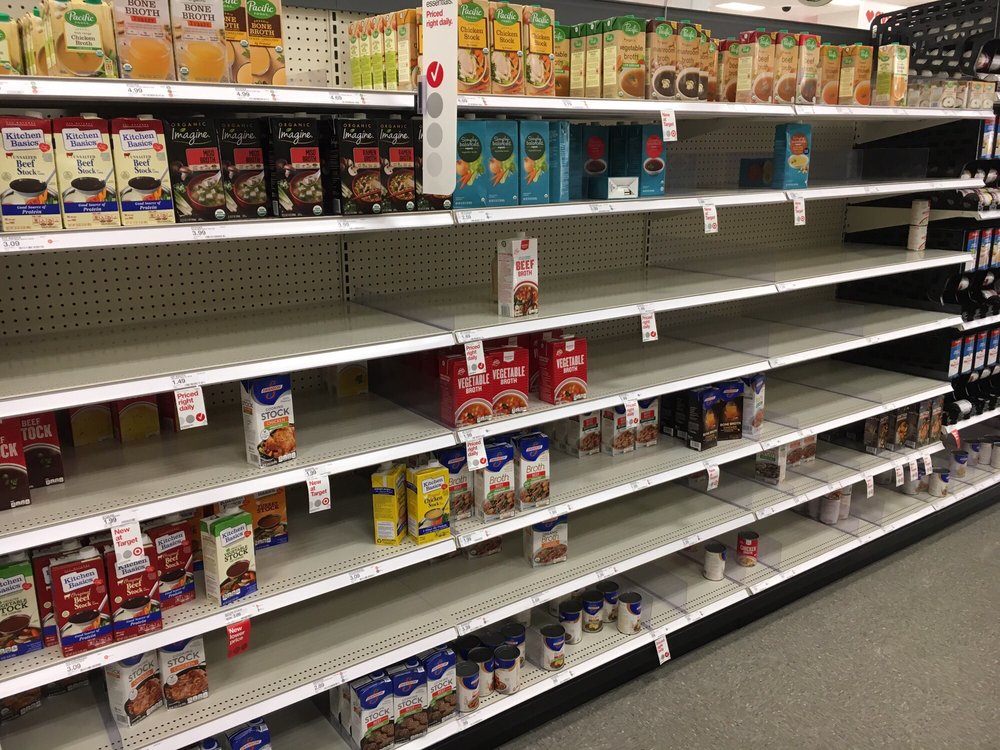
Another cool example is grocery shelves. Because stores like to keep popular products together and right in front of your face (the maxim is “eye level is buy level“), they tend to stock in a normally-distributed pattern with popular stuff right in the middle. We don’t necessarily see this in action until there is a big sale or a rush in an emergency. When stores can’t restock in time, you can see a kind of bell curve emerge on the empty shelves. Products that are high up or off to the side are a little less likely to be picked over.

Paul Swansen, Flickr CC

Have you seen normal distributions out in the wild? Send them my way and I might feature them in a future post!

Evan Stewart is an assistant professor of sociology at University of Massachusetts Boston. You can follow his work at his website, or on BlueSky.

Recent estimates indicate that roughly 45 million students in the United States have incurred student loans during college. Democratic candidates like Senators Elizabeth Warren and Bernie Sanders have proposed legislation to relieve or cancel  this debt burden. Sociologist Tressie McMillan Cottom’s congressional testimony on behalf of Warren’s student loan relief plan last April reveals the importance of sociological perspectives on the debt crisis. Sociologists have recently documented the conditions driving student loan debt and its impacts across race and gender. 

College debt is the new black.
Photo Credit: Mike Rastiello, Flickr CC

In recent decades, students have enrolled in universities at increasing rates due to the “education gospel,” where college credentials are touted as public goods and career necessities, encouraging students to seek credit. At the same time, student loan debt has rapidly increased, urging students to ask whether the risks of loan debt during early adulthood outweigh the reward of a college degree. Student loan risks include economic hardship, mental health problems, and delayed adult transitions such as starting a family.Individual debt has also led to disparate impacts among students of color, who are more likely to hail from low-income families. Recent evidence suggests that Black students are more likely to drop out of college due to debt and return home after incurring more debt than their white peers. Racial disparities in student loan debt continue into their mid-thirties and impact the white-Black racial wealth gap.

365.75
Photo Credit: Kirstie Warner, Flickr CC

Other work reveals gendered disparities in student debt. One survey found that while women were more likely to incur debt than their male peers, men with higher levels of student debt were more likely to drop out of college than women with similar amounts of debt. The authors suggest that women’s labor market opportunities — often more likely to require college degrees than men’s — may account for these differences. McMillan Cottom’s interviews with 109 students from for-profit colleges uncovers how Black, low-income women in particular bear the burden of student loans. For many of these women, the rewards of college credentials outweigh the risks of high student loan debt.

Amber Joy is a PhD candidate in the Department of Sociology at the University of Minnesota. Her current research interests include punishment, policing, victimization, youth, and the intersections of race, gender, and sexuality. Her dissertation explores youth responses to sexual violence within youth correctional facilities.

The ‘power elite’ as we conceive it, also rests upon the similarity of its personnel, and their personal and official relations with one another, upon their social and psychological affinities. In order to grasp the personal and social basis of the power elite’s unity, we have first to remind ourselves of the facts of origin, career, and style of life of each of the types of circle whose members compose the power elite.

— C. Wright Mills. 1956. The Power Elite. Oxford University Press

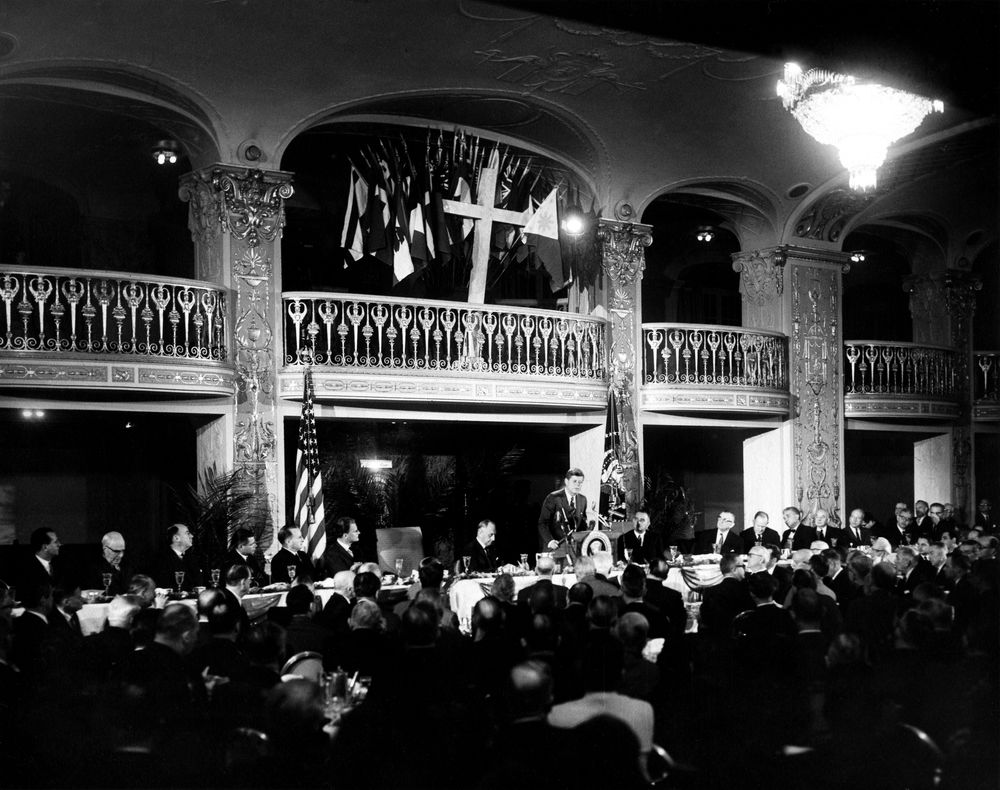
President John F. Kennedy addresses the Prayer Breakfast in 1961. Wikimedia Commons.

A big question in political sociology is “what keeps leaders working together?” The drive to stay in public office and common business interests can encourage elites to cooperate, but politics is still messy. Different constituent groups and social movements demand that representatives support their interests, and the U.S. political system was originally designed to use this big, diverse set of factions to keep any single person or party from becoming too powerful.

Sociologists know that shared culture, or what Mills calls a “style of life,” is really important among elites. One of my favorite profiles of a style of life is Jeff Sharlet’s The Family, a look at how one religious fellowship has a big influence on the networks behind political power in the modern world. The book is a gripping case of embedded reporting that shows how this elite culture works. It also has a new documentary series:

When we talk about the religious right in politics, it is easy to jump to images of loud, pro-life protests and controversial speakers. What interests me about the Family is how the group has worked so hard to avoid this contentious approach. Instead, everything is geared toward simply getting newcomers to think of themselves as elites, bringing leaders together, and keeping them connected. A major theme in the first episode of the series is just how simple the theology is (“Jesus plus nothing”) and how quiet the group is, even drawing comparisons to the mafia.

Vipassana Meditation in Chiang Mai, Thailand. Source: Matteo, Flickr CC.

Sociologists see similar trends in other elite networks. In research on how mindfulness and meditation caught on in the corporate world, Jaime Kucinskas calls this “unobtrusive organizing.” Both the Family and the mindfulness movement show how leaders draw on core theological ideas in Christianity and Buddhism, but also modify those ideas to support their relationships in business and government. Rather than challenging those institutions, adapting and modifying these traditions creates new opportunities for elites to meet, mingle, and coordinate their work.

When we study politics and culture, it is easy to assume that core beliefs make people do things by giving them an agenda to follow. These cases are important because they show how that’s not always the point; sometimes core beliefs just shape how people do things in the halls of power.

Evan Stewart is an assistant professor of sociology at University of Massachusetts Boston. You can follow his work at his website, or on BlueSky.

What do college graduates do with a sociology major? We just got an updated look from Phil Cohen this week:

These are all great career fields for our students, but as I was reading the list I realized there is a huge industry missing: data science and analytics. From Netflix to national policy, many interesting and lucrative jobs today are focused on properly observing, understanding, and trying to predict human behavior. With more sociology graduate programs training their students in computational social science, there is a big opportunity to bring those skills to teaching undergraduates as well.

Of course, data science has its challenges. Social scientists have observed that the booming field has some big problems with bias and inequality, but this is sociology’s bread and butter! When we talk about these issues, we usually go straight to very important conversations about equity, inclusion, and justice, and rightfully so; it is easy to design algorithms that seem like they make better decisions, but really just develop their own biases from watching us.

We can also tackle these questions by talking about research methods–another place where sociologists shine! We spend a lot of time thinking about whether our methods for observing people are valid and reliable. Are we just watching talk, or action? Do people change when researchers watch them? Once we get good measures and a strong analytic approach, can we do a better job explaining how and why bias happens to prevent it in the future?

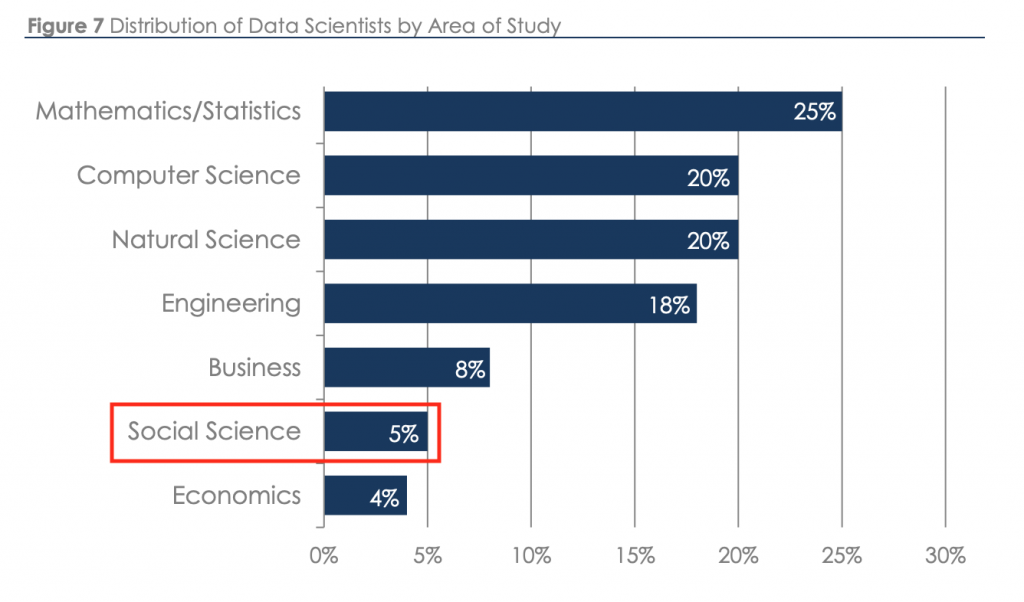
Sociologists are well-positioned to help make sense of big questions in data science, and the field needs them. According to a recent industry report, only 5% of data scientists come out of the social sciences! While other areas of study may provide more of the technical skills to work in analytics, there is only so much that the technology can do before companies and research centers need to start making sense of social behavior. 

Source: Burtch Works Executive Recruiting. 2018. “Salaries of Data Scientists.” Emphasis Mine

So, if students or parents start up the refrain of “what can you do with a sociology major” this fall, consider showing them the social side of data science!

Evan Stewart is an assistant professor of sociology at University of Massachusetts Boston. You can follow his work at his website, or on BlueSky.

Sociology Twitter lit up after the US Women’s National Team’s World Cup win with the revelation that many of their players were sociology majors in college. It is an inspiration to see the team succeed at the highest levels and call for social change while doing so.

https://twitter.com/nedasoc/status/1148237568481398784

This news also raised an interesting question: do student athletes major in sociology because it is a compelling field (yay, us!) or because they are tracked into the major by academic advisors who see it as an “easy” choice to balance with sports?

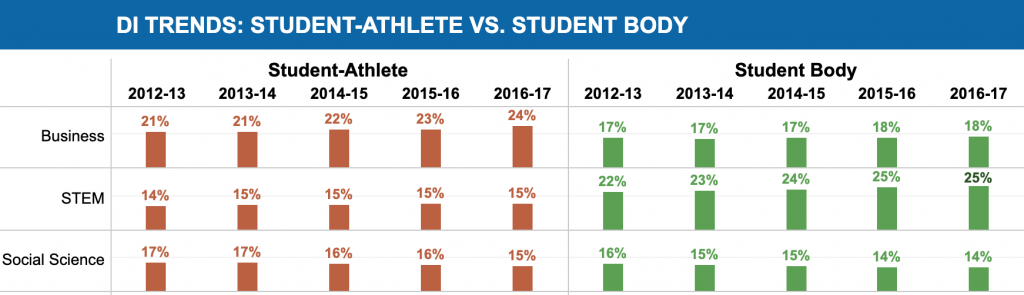
According to data from the NCAA, the most common majors for both student athletes and the wider student body at Division 1 schools are business, STEM, and social sciences. Trend data show the biggest difference is in the choice between business and STEM; both groups seem to pick up social science majors at similar rates.

Source: NCAA D1 Diploma Dashboard

While the rate of majors is not that different, there is something special that sociology can do for these students. Student athlete lives are heavily administered. Between practice, conditioning, scheduled events, meals, and classes, many barely have a few hours to complete a full load of course work. In grad school, I tutored many student athletes who were sociology majors, and I watched them juggle their work with the demands of heavy travel schedules and intense workouts, all under the watchful eye of an army of advisors, coaches, mentors, and doctors. The experience is very close to what Erving Goffman called a “total institution” in Asylums:

“A total institution may be defined as a place of residence and work where a large number of like-situated individuals, cut off from the wider society for an appreciable period of time, together lead an enclosed, formally administered round of life. (1961, p. xiii)”

We usually associate total institutions with prisons and punishment, but this definition highlights the intense management that defines the college experience for many student athletes. When I tutored athletes in sociology, we spent a lot of time comparing their readings to the world around them. Sociological thinking about institutions, bureaucracy, and work gave them a language to think about and talk about their experiences in context.

Athletic programs can be complicated for colleges and universities, and there is ongoing debate about how the “student” status in student athlete shapes their obligation to pay for all this work. As debates about college athletics continue, it is important for players, fans, and administrators to think sociologically about their industry to see how it can better serve players as both students and athletes.

Evan Stewart is an assistant professor of sociology at University of Massachusetts Boston. You can follow his work at his website, or on BlueSky.