
Search results for embed

Cheeseburger Baby - South Beach Miami
Cheeseburger Baby – South Beach Miami by AdamChandler86, Flickr CC

One of the biggest challenges and joys I have in teaching Introduction to Sociology is making ideas like social construction, cultural objects, or bureaucracy visible and intuitive to students. A big part of our value as a general education course is in showing students how to use these ideas in the world. I make a point to focus on bureaucracy, for example, because drawing attention to the unique skills and challenges of navigating a large bureaucratic system like a university is one way sociology can help students across many different majors.

Max Weber plays a big role here, of course, but one of the challenges in teaching his work is the “This is Water” problem — students are so steeped in bureaucracy that it is hard to recognize its unique traits. George Ritzer’s The McDonaldization of Society is a classic example, but the point-of-sale system is now so normal in the service industry that it can be difficult to wrap your head around any other way to organize a business. That’s why I love the charming 2004 documentary Hamburger America, by George Motz.

How do you make a cheeseburger? Ask your students and you will probably get a pretty standardized answer. At least one of these segments will turn that question on its head.

Not only do we get an intuitive sense of how much rich, unexpected variation there is in a cheeseburger, but this documentary also works in so many interesting insights about different regions and local cultures in the U.S. There are hooks here into lived experiences with segregation, de-industrialization, urban planning, and food systems. People are engaging with tradition, history, and economic change. This documentary is a fantastic way to show how culture is embedded in objects — the burgers pair well with Wendy Griswold’s cultural diamond!

All of these anchors give students an intuitive sense of how wildly different social arrangements can emerge without the systematizing force of bureaucracy or large scale, franchised restaurants. It is a great way to spur discussion – just don’t show it right before lunch.

Evan Stewart is an assistant professor of sociology at University of Massachusetts Boston. You can follow his work at his website, or on BlueSky.

A recent photo from Dina Litovsky showing a model’s inflamed feet in slingback heels went viral, with reposts from National Geographic and a whole host of Instagram influencers. The photo garnered just over 500k likes and comments criticizing the prioritization of beauty over pain. This is not the first time these images have gone viral. In Louis Vuitton’s 2012 show in Paris, photos of runway models’ battered and bruised feet made the rounds.  

Photo by Dina Litovsky – see reflections, and even more images of the modeling industry, on the Substack here

Models can and have refused to wear outrageous shoes, but they risk paying the price by being judged as unprofessional, especially models with low status and prestige within the industry. The industry often praises models for their ability to endure long shoots and poses overtly or subtly contortionist. Yet measuring professionalism by a model’s willingness to endure pain demonstrates the toxicity of professional status at the cost of one’s wellbeing. Phrases like “beauty is pain” and “look good, feel good” link one’s appearance to their inherent value and capabilities. On the catwalk, the consequences of professional norms skew models’ agency, and prices of pain are paid to justify, uphold, and maintain a professional image.

These runway shoes teeter between symbols of empowerment and oppression, as models embody cultural ideals of gender, race, class, and sexual identity. Simultaneously, their personhood is commoditized as “aesthetic laborers.” Empowered by the high fashion industry’s exclusivity and idealism, models experience dogged yet isolating work conditions. These images serve looks, but also serve as reminders of social expectations of beauty that reinforce of cultural standards shaped by power, race, and status. Sociologist Ashley Mears’ ethnography of models, Pricing Beauty, argues these ideals become prescriptive shaping cultural expectation of how people should look and be.

The struggle spreads from the fashion industry to the everyday consumer. In her essay “Always Be Optimizing,” Jia Tolentino connects pain and suffering to self-optimization. Narrating her experience and research on intense Pilates and barre workouts, Tolentino argues that gendered beauty ideals have transformed into a pursuit of optimization that hides oppressive cultural beauty standards. These painful practices are obscured as self-care, sweating it out, and getting a toned and sculpted body. Important here is the illusion of “agency” in doing “self-care” and choosing to “optimize” or improving one’s womanly figure. These lures of “look good feel good” and cultural expectations of beauty and that “beauty is pain,” justify the aches and pains from working out. Shoes are both a vehicle for our feet and for gendered cultural and societal expectations, standards, and ideals worthy of praise.

Rachel Bickelman is a MA and PhD student at University of Massachusetts Boston.

Photo courtesy Letta Page

Despite, well, everything, we are trying to get back into the classroom as much as we can at the start of a new academic year. I am scheduled to teach Introduction to Sociology for the first time this coming spring and planning the course this fall.

Whether in person or remote, I will be ecstatic to introduce our field to a new batch of students — to show them what sociologists do, how we work, and how we think about the world. Thinking about those foundations, the start of an academic year is a great time to come back and ask “what, exactly, are we doing?”

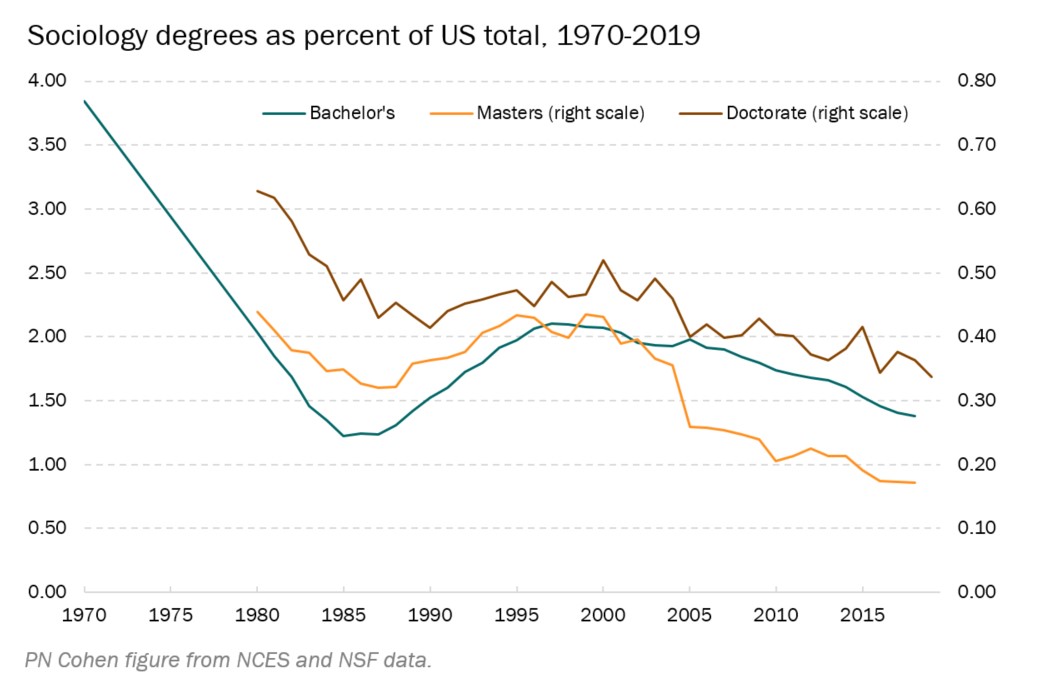
I have been thinking a lot about that question in our current chaotic moment and in the context of sociology’s changing role in higher eduction. This chart made by Philip Cohen keeps coming to mind:

Source: Philip Cohen – original post at Family Inequality

There are a lot of reasons for the decline in sociology majors, and reflections on our purpose as a field are not new at all (examples hereherehere, and on the social sciences in general here). We all bring different ideas about our common methods and missions, and our field has plenty of room for many different sociologies. I like big-tent approaches like the one here at The Society Pages.

For newcomers, though, that range makes it hard to grasp what sociologists actually do, and that makes it tough to do right by our students. At some point, someone is going to ask a new sociology major the dreaded question: “what do you do with that?” I think we have a responsibility to model ways to answer that question clearly and directly, even if we don’t want to lock students into narrow careerist ambitions. A wonky answer about ~society~ doesn’t necessarily help them.

That’s why I love these recent podcast episodes with Zeynep Tufekci. In each case, the hosts ask her how she got so much right about COVID-19 so early in the pandemic. In both, her answers explicitly show us how insights about relationships, organizations, and stigma helped to guide her thinking. These interviews are a model for showing us what sociological thinking actually can do to address pressing issues.

Far too often, our institutions miss out on the benefits of thinking about social systems and relationships in this way. Sources like these help to sell sociology to our students, and they will be a big part of my upcoming intro course. In the coming weeks, we’ll be running more posts that focus on going back to basics for newcomers in sociology, including updates to our “What’s Trending?” series and more content for the intro classroom. Stay tuned, and share how you sell sociology to your students!

Evan Stewart is an assistant professor of sociology at University of Massachusetts Boston. You can follow his work at his website, or on BlueSky.
“W. E. B. Du Bois and his Atlanta School of Sociology pioneered scientific sociology in the United States.”

– Dr. Aldon Morris

I had the good fortune to see Dr. Morris give a version of this talk a few years ago, and it is one of my favorites. If you haven’t seen it before, take a few minutes today and check it out.

Also, go check out the #DuBoisChallenge on Twitter! Data visualization nerds are re-making Du Bois’ pioneering charts and graphs on race and inequality in the United States.

https://twitter.com/asociologist/status/1363827706538975232?s=20

Evan Stewart is an assistant professor of sociology at University of Massachusetts Boston. You can follow his work at his website, or on BlueSky.
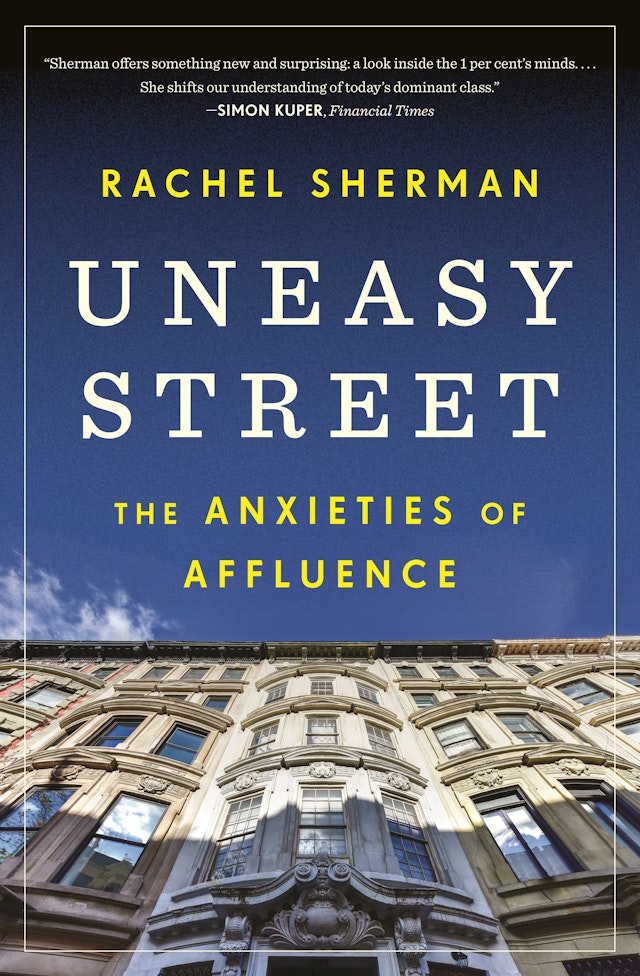
I love this podcast conversation with Rachel Sherman and Anne Helen Petersen about Sherman’s recent book, Uneasy Street: The Anxieties of Affluence. It is a great source for introduction to sociology courses looking to open up a conversation about differences in social class, especially because it draws attention to the fact that people do a lot of work to hide that social class position.

When we think about wealth, it is tempting to focus on flaunting riches through conspicuous consumption of flashy clothes, large homes, and other reality TV fodder. Sherman’s work makes an important point: phrases like “middle class” actually do a lot to hide our economic positions in society, and wealthy people often work to manage others’ perceptions of their wealth.

The podcast pairs well with a recent Twitter thread from John Holbein tracing research from around the world on how people’s perceptions of their economic position line up with their actual income and wealth. In case after case, many people report a social class that doesn’t line up with what they actually have.

This is a point I always try to make with my students: our social relationships are as much about the things we hide and avoid talking about as the things we openly share with each other. One of the most powerful points sociologists can make is to show these hidden patterns in the way we interact. The goal is not to call people out or to accuse them of lying, but rather to ask ourselves what it is about our economic lives that makes us want to work so hard to manage others’ perceptions in this way.

Evan Stewart is an assistant professor of sociology at University of Massachusetts Boston. You can follow his work at his website, or on BlueSky.
It is hard to keep up habits these days. As the academic year starts up with remote teaching, hybrid teaching, and rapidly-changing plans amid the pandemic, many of us are thinking about how to design new ways to connect now that our old habits are disrupted. How do you make a new routine or make up for old rituals lost? How do we make them stick and feel meaningful?

Social science shows us how these things take time, and in a world where we would all very much like a quick solution to our current social problems, it can be tough to sort out exactly what new rules and routines can do for us.

For example, The New York Times recently profiled “spiritual consultants” in the workplace – teams that are tasked with creating a more meaningful and communal experience on the job. This is part of a larger social trend of companies and other organizations implementing things like mindfulness practices and meditation because they…keep workers happy? Foster a sense of community? Maybe just keep the workers just a little more productive in unsettled times?

It is hard to talk about the motives behind these programs without getting cynical, but that snark points us to an important sociological point. Some of our most meaningful and important institutions emerge from social behavior, and it is easy to forget how hard it is to design them into place.

This example reminded me of the classic Social Construction of Reality by Berger and Luckmann, who argue that some of our strongest and most established assumptions come from habit over time. Repeated interactions become habits, habits become routines, and suddenly those routines take on a life of their own that becomes meaningful to the participants in a way that “just is.” Trust, authority, and collective solidarity fall into place when people lean on these established habits. In other words: on Wednesdays we wear pink.

The challenge with emergent social institutions is that they take time and repetition to form. You have to let them happen on their own, otherwise they don’t take on the same same sense of meaning. Designing a new ritual often invites cringe, because it skips over the part where people buy into it through their collective routines. This is the difference between saying “on Wednesdays we wear pink” and saying

“Hey team, we have a great idea that’s going to build office solidarity and really reinforce the family dynamic we’ve got going on. We’re implementing: Pink. Wednesdays.”

All of our usual routines are disrupted right now, inviting fear, sadness, anger, frustration, and disappointment. People are trying to persist with the rituals closest to them, sometimes to the extreme detriment of public health (see: weddings, rallies, and ugh). I think there’s some good sociological advice for moving through these challenges for ourselves and our communities: recognize those emotions, trust in the routines and habits that you can safely establish for yourself and others, and know that they will take a long time to feel really meaningful again, but that doesn’t mean they aren’t working for you. In other words, stop trying to make fetch happen.

Evan Stewart is an assistant professor of sociology at University of Massachusetts Boston. You can follow his work at his website, or on BlueSky.

More than ever, people desire to buy more clothes. Pushed by advertising, we look for novelty and variety, amassing personal wardrobes unimaginable in times past. With the advent of fast fashion, brands like H&M and ZARA are able to provide low prices by cutting costs where consumers can’t see—textile workers are maltreated, and our environment suffers.

In this film, I wanted to play with the idea of fast fashion advertising and turn it on its head. I edited two different H&M look books to show what really goes into the garments they advertise and the fast fashion industry as a whole. I made this film for my Introduction to Sociology class after being inspired by a reading we did earlier in the semester.

Robert Reich’s (2007) book, Supercapitalism, discusses how we have “two minds,” one as a consumer/investor and another as a citizen. He explains that as a consumer, we want to spend as little money as possible while finding the best deals—shopping at stores like H&M. On the other hand, our “citizen mind” wants workers to be treated fairly and our environment to be protected. This film highlights fast fashion as an example of Reich’s premise of the conflict between our two minds—a conflict that is all too prevalent in our modern world with giant brands like Walmart and Amazon taking over consumer markets. I hope that by thinking about the fast fashion industry with a sociological mindset, we can see past the bargain prices and address what really goes on behind the scenes.

Graham Nielsen is a Swedish student studying an interdisciplinary concentration titled “Theory and Practice: Digital Media and Society” at Hamilton college. He’s interested in advertising, marketing, video editing, fashion, as well as film and television culture and video editing.

Read More:

Links to the original look books: Men Women

Kant, R. (2012) “Textile dyeing industry an environmental hazard.” Natural Science4, 22-26. doi: 10.4236/ns.2012.41004.

Annamma J., J. F. Sherry Jr, A. Venkatesh, J. Wang & R. Chan (2012) “Fast Fashion, Sustainability, and the Ethical Appeal of Luxury Brands.” Fashion Theory, 16:3, 273-295, DOI: 10.2752/175174112X13340749707123

Aspers, P., and F. Godart (2013) “Sociology of Fashion: Order and Change.” Annual Review of Sociology  39:1, 171-192

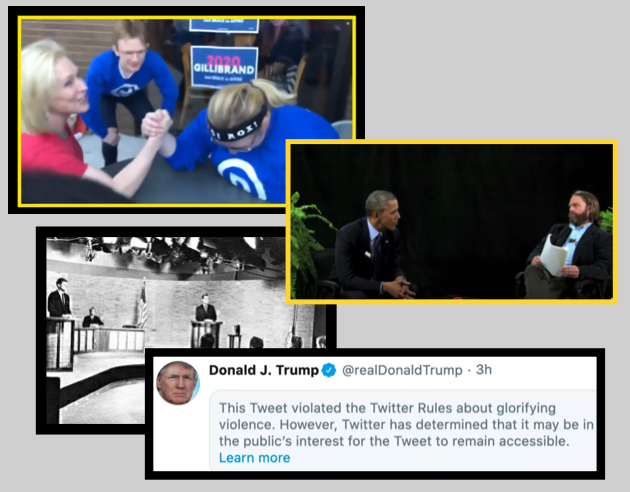
It is a strange sight to watch politicians working to go viral. Check out this video from the political nonprofit ACRONYM, where Alexis Magnan-Callaway — the Digital Mobilization Director of Kirsten Gillibrand’s presidential campaign — talks us through some key moments on social media. 

Social media content has changed the rules of the game for getting attention in the political world. An entire industry has sprung up around going viral professionally, and politicians are putting these new rules to use for everything from promoting the Affordable Care Act to breaking Twitter’s use policy

In a new paper out at Sociological Theory with Doug Hartmann, I (Evan) argue that part of the reason this is happening is due to new structural transformations in the public sphere. Recent changes in communication technology have created a situation where the social fields for media, politics, academia, and the economy are now much closer together. It is much easier for people who are skilled in any one of these fields to get more public attention by mixing up norms and behaviors from the other three. Thomas Medvetz called people who do this in the policy world “jugglers,” and we argue that many more people have started juggling as well. 

Arm-wrestling a constituent is a long way from the Nixon-Kennedy debates, but there are institutional reasons why this shouldn’t surprise us. Juggling social capital from many fields means that social changes start to accelerate, as people can suddenly be much more successful by breaking the norms in their home fields. Politicians can get electoral gains by going viral, podcasts take off by talking to academics, and ex-policy wonks suddenly land coveted academic positions.


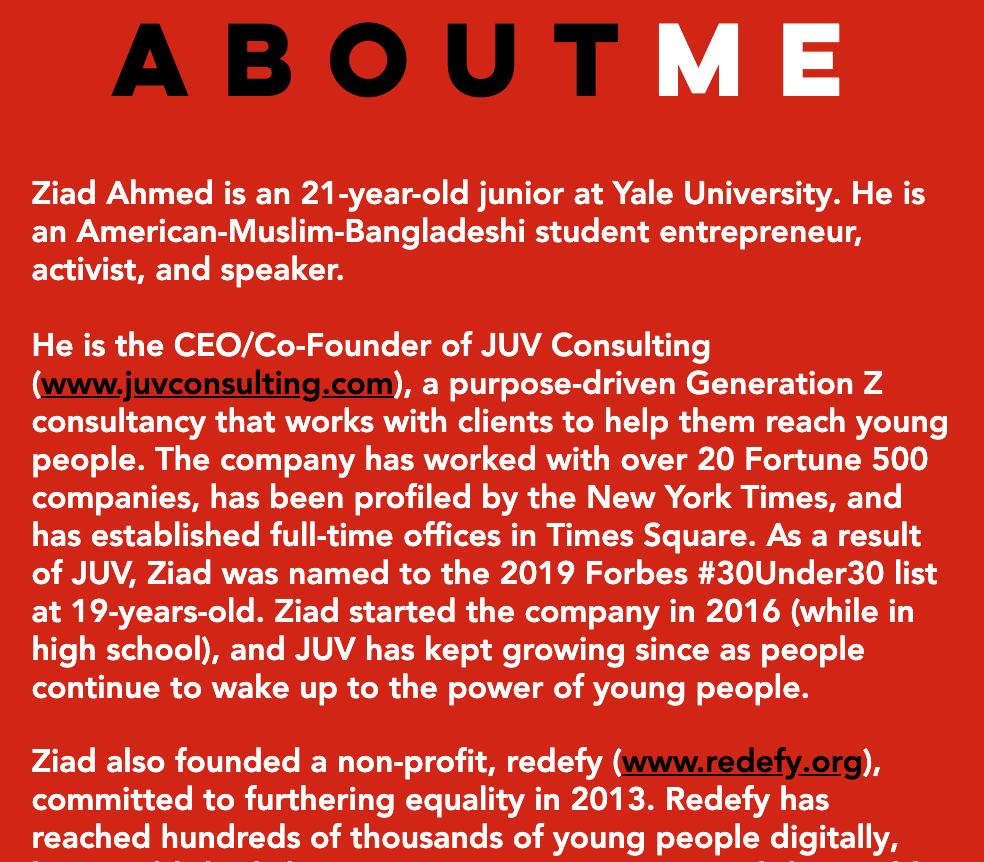
Another good example of this new structural transformation in action is Ziad Ahmed, a Yale undergraduate, business leader, and activist. At the core of his public persona is an interesting mix of both norm-breaking behavior and carefully curated status markers for many different social fields. 

In 2017, Ahmed was accepted to Yale after writing “#BlackLivesMatter” 100 times; this was contemporaneously reported by outlets such as NBC NewsCNNTimeThe Washington PostBusiness InsiderHuffPost, and Mashable

A screenshot excerpt of Ahmed’s bio statement from his personal website

Since then, Ahmed has cultivated a long biography featuring many different meaningful status markers: his educational institution; work as the CEO of a consulting firm; founding of a diversity and inclusion organization; a Forbes “30 Under 30” recognition; Ted Talks; and more. The combination of these symbols paints a complex picture of an elite student, activist, business leader, and everyday person on social media. 

Critics have called this mixture “a super-engineered avatar of corporate progressivism that would make even Mayor Pete blush.” We would say that, for better or worse, this is a new way of doing activism and advocacy that comes out of different institutional conditions in the public sphere. As different media, political, and academic fields move closer together, activists like Ahmed and viral moments like those in the Gillibrand campaign show how a much more complicated set of social institutions and practices are shaping the way we wield public influence today.

Bob Rice is a PhD student in sociology at UMass Boston. They’re interested in perceptions of authority, social movements, culture, stratification, mental health, and digital methods. 

Evan Stewart is an assistant professor of sociology at University of Massachusetts Boston. You can follow his work at his website, or on BlueSky.