Search results for embed

1Recently Nadya Tolokonnikova was interviewed by NPR about Pussy Riot’s latest video. In it, Tolokonnikova explores themes of racism, xenophobia, and misogyny and its influence on governance through a graphic and violent imagined America under a Trump presidency. Trigger warning for… most things:

Tolokonnikova is making a statement about American politics, but she is clearly informed by Putin’s performance of masculinity and how that has translated into policy measures and electoral success. When he took office in early 2000, Putin needed to legitimize his power and counteract the global impression of Russian weakness after the collapse of the Soviet Union.

The projection of masculinity was a PR strategy: fishing and riding a horse shirtless, shooting a Siberian tiger, and emerging from the Black Sea in full scuba gear. These actions combined with bellicose foreign policy initiatives to portray Putin as assertive and unrelenting.

In the book, Sex, Politics, & Putin, Valerie Sperling makes a case that his strategy was successful. She investigates the political culture under Putin and argues there is popular support for Putin’s version of masculinity and its implications for femininity, even among young women. As a consequence, the gender and sexual politics of Russia have deviated from those of wider Europe, as indicated by the rise of the Russian slur “gayropa.”

The machismo and misogyny embodied by Putin have also translated into policy: the “gay propaganda” law, for example, and the ban on international adoption to gay couples. In his 2013 address to the Federal Assembly, Putin framed these policies as necessary to combat the “destruction of traditional values.”

While there is no systematic research on the role of masculinity in Trump’s rise to the national political stage in the US just yet, and while the nature of the link between Putin and Trump remains unclear (if one truly even exists), we should consider Putin’s Russia a cautionary tale. His performances of masculinity – his so-called “locker room talk,” discussion of genitalia size, and conduct towards pageant contestants — could go from publicity stunt to public support to actual policy measures. His bombastic language about defeating ISIS and the need for more American “strength” at home and abroad, for example, could easily translate into foreign policy.

Coverage of Trump during this election cycle is credited for hundreds of millions in profits for news agencies and Trump himself has enjoyed an unprecedented level of coverage. While Trump has benefited from far more airtime than Putin did in 2000, he has not been able to find the same level of popular support. At least not yet. When Putin rose to status as a national figure in Russia his approval rating was approximately 60%, and it grew from there to levels most American politicians only dream of. If Trump is willing and able to adopt other components of Putin’s leadership style, there is precedent for the possibility that his presidency could truly turn American back.
Alisha Kirchoff is a sociology PhD student at Indiana University-Bloomington. She has previously lived and worked in Russia and is currently working on research in political sociology, law and society, organizations, and gender. Her latest project is on fertility intentions and family policies in Putin’s Russia. You can follow her on twitter.

1Just after the United Kingdom voted to leave the European Union, a commentator at the lauded US News and World Report claimed that the “general consensus” was that the vote was a “veritable dumpster fire.” Since then, most citizens of the EU, many Americans, and lots of UK citizens, including many who voted to leave, seem to think that this was a terrible decision, sending the UK into treacherous political and economic territory.

The Prime Minister agreed to step down and, rather quickly, two women rose to the top of the replacement pool. Yesterday Theresa May was the lone contender left standing and today she was sworn in.

.

Is it a coincidence that a woman is about to step into the top leadership position after the Brexit?

Research suggests that it’s not. In contexts as wide-ranging as the funeral business, music festivals, political elections, the military, and law firms, studies have found a tendency for women to be promoted in times of crisis. As a result, women are given jobs that have a higher risk of failure — like, for example, cleaning up a dumpster fire.  It’s called the “glass cliff,” an invisible hazard that harms women’s likelihood of success. One study found that, because of this phenomenon, the average tenure of a female CEO is only about 60% as long as that of the average male CEO.

As one Democratic National Committee chair once said: “The only time to run a woman is when things look so bad that your only chance is to do something dramatic.” Maybe doing “something dramatic” is why so many women are promoted during times of crisis, but the evidence suggests that another reason is because men protect other men from having to take precarious positions. This was the experience of one female Marine Corps officer:

It’s the good old boys network. The guys helping each other out and we don’t have the women helping each other out because there are not enough of us around. The good old boys network put the guys they want to get promoted in certain jobs to make them stand out, look good.

If women are disproportionately promoted during times of crisis, then they will fail more often than their male counterparts. And they do. It will be interesting to watch whether May can clean up this dumpster fire and, if she can’t, what her legacy will be.

Lisa Wade, PhD is an Associate Professor at Tulane University. She is the author of American Hookup, a book about college sexual culture; a textbook about gender; and a forthcoming introductory text: Terrible Magnificent Sociology. You can follow her on Twitter and Instagram.

1Many hope that Misty Copeland is ushering in a new era for ballet. She is the first female African American ballet dancer to have the role of Principal Dancer at the American Ballet Theatre. She has literally changed the face of the dance.

Race is a central and important part of her story, but in A Ballerina’s Tale, the documentary featuring her career, she describes herself as defying not just one, but three ideas about what ballerinas are supposed to look like: “I’m black,” she says, and also: “I have a large chest, I’m muscular.”

In fact, asked to envision a prima ballerina, writes commentator Shane Jewel, what comes to most of our minds is probably a “perilously thin, desperately beautiful, gracefully elongated girl who is… pale as the driven snow.” White, yes, but also flat-chested and without obvious muscularity.

It feels like a timeless archetype — at least as timeless as ballet itself, which dates back to the 15th century — but it’s not. In fact, the idea that ballerinas should be painfully thin is a new development, absorbing only a fraction of ballet’s history, as can clearly be seen in this historical slideshow.

It started in the 1960s — barely more than 50 years ago — in response to the preferences of the influential choreographer George Balanchine. Elizabeth Kiem, the author of Dancer, Daughter, Traitor, Spy, calls him “the most influential figure in 20th century dance,” ballet and beyond. He co-founded the first major ballet school in America, made dozens of dancers famous, and choreographed more than 400 performances. And he liked his ballerinas wispy: “Tall and slender,” Kiem writes, “to the point of alarm.” It is called, amongst those in that world, the “Balanchine body.”


We’re right to view Copeland’s rise with awe, gratitude, and hope, but it’s also interesting to note that two of the the ceilings she’s breaking (by being a ballerina with breasts and muscles) have only recently been installed. It reminds me how quickly a newly introduced expectation can feel timeless; how strongly it can ossify into something that seems inevitable; how easily we accept that what we see in front of us is universal.

In The Social Construction of Reality, the sociologists Peter Berger and Thomas Luckmann explain how rapidly social inventions “harden” and “thicken.” Whoever initiates can see it for what it is — something they created — but to whoever comes next it simply seems like reality. What to Balanchine was “I will do it this way” became to his successors “This is how things are done.” And “a world so regarded,” Berger and Luckmann write, “attains a firmness in consciousness; it becomes real in an ever more massive way, and it can no longer be changed so readily.”

Exactly because the social construction of reality can be so real, even though it was merely invented, Copeland’s three glass ceilings are all equally impressive, even if only one is truly historic.

Lisa Wade, PhD is an Associate Professor at Tulane University. She is the author of American Hookup, a book about college sexual culture; a textbook about gender; and a forthcoming introductory text: Terrible Magnificent Sociology. You can follow her on Twitter and Instagram.

1Most Americans are either attracted to or repulsed by Donald Trump’s strong rhetoric around the “wall” between the US and Mexico. His plan is to build one taller and wider than the ones we already have, on the assumption that this will curb undocumented immigration and the number of migrants who live here.

But the idea isn’t just exciting or offensive, depending on who you’re talking to, it’s also wrong-headed. That is, there’s no evidence that building a better wall will accomplish what Trump wants and, in fact, the evidence suggests the opposite.

.

The data comes from a massive 30-year study led by sociologist Douglas Massey, published last month at the American Journal of Sociology and summarized at Made in America. He and his colleagues collected the migration histories of about 150,000 Mexican nationals who had lived for at least a time in the US and compared them with border policy. They found that:

  • More border enforcement changed where migrants crossed into the US, but not whether they did. More migrants were apprehended, but this simply increased the number of times they had to try to get across. It didn’t slow the flow.
  • Border enforcement did, though, make crossing more expensive and more dangerous, which meant that migrants that made it to the US were less likely to leave. Massey and his colleagues estimate that there are about 4 million more undocumented migrants in the US today than there would have been in the absence of enforcement.
  • Those who stayed tended to disperse. So, while once migrants were likely to stay along the border and go back and forth to Mexico according to labor demands, now they are more likely to be settled all across the US.

In any case, the economic impetus to migrate has declined; for almost a decade, the flow of undocumented migrants has been zero or even negative (more leaving than coming). So, Trump would be building a wall at exactly the moment that undocumented Mexican immigration has slowed. To put it in his terms, a wall would be a bad investment.

Lisa Wade, PhD is an Associate Professor at Tulane University. She is the author of American Hookup, a book about college sexual culture; a textbook about gender; and a forthcoming introductory text: Terrible Magnificent Sociology. You can follow her on Twitter and Instagram.

1Rumors are circulating that the Bureau of Land Management (BLM) has plans to euthanize 44,000 wild horses. The rumor is partly true. An advisory board has authorized the BLM to do so; they have yet to make a decision as to whether they will. Even the possibility of such a widespread cull, though, has understandably sparked outrage. Yet the reality of the American mustang is not as simple as the love and admiration for these animals suggests.

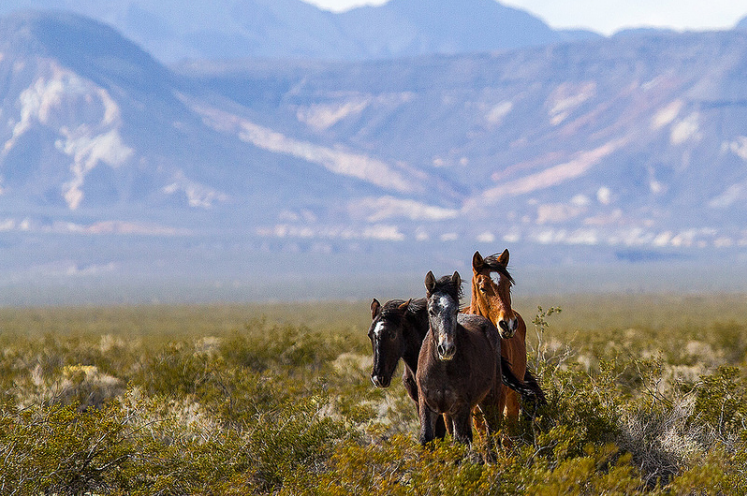
Mustangs are powerful symbols of the American West. The modern mustang is the descendant of various breeds of horses worked by everyone from Spanish conquistadors to pioneers in wagon trains into the Western US. Some inevitably escaped over time and formed herds of feral horses. Wild herds in the east were generally either driven west or recaptured over time as the frontier moved ever westward (the wild ponies of Assateague Island off the coast of Virginia being a famous exception). Over time, they became inextricably entwined with perceptions of the West as still wild and free, not yet fully domesticated. The image of a herd of beautiful horses against a gorgeous but austere Western landscape is a striking one, perhaps something like this:

Flickr creative commons James Marvin Phelps.

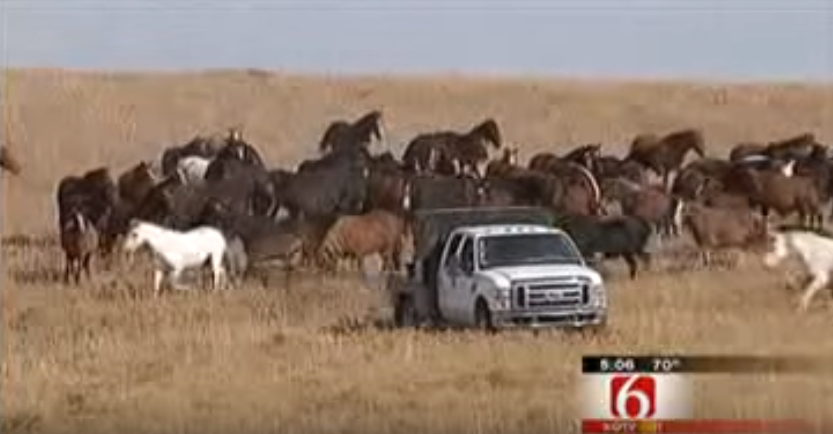
So how do we get from that to these mustangs penned up in a pasture running after a feed truck in Oklahoma (a screenshot from the video below):

2 (1)

It’s a complicated story involving conflicts surrounding federal land management, public attitudes toward mustangs, and unintended consequences of public policies.

Wild horses fall under the purview of the BLM because most live on public range (particularly in Nevada, California, and Idaho, as well as Washington, Wyoming, and other Western states). Mustangs have no natural predators in the West; mountain lions, bears, and wolves kill some horses each year, but their numbers simply aren’t large enough to be a systematic form of population control for wild horse herds, especially given that horses aren’t necessarily their first choice for a meal. So wild horse herds can grow fairly rapidly. Currently the BLM estimates there are about 67,000 wild horses and burros on public land in the West, 40,000 more than the BLM thinks the land can reasonably sustain.

Of course, managing wild horses is one small part of the BLM’s mission. The agency is tasked with balancing various uses of federal lands, including everything from resource extraction (such as mining and logging), recreational uses for the public, grazing range for cattle ranchers, wildlife habitat conservation, preservation of archaeological and historical sites, providing water for irrigation as well as residential use, and many, many more. And many of these uses conflict to some degree. Setting priorities among various potential uses of BLM land has, over time, become a very contentious process, as different groups battle, often through the courts, to have their preferred use of BLM land prioritized over others.

The important point here is that managing wild horse numbers is part, but only a small part, of the BLM’s job. They decide on the carrying capacity of rangeland — that is, how many wild horses it can sustainably handle — by taking into account competing uses, like how many cattle will be allowed on the same land, its use as wildlife habitat, possible logging or mining activities, and so on. And much of the time the BLM concludes that, given their balance of intended uses, there are too many horses.

So what does the BLM do when they’ve decided there are too many horses?

For many years, the BLM simply allowed them to be killed; private citizens had a more or less free pass to kill them. There wasn’t a lot of oversight regarding how many could be killed or the treatment of the horses during the process. Starting in the late 1950s, the BLM began to get negative press, and a movement to protect wild horses emerged. It culminated in the Wild Free-Roaming Horses and Burros Act, passed in 1971. The law didn’t ban killing wild horses, but it provided some protection for them and required the BLM to ensure humane treatment, guarantee the presence of wild horses on public lands, and encourage other methods of disposing of excess horses.

One such method is making such horses (and burros) available to the general public for adoption. The BLM holds periodic adoption events. However, currently the demand for these animals isn’t nearly large enough to absorb the supply. For instance, in 2010, 9,715 wild horses were removed from public lands, while 2,742 were adopted.

So, there aren’t enough people to adopt them and killing them has become increasingly unpopular. Controlling herd populations through some form of birth control hasn’t been widely implemented and has led to lawsuits. What to do?

One solution was for the federal government to pay private citizens to care for mustangs removed from public lands. Today there are 46,000 wild horses penned up on private lands, fed by feed trucks. Something for which the American taxpayer pays $49 million dollars a year. Holding wild horses has become a business. Here’s a news segment about one of these wild horse operations:

The ranch in video is owned by the Drummond family, a name that might ring a bell if you’re familiar with the incredibly popular website The Pioneer Woman, by Ree Drummond. They are just one of several ranching families in north central Oklahoma that have received contracts to care for wild horses.

In addition to the sheer cost involved, paying private citizens to hold wild horses brings a whole new set of controversies, as well as unintended consequences for the region. Federal payments for the wild horse and burro maintenance program are public information. A quick look at the federal contracts database shows that in just the first three financial quarters of 2009, for example, the Drummonds (a large, multi-generational ranching family) received over $1.6 million. Overall, two-thirds of the BLM budget for managing wild horses goes to paying for holding animals that have been removed from public lands, either in short-term situations before adoptions or in long-term contracts like the ones in Oklahoma.

This is very lucrative. Because prices are guaranteed in advance, holding wild horses isn’t as risky as raising cattle. And, if a horse dies, the BLM just gives the rancher a new one. But this income-generating opportunity isn’t available to everyone; generally only the very largest landowners get a chance. From the BLM’s perspective, it’s more efficient to contract with one operation to take 2,000 horses than to contract with 20 separate people to take 100 each. So almost all small and mid-size operations are shut out of the contracts. This has led to an inflow of federal money to operations that were already quite prosperous by local standards. These landowners then have a significant advantage when it comes to trying to buy or lease pastures that become available in the area; other ranchers have almost no chance of competing with the price they can pay. The result is more concentration of land ownership as small and medium-sized ranchers, or those hoping to start up a ranch from scratch, are priced out of the market. In other words, the wild horse holding program contributes to the wealth of the 1%, while everyone else’s economic opportunities are harmed.

This is why the BLM is considering a cull. Not because they love the idea of killing off mustangs, but because they’re caught between a dozen rocks and hard places, trying to figure out how to best manage a very complicated problem, with no resolution in sight.

Revised and updated; originally posted in 2011. Cross-posted at Scientopia and expanded for Contexts.

Gwen Sharp, PhD is a professor of sociology and the Associate Dean of liberal arts and sciences at Nevada State College. 

1Originally posted at Montclair Socioblog.

A girl takes a selfie, posts it to Instagram, and waits. She doesn’t have to wait long – a minute or two – before the likes and comments start rolling in. “Gorgeous,” “So pretty OMG,” “Stunning,” “Cutest.”

.
You can see why people might look at this and think: narcissism. You can see why they might think that new technologies – Instagram, cell phones (self-phones?) – have made kids today the most narcissistic generation in history.  In an earlier post, I expressed my skepticism about that claim. And, if we can generalize from an episode of This American Life last November, the selfie-Instagram-comments syndrome is not about narcissism – seeing yourself as standing shiningly above everyone else. It’s about fitting in – reading the social map, finding where you stand, and maybe changing that place.

Here is a slightly edited-down excerpt of the first part of the show. As Ira Glass says, if you have teenage girls in your life, you’re probably familiar with this. I don’t and I’m not, so I found it fascinating listening. (When the girls were reading their comments, I thought one of the girls, Jane, was saying “Hard eyes,” and I couldn’t imagine why that was a compliment. Turns out, she was saying “Heart eyes.”) Here’s Ira Glass’s distillation:

They want comments from other girls. This is not about sex. It’s not about boys. It’s about girls, and friendship. And it’s very repetitive – the same phrases, over and over.

All these moves – the posting, the commenting and liking – have a meaning that girls know intuitively but that must be decoded for outsiders like me and Ira.


.

Transcript:

Ira Glass: These comments are a very specific language that tells the girls all kinds of things.  And a lot of the meaning in the comments has nothing to do with the actual words. . .  It’s about who is doing the commenting . . .  Liking a photo means something totally different from commenting. You comment with someone you’re close to or someone you want to get close to.

Ella: It’s definitely a social obligation, because you want to let them know, and also let people who are seeing those, that I have a close relationship with this person, so close that I can comment on their pictures, like, this is so cute, or, you look so great here.

Jane:  Especially because we, like, just started high school, so we’re meeting a lot of new people. So you would comment on someone’s photo who you’re not really super close with or that you don’t know really well. And it’s sort of a statement, like, I want to be friends with you, or I want to get to know you, or like, I think you’re cool.

If someone that you don’t know very well commented on your photo, you – it’s sort of like an unspoken agreement that you have to comment back on their photo. Like when you’re making new friends, if they comment on your photo, you comment on their photo.

It’s hard to find narcissism or vanity in any of this. The girls are not preening, not basking in their triumphs, not nursing an ego wounded from some social slight. They are reading a constantly changing sociogram or network model of their world.

.


Transcript:

Ira Glass:  They’re only three months into high school, so there is a lot at stake right now.

Julia:  One of my, like, best friends posts a selfie. Maybe this isn’t, like, healthy. But I might go through the comments and see who she’s, like, really good friends with, just ’cause we’re in high school and there’’s that sense of jealousy between everyone.

Ira Glass:  Do you have people who you’re jealous of?

Jane: Yeah.

Julia:  Yeah. I definitely would. I go through, like, the comments that people see– like that people say, and like, I see what other people have said to other people.

Jane:  Yeah.

Julia:  Just to see, like, the whole– like, the whole social like map.

Jane:  Looking, mapping out your social world, seeing who’s with who, who’s hanging out with who, who is best friends with who.

Julia:  If you didn’t have it, like, I feel like I’d be missing so much. And it would just –

Jane:    Because you wouldn’t see what other people were saying. A lot goes on.

Ira Glass:  Well, no, that’s, I feel like, the thing that I’m understanding from this conversation, is like – it’s actually like, you’re getting a picture of your entire social world and who’s up and who’s down and who’s close to who, and it’s like you’re getting a diagram of where everybody stands with everybody else.

Jane:  Yeah.

Ella:  Yeah.

Jane:  Definitely. Definitely.

Ira Glass: As it changes in real time, every day, every 10 minutes.

Ella: Yeah.

Jane:  Yeah. Everyone can see it.

Julia:  It’s crazy.

If you look at the individual –a girl posting a selfie and reading the laudatory comments – you see a personality trait, narcissism. But the behavior that looks like narcissism is really an aspect of the social structure (girls’ friendships networks) and the institution those networks are embedded in (school).

Jay Livingston is the chair of the Sociology Department at Montclair State University. You can follow him at Montclair SocioBlog or on Twitter.

1In his speech accepting the Republican nomination for President, Donald Trump said (my emphasis):

…our plan will put America First. Americanism, not globalism, will be our credo. As long as we are led by politicians who will not put America First, then we can be assured that other nations will not treat America with respect.

Donald Trump’s insistence that we put “America First” hardly sounds harmful or irrational on its face. To be proud and protective of one’s country sounds like something good, even inevitable.  Americans are, after all, Americans. Who else would we put first?

But nationalism — a passionate investment in one’s country over and above others — is neither good nor neutral. Here are some reasons why it’s dangerous:

  • Nationalism is a form of in-group/out-group thinking. It encourages the kind of “us” vs. “them” attitude that drives sports fandom, making people irrationally committed to one team. When the team wins, they feel victorious (even though they just watched), and they feel pleasure in others’ defeat. As George Orwell put it:

A nationalist is one who thinks solely, or mainly, in terms of competitive prestige… his thoughts always turn on victories, defeats, triumphs and humiliations.

  • Committed to winning at all costs, with power-seeking and superiority as the only real goal, nationalists feel justified in hurting the people of other countries. Selfishness and a will to power — instead of morality, mutual benefit, or long-term stability — becomes the driving force of foreign policy. Broken agreements, violence, indifference to suffering, and other harms to countries and their peoples destabilize global politics. As the Washington Post said yesterday in its unprecedented editorial board opinion on Donald Trump, “The consequences to global security could be disastrous.”
  • Nationalism also contributes to internal fragmentation and instability. It requires that we decide who is and isn’t truly part of the nation, encouraging exclusionary, prejudiced attitudes and policies towards anyone within our borders who is identified as part of “them.” Trump has been clearly marking the boundaries of the real America for his entire campaign, excluding Mexican Americans, Muslims, African Americans, immigrants, and possibly even women. As MSNBC’s Chris Hayes tweeted on the night of Trump’s acceptance speech:

  • A nationalist leader will have to lie and distort history in order to maintain the illusion of superiority. A nationalist regime requires a post-truth politics, one that makes facts irrelevant in favor of emotional appeals. As Dr. Ali Mohammed Naqvi explained:

To glorify itself, nationalism generally resorts to suppositions, exaggerations, fallacious reasonings, scorn and inadmissible self-praise, and worst of all, it engages in the distortion of history, model-making and fable-writing. Historical facts are twisted to imaginary myths as it fears historical and social realism.

  • Thoughtful and responsive governance interferes with self-glorification, so all internal reflection and external criticism must be squashed. Nationalist leaders attack and disempower anyone who questions the nationalist program and aim to destroy social movements. After Trump’s acceptance speech, Black Lives Matter co-founder Patrisse Cullers responded: “He… threaten[ed] the vast majority of this country with imprisonment, deportation and a culture of abject fear.” Anyone who isn’t on board, especially if they are designated as a “them,” must be silenced.

When Americans say “America is the greatest country on earth,” that’s nationalism. When other countries are framed as competitors instead of allies and potential allies, that’s nationalism. When people say “America first,” expressing a willfulness to cause pain and suffering to citizens of other countries if it is good for America, that’s nationalism. And that’s dangerous. It’s committing to one’s country’s preeminence and doing whatever it takes, however immoral, unlawful, or destructive, to further that goal.

.

Lisa Wade, PhD is an Associate Professor at Tulane University. She is the author of American Hookup, a book about college sexual culture; a textbook about gender; and a forthcoming introductory text: Terrible Magnificent Sociology. You can follow her on Twitter and Instagram.

Cross-posted at Cyborgology.

Fake news among the alt-right has been central in post-election public discourse, like with Donald Trump’s dubiously sourced tweet about the “millions of illegal voters” supposedly driving Clinton’s substantial lead in the popular vote. Less attention, however, has been paid to the way “real” news is, to use the sociologist Nathan Jurgenson’s term, based in “factiness,” described as “the feel and aesthetic of ‘facts,’ often at the expense of missing the truth.”  Mainstream news gets cast as objective in part because journalists, stack of papers and obligatory pen studiously in hand, point to statistics that back up their reports. Such reliance on “data” can mask the way that humans are involved in turning things into numbers and numbers into stories. So here I present a cautionary tale.

It is a common truism that white male voters without college degrees disproportionately supported Trump in the 2016 election. Indeed, the notion that men with high school as their highest level of education were more likely to vote for Trump is an empirically supported fact. This data point spread widely throughout the campaign season, and bore out in the post-election analyses. But also in the post-election analyses — over which researchers poured in response to the statistically surprising result — another data point emerged that could have, but didn’t, change the narrative around this demographic voting bloc.

The data point that emerged was that white American men without college degrees have remained economically depressed since the 2008 recession and subsequent recovery. Although the U.S. economy has been steadily improving, the economic reality for this particular segment of the population has not. This is what Michael Moore talked about experientially (but not statistically), claiming that he knows the people who live in the rust belt, and they are struggling. He was right, the data show that they are struggling. Highlighting the economic reality for people without college degrees in the U.S. tells a very different story than highlighting the fact that they don’t have college degrees. The former renders an image of a voting contingent who, in the face of personal economic hardship that contrasts with national economic gain, are frustrated and eager to try something — anything — new. The latter renders an image of ignorance.

Data about education levels of voters is transformed by its coupling with economic trajectories. What’s been strange, is that although this coupling was discovered, it never really penetrated the larger “what happened” narrative. This is particularly strange given the meticulous and sometimes frantic search for explanation and the media’s public introspective quests to understand how so many got it all so wrong.

The transformative effect of the economic data point and its failure to effectively transform the story underlines two related things: data are not self-evident and narrative currents are hard to change.

The data weren’t wrong — people without college degrees were more likely to vote for Trump — but they were incomplete and in their partialness, quite misleading. That’s not a data problem, it’s a people problem. Data are not silent, but they are inarticulate. Data make noise, but people have to weave that noise into a story. The weaving process begins with survey construction, and culminates in analyses and reports. Far from an objective process, turning data into narrative entails nuanced decisions about the relevance of, and relationship between, quantifiable items captured through human-created measures. The data story is thus always value-laden and teeming with explicit and implicit assumptions.

Framing a contingent of Trump supporters through the exclusive metric of education without examining the interaction, mediating, and moderating effects of economic gains, was an intellectual decision bore out through statistical analyses. That is, pollsters, strategists, and commentators treated “lack of education” as the variable with key explanatory power. Other characteristics or experiences of those with low levels of education could/should/would be irrelevant.

Such dismissal created a major problem with regard to Democratic strategy. To situate a voting bloc as “uneducated” is to dismiss that voting bloc. How does one campaign to those voting in ignorance? In contrast, to situate a voting bloc as connected through an economic plight not only validates their position, but also gives a clear policy platform on which to speak.

But okay, after the election, analysts briefly shed light on the way that economics and education operated together to predict candidate preference. Why has this gotten so little attention? Why is education — rather than economics or the economic-education combination — still the predominant story?

The predominance of education remains because narrative currents are strong. Even when tied to newly emergent data, established stories are resistant to change. Narratives are embedded with social frameworks, and changing the story entails changing the view of reality. A key tenet of sociology is that people tend towards stability. Once they understand and engage the world in a particular way, they do social and psychological gymnastics to continue understanding and engaging the world in that way. To reframe (some) Trump voters as part of an economic interest group that has been recently underserved, is an upheaval of previous logics. Moreover, disrupting existing logics in this way forces those who practice those logics to, perhaps, reframe themselves, and do so in a way that is not entirely flattering or identity affirming. To switch from a frame of ignorance to a frame of economics is to acknowledge not only that the first frame was distorted, but also, to acknowledge that getting it wrong necessarily entailed ignoring the economic inequality that progressives take pride in caring so much about. Switching from ignorance to economics entails both a change in logic and also, a threat to sense of self.

Data are rich material from which stories are formed, and they are not objective. Tracing data is a process of deconstructing the stories that make up our truths — how those stories take shape, evolve, and solidify into fact. The “truth” about Trump voters is of course complex and highly variable. The perpetually missed nuances tell as much of a story as those on which predominant narratives hang.

Jenny L. Davis, PhD, is in the department of sociology at James Madison University. She studies social psychology, experimental research methods, and new and social media. She is also a contributing author and editor at Cyborgology.  You can follow her at @Jenny_L_Davis.