Search results for embed

Before there were flight attendants, there were stewardesses.  Below a vintage commercial for airlines (found here thanks to AdFreak, see also this print ad):

While pressure on airlines to be less sexist means that we don’t see ads like this anymore, Stephen W. alerted us to the ongoing sexism in “general aviation,” that is private planes and jets owned by individuals and companies.

Airports have FBOs (or “fixed based operators”) which are, essentially, glorified gas stations for planes.  A private pilot can choose which airport and thus FBO, or which FBO at which airport, to patronize.  So FBOs will compete for customers.  Stephen pointed to one strategy: plying pilots, assumed to be men, with sex.

This website allows pilots to see what “FBO Girls” all over the country, the women working behind the counters at FBOs, look like.  Another website, FBO Hotties, allows pilots to submit their favorite girls.

Flower Aviation promises that you will be guided into your parking spot by “girls in short ‘skorts’ and tank tops.”

Here are some of the images from the website, notice that when you spend money on fuel, they reward you with red meat (and fresh baked chocolate chip cookies):

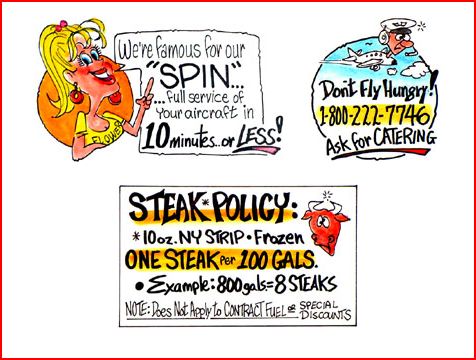
So, there you have it.  Private aviation, still very much a man’s world.

Other than the objectification, I think an interesting sociological question might be: Why have the airlines dropped overt sexist advertising, while general aviation has not? One possibility is that general aviation is, literally, less public and, thus, less vulnerable to public censor. Another may be that pilots are still overwhelmingly men, unlike the customers served by airlines, and so there may still be profit in sexism for general aviation, but not in commercial aviation. I’d welcome your thoughts as well.
I’ve been thinking a lot lately about how certain characteristics–like intelligence, artistic talent, and athleticism–are often understood to be inborn, innate, or natural.  If intelligence, for example, is believed to be inborn, the idea that people can nurture their intelligence and get smarter can get lost.  In which case, it might seem to be a fool’s errand to work to become better at things in which we don’t believe we are naturally gifted.  What potential could we collectively tap if we believed, instead, that the intelligence, artistic talent, and athleticism in each of us could be grown through effort?

I was reminded of these thoughts by this Nike commercial called “Fate” (found here).  Comments after the video:

This commercial posits that LaDainian Tomlinson and Troy Polamalu were born to play football.  Such a narrative erases all of the incredibly hard physical and mental work that Polamalu and Tomlinson no doubt put in over their lives, at the same time that it discourages anyone who does not believe that “fate” has been so kind from trying to develop their own athletic ability.

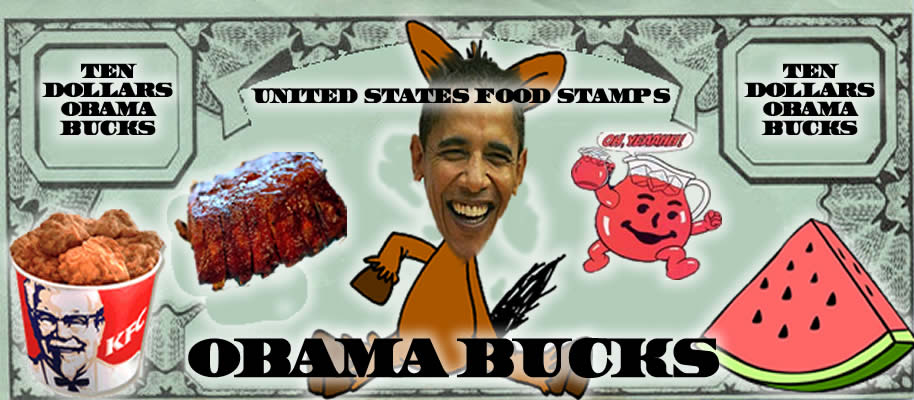
I just saw a story about this image on “Countdown with Keith Olbermann” (image found here):

It is a “joke” included in the “October newsletter by the Chaffey Community Republican Women, Federated” (I read more about it here; the group is from San Bernardino, CA), in which they claim that if Obama wins, his face will be on food stamps, not dollar bills. From a story in The Press-Enterprise:

Fedele [the group’s president] said she got the illustration in a number of chain e-mails and decided to reprint it for her members in the Trumpeter newsletter because she was offended that Obama would draw attention to his own race. She declined to say who sent her the e-mails with the illustration. She said she doesn’t think in racist terms, pointing out she once supported Republican Alan Keyes, an African-American who previously ran for president. “I didn’t see it the way that it’s being taken. I never connected,” she said. “It was just food to me. It didn’t mean anything else.”

Uh huh. Right. Who could possibly have known that African Americans were historically portrayed in racist carictures eating fried chicken, ribs, and/or watermelon, or that there’s a long-standing political tradition of trying to connect Blacks and welfare in the public mind?

Honestly, it’s been awhile since an image of Obama actually made me gasp, but that one did.

UPDATE: Larry, from the L.A. TimesDaily Mirror blog, sent in a link to this post at the blog Please God No, in which the author claims to be the creator of the Obama bucks cartoon and says,

It was a satirical look at some of the Fox News watching right-wingers out there that are afraid of a government that sponsors welfare type programs. It was intended to poke fun at the unrealistic fears and agenda of racism that a fringe element of Republicans strongly embrace.

The author continues,

This “cartoon” (as described in the media), was meant to empower African Americans to stand up for and defend themselves against racial intolerance. This “cartoon” was prescribed to showcase the racial hatred and intolerance towards the “left” and it’s liberal “welfare” economic plan. Guess what? The radical right picked up this fumble and ran with it right into the opponents goal line. The fact that a website like this exists is not evidence of racial hatred or divide, but the fact that an image taken from this website was used in a legitimate publication to promote the Conservative agenda must be proof of either existing racism or utter stupidity.

I thought the author’s response might be interesting for a discussion of political parody and humor and the limits of satire. What makes political humor effective and what makes it, as in this case, actually appeal to the group the humorist claimed to be mocking? If people miss the satire, is that because they’re dumb or because the satire isn’t that good? If someone says they’re being satirical, does that automatically shield them from any accusations of sexism, racism, etc.? I really find the issue of humor to be fascinating–what we find funny, what happens when some groups don’t recognize what another group claims was an attempt to be humorous, and how claims of being satirical or “just joking” can be used to avoid responsibility for the content of statements or images. This seems like a particularly good example of some of those issues.

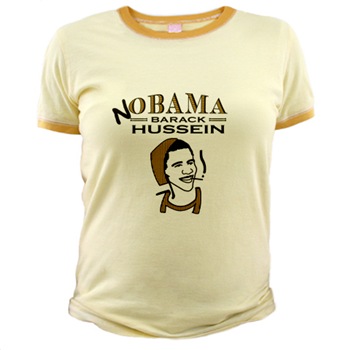
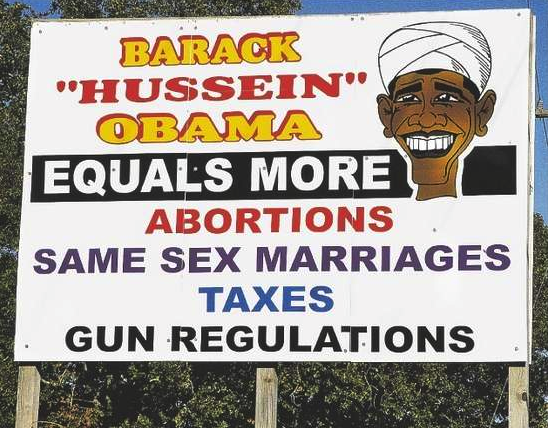
Dara G. sent in a link to this billboard in West Plains, Missouri, featuring a caricature of Obama in a turban meant to imply he’s an Arab/Muslim (found here):

NEW!  Here’s another (found here):


For other examples of accusations that Obama is Arab/Muslim (and that that is bad), see here, here, here, and here. For a non-racist caricature of Obama (showing it can, indeed, be done), see this post.

Thanks, Dara!

And I just saw on Rachel Maddow’s show that this image showed up briefly on the Sacramento County Republican Party’s website (image found here):

There’s more!

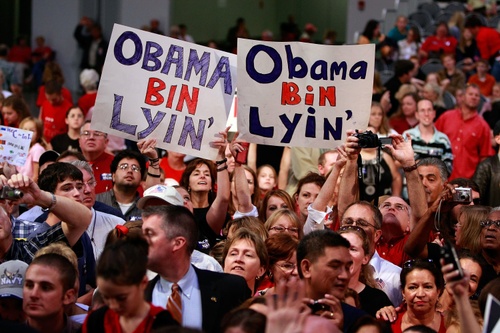
This image is from a recent rally (found here):

And, if you haven’t seen it yet, here is the by-now-classic video of supporters of a McCain rally yelling that Obama is a “terrorist” bound on spreading “terror” (found here):

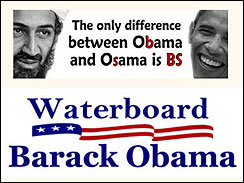
I presume you can figure out for yourself how these might be used in classes. Negative messages about Arabs/Muslims, attempts to use fear of the connection between Arabs and terrorism, joking about torture, racist imagery, etc. etc….You don’t need me for this one.

To be fair, McCain, in at least one instance, has been attempting to temper this fervor. But, as Gwen mentioned in a previous post, those who stir up hatred often have a difficult time controlling it. I’d love to have some social psychologists weigh in on the phenomenon.

NEW! Man in Ohio hangs Obama from a tree in his front yard and boldly claims racist motivation (found here):

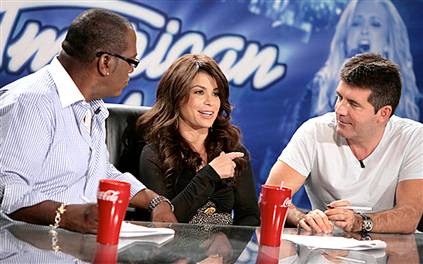
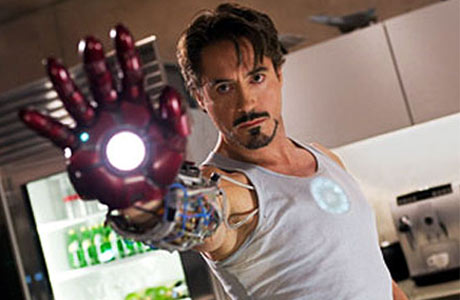
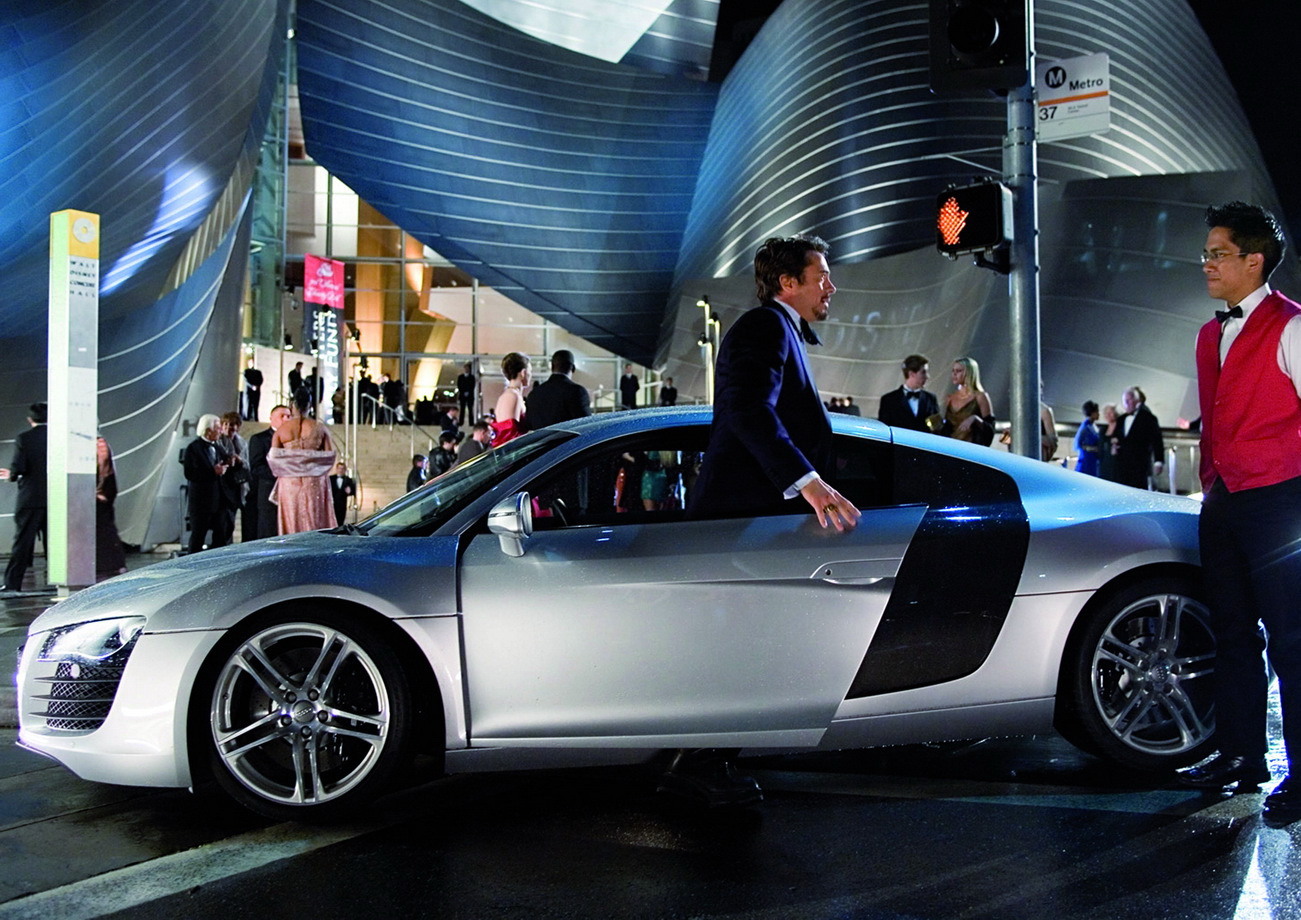
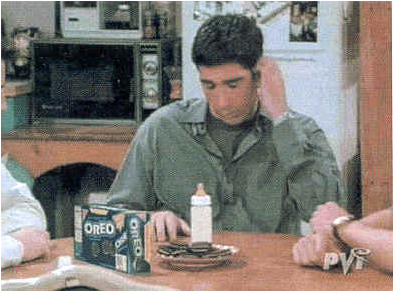
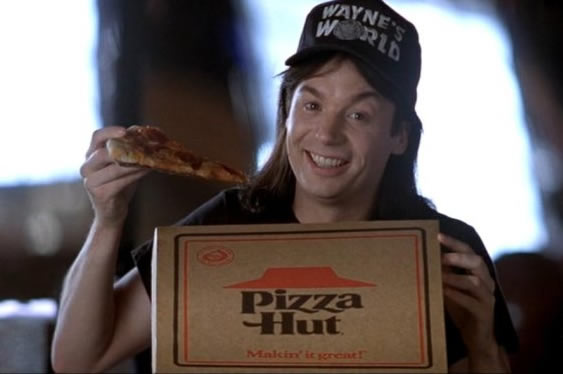
In an era in which it is increasingly possible to bypass commercials, product placement–or the placing of products in the narrative alongside the actors themselves–is increasingly important.  Remember, this isn’t simply set decoration, but a deal between the producers and companies that is about money.  Here are some examples of product placement in movies and TV shows:

Coca Cola on American Idol (found here):

Sprite (?) and Audi in Ironman (found here and here):

Oreos on Friends (found here):

Pizza Hut on Wayne’s World (found here):

And, finally, Absolute Vodka on Sex and the City (found here):

–Not safe for work–

more...

Both men and women should be troubled by representations like this.  It is insulting to men, of course. But representations of men as childlike also contributes to the idea that men cannot be held responsible or accountable for bad behavior.  As I have explained elsewhere on this blog:

So long as we buy into the idea that we can’t expect men to be good partners or fathers, we will tolerate women’s responsibility for the second shift and their placement on the mommy track at work.

This extends, too, to not coercing women sexually, not cheating, and being partners and lovers who give as much as they receive.

This portrayal of men as children, idiots, animals  (see here and here), and monkeys perpetuates patriarchy, even as this perpetuation is disguised by the denigration of men.


Shoshannah F. sent in this video of a group singing what is titled “Eid Mubarak India Song.” Shoshannah says,

“Eid mubarak” is a traditional Muslim greeting reserved for use on the festivals of Eid ul-Adha and Eid ul-Fitr.

Eid al Fitr, by the way, is the festival celebrating the end of Ramadan; it was celebrated last week.

There are several things in the video I think are interesting. First, it might be a good example of the diversity that exists in the Muslim world. As we’ve talked about before on Soc Images (see here and here) , in the U.S. Islam is often associated very strongly with “the veil” or even “the burqa.” This is used as evidence that Islam is automatically and uniquely oppressive to women. Yet in this video we see some women wearing scarves that cover some of their hair and other women whose heads are completely uncovered. It might be a useful video to show (at least a bit of it) if you’re talking about stereotypes of Islam and the idea that all Muslim women have to wear head coverings.

I can also imagine using a short clip from it to illustrate the fact that students’ frequent belief that Muslim = Arab = Middle Easterner is actually inaccurate. I assign a reading in my race class by Nadine Naber titled “Ambiguous Insiders: An Investigation of Arab American Invisibility” (2000, Journal of Ethnic and Racial Studies vol 23, number 1, p. 37-62). She argues that Islam has been racialized in the U.S., such that most Americans assume all Arabs are Muslims and all Muslims are Arabs, and negative stereotypes of Arabs and Arab Americans are extended to Muslims in general. On a global basis, only a minority of Muslims live in the Arab-speaking world (which is, by the way, the definition of “Arab”); the largest Muslim population lives in Indonesia, and though they are predominantly Muslim countries, neither Turkey, Iran, Pakistan, nor Afghanistan are Arab countries. I might show a small portion of this video as part of a lecture on the inaccuracy of equating Muslims with Arabs.

Another element that really struck me was how certain aspects of the type of masculinity on display here differ from our ideas of how men should act in the U.S. The men are wearing pastel colors that are generally only worn by women in the U.S. (though as this post shows, men are, under certain circumstances, allowed to wear pink). The men also dance closely and hug in ways that would not be acceptable between straight men in the U.S. The video could be used as an example of the social construction of gender, and how the things considered appropriate for men or women to do in one culture may not be viewed the same in others.

Now, I have no idea what the meaning of the guys looking all aghast at the guy in the business suit (at about 3:45) until he starts dancing is. I don’t know what that is supposed to signify–that he’s Westernized and might not take part in the festival? If any readers have any insights on what the meaning of that exchange is, I’d love to hear them.

Thanks, Shoshannah!

UPDATE: Commenter Silviu G. makes a good point:

What struck me was that, in commenting the video, the blogger didn’t emphasize the strict segregation of women and men.

Indeed I didn’t…thanks for pointing out the oversight in my analysis, Silviu! That might add to an interesting discussion of how, in the U.S., we would view men who interacted primarily with one another, hugging and dancing together, and remained entirely separate from one another. In the U.S., such behavior would almost certainly lead to the men being defined as gay; however, I don’t think that is in any way implied in this video, which again points to the variation in norms of gender behavior.

Also, just to clarify…Silviu suggests that I was “praising” Muslim TV for showing women with uncovered hair. That was not my intention–in fact, it would be terribly condescending of me to be all “Hey, look! How nice! They let some women be in public with no headscarves!” My point in mentioning that the women’s heads aren’t covered was just that, at least among my students, there’s often a belief that all Muslim women cover their hair all the time (I’ve had them ask if they have to cover their hair while they sleep), and that this video might be used just to get the point across that there’s no single way that Muslim women dress, any more than all Christian women dress the same, which many of my students found very surprising.


Last week, in my Race and Ethnicity class, I was talking about how race was used by white elites in early American history to divide and conquer the poor who, black or white, had a joint interest in undermining the class structure from which those elites benefited.  I then show them this video by Tim Wise making this same argument and suggesting that using race to divide and conquer is still ongoing.  One student said: “No offense, but Tim Wise said it better than you.”  It’s true.

Anyway, I bring up this argument–that race is used to divide and conquer the poor and working class for the benefit of economic elites–because of a recent speech made by AFL-CIO Secretary/Treasurer Richard Trumka.  In this speech, below, Trumka argues in favor of bridging racial (and gender) divides in the labor movement specifically because of the phenomena that Wise describes.  In other words, Trumka calls for a join and resist strategy.  I think the two speeches nicely illustrate two sides of one conflict coin.

Don’t miss Tim Wise.

And here’s Richard Trumka:

You might also see this post on the way in which lefty movements and companies tend to focus only on one axis of inequality at a time, such that they are all undermining each other and, thus, the entire left agenda.

Hat tip to Peter D.

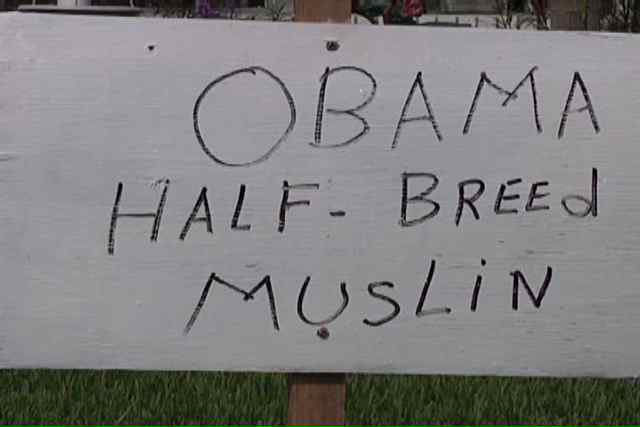
Tony S. brought my attention to this yard sign about Obama that has become quite famous (found at BlackPoliticsontheWeb):

A Florida man put it up in his yard, and it has, not surprisingly, led to some complaints and a lot of online discussion.

Obviously this is fascinating for a discussion of how Obama’s race continues to be emphasized by some opponents, despite the chorus of media voices saying that we’re a “post-racial” nation now. This is a bit of a new twist, in that most examples of opponents referring to Obama’s race have tended to focus exclusively on his Black ancestry. Here he’s referred to as a “half-breed.” Whereas highlighting his Blackness brings up one set of stereotypes that might seem threatening to White voters, “half-breed” brings up a whole other issue that might make some voters uncomfortable–racial mixing. There’s also the association with Islam.

Aside from the specific reference to Obama, there’s an interesting linguistic element here. Why would calling someone a half-breed Musli[m] be automatically recognizable as a slur? It says something about how Muslims are currently viewed in our society that, for at least some Americans, all you have to do is refer to someone as a Muslim to imply that they are unworthy of office. Similarly, the word half-breed is stigmatizing in a way that, say, “multiracial” isn’t. Imagine a similar sign that said, say, “Obama: Multiracial Lutheran.” Doesn’t have quite the same effect, because being multiracial and Lutheran aren’t stigmatized the way half-breed and Muslim are. It might also be good for a discussion of how groups might adopt new terms (such as multiracial) to try to counter the negative associations of others, like half-breed.

However, the other thing I found interesting about this was how every account I could find of this sign online mentioned that he misspelled Muslim as “Muslin.” I’m a stickler for language and misspellings actually give me pain in any kind of formal writing, but I was struck by the fact that many of the comments about the sign focused not on the offensive racial element, but on the misspelling. It seems many people dismiss this guy as a nutjob not because he’s trying to draw on the old knee-jerk fear of racial mixing, but because he misspelled something on his handmade sign. That’s…well, weird.

Thanks, Tony!

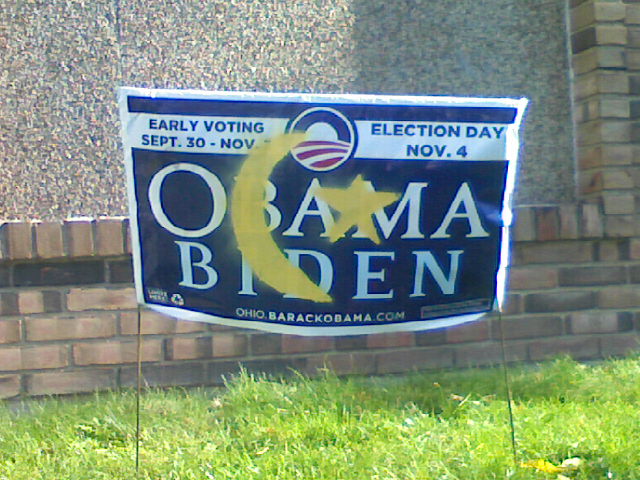
NEW!  In our comments, Zach also pointed us to this picture he took in Ohio:

ALSO NEW!  Velanie W. sent in this clip from Al Jazeera English where people associated Obama with Islam and terrorism:

Thanks, Velanie!